Even Satoshi Nakamoto Would Kowtow to the God of Wealth

marsbit2025-12-25 tarihinde yayınlandı2025-12-25 tarihinde güncellendi

Özet

The article humorously explores the growing trend of integrating traditional Chinese mysticism, such as fortune-telling and feng shui, into the cryptocurrency world. It begins with the author’s visit to a temple during the Chinese New Year, where they observe well-known crypto influencers and traders—often vocal about decentralization—engaging in superstitious rituals like burning incense and praying for wealth. The piece highlights how practices like astrological analysis of Bitcoin (e.g., predicting a difficult period in 2026 based on elemental cycles) and judging founders by their facial features have become part of crypto culture. Examples include a venture capital firm considering "face reading" as due diligence and a listed company CEO whose devotion to feng shui reportedly contributed to massive Bitcoin gains. The author argues that this turn to mysticism isn’t merely superstition but a psychological response to extreme market volatility. Like ancient maritime cultures relying on deities for safety in unpredictable seas, crypto participants use these beliefs as mental anchors amid chaotic price swings influenced by tweets and macros. Ultimately, when assets can swing 50% in a day, faith in something beyond charts becomes a way to cope.

Author: Xiaobing, Deep Tide TechFlow

Every year on the fifth day of the Lunar New Year, Xiaobing wakes up early to visit the Temple of the God of Wealth at Beigao Peak in Hangzhou.

I thought I would be jostling with aunties and uncles, but when I arrived, the scene was filled with familiar faces amidst the swirling incense smoke.

To my left was a well-known爆料KOL, to my right were community builders of pyramid schemes, and a few tech elites who usually preach "decentralization" were devoutly kowtowing with loud thuds. At that moment, no algorithmic consensus or Federal Reserve moves could compare to the three sticks of incense in their hands.

Over the past two years, mysticism has become the "mainstream" in the crypto world. If you’re still looking at K-line charts, you’re a classical韭菜 (dumb money). The real veterans are now reading八字 (fortune-telling based on birth dates).

A crypto trader familiar with various indicators eventually turned to mysticism and recently calculated Bitcoin’s八字. The result was grim: Fire clashes with the wealth vault, making 2026 (the Year of the Fire Horse) Bitcoin’s darkest hour. I quickly checked my wallet—thankfully, it was already empty.
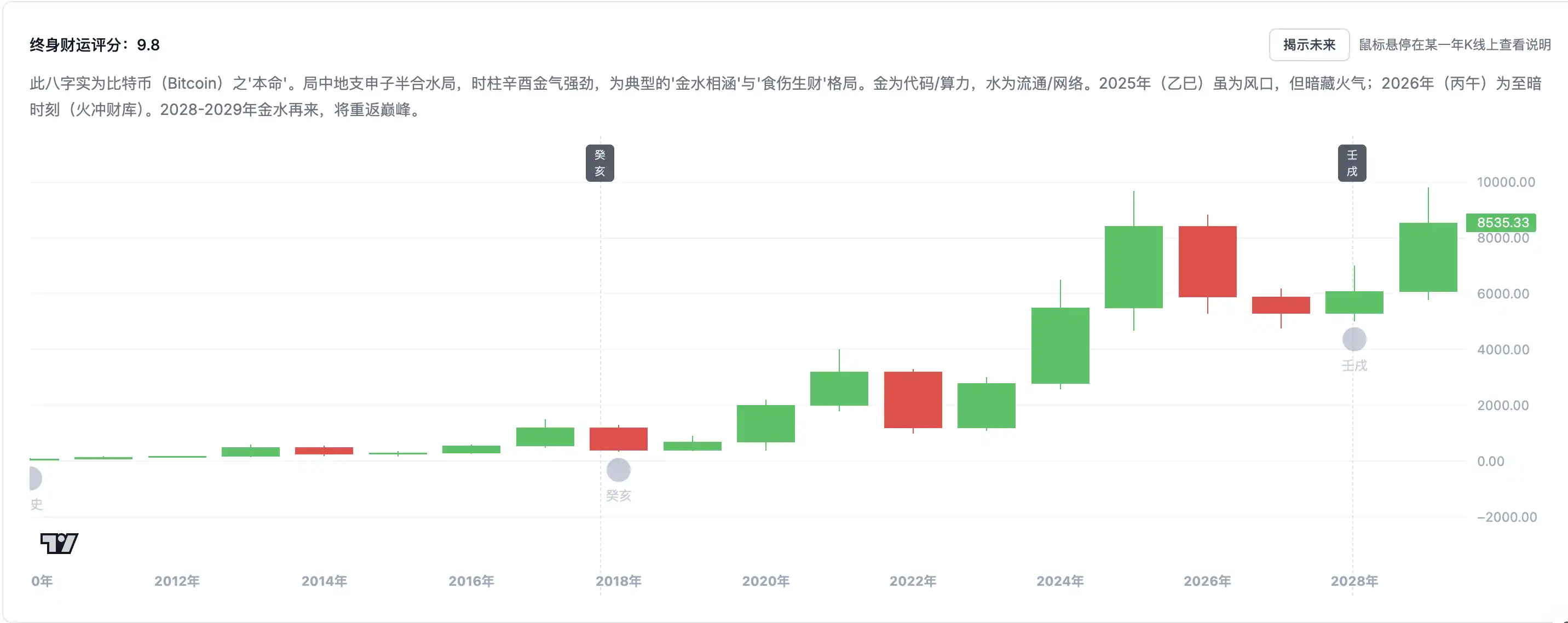
As Alen, a partner at crypto VC y2z Ventures, once bluntly stated, one of their fund’s core competencies is "reading faces." Due diligence used to focus on code audits and business models, but now it’s different. First, they check if the founder has a "wealth-draining face," then they assess whether the project’s name clashes with风水 (geomancy).

During a recent trip to Shenzhen, I noticed that traders and KOLs’ standard accessory isn’t a data terminal—it’s a "feng shui consultant" standing behind them.

Don’t laugh—this approach actually works in the crypto world. Xiaobing knows a listed company boss in Hong Kong who is a devout believer in feng shui, donating more to temples than his company spends on R&D.

And the result? Feng shui brought him noble support. He started buying Bitcoin in 2023, made hundreds of millions by hoarding it, and later rode the wave of DAT (Crypto Treasury Reserve) narratives, doubling his company’s stock price... While everyone knows this is "survivorship bias," you can’t argue with the fact that he got rich.

There are counterexamples too. A爆料KOL with a frog avatar also had a feng shui consultant who advised him not to trade recently, but he couldn’t resist playing with contracts and got liquidated neatly.

This isn’t entirely superstition.

Our traditional land-based civilization emphasizes farming—"sow one seed in spring, reap ten thousand grains in autumn"—all about certainty. But what do ocean-based civilizations face? Storms and unknown waters.

Why do people in southeastern coastal areas worship Mazu? Not because they’re ignorant, but because on the vast, unpredictable sea, besides experience and technology, you need something else.

The crypto world is essentially a modern version of the "Age of Exploration." It faces bottomless depths and sudden storms. Humans are like this: the greater the randomness and volatility, the more we seek supernatural anchors.

When K-line charts fail, and a single tweet from Elon Musk, Donald Trump, or CZ can sway the market, feng shui becomes the last psychological防线. This isn’t ignorance—it’s an instinctive应激反应 to massive wealth fluctuations.

After all, when your assets can swing 50% in a day, you need to believe in something to sleep at night. Does it matter if the God of Wealth understands blockchain?


İlgili Sorular

QWhat is the main theme of the article regarding the crypto community's behavior?

AThe article highlights that mysticism and fortune-telling, such as consulting feng shui masters and analyzing birth charts, have become prevalent in the crypto community as a psychological coping mechanism against extreme market volatility and uncertainty.

QHow does the article contrast traditional land-based civilizations with maritime civilizations in the context of belief systems?

AIt explains that land-based civilizations emphasize certainty and predictability (like farming cycles), while maritime civilizations, facing unpredictable storms and unknowns, turn to supernatural beliefs (e.g., worshipping Mazu) for psychological anchoring—similar to how crypto traders use mysticism amid market chaos.

QWhat example does the article give to show the effectiveness of feng shui in crypto success?

AIt cites a Hong Kong-listed company boss who devoutly donated to temples and followed feng shui advice, leading to massive profits from Bitcoin investments and a surge in his company's stock during the DAT narrative wave, though it acknowledges survivorship bias.

QWhat negative example is provided about ignoring mystical advice in the crypto space?

AA frog-avatar KOL ignored his feng shui advisor's warning to avoid trading and subsequently lost everything through contract trading, illustrating the consequences of disregarding such guidance.

QWhy does the article argue that crypto participants turn to superstition despite technological expertise?

ABecause the crypto market's extreme randomness, influenced by factors like celebrity tweets and unpredictable events, renders traditional analysis (e.g., charts) ineffective, leading people to seek supernatural beliefs as a mental safeguard to cope with stress and sleep better.

İlgili Okumalar

STAR 50 Soars 10.73%, Why Did A-Shares Stage a "V-Shaped Reversal"?

After a prolonged decline, the Chinese A-share market staged a strong rally on July 21. The STAR 50 index surged 10.73%, its largest single-day gain in nearly a year, leading a broad-based "V-shaped" reversal. The Shanghai Composite Index rose 1.79%, the Shenzhen Component Index gained 4.81%, and the ChiNext Index jumped 7.05%. Total market turnover reached 2.97 trillion yuan, an increase of 256.1 billion yuan from the previous session, with over 3,100 stocks advancing. The semiconductor sector spearheaded the rebound, with related ETFs posting significant gains. Analysts attribute the surge to three converging factors. First, coordinated capital inflows from "national team" institutions, insurance funds, listed company buybacks, and fund house self-purchases have bolstered market liquidity and confidence. Second, supportive policy signals, including commitments from regulators to ensure stable market operations, provided a favorable backdrop. Third, a stabilization and recovery in overseas markets, notably South Korea, created a positive external environment. Institutions suggest the most severe panic selling phase for the tech sector has likely passed, following a significant digestion of crowded positions and leveraged funds. While short-term volatility may persist, the medium to long-term outlook remains underpinned by enduring trends like AI computing demand expansion and semiconductor localization. The market's focus now shifts to the sustainability of supportive fund flows, earnings reports, and upcoming catalysts from the global AI industry chain.

marsbit17 dk önce

STAR 50 Soars 10.73%, Why Did A-Shares Stage a "V-Shaped Reversal"?

marsbit17 dk önce

U.S. Tech Momentum Stocks Post Largest Single-Day Gain Ever, But Is the Plunge Over?

US tech momentum stocks staged a sharp rebound on Tuesday (July 21st). Morgan Stanley's TMT Momentum Factor surged over 12%, marking its largest single-day gain on record, exceeding even peaks from the 2000 dot-com bubble. Key momentum indices from Goldman Sachs also posted their strongest daily performances in years. The rally was led by semiconductors, with the Philadelphia Semiconductor Index jumping 4.6%. This rebound followed three consecutive down days and a cumulative 33% plunge in momentum stocks, one of the steepest drawdowns since the dot-com era. Analysts attribute the surge largely to a short squeeze. Heavy selling had pushed high-beta momentum stocks into deeply oversold territory, forcing many short sellers, particularly in Asia, to cover their positions, creating a self-reinforcing buying spiral. However, the rebound's internals appear weak. Trading volume was notably low, and advancing stocks still lagged decliners on the S&P 500, indicating a narrow, concentrated rally rather than broad market participation. Diverging views emerge on the outlook. BTIG warns the bounce has hit key resistance and recommends selling into strength, citing extreme volatility and historical parallels to past market tops. Conversely, Goldman Sachs and UBS believe the momentum unwind is nearing its end, suggesting it may be time to gradually add exposure, as positioning has been significantly reduced. They caution, however, that high volatility warrants a measured approach, potentially using defined-risk strategies. The upcoming earnings season, particularly reports from major tech firms like Alphabet, is seen as a critical test for the rally's sustainability. Simultaneously, bond markets flashed a warning, with yields rising partly due to spiking oil prices. Analysts note that if long-term Treasury yields break decisively higher, it could pose a significant headwind for equities, especially growth stocks.

marsbit25 dk önce

U.S. Tech Momentum Stocks Post Largest Single-Day Gain Ever, But Is the Plunge Over?

marsbit25 dk önce

U.S. Tech Momentum Stocks Record Largest Single-Day Gain Ever, but Has the Rout Ended?

U.S. tech momentum stocks staged a dramatic rebound on Tuesday, July 21st. Key momentum indices like the Morgan Stanley TMT Momentum Factor and Goldman Sachs' High Beta Momentum Long Index posted historic or near-historic single-day gains, fueled largely by semiconductor stocks. This sharp rally followed a severe three-day sell-off that saw momentum stocks plunge 33%, marking one of the steepest pullbacks since the dot-com bubble. Analysts attribute the bounce primarily to a short squeeze, as forced covering from over-leveraged traders, particularly in Asia, created a buying spiral. However, the rally's health is questioned due to weak market breadth—overall trading volume was low, and decliners outnumbered advancers in the S&P 500 despite the index's gain—suggesting a narrow, concentrated surge rather than broad recovery. Opinions on the sustainability diverge. BTIG strategists warn the rebound has hit key resistance levels, citing extreme volatility and historic stock dispersion as signs of an ongoing broader correction, and recommend selling into strength. Conversely, Goldman Sachs and UBS view the aggressive momentum unwinding as nearing its end, noting reduced positioning and a lack of new fundamental catalysts. They suggest the sell-off presents a selective opportunity to add exposure, albeit cautiously and gradually using defined-risk strategies. The immediate trajectory hinges on the ongoing earnings season, with market focus on Alphabet's capital expenditure guidance for AI investment clarity. Meanwhile, bond markets present a risk, with rising Treasury yields—potentially heading toward 5.5%—and widening credit spreads for mega-cap tech companies posing a threat to equity valuations. The combination of technical factors, earnings results, and macro conditions leaves the durability of the rebound in doubt.

链捕手27 dk önce

U.S. Tech Momentum Stocks Record Largest Single-Day Gain Ever, but Has the Rout Ended?

链捕手27 dk önce

Long-Divided Must Unite, Long-United Must Divide: When L1 Becomes Its Own Rollup, What Is Ethereum's Endgame?

"The Inevitable Cycle: When L1 Becomes Its Own Rollup – What is Ethereum's Endgame?" For years, the Ethereum community grappled with concerns that L2s were fragmenting the ecosystem and eroding L1's value. While L2s provided cheaper execution, they also splintered liquidity and the unified user experience of a single chain. This has prompted a fundamental reassessment of the relationship between L1 and L2. Ethereum's roadmap is evolving. The "Scale" initiative merges L1 and L2 expansion into a holistic framework. L1 itself is advancing with higher gas limits, statelessness, and zkEVM verification, no longer content to be just a low-throughput settlement layer. Consequently, the primary value proposition of L2s is shifting from merely providing cheap blockspace to offering L1 cannot easily provide: application-specific optimizations, privacy features, and flexible governance models. L2s are becoming a spectrum of execution environments with varying degrees of security inheritance from Ethereum. A critical challenge in this multi-chain future is interoperability. The vision is to make Ethereum "feel like one chain again." This relies on advancements in native account abstraction (like EIP-7702) and intent-based architectures (Open Intents Framework), where users declare desired outcomes, and solvers handle the complex cross-chain execution. Furthermore, shortening Ethereum's finality time from minutes to seconds is crucial, as it underpins trust between chains for bridges, stablecoins, and cross-chain applications. Perhaps the most provocative idea is that Ethereum L1 itself could become a form of "its own Rollup." As zkEVM and proof systems mature, high-performance nodes could execute transactions and generate validity proofs. Regular validators would then verify these proofs instead of re-executing all transactions. This blurs the traditional L1/L2 hierarchy, making "Rollup" more of a general execution-verification architecture. Native Rollup aims to integrate L2 validation more directly into the Ethereum protocol, allowing L2s to inherit L1's security more fully and move away from reliance on security councils. In the end, L2s are not destined to replace L1 or be made obsolete by it. The likely future is a unified system where diverse execution environments—each optimized for specific use cases like DeFi, gaming, or privacy—coexist. They will share a common foundation of security, liquidity, and verifiable state, seamlessly connected to restore a cohesive user experience. The next phase for Ethereum is not just about scaling through separation, but about intelligently reintegrating what was separated back into a coherent whole.

链捕手43 dk önce

Long-Divided Must Unite, Long-United Must Divide: When L1 Becomes Its Own Rollup, What Is Ethereum's Endgame?

链捕手43 dk önce

İşlemler

Spot
活动图片




