Ending 'Subsidized Growth': The Logic of Ultimate Capital Efficiency Behind Berachain's 'Fiscal' Reform

marsbit2026-03-10 tarihinde yayınlandı2026-03-10 tarihinde güncellendi

Özet

Berachain has implemented a major reform of its Proof-of-Liquidity (PoL) mechanism, reducing the annual inflation rate of its non-transferable governance token $BGT from 8% to 5%—a 46% cut in emissions. This move, described as a "fiscal reform," signals the end of the initial subsidy-driven growth phase and a shift toward a more capital-efficient economic model. The update also involves removing around 200 underperforming reward vaults and introducing stricter, performance-based criteria for vault eligibility. Key tokens in the PoL system include $BERA (gas token), $HONEY (native stablecoin), and $BGT (governance token). The reforms aim to enhance the value and utility of $BGT by directing incentives toward protocols that demonstrate real user activity, sustainable demand, and measurable contributions to the ecosystem—such as boosting transaction volume or deepening liquidity. This restructuring is designed to prioritize quality over quantity, encouraging projects with stronger product-market fit and business models. By making $BGT emissions more scarce and targeted, Berachain aims to build a self-sustaining economy where incentives function as productive capital rather than subsidies, ultimately supporting long-term growth and value creation for token holders.

Author: Black Mario

Recently, Berachain's PoL mechanism underwent a reform, reducing the annual inflation rate of $BGT from 8% to 5% (an active cut of approximately 46% in emissions), while clearing a series of "ghost vaults" and updating the vault access standards. This move has been hailed by the community as a sovereign fiscal reform.

This seems to signal that Berachain is officially ending the subsidy era of its cold start, and through ultimate "capital efficiency" and a "business closed-loop," it is beginning to build a mature economic system with higher ROI certainty.

The Logical Evolution from Cold Start Strategy to Sovereign Value Return

In traditional PoS systems, security is directly tied to the scale of staking, and "staking coins equals participation in governance" is the core logic. Focusing on the PoL (Proof-of-Liquidity) mechanism itself, it is a highly complex financial engineering design that binds network security, governance power, and ecological liquidity together with liquidity as the core element, attempting to redefine the internal power distribution and incentive flow within a public chain.

The operation of the PoL system relies on three types of tokens with clear functions and mutual checks and balances.

  • $BERA (Fuel Base): The operating fuel of the system, carrying basic security functions, is the asset foundation of the entire Berachain.
  • $HONEY (Value Scale): An over-collateralized native stablecoin, serving as the financial settlement medium within the ecosystem, ensuring the stability of on-chain economic activities.
  • $BGT (Governance Hub): As a non-transferable soul-bound token, $BGT is the soul of the PoL system. It deeply binds governance rights with "real ecological contributions." Holding and delegating $BGT means mastering the distribution rights of network incentive routing.

Validators, by receiving delegated $BGT, can dynamically influence which Reward Vaults the incentives flow to. This is not only a symbol of power but also the most critical value lever in Berachain's sovereign economic system.

In the early stages of the mainnet launch, Berachain adopted a high inflation model of approximately 8%–10%. As a typical cold start strategy, it successfully achieved primitive accumulation of liquidity in the short term and verified the实战 resilience of the PoL mechanism.

However, as the ecosystem matures, some potential issues have emerged:

  • The high-yield environment in the early stage attracted a large amount of highly sensitive capital. While this capital completed the task of attracting funds during the cold start phase, its contribution to long-term retention and commercial co-building still has room for optimization.
  • Some vaults in the ecosystem are operating inefficiently, and there are even some self-circulating distribution paths. This, to some extent, disperses the precious $BGT budget and fails to fully transform into long-term stickiness of the ecosystem.
  • Sustained high emission rates have somewhat affected the marginal value of $BGT as a sovereign asset. For long-term builders, optimizing the inflation structure is an inevitable choice to protect their long-term rights and enhance the network's risk resistance.

If the PoL incentive mechanism eventually evolves into a pure operating cost, no matter how good the short-term data looks, the long-term value of the entire ecosystem will face limitations. Incentives should not be just subsidies, nor should they be indiscriminate airdrops. Instead, they should be regarded as productive capital capable of generating ROI. Every unit of $BGT emission should be exchanged for sustainable transactions, user retention, and real cash flow potential. This is perhaps the true meaning behind the slogan "Bera Builds Businesses."

Under this consensus, this reform aimed at "eliminating the false and retaining the true" and重构 sovereign fiscal efficiency officially kicked off at the beginning of the new year 2026.

Berachain's "Fiscal" Reform

$BGT Emission Optimization: Anchoring the Long-Term Value Coordinates of the Ecosystem

In fact, in any mature economy, adjustments in monetary policy often signal a qualitative change in the growth logic. Berachain's reduction of the annual $BGT inflation rate from about 8% to 5% is essentially a key step towards "value sovereignty."
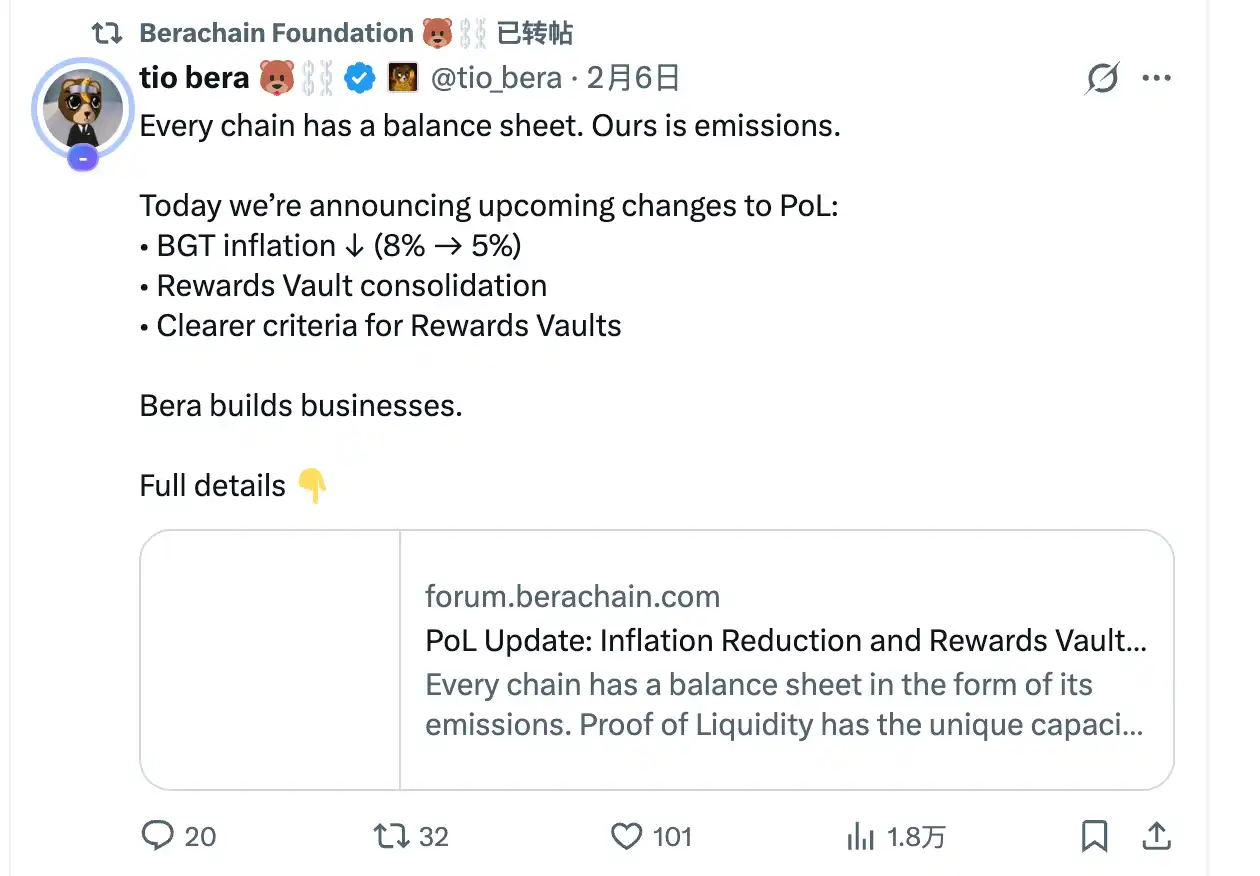
We see that the earlier 8% inflation rate was more like an "expansionary credit" for the ecosystem's startup phase, successfully completing the primitive accumulation of liquidity in the short term. Now, reducing PoL-related emissions by approximately 46% (reward rate reduced from 1.2 to 0.65) not only reflects its precise control over the current ecosystem's carrying capacity and incentive efficiency but also embodies a refinement of liquidity management:

That is, while maintaining the stability of the network security base rate, by moderately tightening new emissions, ensuring that every $BGT injected into the ecosystem gains a higher value anchor.

For $BGT, a governance asset with the attributes of a soul-bound token, scarcity is the core pillar for exercising its引流 power. As the emission rate slows, the marginal dilution pressure faced by holders and delegators is significantly reduced. This "active balance sheet reduction" directly strengthens the hard currency属性 of $BGT as a core governance asset, further promoting the rebalancing of value capture:

Of course, if we observe the development paths of Ethereum or various top L1s, a steady decline in the inflation rate is often the entry ticket to the "golden maturity period." Berachain's turn at this moment actually sends a clear signal that the ecosystem has already achieved stability driven by "endogenous growth" and no longer relies solely on scale expansion.

Then, as the total incentive becomes more precious, protocols within the ecosystem will spontaneously initiate an efficiency competition.

This "tight" incentive budget is actually creating higher溢价 space for high-quality protocols. Under the new economic model, $BGT emission rights will flow more to those "high-productivity protocols" that can generate real interactions and have a deep user base.

Reward Vault Integration—Ecological Value Sedimentation from "Scale Expansion" to "Quality and Depth"

If inflation reduction is a "balance sheet reduction" at the macro level, then the further integration of reward vaults is a precise drip irrigation targeting micro-efficiency within the ecosystem.

The Berachain Foundation stated in its latest tweet that the ecosystem plans to remove about 200 reward vaults with low operational efficiency. Of course, the plan itself is not simply a negation of early projects but more of a resource rebalancing expected after the Berachain ecosystem enters a specific stage.

In fact, during the cold start phase, a wide distribution of vaults helps探测 different market demands. When the ecosystem enters maturity, withdrawing incentive resources from长期闲置 or functionally overlapping pools and re-injecting them into core protocols with real trading activity is an inevitable choice to enhance the network's overall competitiveness.

Similarly, with the integration, Berachain immediately enacted more rigorous and dynamic vault access standards. This means that future incentive distribution will no longer be based on the first-come-first-served inertia of the early days but will更多的是 based on a multi-dimensional KPI evaluation system. Some potential standards may include:

  • Sustained Demand: Examining whether the protocol has generated real transaction volume and user interaction, not just static沉淀 of funds.
  • External Incentive Coordination: Encouraging protocol parties to use their own resources and external financing to form a synergy with $BGT emissions, jointly energizing the ecosystem.
  • Verifiable Contribution: Every unit of incentive emission must be transformed into an observable network effect, such as the depth of $HONEY liquidity or the value回流 of transaction fees.

By clearing some self-circulating or inefficient incentive paths, Berachain is actually making room for growth for teams with real product strength. This process of "discarding the dross and selecting the essential" aims to end models that rely solely on system subsidies for survival,转而扶持 business entities with independent profitability capabilities.

This is also perhaps the embodiment of the "Bera Builds Businesses" vision: the incentive mechanism is no longer an indiscriminate温床 but a precise capital accelerator. Projects筛选ed through this mechanism will have stronger risk resistance and commercial value, thereby providing $BGT holders with more确定性 value support in the fierce L1 competition.

Evolution is the Only Way Out

This major reform of Berachain's PoL marks the ecosystem's official paradigm shift towards a "mature L1 with real output." By optimizing emission efficiency, the ecosystem is彻底重构 $BGT emissions into productive capital with ROI certainty. While pushing the network towards the ultimate capital efficiency interval, it is also anchoring a more solid value signal for $BGT and $BERA holders.

Under the new pilot mechanism, incentives are endowed with precise引流 properties: every unit of injected liquidity will激发超额 real transaction fees, interest income, or ecological溢价 at the protocol layer, thereby constructing a positive value closed-loop of "incentive cost < protocol收益".

This "1 > 1 capital alchemy" is a public chain-level active asset management system,正在 transforming every bit of inflation into KPIs that drive commercial prosperity, fundamentally locking in the return of Berachain's long-term sovereign value, and establishing a leading position towards real economic growth and business闭环 in the highly homogeneous L1 track.

Thus, "Bera Builds Businesses" is also transforming from a grand narrative into a precise financial engine.


Trend Kriptolar

İlgili Sorular

QWhat is the core change in Berachain's PoL mechanism as described in the article?

AThe core change is a reduction in the annual inflation rate of $BGT from 8% to 5%, which is an active cut of approximately 46% in emissions.

QWhat are the three tokens in the PoL system and their primary functions?

AThe three tokens are: $BERA (the gas token and base for security), $HONEY (an over-collateralized native stablecoin for financial settlement), and $BGT (a non-transferable soulbound token that serves as the governance hub, binding governance power to 'real contributions' to the ecosystem).

QWhat was the main purpose of the high inflation model (8-10%) used by Berachain at its mainnet launch?

AIt was a cold-start strategy designed to achieve the primitive accumulation of liquidity in the short term and validate the practical resilience of the PoL mechanism.

QWhat are some of the new potential criteria for a vault to gain access to incentives after the reform?

APotential criteria include: Sustainable Demand (real transaction volume and user interaction), Coordination with External Incentives (using the protocol's own resources and external financing alongside $BGT emissions), and Verifiable Contribution (converting each unit of incentive into observable network effects like $HONEY liquidity depth or fee value回流).

QHow does the article characterize the ultimate goal of Berachain's incentive mechanism after this reform?

AThe goal is to transform the incentive mechanism from a blanket subsidy into a precise capital accelerator, ensuring every unit of $BGT emission is productive capital with a high certainty of ROI, ultimately building a positive value closed-loop where 'incentive cost

İlgili Okumalar

STAR 50 Soars 10.73%, Why Did A-Shares Stage a "V-Shaped Reversal"?

After a prolonged decline, the Chinese A-share market staged a strong rally on July 21. The STAR 50 index surged 10.73%, its largest single-day gain in nearly a year, leading a broad-based "V-shaped" reversal. The Shanghai Composite Index rose 1.79%, the Shenzhen Component Index gained 4.81%, and the ChiNext Index jumped 7.05%. Total market turnover reached 2.97 trillion yuan, an increase of 256.1 billion yuan from the previous session, with over 3,100 stocks advancing. The semiconductor sector spearheaded the rebound, with related ETFs posting significant gains. Analysts attribute the surge to three converging factors. First, coordinated capital inflows from "national team" institutions, insurance funds, listed company buybacks, and fund house self-purchases have bolstered market liquidity and confidence. Second, supportive policy signals, including commitments from regulators to ensure stable market operations, provided a favorable backdrop. Third, a stabilization and recovery in overseas markets, notably South Korea, created a positive external environment. Institutions suggest the most severe panic selling phase for the tech sector has likely passed, following a significant digestion of crowded positions and leveraged funds. While short-term volatility may persist, the medium to long-term outlook remains underpinned by enduring trends like AI computing demand expansion and semiconductor localization. The market's focus now shifts to the sustainability of supportive fund flows, earnings reports, and upcoming catalysts from the global AI industry chain.

marsbit29 dk önce

STAR 50 Soars 10.73%, Why Did A-Shares Stage a "V-Shaped Reversal"?

marsbit29 dk önce

U.S. Tech Momentum Stocks Post Largest Single-Day Gain Ever, But Is the Plunge Over?

US tech momentum stocks staged a sharp rebound on Tuesday (July 21st). Morgan Stanley's TMT Momentum Factor surged over 12%, marking its largest single-day gain on record, exceeding even peaks from the 2000 dot-com bubble. Key momentum indices from Goldman Sachs also posted their strongest daily performances in years. The rally was led by semiconductors, with the Philadelphia Semiconductor Index jumping 4.6%. This rebound followed three consecutive down days and a cumulative 33% plunge in momentum stocks, one of the steepest drawdowns since the dot-com era. Analysts attribute the surge largely to a short squeeze. Heavy selling had pushed high-beta momentum stocks into deeply oversold territory, forcing many short sellers, particularly in Asia, to cover their positions, creating a self-reinforcing buying spiral. However, the rebound's internals appear weak. Trading volume was notably low, and advancing stocks still lagged decliners on the S&P 500, indicating a narrow, concentrated rally rather than broad market participation. Diverging views emerge on the outlook. BTIG warns the bounce has hit key resistance and recommends selling into strength, citing extreme volatility and historical parallels to past market tops. Conversely, Goldman Sachs and UBS believe the momentum unwind is nearing its end, suggesting it may be time to gradually add exposure, as positioning has been significantly reduced. They caution, however, that high volatility warrants a measured approach, potentially using defined-risk strategies. The upcoming earnings season, particularly reports from major tech firms like Alphabet, is seen as a critical test for the rally's sustainability. Simultaneously, bond markets flashed a warning, with yields rising partly due to spiking oil prices. Analysts note that if long-term Treasury yields break decisively higher, it could pose a significant headwind for equities, especially growth stocks.

marsbit36 dk önce

U.S. Tech Momentum Stocks Post Largest Single-Day Gain Ever, But Is the Plunge Over?

marsbit36 dk önce

U.S. Tech Momentum Stocks Record Largest Single-Day Gain Ever, but Has the Rout Ended?

U.S. tech momentum stocks staged a dramatic rebound on Tuesday, July 21st. Key momentum indices like the Morgan Stanley TMT Momentum Factor and Goldman Sachs' High Beta Momentum Long Index posted historic or near-historic single-day gains, fueled largely by semiconductor stocks. This sharp rally followed a severe three-day sell-off that saw momentum stocks plunge 33%, marking one of the steepest pullbacks since the dot-com bubble. Analysts attribute the bounce primarily to a short squeeze, as forced covering from over-leveraged traders, particularly in Asia, created a buying spiral. However, the rally's health is questioned due to weak market breadth—overall trading volume was low, and decliners outnumbered advancers in the S&P 500 despite the index's gain—suggesting a narrow, concentrated surge rather than broad recovery. Opinions on the sustainability diverge. BTIG strategists warn the rebound has hit key resistance levels, citing extreme volatility and historic stock dispersion as signs of an ongoing broader correction, and recommend selling into strength. Conversely, Goldman Sachs and UBS view the aggressive momentum unwinding as nearing its end, noting reduced positioning and a lack of new fundamental catalysts. They suggest the sell-off presents a selective opportunity to add exposure, albeit cautiously and gradually using defined-risk strategies. The immediate trajectory hinges on the ongoing earnings season, with market focus on Alphabet's capital expenditure guidance for AI investment clarity. Meanwhile, bond markets present a risk, with rising Treasury yields—potentially heading toward 5.5%—and widening credit spreads for mega-cap tech companies posing a threat to equity valuations. The combination of technical factors, earnings results, and macro conditions leaves the durability of the rebound in doubt.

链捕手39 dk önce

U.S. Tech Momentum Stocks Record Largest Single-Day Gain Ever, but Has the Rout Ended?

链捕手39 dk önce

Long-Divided Must Unite, Long-United Must Divide: When L1 Becomes Its Own Rollup, What Is Ethereum's Endgame?

"The Inevitable Cycle: When L1 Becomes Its Own Rollup – What is Ethereum's Endgame?" For years, the Ethereum community grappled with concerns that L2s were fragmenting the ecosystem and eroding L1's value. While L2s provided cheaper execution, they also splintered liquidity and the unified user experience of a single chain. This has prompted a fundamental reassessment of the relationship between L1 and L2. Ethereum's roadmap is evolving. The "Scale" initiative merges L1 and L2 expansion into a holistic framework. L1 itself is advancing with higher gas limits, statelessness, and zkEVM verification, no longer content to be just a low-throughput settlement layer. Consequently, the primary value proposition of L2s is shifting from merely providing cheap blockspace to offering L1 cannot easily provide: application-specific optimizations, privacy features, and flexible governance models. L2s are becoming a spectrum of execution environments with varying degrees of security inheritance from Ethereum. A critical challenge in this multi-chain future is interoperability. The vision is to make Ethereum "feel like one chain again." This relies on advancements in native account abstraction (like EIP-7702) and intent-based architectures (Open Intents Framework), where users declare desired outcomes, and solvers handle the complex cross-chain execution. Furthermore, shortening Ethereum's finality time from minutes to seconds is crucial, as it underpins trust between chains for bridges, stablecoins, and cross-chain applications. Perhaps the most provocative idea is that Ethereum L1 itself could become a form of "its own Rollup." As zkEVM and proof systems mature, high-performance nodes could execute transactions and generate validity proofs. Regular validators would then verify these proofs instead of re-executing all transactions. This blurs the traditional L1/L2 hierarchy, making "Rollup" more of a general execution-verification architecture. Native Rollup aims to integrate L2 validation more directly into the Ethereum protocol, allowing L2s to inherit L1's security more fully and move away from reliance on security councils. In the end, L2s are not destined to replace L1 or be made obsolete by it. The likely future is a unified system where diverse execution environments—each optimized for specific use cases like DeFi, gaming, or privacy—coexist. They will share a common foundation of security, liquidity, and verifiable state, seamlessly connected to restore a cohesive user experience. The next phase for Ethereum is not just about scaling through separation, but about intelligently reintegrating what was separated back into a coherent whole.

链捕手55 dk önce

Long-Divided Must Unite, Long-United Must Divide: When L1 Becomes Its Own Rollup, What Is Ethereum's Endgame?

链捕手55 dk önce

İşlemler

Spot

Popüler Makaleler

POL Nasıl Satın Alınır

HTX.com’a hoş geldiniz! Polygon Ecosystem Token (POL) satın alma işlemlerini basit ve kullanışlı bir hâle getirdik. Adım adım açıkladığımız rehberimizi takip ederek kripto yolculuğunuza başlayın. 1. Adım: HTX Hesabınızı OluşturunHTX'te ücretsiz bir hesap açmak için e-posta adresinizi veya telefon numaranızı kullanın. Sorunsuzca kaydolun ve tüm özelliklerin kilidini açın. Hesabımı Aç2. Adım: Kripto Satın Al Bölümüne Gidin ve Ödeme Yönteminizi SeçinKredi/Banka Kartı: Visa veya Mastercard'ınızı kullanarak anında Polygon Ecosystem Token (POL) satın alın.Bakiye: Sorunsuz bir şekilde işlem yapmak için HTX hesap bakiyenizdeki fonları kullanın.Üçüncü Taraflar: Kullanımı kolaylaştırmak için Google Pay ve Apple Pay gibi popüler ödeme yöntemlerini ekledik.P2P: HTX'teki diğer kullanıcılarla doğrudan işlem yapın.Borsa Dışı (OTC): Yatırımcılar için kişiye özel hizmetler ve rekabetçi döviz kurları sunuyoruz.3. Adım: Polygon Ecosystem Token (POL) Varlıklarınızı SaklayınPolygon Ecosystem Token (POL) satın aldıktan sonra HTX hesabınızda saklayın. Alternatif olarak, blok zinciri transferi yoluyla başka bir yere gönderebilir veya diğer kripto para birimlerini takas etmek için kullanabilirsiniz.4. Adım: Polygon Ecosystem Token (POL) Varlıklarınızla İşlem YapınHTX'in spot piyasasında Polygon Ecosystem Token (POL) ile kolayca işlemler yapın.Hesabınıza erişin, işlem çiftinizi seçin, işlemlerinizi gerçekleştirin ve gerçek zamanlı olarak izleyin. Hem yeni başlayanlar hem de deneyimli yatırımcılar için kullanıcı dostu bir deneyim sunuyoruz.

311 Toplam GörüntülenmeYayınlanma 2024.12.11Güncellenme 2026.06.02

POL Nasıl Satın Alınır

Tartışmalar

HTX Topluluğuna hoş geldiniz. Burada, en son platform gelişmeleri hakkında bilgi sahibi olabilir ve profesyonel piyasa görüşlerine erişebilirsiniz. Kullanıcıların POL (POL) fiyatı hakkındaki görüşleri aşağıda sunulmaktadır.

活动图片












