Duan Yongping Makes First Investment in Crypto Company: Why Circle?

链捕手2026-05-20 tarihinde yayınlandı2026-05-20 tarihinde güncellendi

Özet

Duan Yongping, a renowned Chinese investor known as the "Chinese Buffett," has made his first investment in the cryptocurrency space through his family office, H&H International Investment LLC. According to a recent 13F filing, the firm acquired a position in stablecoin issuer Circle (CRCL), valued at approximately $19.08 million. While this amount represents only 0.2% of Duan's total portfolio, the move is symbolically significant. Historically cautious towards Web3 and crypto assets, Duan's investment philosophy aligns with traditional value investing principles—emphasizing understandable business models, strong moats, and stable cash flows. Most crypto projects have not met these criteria. Circle, however, stands apart. Its core business revolves around issuing the USDC stablecoin and generating interest income from its reserve assets, primarily U.S. Treasuries. This model resembles a money market fund or digital dollar bank, providing predictable revenue. Circle's Q1 2026 financials showed strong growth: revenue reached $694 million (up 20% year-on-year), with 94% from reserve interest, and adjusted EBITDA was $151 million (up 24%). USDC circulation grew 28% to $77 billion. Duan's investment signals a shift: stablecoin infrastructure like Circle's is becoming legible to traditional value investors. It represents a bridge between crypto and mainstream finance, underscored by Circle's recent $222 million pre-sale for its Arc layer-1 blockchain, backed by major firms like...

Circle Author: Hu Tao, ChainCatcher

H&H International Investment LLC, the family wealth management firm of renowned investor Duan Yongping, often referred to as the "Chinese Buffett," recently filed its Q1 13F holdings report with the U.S. SEC for the period ending March 31, 2026.

According to the report, the total market value of Duan Yongping's investment portfolio grew significantly from $17.49 billion last quarter to $20.004 billion. While continuing to hold heavy positions in Apple (AAPL), Berkshire Hathaway (BRK.B), and NVIDIA (NVDA), a new name has drawn the joint attention of both the crypto industry and value investors: stablecoin giant Circle (NYSE: CRCL).

Although the initial purchase amount of $19.08 million represents only 0.2% of Duan Yongping's vast portfolio, the signal it sends is highly symbolic. For a veteran value investor who has always invested only in businesses that are "understandable, have a moat, and generate good cash flow," the logic behind buying Circle is worth pondering.

From Exclusion to Acceptance

It is well known that Duan Yongping is one of China's most successful entrepreneur-investors and one of the very few Chinese investors who have truly practiced Buffett-style value investing long-term with great success.

However, Duan Yongping has long maintained a cautious attitude towards blockchain and Web3. Over the past few years, he has rarely publicly participated in the Web3 frenzy and has not frequently discussed concepts like NFTs, DeFi, or public blockchains as some tech investors have. He has also shown no significant interest in Bitcoin during its multiple boom-and-bust cycles.

This is actually not surprising. Duan Yongping's core investment framework is essentially closer to the Buffett system: it emphasizes long-term cash flow, understandability of the business model, brand and channel moats, and management quality. He particularly favors companies with strong consumer mindshare, high free cash flow, and long-term compounding ability, such as Apple, Kweichow Moutai, and Berkshire Hathaway.

However, most crypto projects in the past have found it difficult to meet these criteria.

Many Web3 projects have been highly dependent on token price movements, with fragile business models and unsustainable cash flows; the industry has long been accompanied by regulatory uncertainty, governance chaos, and cyclical bubbles. These characteristics are almost inherently at odds with the "certainty" emphasized by traditional value investors.

But Circle is an exception. Compared to many crypto projects that rely on "storytelling" or speculation to sustain valuations, Circle is more like a typical financial infrastructure company.

Why Circle?

Circle's core business is not "speculating on crypto," but issuing the stablecoin USDC and earning interest income through reserve assets like U.S. Treasuries. Its profit model is actually closer to that of a money market fund, a payment clearing platform, or even a "digital dollar bank."

This also means its revenue source is highly predictable. And Circle's latest Q1 2026 earnings report further reinforces this point.

The report shows that Circle's total Q1 revenue reached $694 million, a 20% year-on-year increase, with 94% coming from reserve interest income; adjusted EBITDA reached $151 million, a 24% year-on-year increase.

More crucially, its core business metrics are still expanding rapidly: USDC circulation reached $77 billion, up 28% year-on-year; USDC on-chain transaction volume reached $21.5 trillion, a staggering 263% year-on-year surge.

This means Circle has formed a relatively complete "stablecoin interest machine." Under the U.S. high-interest-rate cycle, the interest income generated from USDC reserves is growing rapidly, making Circle one of the few large companies in the crypto industry that truly has stable cash flow and can sustain profitability.
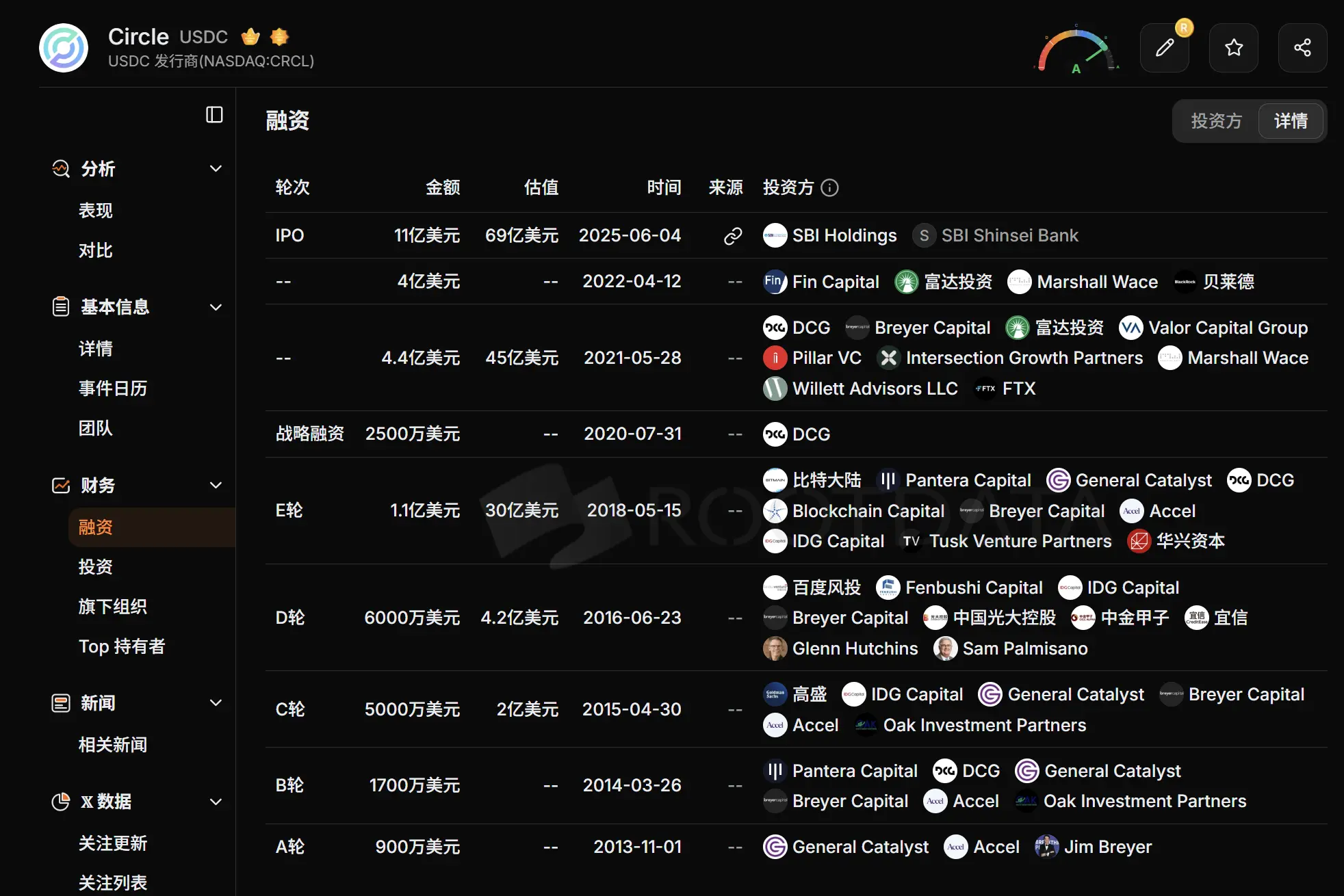
Circle's Financing History Source: RootData

For an investor like Duan Yongping who emphasizes the "essence of business," Circle has finally begun to take on a "understandable" form.

At the end of April, Circle also announced that its Layer 1 network, Arc, completed a token pre-sale financing round of $222 million, valuing it at $3 billion. a16z led a $75 million investment, with participation from more than ten institutions including BlackRock, Apollo Funds, Intercontinental Exchange (ICE), Standard Chartered Ventures, ARK Invest, and Bullish.

The expansion into the public chain network and the issuance of a native token have further opened the ceiling for Circle's business, and its stock price has risen accordingly. In May, Circle's stock price surged nearly 3 times from its yearly low ($50), briefly breaking through $140, and has since retreated slightly to around $111.

Traditional Finance is Increasingly Accepting Crypto Assets

Today, more and more crypto companies are attempting IPOs. From exchanges and stablecoin issuers to on-chain payment and custody infrastructure, many crypto enterprises are actively entering traditional capital markets, hoping to gain more stable financing channels, a broader institutional shareholder base, and stronger regulatory legitimacy.

At the same time, traditional financial giants are also entering the crypto space at an unprecedented pace. Whether it's BlackRock promoting Bitcoin ETFs, traditional banks exploring stablecoin settlement and on-chain asset custody, or payment institutions integrating with the USDC network, it essentially illustrates one thing:

The crypto industry is no longer just an independently existing "alternative market," but is beginning to integrate deeply with the global financial system.

In this process, stablecoin companies like Circle are becoming the bridge most easily understood and accepted by traditional capital.

The significance of Duan Yongping's purchase of Circle lies precisely here. It may not mean he is fully bullish on Web3, nor does it mean the value investing system is embracing all crypto assets. But at the very least, it shows that stablecoins and the on-chain dollar system have begun to enter the "circle of competence" of some traditional top-tier investors.

From a broader perspective, Circle is just one of the pioneers being "translated" by traditional mainstream capital from the crypto industry. As regulatory frameworks gradually become clearer, infrastructure matures, and profit models are continuously validated, more crypto-native enterprises like Circle will likely enter the view of traditional capital markets in the future.


İlgili Sorular

QWhat is the significance of Duan Yongping's first investment in a crypto company, Circle, according to the article?

AThe article states that while the investment amount is small relative to his portfolio (0.2%), it is highly symbolic. It signifies that a traditional, Buffett-style value investor, who emphasizes investing in understandable businesses with strong moats and good cash flow, has found a crypto company (Circle) that fits his investment criteria. This reflects a potential bridge between traditional finance and the crypto sector.

QWhy did Duan Yongping historically avoid most crypto investments, and how is Circle an exception?

ADuan Yongping avoided most crypto investments because they often did not meet his value investing criteria: they lacked predictable long-term cash flows, had fragile business models dependent on token prices, and operated in a space with high regulatory uncertainty. Circle is an exception because its core business model, issuing the stablecoin USDC and earning interest from reserve assets, is more akin to a financial infrastructure company or a 'digital dollar bank' with predictable and profitable cash flows.

QWhat are the key financial metrics from Circle's latest quarterly report that likely made it attractive to a value investor?

ACircle's Q1 report showed total revenue of $694 million (up 20% YoY), with 94% coming from reserve interest income. Adjusted EBITDA was $151 million (up 24% YoY). Key operational metrics also grew: USDC circulation reached $77 billion (up 28% YoY) and USDC on-chain transaction volume surged to $21.5 trillion (up 263% YoY), demonstrating a scalable and profitable 'stablecoin interest machine'.

QHow does Circle's recent funding round for its Layer 1 network, Arc, relate to its business prospects and stock performance?

AIn late April, Circle announced a $222 million token pre-sale for its Layer 1 network Arc, valuing it at $3 billion, with backing from major firms like a16z, BlackRock, and Apollo. This expansion into a blockchain network and native token opens up new growth avenues for Circle, increasing its business ceiling. Subsequently, Circle's stock price rose significantly in May, nearly tripling from its yearly low to briefly surpass $140.

QWhat broader trend in the finance industry does Duan Yongping's investment in Circle represent?

AIt represents the increasing integration of the crypto industry with the traditional financial system. More crypto companies are seeking IPOs for legitimacy and funding, while traditional finance giants like BlackRock are entering the crypto space (e.g., via Bitcoin ETFs). In this context, stablecoin companies like Circle, which function as financial infrastructure, are becoming the most understandable and acceptable bridge for traditional capital, signaling a wider acceptance of certain crypto-native business models.

İlgili Okumalar

Five Core Forms of AI Agent in YC's Eyes

The article outlines five core architectural patterns for effective AI Agents, emerging from tools like Codex and Claude, that move beyond simple prompts towards reusable, process-based capabilities. 1. **Skills**: Reusable, parameterized workflows that function like method calls, allowing a single process (e.g., "/investigate") to handle various tasks based on input parameters. 2. **Thin Harness**: A lightweight execution framework (~200 lines) that manages the AI model's "hands and feet"—handling loops, file I/O, and context—without becoming bloated. 3. **Resolvers**: Routing tables that map tasks to specific Skills, preventing "context corruption" when managing dozens of Skills and ensuring outputs go to the correct locations. 4. **Latent vs. Deterministic Layer**: A critical separation where LLMs handle judgment, synthesis, and pattern recognition, while deterministic code handles tasks requiring precision, consistency, and low cost (like calculations). 5. **Memory**: A persistent, accumulating knowledge base (e.g., a markdown folder) with a "current trusted conclusion" section and an append-only timeline, enabling the system to learn and retain context over time. Together, these patterns create a "process power"—a durable competitive advantage. Unlike one-off prompt-based applications whose value quickly commoditizes, a well-designed AI Agent system encodes experience into reusable, parameterized workflows, offloads stable rules to code, and continuously learns through memory. This creates a structured, hard-to-replicate capability that can provide sustained value for individuals or businesses, such as an accountant automating client reviews while preserving privacy and accumulating expertise.

marsbit55 dk önce

Five Core Forms of AI Agent in YC's Eyes

marsbit55 dk önce

Tiger Research: On-Chain Risk Operators, The Market Cap Gap Between 147 Trillion and 70 Billion

This report by Tiger Research examines the evolution of risk management in decentralized finance (DeFi) lending. It highlights a power shift from protocol developers to specialized professional risk operators who manage on-chain capital. The era of protocols and community governance solely dictating DeFi lending is ending. A new professional asset management layer has emerged. While the sector is nascent, capital and distribution channels are rapidly consolidating around top risk operator teams, whose past performance is now a key criterion for institutional entry. The industry's development, accelerated by modular infrastructures like Morpho, has led to a clear division of labor mirroring traditional finance: distribution channels (e.g., exchanges), strategy/risk management (the risk operators), and product infrastructure/asset custody (smart contract protocols). This structure lowers the entry barrier for traditional institutions. Currently, the total value managed by risk operators is approximately $70 billion, dominated by a few leading teams like Steakhouse (RWA focus), Sentora (AI models), and Gauntlet (crisis management). Competition now centers on collateral standards, distribution access, and crisis response capabilities. The report outlines three primary entry paths for institutions: 1) **Distribution Model**: Leveraging external risk operators as backend service providers (common for exchanges). 2) **Asset Supply Model**: Onboarding real-world assets to DeFi as collateral. 3) **Independent Operator Model**: Building an in-house team to become a risk operator (e.g., Bitwise). The core opportunity lies in the strategy/risk management layer, where traditional financial institutions can leverage their existing expertise in due diligence and risk assessment without deep technical development. A vast opportunity gap exists: the global traditional asset management industry manages ~$147 trillion, while the entire DeFi sector is only ~$800 billion, with the risk operator niche at ~$70 billion. This disparity signifies immense growth potential. Once robust risk frameworks and clearer regulations are established, even a minor allocation from traditional markets could trigger exponential DeFi growth. Early movers who help build these foundational systems will gain significant rule-setting influence and first-mover advantages.

marsbit1 saat önce

Tiger Research: On-Chain Risk Operators, The Market Cap Gap Between 147 Trillion and 70 Billion

marsbit1 saat önce

Interview with Circle's Chief Economist: USDC's Entry into Hyperliquid Benefits Circle and HYPE, Stablecoins Are Becoming Marginal Buyers of U.S. Treasuries

In an interview with Circle's Chief Economist Gordon Liao, the conversation covers the strategic significance of USDC replacing USDH as the reference asset on the decentralized perpetual exchange Hyperliquid. This shift, facilitated by Coinbase as the reserve manager and Circle providing technical infrastructure, aims to capture net interest income for the platform, with 90% of reserve earnings directed back to Hyperliquid for HYPE token buybacks. Liao discusses how stablecoins like USDC, with their substantial on-chain settlement volumes (e.g., $21 trillion in Q1 2026), are emerging as marginal buyers of U.S. Treasuries, concentrating on short-term debt and effectively reducing the weighted duration of the market, which may provide underlying support for long-term rates. The dialogue also explores the evolving nature of stablecoins as both a medium of exchange and a vehicle for capital and collateral liquidity. Additionally, the panel touches on the CLARITY Act's legislative progress, noting compromises around "activity-based rewards" and remaining hurdles like ethics concerns. On AI, there's debate over value capture, with predictions that distribution and application layers, rather than foundational model companies like OpenAI, will accrue most value. Regarding the bond market, Liao attributes the rise in 30-year yields primarily to an increased term premium (around 80 bps) driven by supply-demand dynamics, including fiscal expansion and changing investor demand, rather than expectations of Fed rate hikes.

marsbit1 saat önce

Interview with Circle's Chief Economist: USDC's Entry into Hyperliquid Benefits Circle and HYPE, Stablecoins Are Becoming Marginal Buyers of U.S. Treasuries

marsbit1 saat önce

İşlemler

Spot
Futures
活动图片