On the 29th, shares of South Korean semiconductor company SK Hynix plummeted during trading hours, falling over 19%, setting a record for its largest single-day drop. In the Hong Kong market, the "CSOP 2x Long Hynix" product plunged more than 28% intraday, narrowing its decline to 13.99% by the close, ending at HK$32.70.
On July 27, CSOP Asset Management announced that its 2x leveraged and inverse products linked to individual stocks such as SK Hynix, Samsung Electronics, NVIDIA, and Tesla will officially switch to a flexible leverage structure on August 3. Under extreme market conditions, the leverage ratio could be reduced to as low as 1.1x or -1.1x.
Over 80% Drop in One Month
Over the past month or so, SK Hynix's stock price has seen a significant correction. On June 25, the company's stock price in the Korean market hit a high of 2.987 million won per share; since then, it has been on a downward trend. By the close on July 29, SK Hynix was trading at 1.401 million won per share, having been "halved" from its peak.
The decline of the "CSOP 2x Long Hynix" product has been even more severe. From its peak of HK$193.65 on June 25, it fell to HK$32.70 at the close on July 29, a staggering drop of 83%.
Public information shows that the full name of "CSOP 2x Long Hynix" is CSOP SK Hynix Daily Leveraged (2x) Product (HKEX code: 07709). It is issued and managed by CSOP Asset Management Limited ("CSOP") and was officially listed on the Hong Kong Stock Exchange on October 16, 2025.
The fund's market price rose from HK$17.5 at the beginning of the year to a peak of HK$193.65, a surge of over 10 times. After nearly a month of adjustment, the "2x Long Hynix ETF" has retreated to its price level from the end of February this year.
According to media reports, CSOP's CEO Ding Chen stated at an event on July 16 that CSOP's globally first 2x leveraged product on SK Hynix, launched just 8 months ago, had reached a size of HK$130 billion by June this year, becoming the world's largest individual stock leveraged product by size.
Accompanying the drop in market price, the fund's asset size has also "shrunk." Latest data shows that on July 29, its asset size was only HK$31.9 billion, shrinking by nearly HK$100 billion in about a month, a decrease of over 70% from its peak.

Surge in Earnings, Plunge in Share Price
On July 29, SK Hynix released its Q2 2026 financial report. The data showed the company's revenue for the quarter reached 79.32 trillion won (approximately RMB 3.68838 trillion), a massive year-on-year increase of 257%, but falling short of market expectations of 84 trillion won. Operating profit was 60.54 trillion won (approximately RMB 2.81511 trillion), soaring 557% year-on-year, also below the expected 64 trillion won. Net profit was 93.92 trillion won (approximately RMB 4.36728 trillion), surging over 12 times year-on-year.
According to Yonhap News Agency, in the earnings conference call, SK Hynix addressed concerns about reduced investment in AI infrastructure, stating, "As AI competition among cloud service providers continues and services expand, we expect AI infrastructure investment to remain stable and sustained beyond next year."
Regarding price negotiations for High Bandwidth Memory (HBM) next year, SK Hynix said, "Due to contractual relationships, specific prices and details are difficult to disclose," adding, "We are currently negotiating supply volumes and prices with major customers. Discussions are progressing smoothly based on solid customer demand."
The report cited Kim Seok-hwan, a researcher at Mirae Asset Securities, who said, "SK Hynix's revenue, operating profit, and operating profit margin for the last quarter all fell short of market expectations."
A Reuters report suggested the company downplayed market concerns that its capacity expansion might trigger oversupply, stating it would dynamically adjust its investment scale based on market demand.
SK Hynix stated, "Major tech companies continue to increase investment in AI infrastructure construction, driving new supply demand. The revenue generated by AI services will continue to support related capital expenditures, so the growth momentum for memory chip demand is expected to continue."
The report cited analysts saying that while long-term supply agreements allow companies to better predict future demand, they also restrain short-term product price increases, which is one of the reasons for the company's earnings miss this time.
Analysts added that SK Hynix has a higher proportion of High Bandwidth Memory (HBM) business, and the price increase for such chips has not been as strong as for traditional memory chips.
To Dynamically Adjust Leverage Multiples
On July 24, the Hong Kong Securities and Futures Commission (SFC) issued a revised version of the "Circular on Listed Structured Funds" (the "Circular"), which sets out requirements for listed structured funds, including leveraged and inverse products.
Among them, additional requirements were proposed for leveraged and inverse products. It mandates that leveraged and inverse products whose carrying scale fluctuates significantly with market conditions must adopt a flexible leverage mechanism, meaning the daily leverage multiple can be dynamically adjusted, but must not exceed the prescribed leverage cap (the conventional leverage range cap is 2x to -2x). After the close of each trading day, the issuer must announce the target leverage multiple for the next trading day on the product's official website and the HKEX website.
The "Circular" pointed out that leveraged and inverse products are short-term trading tools and are completely different from traditional long-term investment ETFs. The names of such products authorized by the SFC must not be labeled as ETFs; they must be named "Leveraged Product" or "Inverse Product" based on the product type. The name must clearly indicate the leverage/inverse multiple and include the word "Daily" to highlight the daily rebalancing feature.
Affected by the new regulations, CSOP announced on July 27 that its 2x leveraged and inverse products linked to individual stocks such as SK Hynix, Samsung Electronics, NVIDIA, and Tesla will officially switch to the flexible leverage structure on August 3. Under extreme market conditions, the leverage can be reduced to as low as 1.1x (for inverse products, as low as -1.1x under extreme conditions), and the product names will be changed accordingly.
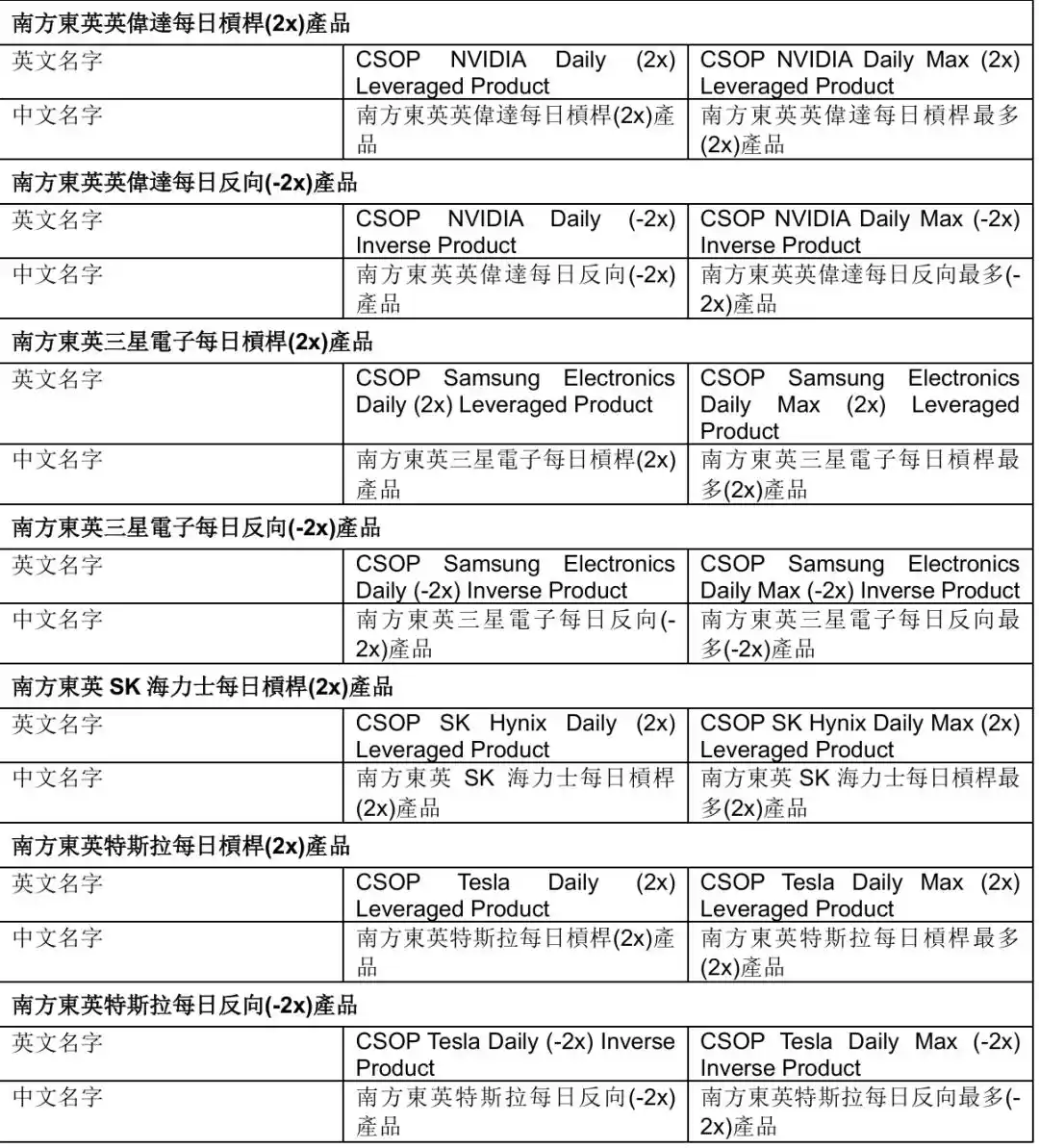
Screenshot from CSOP official website
Guo Yiming, Investment Advisor Director at Jufeng Investment Consulting, told China News Service that previous 2x leveraged fund products strictly amplified daily gains and losses by two times regardless of underlying volatility or market liquidity tightness. Once a heavily weighted stock experiences a sharp single-day fluctuation, the fund's swap exposure would quickly max out, and market makers, to control risks, could only passively close positions. This easily led to a significant disconnect between the product's net asset value and the underlying stock's performance, causing premiums to plummet, with risks borne entirely by investors and the issuer.
"After switching to the flexible leverage mechanism, the product retains the maximum leverage cap of 2x, but the fund can now reduce the actual leverage daily based on factors like the individual stock's trading activity, remaining swap quota, and intraday volatility. In extreme market conditions, the leverage can be lowered to a minimum of 1.1x. At the same time, new mandatory requirements are added, such as daily disclosure of real-time leverage and renaming products to indicate variable leverage," Guo Yiming said.
In Guo Yiming's view, compared to the old mechanism, the issuer significantly reduces operational risks during extreme market conditions and mitigates significant premium/discount anomalies. For ordinary investors, the biggest change is that the profit and loss elasticity is no longer constant; during highly volatile periods, the amplitude of gains or losses will be far lower than the original fixed 2x level. This also means investors can no longer rely on the previous fixed two-fold trading prediction and must check the disclosed actual leverage for each day before trading.
Guo Yiming warned that such products are only suitable for short-term speculation and not for medium- to long-term holding, and investors should be mindful of the risks.
This article is from the WeChat public account "China News Service" (ID: jwview), author: Wei Wei.