USDT Supply Shrinks by $5.5 Billion While Stablecoin Turnover Hits Record High

cryptonews.ru2026-07-29 tarihinde yayınlandı2026-07-29 tarihinde güncellendi

Özet

The supply of stablecoins has contracted for the first time in years, with total market capitalization falling 4.3% from its May peak to $308.5 billion. Despite this decline, June saw a record $1.83 trillion in adjusted transaction volume for stablecoins, a 60% increase from May. This divergence suggests a shift in usage patterns: less capital is sitting idle, while the remaining supply circulates more rapidly through payment and trading systems. Specifically, the supply of Tether's USDT decreased from approximately $189.54 billion to $184 billion between May 1 and July 29, while Circle's USDC supply fell from $77.27 billion to $72.41 billion. Part of this capital appears to have moved into tokenized Treasury products, a sector whose value has grown to over $16 billion, partly driven by regulations like the 2025 GENIUS Act that prohibit interest payments on payment-focused stablecoins. Transaction velocity is emerging as a key metric, with stablecoins now turning over about six times per month—double the rate from two years ago. USDC, despite having a smaller supply than USDT, processed about $1.21 trillion in adjusted volume in June, leading in settlement activity. While a significant portion of on-chain volume may not represent genuine economic payments, identifiable real-world payments have grown sharply, reaching an estimated $390 billion in 2025. The data indicates stablecoins are evolving from static collateral into active financial infrastructure.

The total supply of stablecoins has declined for the first time in years, but this decrease may not indicate as much about demand as it seems.

The overall market capitalization has fallen by approximately 4.3% from its May peak of $322.41 billion to $308.5 billion. In June alone, the drop amounted to $7.7 billion—the most significant monthly decline since the Terra crash in May 2022.
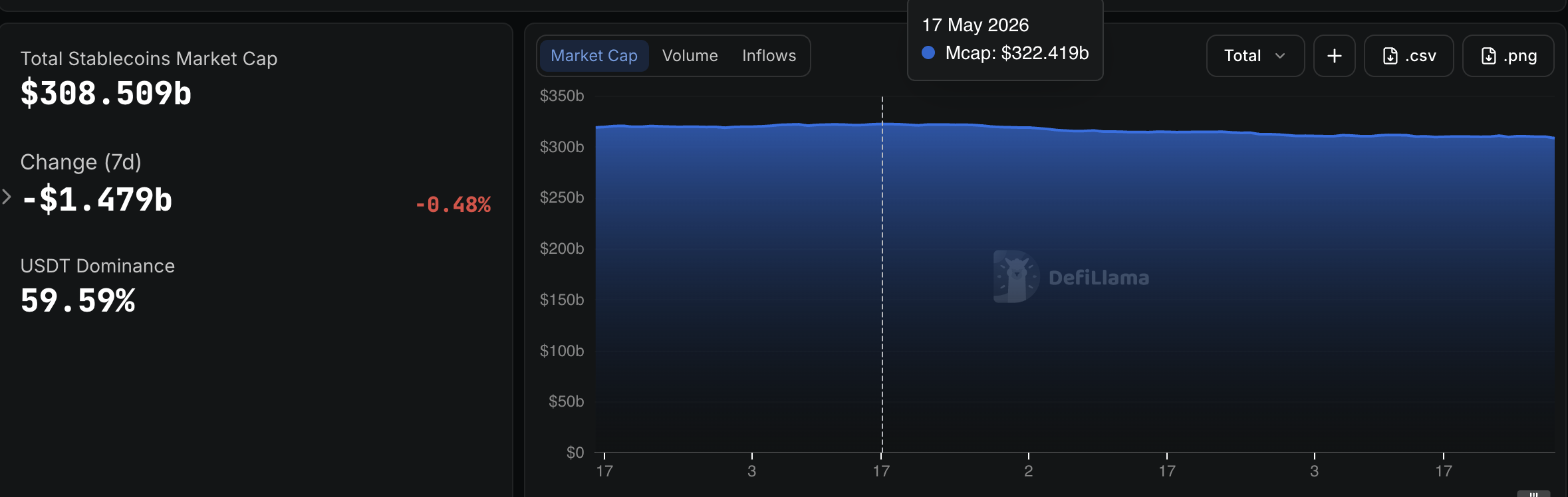
Source: Defillama

At the same time, the adjusted transaction volume for stablecoins reached a record $1.83 trillion in June. This is 60% higher than May's figure and more than double the level recorded a year ago.

This discrepancy points to a change in the nature of stablecoin usage. Fewer dollars are sitting idle, while the remaining supply is moving faster through payment, trading, and settlement systems.
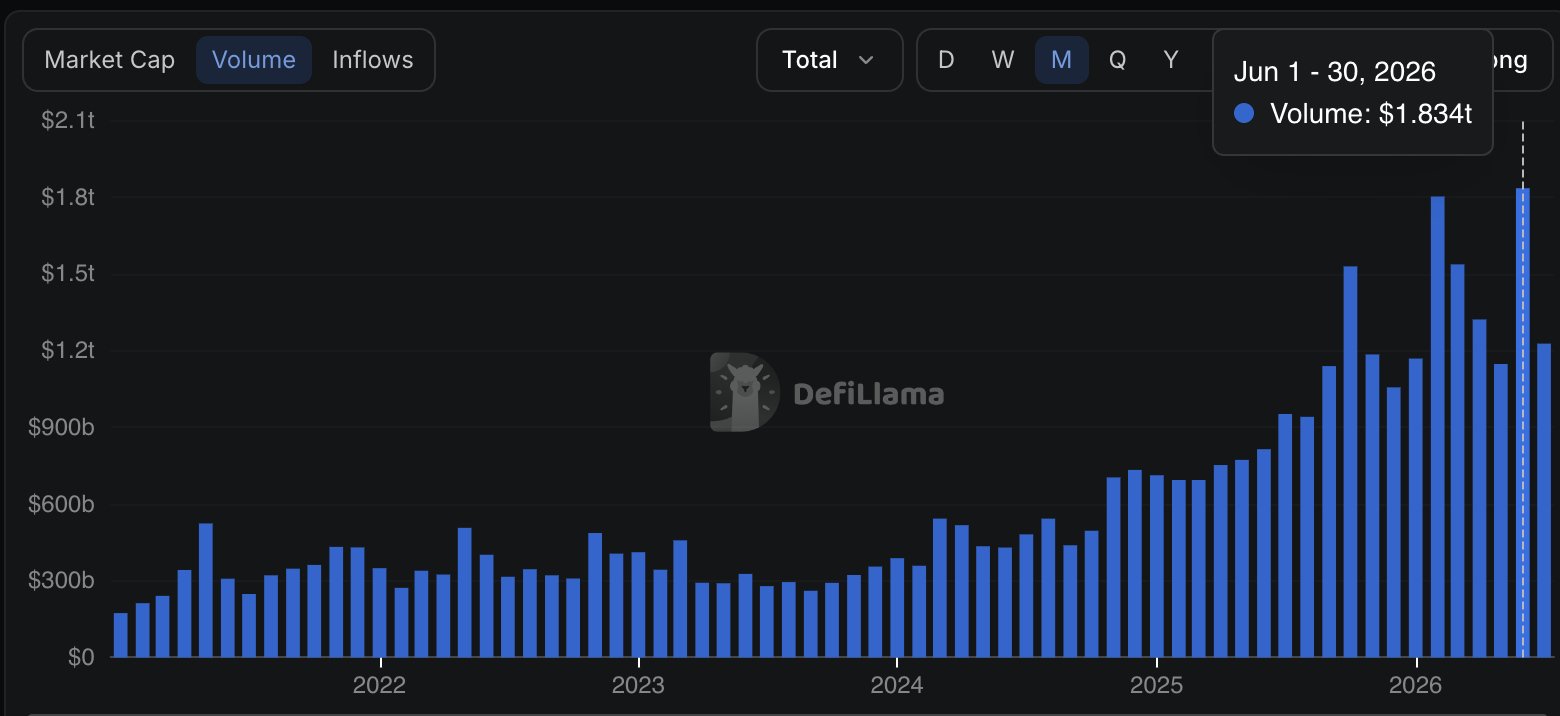
Source: Defillama

Idle Balances Move to Yield-Bearing Assets

The supply of $USDT by Tether decreased from $189.54 billion as of May 1 to approximately $184 billion as of July 29. Over the same period, the supply of $USDC by Circle dropped from $77.27 billion to $72.41 billion. This reduction remains moderate compared to the market's 26% crash in 2022.

Apparently, some capital has flowed into tokenized Treasury products, which offer yields not available for payment stablecoins. According to rwa.xyz, the volume of this sector has grown to over $16 billion compared to roughly $11 billion in March.
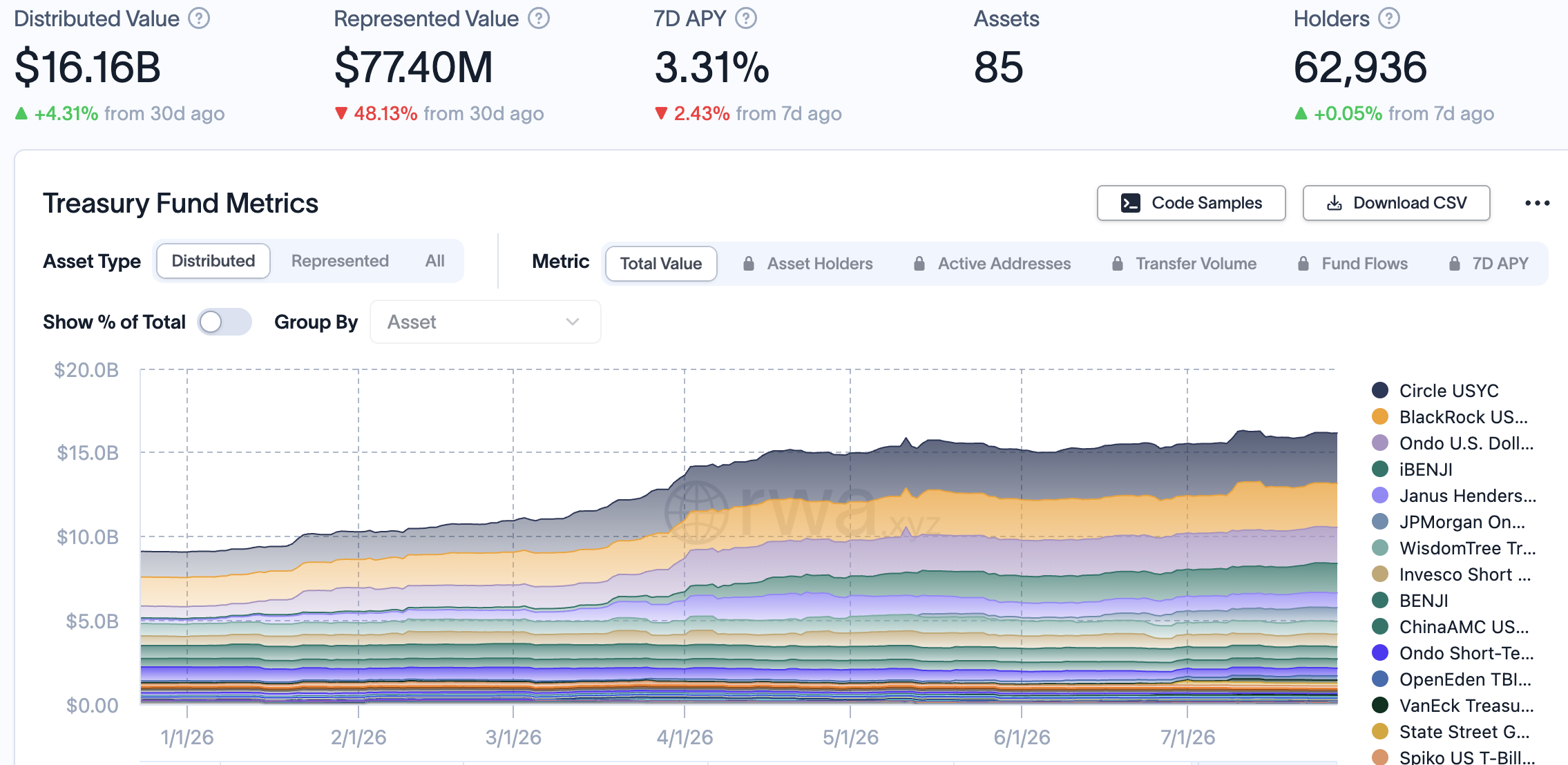
Source: rwa.xyz

The GENIUS Act, signed in July 2025, prohibits issuers from paying interest directly on payment stablecoins. This structure encourages treasurers to keep savings in tokenized funds, holding stablecoins only when payments need to be made.

Turnover Velocity Replaces Market Cap as Key Metric

According to a Standard Chartered report from March 2026, stablecoin turnover is now about six times per month. This is roughly double the rate from two years ago. Visa data also shows that each dollar in a stablecoin moves much more frequently than a dollar stored in an ordinary U.S. bank account.

$USDC has become the leading settlement asset, despite its supply being smaller than that of $USDT. In June, it processed about $1.21 trillion in adjusted volume, compared to $576 billion for $USDT.

However, not all blockchain transfers represent real economic payments. Automated activity, exchange transfers, and wash trades can inflate the raw figures.

According to a Forbes report, estimates by McKinsey and Artemis suggest that identifiable real-world payments accounted for about $390 billion in 2025. Business-to-business transactions made up $226 billion, while payroll and remittance payments were approximately $90 billion.

The share of payments is still small but has grown sharply over two years.

Stablecoin market capitalization still matters, as issuers earn interest on reserves. However, for networks, processors, and financial platforms, transaction frequency may become a more valuable metric. June data indicates that stablecoins are transforming from 'frozen' collateral into active financial infrastructure.


İlgili Sorular

QAccording to the article, what is the key change in the nature of stablecoin usage indicated by the data?

AThe data indicates a change in the nature of stablecoin usage: fewer dollars are sitting idle, while the remaining volume is moving faster through payment, trading, and settlement systems. This is shown by the supply shrinking while transaction turnover hits a record high.

QWhat is one major reason suggested in the article for the migration of capital away from payment stablecoins like USDT and USDC?

AOne major reason is the flow of capital into tokenized Treasury products, which offer yields not available to payment stablecoins. This was further encouraged by the GENIUS Act signed in July 2025, which prohibits issuers from paying interest directly on payment stablecoins.

QWhy does the article suggest that transaction turnover (velocity) is becoming a more valuable metric than market capitalization for certain entities?

AFor networks, processors, and financial platforms, the frequency of transactions (turnover velocity) may become a more valuable metric than market capitalization because it reflects active usage and utility within the financial infrastructure, rather than just stored value.

QWhich stablecoin processed a higher adjusted transaction volume in June, USDT or USDC, despite having a smaller supply?

AUSDC processed a higher adjusted transaction volume in June (approximately $1.21 trillion) compared to USDT ($576 billion), even though USDC's supply is smaller than that of USDT.

QWhat does the article cite as a potential factor that can inflate raw on-chain transaction figures?

AThe article states that automated activity, exchange transfers, and wash trading can inflate the raw on-chain transaction figures, meaning not all blockchain transfers represent real economic payments.

İlgili Okumalar

SemiAnalysis on the Epic Plunge: It's Not Over Yet

SemiAnalysis Weekly discusses the recent sharp correction in the semiconductor market after a historic first half. Analysts Doug O'Loughlin and Dylan note that despite healthy fundamentals, markets like South Korea's KOSPI have plunged 40%, wiping out leveraged retail investors. A core debate focuses on AI demand versus supply constraints. Dylan cites SemiAnalysis's internal use of AI coding agents, leading to a 100x increase in AI spending, as evidence of powerful demand. Doug agrees demand is strong but questions its exact magnitude, calling it a "trillion-dollar question." His primary concern is physical and financial bottlenecks: a shortage of 100,000 electricians in the US, massive $450B in corporate debt issuance by hyperscalers (funded by a shrinking pension pool), and labor/scale limits in regions like Taiwan, where TSMC constitutes 20% of GDP. The conversation covers market dynamics, including the typical semiconductor cycle where over-ordering leads to crashes, China's growing memory capacity, and the potential for older chips like the H100 to lose value as models scale. Politically, AI is seen as a likely scapegoat in upcoming elections, though not a top-tier voter priority. The analysts conclude that while the long-term potential is significant, the scaling path is narrowing. The challenge is matching exponential compute demands with real-world constraints on capital, labor, and permits, risking scenarios where massive investment outpaces near-term revenue generation.

marsbit20 dk önce

SemiAnalysis on the Epic Plunge: It's Not Over Yet

marsbit20 dk önce

After Robinhood's Aggressive Entry, Why is PUMP Defying the Trend and Rising?

Amid a prolonged crypto bear market that has strained many projects, Pump.fun stands out by maintaining strong profitability. Despite a major token unlock in mid-July that was expected to cause selling pressure, its native token PUMP has risen nearly 48% over the past month. Analysis shows only a small portion of unlocked tokens were sold, with 92% of investor allocations still held. A buyback-and-burn mechanism has also supported the price, though daily回购 funds have declined by 77.5% from their peak, partly due to a change in tokenomics and lower platform revenue. Pump.fun remains a top revenue generator in crypto, with annualized revenue of around $450 million, ranking just behind giants like Tether and Circle. However, its daily revenue is down about 69% from its all-time high, reflecting dependence on meme coin market cycles. The platform also faces a class-action lawsuit alleging market manipulation and securities violations. New competition has emerged with Robinhood Chain's launchpad, which recently saw higher weekly volume and active addresses than Pump.fun. While Pump.fun's metrics haven't declined yet, it has responded with a new token launch mechanism called BOOST to improve liquidity. This has increased platform activity but raised community concerns about potential exploitation for short-term pumps. Ultimately, Pump.fun's success remains tightly linked to meme coin speculation and broader market sentiment.

marsbit20 dk önce

After Robinhood's Aggressive Entry, Why is PUMP Defying the Trend and Rising?

marsbit20 dk önce

China Business Journal Unveils Cryptocurrency Extortion Scheme

China Business Journal, a state-run Chinese newspaper, has issued a warning about scammers using its name to extort cryptocurrency from companies. According to the publication, fraudsters are sending emails impersonating its journalists. These emails threaten to publish damaging information about a company unless a Bitcoin payment is made. The scammers, using Proton Mail addresses, claim to possess compromising material from a secretive investigation. The newspaper's representatives have clarified that it has no involvement with these messages. They emphasized that the publication does not engage in such practices, never demands payment to suppress stories, and does not negotiate in this manner. The editorial team believes the criminals are exploiting the newspaper's authoritative reputation to pressure companies into making hasty decisions under threat of reputational harm. China Business Journal stated it is collecting evidence of this brand misuse, analyzing the fraudulent emails, and preparing materials for law enforcement. It reserves the right to pursue both civil and criminal liability against the scheme's organizers. Companies are urged to carefully verify any communication purportedly from the newspaper, avoid transferring cryptocurrency to unknown recipients, and report such incidents to the authorities. The newspaper confirmed it will continue its own investigation into the matter.

cryptonews.ru55 dk önce

China Business Journal Unveils Cryptocurrency Extortion Scheme

cryptonews.ru55 dk önce

İşlemler

Spot
活动图片