DeFi Recent Updates: Stablecoin Public Chains Face Internal Competition and Cooling Off, RWA Welcomes Its 'SEC Moment'

marsbit2025-12-17 tarihinde yayınlandı2025-12-17 tarihinde güncellendi

Özet

The DeFi market is currently bearish, with sentiment leaning towards further downside for Bitcoin and a shift of attention and capital towards AI. The author's strategy involves moving away from most altcoins to focus on major assets like BTC and ETH, retaining only a few with strong cash flows like AAVE and LINK. Key developments include a governance dispute between Aave DAO and Aave Labs, highlighting industry-wide governance challenges, and an update to Aave V4's liquidation mechanism to reduce over-liquidations. The article discusses the underwhelming performance of new stablecoin-focused Layer 1 blockchains, which have failed to significantly capture market share from established players like Ethereum and Tron. Their true potential lies in onboarding new, off-chain stablecoin users, a challenging task. A major focus is on the tokenization of real-world assets (RWA) following the SEC's approval of DTCC's tokenization plan. This is seen as a significant, positive regulatory step. The approval outlines strict requirements for compliant blockchains, with Ethereum/L2s being a likely fit. This development is analyzed as a potential indirect benefit for existing projects like Ondo Finance, which recently had an SEC investigation closed with no charges. Ondo's mechanism for facilitating large on-chain stock token trades using its own stablecoin, USDon, is explained. Other updates include Ethena's new airdrop season requirements, which users must interact with its HyENA perps...

In terms of market sentiment, it's largely bearish across the board. In groups focused purely on trading charts, prices below $50,000 are already being discussed. The research-oriented crowd is also very pessimistic, generally believing that it's hard for any good innovation to emerge now, and that attention and capital are being heavily drained by the AI sector.

The strategy discussed last week was to abandon most altcoins and shift to mainstream assets, primarily concentrating on BTC and ETH. Only a portion of altcoin assets with cash-flow businesses were kept, such as AAVE and LINK. Public chains and L2s were mostly swapped for ETH.

Compared to the last cycle, I feel I've become very conservative. During the bear market after LUNA, I bought the dip on a large number of altcoins. Although the overall account was ultimately profitable, and I even witnessed projects like AAVE rise again, I also experienced too many stories of going to zero.

The situation this cycle is a bit different. I think there are very few mispriced altcoins left; the market's computational and evaluation capabilities have greatly improved, and 'bargain hunting' isn't so easy anymore.

Especially this cycle, there are a large number of projects without real business, and also reborn projects meant to fulfill previous fundraising obligations. These projects are very dangerous.

Of course, if there really is a good opportunity, I would still buy, but right now, it's basically non-existent.
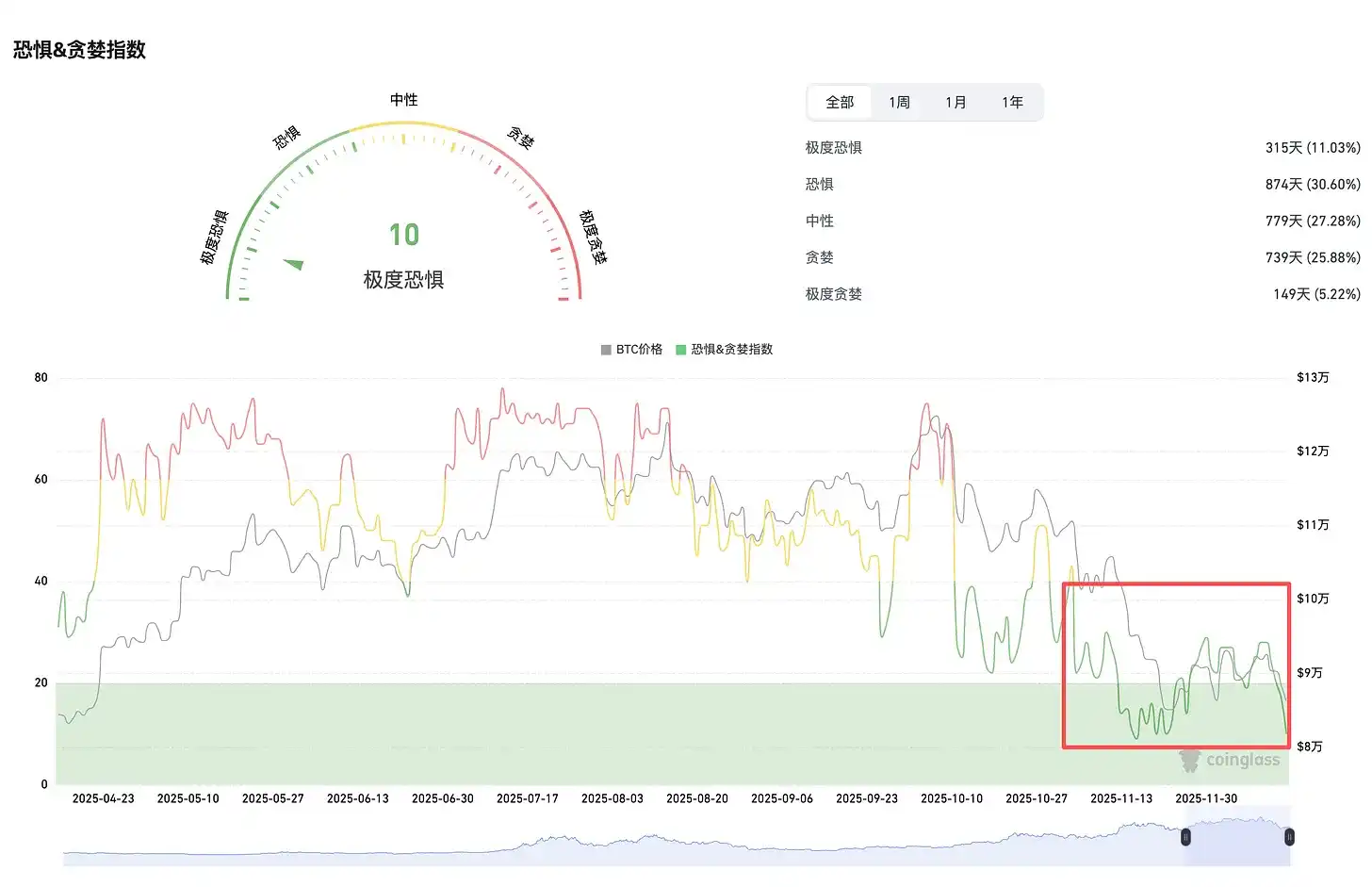
We have been continuously in a state of panic - extreme panic for over a month since early November

Thanks for reading CM's DeFi! Subscribe for free to receive new posts and support my work.

Subscribe

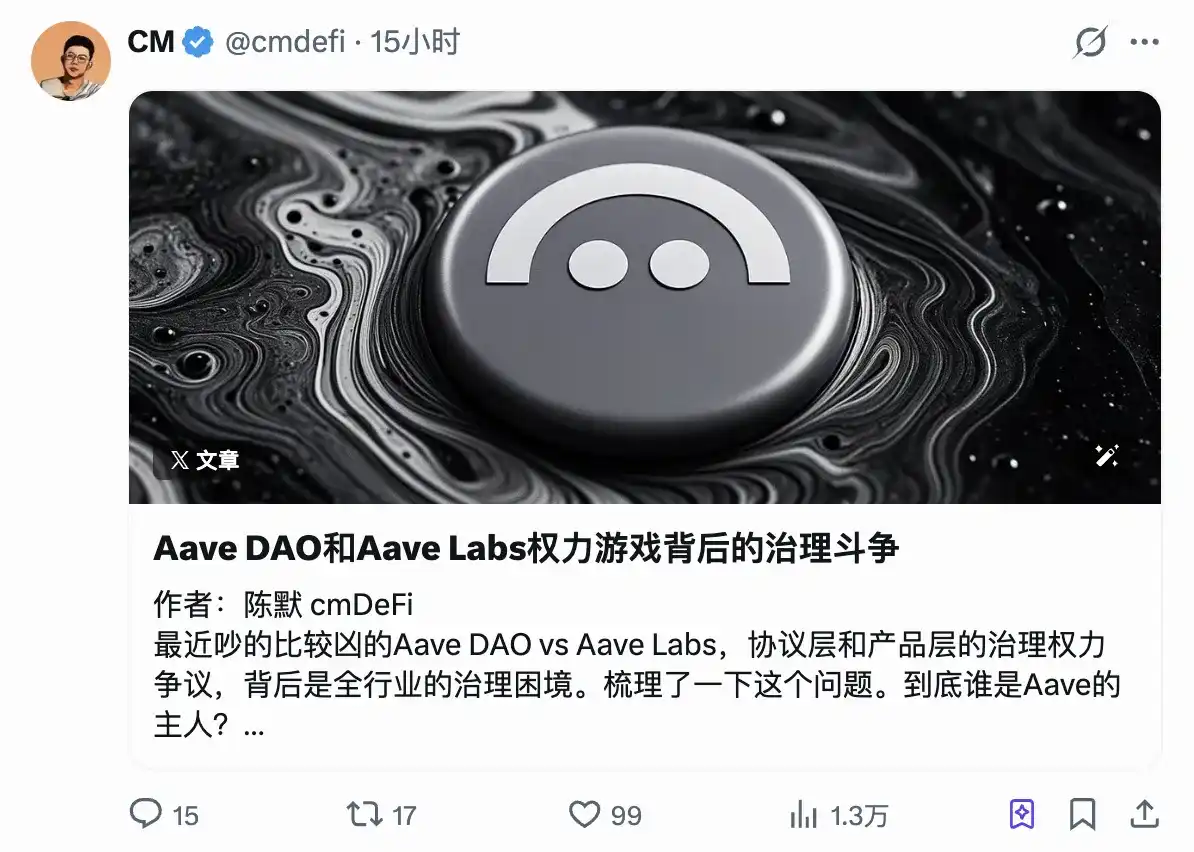
2. Aave DAO vs Aave Labs Governance Power Dispute

This has been fiercely debated recently. I wrote an article about it, recommended reading. This also reflects the governance dilemma faced by the entire industry.
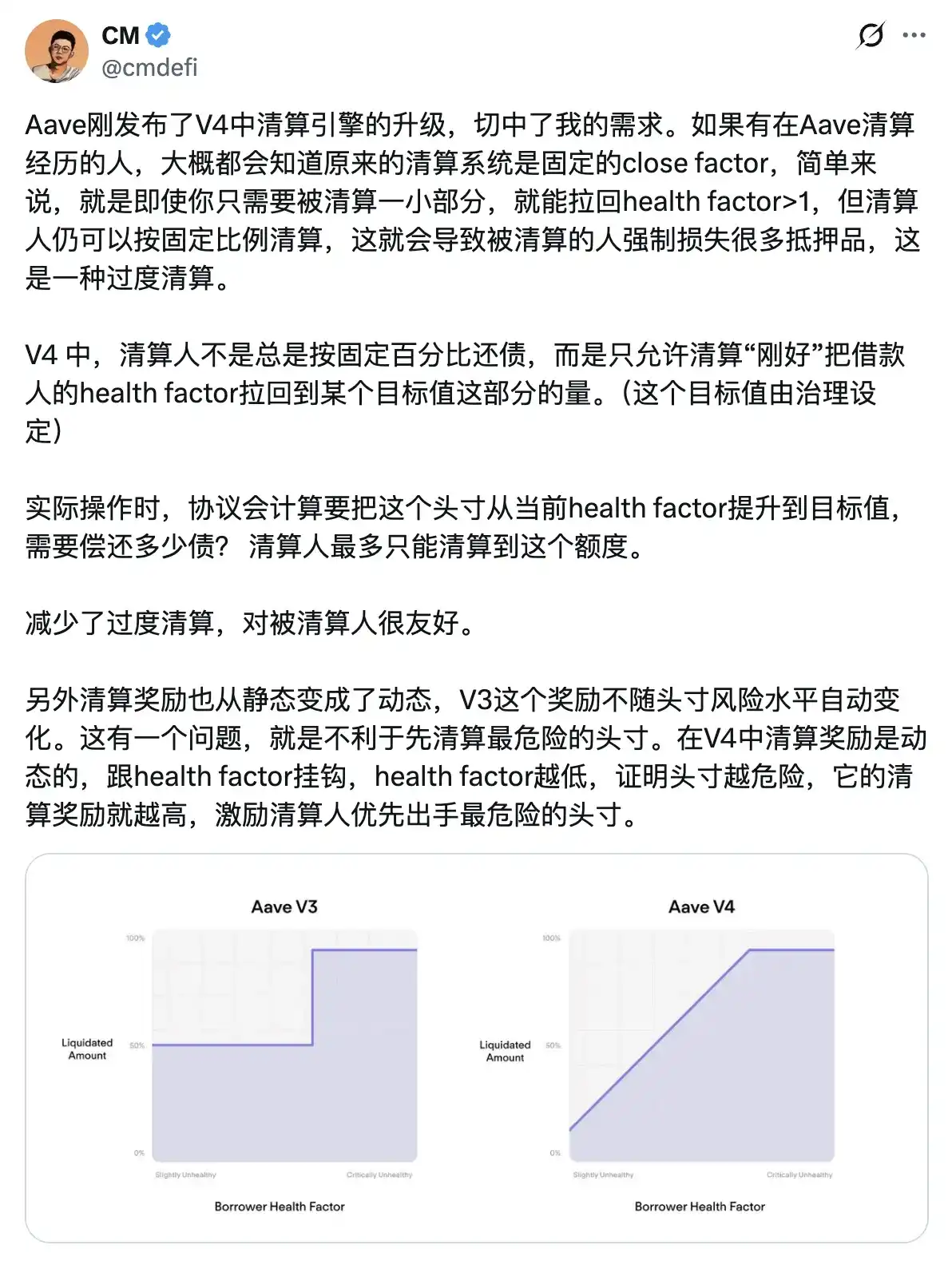
3. Aave V4 Updated Liquidation Mechanism, Reducing Over-Liquidation.
4. About the Hot Stablecoin Public Chains This Cycle

This sector is in a somewhat awkward position currently, and the market's interpretation is also problematic. When Plasma first launched, many thought it would crush other public chains and take away USDT's market share. But in reality, the impact on Ethereum and Tron has been minimal. Even with massive token rewards投放 (deployed), they haven't captured a significant market share.

The real narrative for this赛道 (sector) is to open up the stablecoin market outside the圈 (circle/crypto sphere). After all, in the context of the stablecoin compliance bill being passed this cycle, stablecoin entrepreneurship is a赛道 (sector) that occupies the right timing and conditions. However, currently, no one has been seen to successfully pull this off. Of course, the difficulty is also very high. I think this will be the key factor testing a stablecoin L1 in the future, rather than endlessly competing in the存量 (existing) stablecoin market.

5. Stock Tokenization and RWA Sector

DTCC was approved by the SEC for its asset tokenization plan. This news has once again drawn market attention to this sector. In terms of trend, the SEC is taking a very open and supportive attitude to advance this matter, with documents, details, and standards.

DTCC (Depository Trust & Clearing Corporation) is a leading global provider of financial market infrastructure, processing over 90% of U.S. stock, bond, and treasury trades globally.

First, some standards defined in the SEC's No-Action Letter for 'Qualified Blockchains': (Excerpt)

  • Reliability and Resilience: The blockchain network must demonstrate high reliability and resilience, including assessments based on availability, performance, and historical outage records, to prevent operational disruptions.

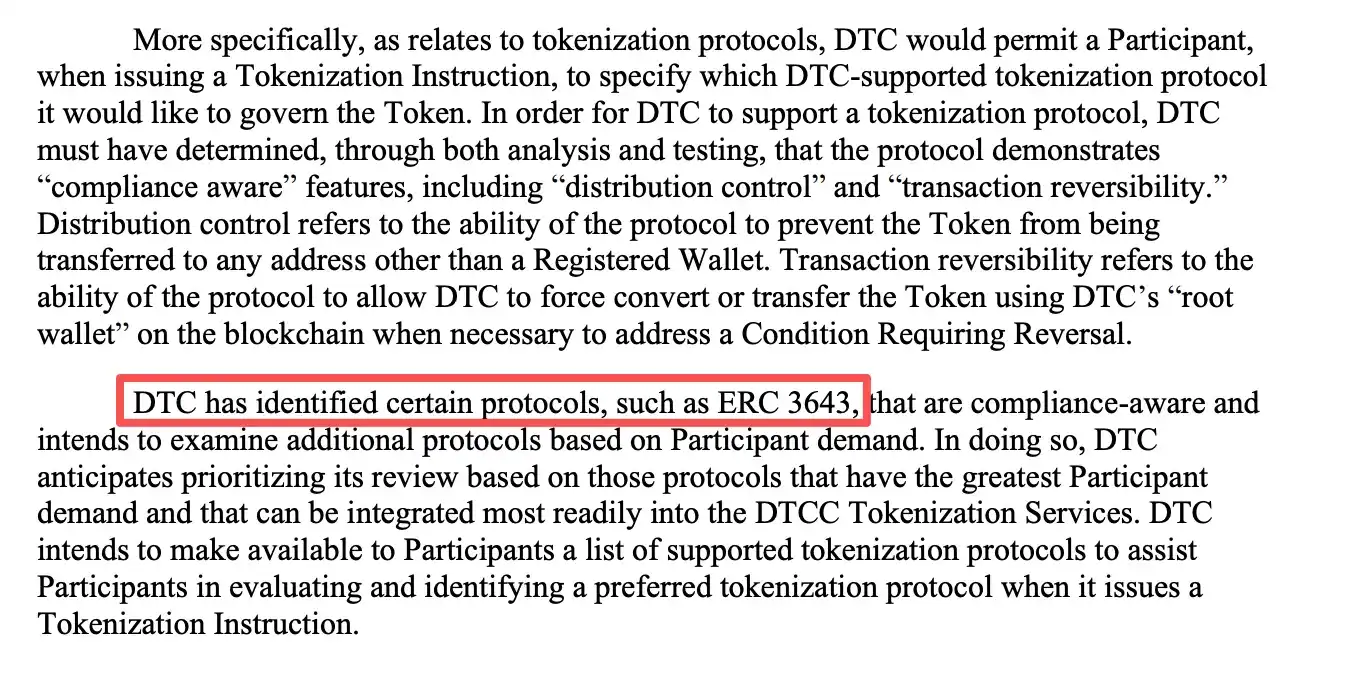
  • Compliance Function Support: Only DTCC participants can register wallets and are fully responsible for wallet activity. The network must support compliance-aware functions, including distribution controls (preventing transfers to non-registered wallets) and transaction reversibility (allowing DTCC to强制转换 (force convert) or transfer via a root wallet to handle 'reversal conditions' such as erroneous entries, lost tokens, or malicious acts).

  • Observability: Even when using privacy features (like zero-knowledge proofs), the network must allow DTCC to observe all token transfers directly or through supporting technology.

  • Wallet Screening: DTCC needs to screen registered wallets itself to confirm compliance with the Office of Foreign Assets Control (OFAC) requirements.

Source document link I've posted here →Click to read

Here, I think if choosing among existing public chains, I still believe Ethereum/L2 is the most compliant, especially since the SEC's original text mentioned ERC-3643, which was explicitly cited as an example of a compliance-aware protocol supporting distribution controls and transaction reversibility. Additionally, DTCC has previously used Ethereum for pilot projects (2020's Project Whitney).
Another point is the impact on existing RWA projects. Many market interpretations are negative, but there is a misunderstanding here. My personal interpretation is still偏向利好 (leaning positive/利好).

First, this matter serves institutional clients (primarily targeting DTC participants and their clients, who are typically financial institutions like banks, brokers, and asset managers). It has no direct relationship with retail investors. Therefore, it is not conflicting with existing stock tokenization products like Ondo (this is where the market interpretation is mistaken). For institutional clients, it offers faster settlement and improved efficiency, opens the possibility of 24/7 trading, and enables some automated management through smart contracts (reducing manual intervention).

From a retail perspective, faster and cheaper institutional settlement could lead brokers (like Robinhood or Fidelity) to reduce fees or commissions, passing the savings to retail. When trading through institutional products (like ETFs or mutual funds), retail might experience faster order execution and better price discovery. Similarly, when using products like Ondo, they could theoretically benefit because its underlying efficiency also relies on the execution efficiency of off-chain institutions.

So this relationship is微妙 (subtle/delicate). The SEC is starting to support stock tokenization in attitude and is also advancing technically. But for on-chain 'gray area' businesses like Ondo, how they will be regulated is not yet clear, while they can still benefit under current policies.估计 (I estimate) it will remain in a state of benign neglect for the short term. It might be different once the scale becomes larger; we'll see then. For now, my interpretation is利好 (positive).

(This month, the U.S. Securities and Exchange Commission (SEC) formally ended its two-year investigation into Ondo Finance and confirmed it would not bring any charges.)

6. Ondo's Stock Tokens Can Support Single Transactions of $100,000 On-Chain

There isn't that much liquidity on-chain. How is this achieved?

It uses a very clever method: it mints its own stablecoin, USDon. Then, when there is buy demand, it directly mints the stock token, using its own USDon as a bridge. This eliminates the need for external liquidity because both the stock token and USDon are under its own control – theoretically offering infinite liquidity. Conversely, when someone sells, it first burns the stock token, then converts it to USDon based on the Oracle price, and finally exchanges it for the on-chain asset the user wants.

Regarding USDon, in terms of composition, its collateral is U.S. dollars and U.S. Treasuries等高流动性资产 (highly liquid assets), held in a regulated brokerage account. On-chain, it is placed together with USDC in a Swapper contract. When a transaction occurs, USDon is used as the intermediary asset.

For example, to buy NVDAon: User inputs USDC → swapper converts to USDon → uses USDon to mint NVDAon, all completed in a single transaction.

The swapper is a smart contract pool holding liquidity for USDon and USDC. If liquidity is sufficient, the conversion can be done instantly at 1:1. For very large amounts, exceeding the liquidity threshold, one would have to wait or trade in batches. The liquidity of this contract is maintained by Ondo itself.

Theoretically, Ondo can increase the supported single transaction size by injecting more USDon (or corresponding USDC) into the Swapper. The only potential issue later is that if demand picks up, high-frequency trading might expose the Swapper's bottleneck. This would test the on-chain performance and Ondo's ability to rebalance and manage the Swapper.

For Ondo, although its current implementation seems optimal with the best liquidity, it has little to do with the ONDO token. Also, whether this project can scale up and whether it will face regulatory issues is hard to say. It is still in a 'gray area' currently. But if you want to bet on the stock tokenization narrative, then Ondo is probably unavoidable.

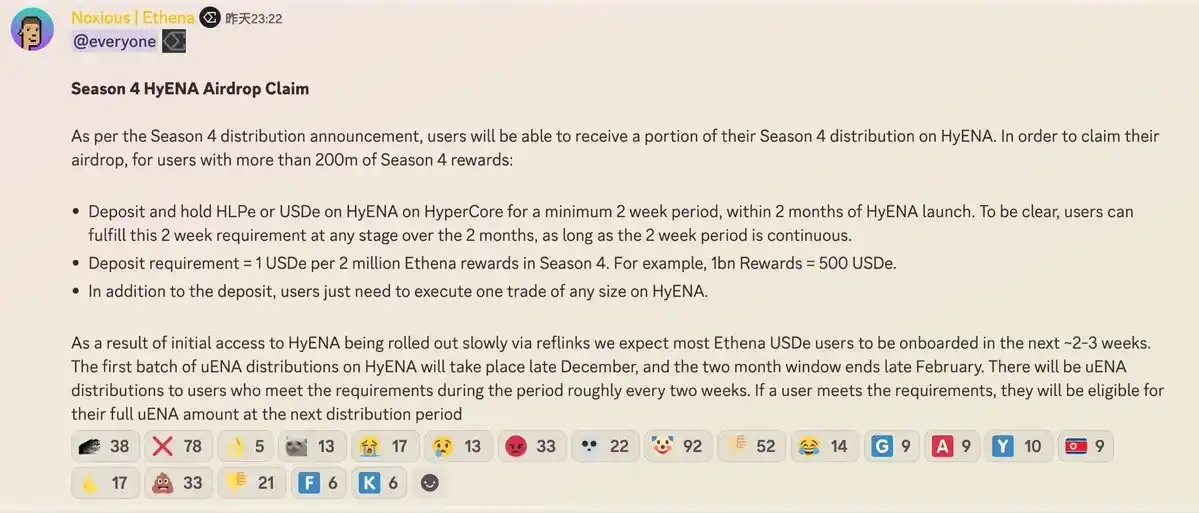
7. Ethena Updated Season 4 Airdrop, Added HyENA Related Portion

  • For users with over 200 million points, they need to deposit and hold HLPe or USDe on HyENA for at least 2 weeks, and it must be consecutive. The deposit amount required is 1 USDe for every 2 million points. Based on the minimum threshold of 200 million points, that's 100 USDe.

  • Besides depositing, users need to make a transaction of any size on HyENA. Rewards are distributed in uENA (the version of ENA on Hyper). The first batch starts in late December, with a two-month window lasting until February. This means during these 2 months, you choose any continuous 2-week period to deposit.

This is essentially forcing traffic to HyENA. Ethena places great importance on the Perps business (after all, it's very profitable).
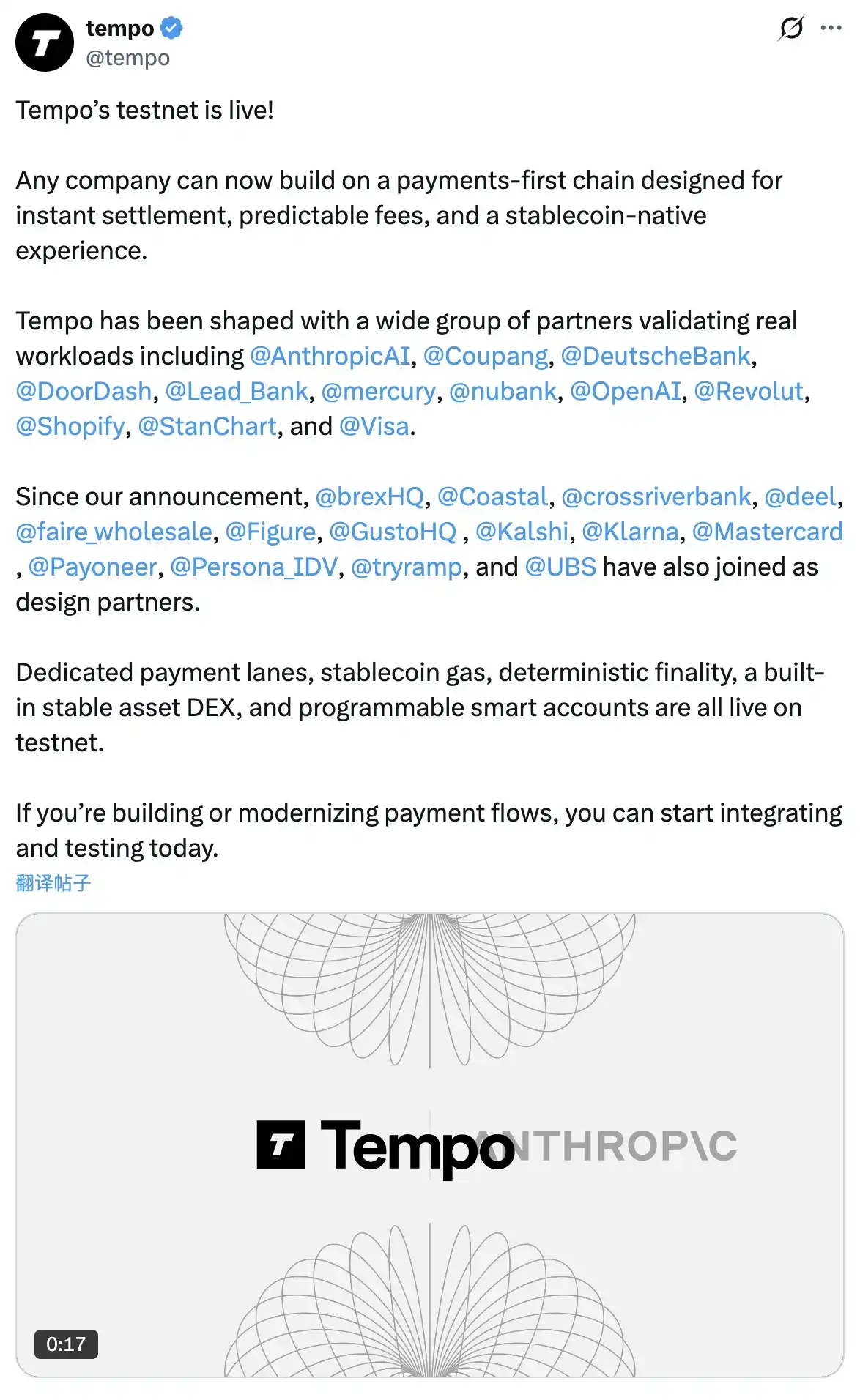
8. Tempo Launches Testnet

Co-incubated and developed by Stripe and Paradigm. Partners include Anthropic AI, Coupang, Deutsche Bank, DoorDash, Lead Bank, Mercury, NuBank, OpenAI, Revolut, Shopify, Standard Chartered, Visa.

Tempo's goal is to solve the pain points of existing blockchains in the payment field, such as high fees, latency, and uncertainty, making stablecoins a mainstream payment tool.
İlgili Sorular

QWhat is the author's current investment strategy for the crypto market, and why have they become more conservative?

AThe author's strategy is to shift from most altcoins to mainstream assets like BTC and ETH, keeping only a few altcoins with cash flow businesses such as AAVE and LINK. They have become more conservative because they believe there are fewer undervalued altcoins in this cycle, and the evaluation capabilities of the market have improved, making it harder to find bargains. Additionally, many projects lack real business models or are rebranded projects from previous funding rounds, increasing risks.

QWhat is the key challenge for stablecoin-focused Layer 1 blockchains according to the author?

AThe key challenge for stablecoin-focused Layer 1 blockchains is to expand into the off-chain stablecoin market rather than competing for the existing on-chain market share. Despite heavy token incentives, they have not significantly captured market share from established chains like Ethereum or Tron. The real opportunity lies in leveraging the regulatory environment for stablecoins to attract external users, but this remains difficult to achieve.

QHow does the SEC's approval of DTCC's tokenization plan impact the RWA and stock tokenization sector?

AThe SEC's approval is seen as a positive development, showing regulatory support for asset tokenization with clear standards. It benefits institutional clients by enabling faster settlements, 24/7 trading, and automated management via smart contracts. While it directly serves institutions, retail investors may indirectly benefit through lower fees and improved efficiency from brokers. Projects like Ondo are not directly conflicted by this but operate in a 'gray area,' potentially gaining from the overall positive momentum.

QHow does Ondo Finance facilitate large on-chain stock token trades without sufficient liquidity?

AOndo uses its own stablecoin, USDon, as an intermediary. When a user buys a stock token like NVDAon, USDC is converted to USDon via a swapper contract, and USDon is then used to mint the stock token. This allows Ondo to create 'infinite' liquidity since both USDon and the stock tokens are controlled by Ondo. The swapper contract holds liquidity in USDon and USDC, managed by Ondo, which can inject more funds to support larger trades, though high-frequency trading may expose scalability challenges.

QWhat is the purpose of Ethena's Season 4 airdrop update involving HyENA?

AEthena's Season 4 airdrop update requires users with over 200 million rewards to deposit and hold HLPe or USDe on HyENA for at least two consecutive weeks and perform any transaction on HyENA. This is designed to drive traffic to HyENA, as Ethena prioritizes its perpetuals business, which is highly profitable. Rewards are distributed in uENA over a two-month window from December to February.

İlgili Okumalar

STAR 50 Soars 10.73%, Why Did A-Shares Stage a "V-Shaped Reversal"?

After a prolonged decline, the Chinese A-share market staged a strong rally on July 21. The STAR 50 index surged 10.73%, its largest single-day gain in nearly a year, leading a broad-based "V-shaped" reversal. The Shanghai Composite Index rose 1.79%, the Shenzhen Component Index gained 4.81%, and the ChiNext Index jumped 7.05%. Total market turnover reached 2.97 trillion yuan, an increase of 256.1 billion yuan from the previous session, with over 3,100 stocks advancing. The semiconductor sector spearheaded the rebound, with related ETFs posting significant gains. Analysts attribute the surge to three converging factors. First, coordinated capital inflows from "national team" institutions, insurance funds, listed company buybacks, and fund house self-purchases have bolstered market liquidity and confidence. Second, supportive policy signals, including commitments from regulators to ensure stable market operations, provided a favorable backdrop. Third, a stabilization and recovery in overseas markets, notably South Korea, created a positive external environment. Institutions suggest the most severe panic selling phase for the tech sector has likely passed, following a significant digestion of crowded positions and leveraged funds. While short-term volatility may persist, the medium to long-term outlook remains underpinned by enduring trends like AI computing demand expansion and semiconductor localization. The market's focus now shifts to the sustainability of supportive fund flows, earnings reports, and upcoming catalysts from the global AI industry chain.

marsbit27 dk önce

STAR 50 Soars 10.73%, Why Did A-Shares Stage a "V-Shaped Reversal"?

marsbit27 dk önce

U.S. Tech Momentum Stocks Post Largest Single-Day Gain Ever, But Is the Plunge Over?

US tech momentum stocks staged a sharp rebound on Tuesday (July 21st). Morgan Stanley's TMT Momentum Factor surged over 12%, marking its largest single-day gain on record, exceeding even peaks from the 2000 dot-com bubble. Key momentum indices from Goldman Sachs also posted their strongest daily performances in years. The rally was led by semiconductors, with the Philadelphia Semiconductor Index jumping 4.6%. This rebound followed three consecutive down days and a cumulative 33% plunge in momentum stocks, one of the steepest drawdowns since the dot-com era. Analysts attribute the surge largely to a short squeeze. Heavy selling had pushed high-beta momentum stocks into deeply oversold territory, forcing many short sellers, particularly in Asia, to cover their positions, creating a self-reinforcing buying spiral. However, the rebound's internals appear weak. Trading volume was notably low, and advancing stocks still lagged decliners on the S&P 500, indicating a narrow, concentrated rally rather than broad market participation. Diverging views emerge on the outlook. BTIG warns the bounce has hit key resistance and recommends selling into strength, citing extreme volatility and historical parallels to past market tops. Conversely, Goldman Sachs and UBS believe the momentum unwind is nearing its end, suggesting it may be time to gradually add exposure, as positioning has been significantly reduced. They caution, however, that high volatility warrants a measured approach, potentially using defined-risk strategies. The upcoming earnings season, particularly reports from major tech firms like Alphabet, is seen as a critical test for the rally's sustainability. Simultaneously, bond markets flashed a warning, with yields rising partly due to spiking oil prices. Analysts note that if long-term Treasury yields break decisively higher, it could pose a significant headwind for equities, especially growth stocks.

marsbit35 dk önce

U.S. Tech Momentum Stocks Post Largest Single-Day Gain Ever, But Is the Plunge Over?

marsbit35 dk önce

U.S. Tech Momentum Stocks Record Largest Single-Day Gain Ever, but Has the Rout Ended?

U.S. tech momentum stocks staged a dramatic rebound on Tuesday, July 21st. Key momentum indices like the Morgan Stanley TMT Momentum Factor and Goldman Sachs' High Beta Momentum Long Index posted historic or near-historic single-day gains, fueled largely by semiconductor stocks. This sharp rally followed a severe three-day sell-off that saw momentum stocks plunge 33%, marking one of the steepest pullbacks since the dot-com bubble. Analysts attribute the bounce primarily to a short squeeze, as forced covering from over-leveraged traders, particularly in Asia, created a buying spiral. However, the rally's health is questioned due to weak market breadth—overall trading volume was low, and decliners outnumbered advancers in the S&P 500 despite the index's gain—suggesting a narrow, concentrated surge rather than broad recovery. Opinions on the sustainability diverge. BTIG strategists warn the rebound has hit key resistance levels, citing extreme volatility and historic stock dispersion as signs of an ongoing broader correction, and recommend selling into strength. Conversely, Goldman Sachs and UBS view the aggressive momentum unwinding as nearing its end, noting reduced positioning and a lack of new fundamental catalysts. They suggest the sell-off presents a selective opportunity to add exposure, albeit cautiously and gradually using defined-risk strategies. The immediate trajectory hinges on the ongoing earnings season, with market focus on Alphabet's capital expenditure guidance for AI investment clarity. Meanwhile, bond markets present a risk, with rising Treasury yields—potentially heading toward 5.5%—and widening credit spreads for mega-cap tech companies posing a threat to equity valuations. The combination of technical factors, earnings results, and macro conditions leaves the durability of the rebound in doubt.

链捕手37 dk önce

U.S. Tech Momentum Stocks Record Largest Single-Day Gain Ever, but Has the Rout Ended?

链捕手37 dk önce

Long-Divided Must Unite, Long-United Must Divide: When L1 Becomes Its Own Rollup, What Is Ethereum's Endgame?

"The Inevitable Cycle: When L1 Becomes Its Own Rollup – What is Ethereum's Endgame?" For years, the Ethereum community grappled with concerns that L2s were fragmenting the ecosystem and eroding L1's value. While L2s provided cheaper execution, they also splintered liquidity and the unified user experience of a single chain. This has prompted a fundamental reassessment of the relationship between L1 and L2. Ethereum's roadmap is evolving. The "Scale" initiative merges L1 and L2 expansion into a holistic framework. L1 itself is advancing with higher gas limits, statelessness, and zkEVM verification, no longer content to be just a low-throughput settlement layer. Consequently, the primary value proposition of L2s is shifting from merely providing cheap blockspace to offering L1 cannot easily provide: application-specific optimizations, privacy features, and flexible governance models. L2s are becoming a spectrum of execution environments with varying degrees of security inheritance from Ethereum. A critical challenge in this multi-chain future is interoperability. The vision is to make Ethereum "feel like one chain again." This relies on advancements in native account abstraction (like EIP-7702) and intent-based architectures (Open Intents Framework), where users declare desired outcomes, and solvers handle the complex cross-chain execution. Furthermore, shortening Ethereum's finality time from minutes to seconds is crucial, as it underpins trust between chains for bridges, stablecoins, and cross-chain applications. Perhaps the most provocative idea is that Ethereum L1 itself could become a form of "its own Rollup." As zkEVM and proof systems mature, high-performance nodes could execute transactions and generate validity proofs. Regular validators would then verify these proofs instead of re-executing all transactions. This blurs the traditional L1/L2 hierarchy, making "Rollup" more of a general execution-verification architecture. Native Rollup aims to integrate L2 validation more directly into the Ethereum protocol, allowing L2s to inherit L1's security more fully and move away from reliance on security councils. In the end, L2s are not destined to replace L1 or be made obsolete by it. The likely future is a unified system where diverse execution environments—each optimized for specific use cases like DeFi, gaming, or privacy—coexist. They will share a common foundation of security, liquidity, and verifiable state, seamlessly connected to restore a cohesive user experience. The next phase for Ethereum is not just about scaling through separation, but about intelligently reintegrating what was separated back into a coherent whole.

链捕手53 dk önce

Long-Divided Must Unite, Long-United Must Divide: When L1 Becomes Its Own Rollup, What Is Ethereum's Endgame?

链捕手53 dk önce

İşlemler

Spot
活动图片





