DeFi Hacked Again for $292 Million, Is Even Aave No Longer Safe?

marsbit2026-04-18 tarihinde yayınlandı2026-04-18 tarihinde güncellendi

Özet

On April 19, a major DeFi security breach occurred, resulting in the loss of approximately $292 million. The attack targeted Kelp DAO’s rsETH bridge contract built on LayerZero, with 116,500 rsETH stolen. The attacker initiated the exploit using funds from Tornado Cash and manipulated the LayerZero EndpointV2 contract to transfer the assets. Kelp DAO confirmed the incident and temporarily paused rsETH contracts across multiple networks while collaborating with security experts for investigation. Initial analysis suggests the root cause was a compromised private key on the source chain, with the contract secured by only a 1/1 validator set, making it vulnerable to a single malicious transaction. The attacker used the stolen rsETH as collateral on lending platforms—including Aave, Compound, and Euler—to borrow more liquid assets like WETH, accumulating over $236 million in debt. Aave alone accounted for $196 million of this amount. In response, Aave froze its rsETH markets and stated it would explore covering potential bad debt through its Umbrella safety module, which holds around $50 million in WETH. This incident follows another large exploit earlier in April, where Drift Protocol on Solana lost $280 million. The repeated high-value attacks raise concerns about DeFi security, even affecting major protocols like Aave. Users are advised to exercise caution, diversify holdings, and limit exposure to on-chain protocols until more robust security measures are established.

Original | Odaily Planet Daily (@OdailyChina)

Author | Azuma (@azuma_eth)
On April 19th, Beijing time, DeFi security suffered another major blow.

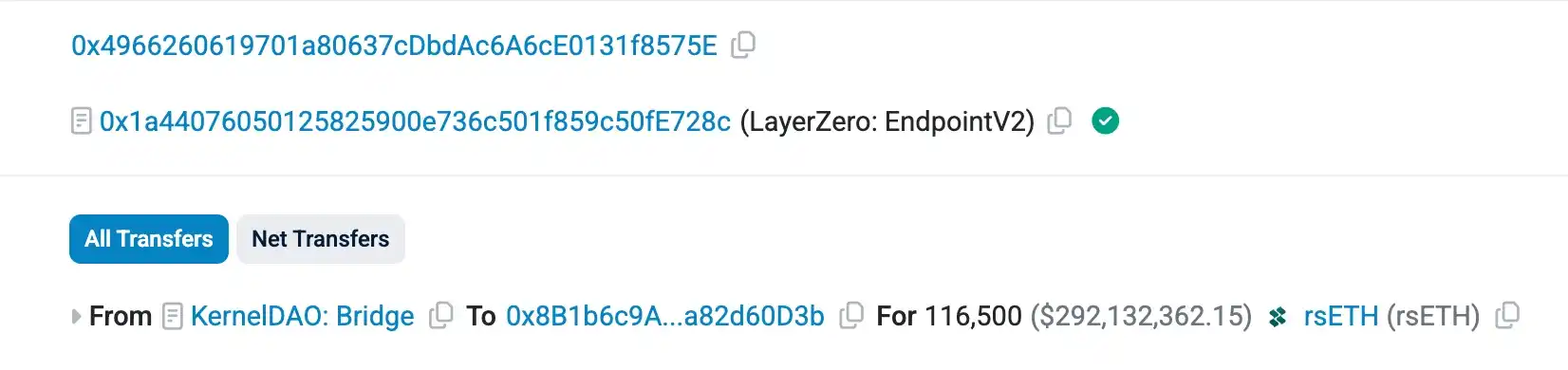
On-chain data shows that around 1:35 this morning, the rsETH bridge contract of Kelp DAO, the second-largest liquid staking protocol, based on LayerZero, was suspected to be exploited by hackers, resulting in a loss of 116,500 rsETH, valued at approximately $292 million.

Further tracing the on-chain records, the attacker's address received 1 ETH in initial funds from the mixing protocol Tornado Cash about 10 hours before the incident. Subsequently, this address called the lzReceive function on the LayerZero EndpointV2 contract. This call triggered Kelp's bridge contract, transferring 116,500 rsETH to another attacker address.
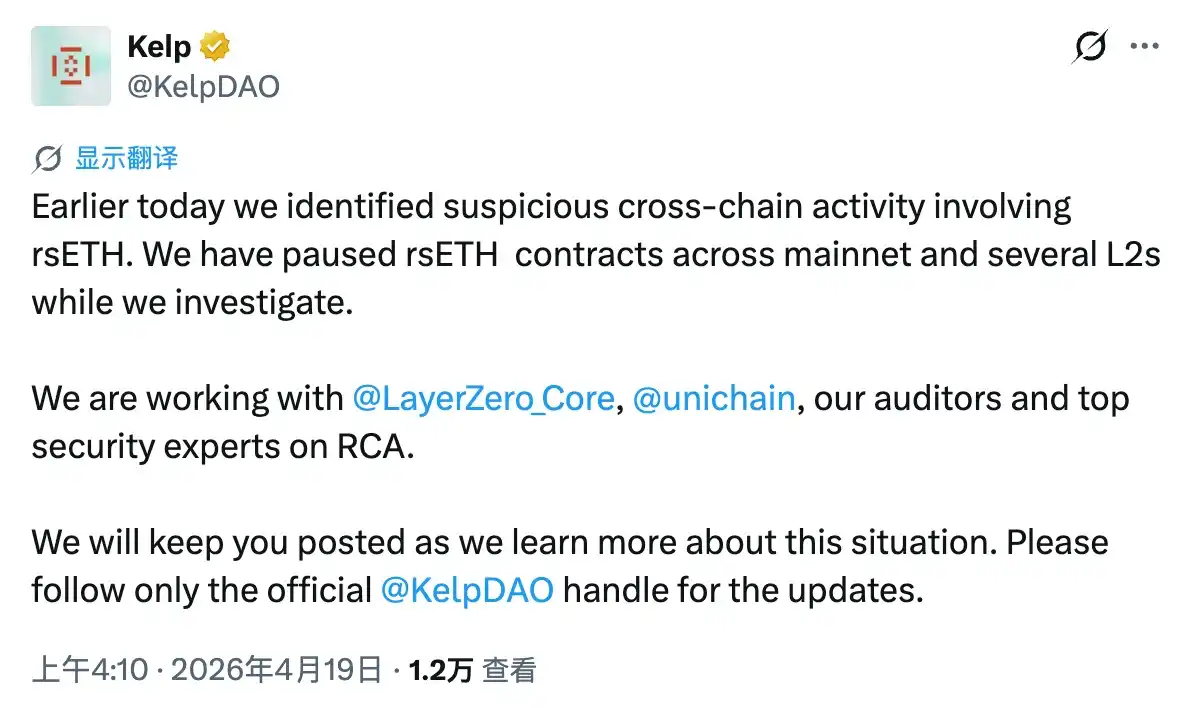
Approximately 2.5 hours after the incident, Kelp DAO officially confirmed the attack on X: "Earlier today, we detected suspicious cross-chain activity involving rsETH. During the investigation, we have suspended the rsETH contracts on the mainnet and multiple Layer 2s. Our auditors are working with security experts from LayerZero and Unichain to closely monitor the situation. We will keep you updated on the latest developments. Please follow official channels."
After the incident, various DeFi projects and security agencies analyzed the cause. An analysis by D2 Finance was frequently cited within the community — LayerZero Scan marked the source's counterpart as Kelp DAO, meaning the message came from a legitimately deployed counterpart contract by Kelp itself, and this path had previously recorded 308 message nonces. Therefore, the root cause of this attack is a 'compromise of the source chain private key.'

Steven Enamakel, a developer at TinyHumans AI, added that the contract was secured by only a 1/1 validator set (DVN), meaning a single erroneous transaction from the validator was sufficient to cause the issue.

Hacker Escapes via Aave, Suspected Bad Debt Incurred

Due to the limited trading liquidity of rsETH itself, the hacker's chosen escape strategy was to route through lending protocols like Aave, using rsETH as collateral to borrow more liquid wETH.

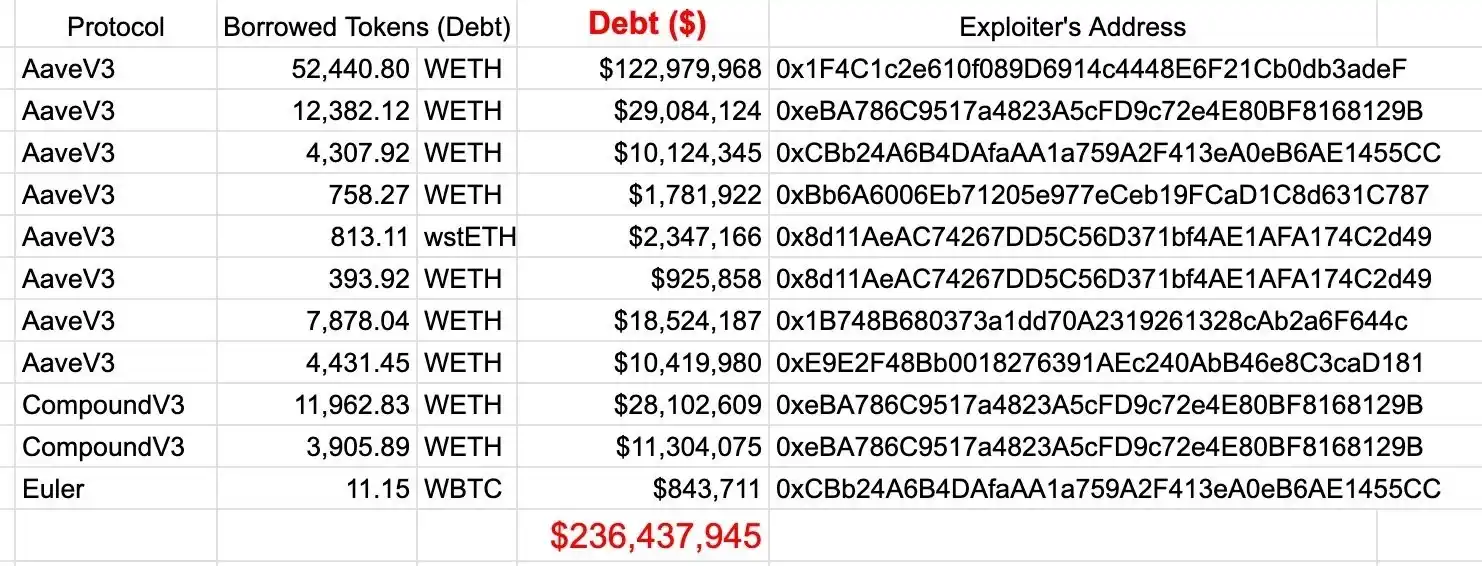
Monitoring by PeckShield Alert showed that as of 4:30 this morning, the hacker's address had deposited the stolen rsETH into lending protocols including Aave V3, Compound V3, and Euler, borrowing a large amount of WETH, with a total debt exceeding $236 million — of which Aave alone accounted for $196 million, Compound $39.4 million, and Euler only $840,000.
Following the incident, Aave promptly froze the rsETH market on Aave V3 and V4. The team subsequently issued an official statement on X: "Aave's contracts were not attacked; this attack is related to rsETH. Freezing rsETH is to prevent new rsETH deposits and collateral borrowing while the situation is assessed. We are reviewing the rsETH borrowing information on Aave that occurred after the attack and will share more details as soon as possible."

Shortly after the initial statement, Aave updated the post, adding: "If the protocol accumulates bad debt due to this incident, we will explore avenues to cover the deficit."

As of writing, the specific amount of bad debt caused by this incident is still unclear.

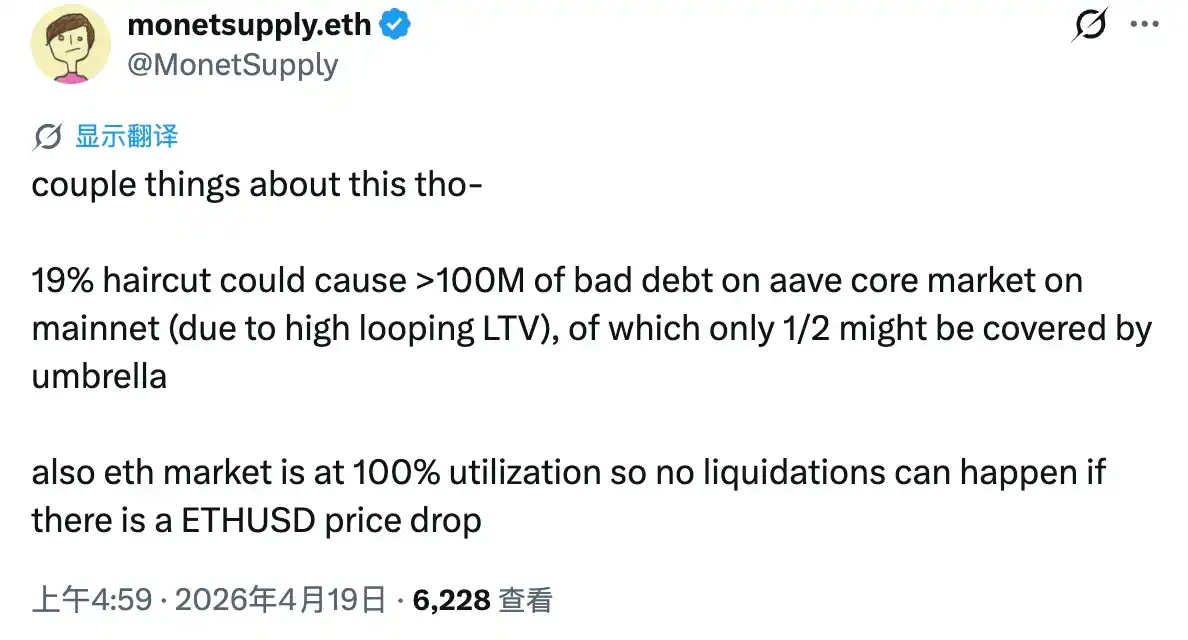
monetsupply.eth, Head of Strategy at Aave's direct competitor Spark, stated that if rsETH experiences a 19% discount (the stolen amount represents 19% of the total rsETH supply), Aave could potentially incur over $100 million in bad debt due to highly leveraged recursive borrowing.
However, Marc Zeller, founder of the representative Aave governance team Aave Chan Initiative (ACI) (who has announced he will leave Aave in July due to governance disagreements), offered a different perspective. Zeller initially advised users to quickly withdraw WETH from Aave V3 to avoid losses and confirmed that the USDC and USDT markets on Aave were unaffected. In response to another user's speculation that 'bad debt could reach hundreds of millions,' he stated: 'Far less than that figure.'
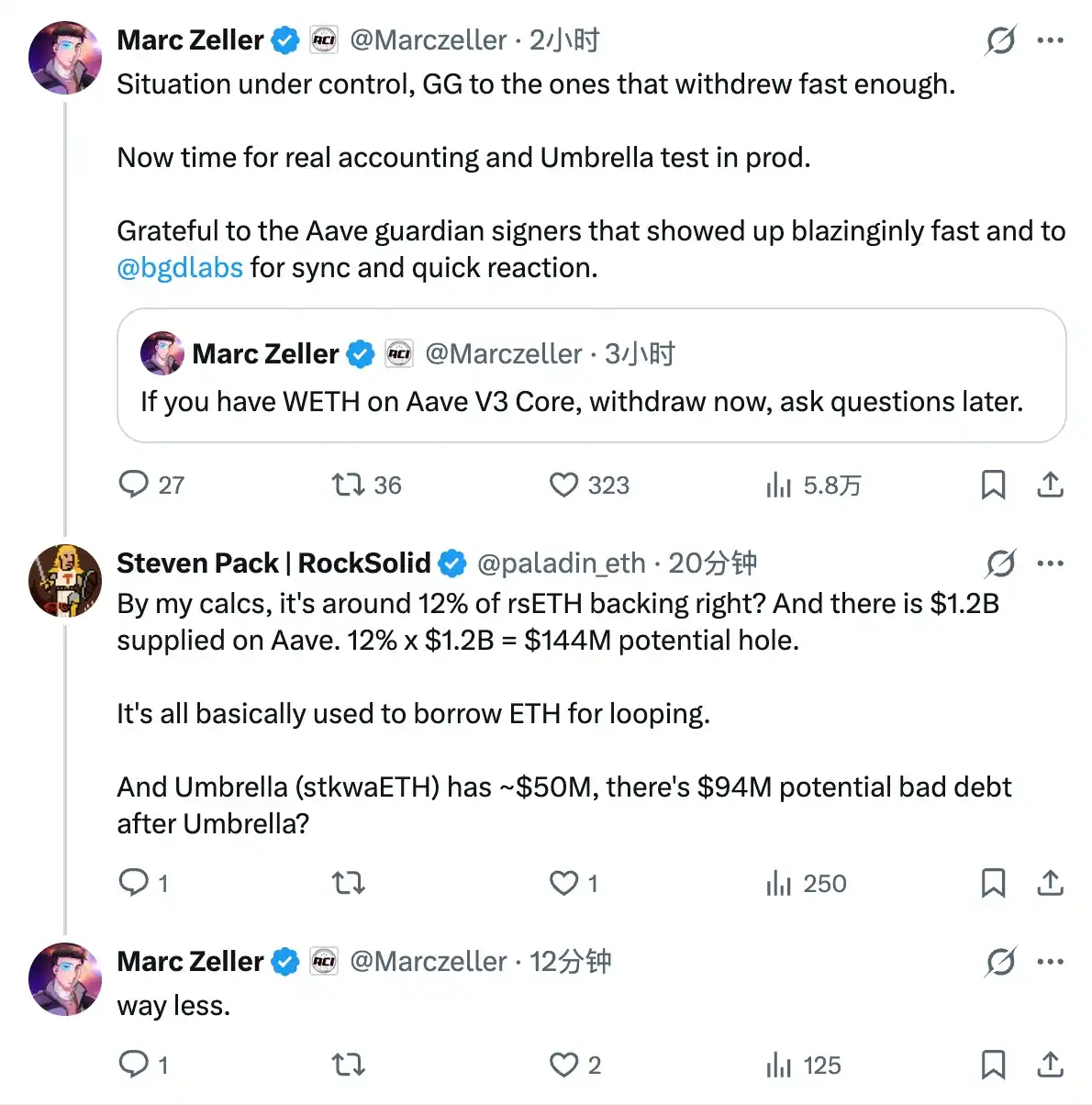
But Marc Zeller also mentioned that it was time to test Umbrella in a real production environment. Umbrella refers to Aave's automatic security module, essentially a pool of funds to handle bad debt. Users can deposit assets into it for higher incentives, but the pool also bears potential losses if the protocol incurs bad debt.

Aave protocol data shows that Umbrella currently holds approximately $50 million worth of WETH that could be used to address potential bad debt from this incident, but it is uncertain whether this will be sufficient to cover the shortfall.

Affected by this event, AAVE's price fell sharply by nearly 10%, trading at around 104.6 USDT at the time of writing.

Another Hundred-Million-Dollar Security Incident in April

This is not the first major security incident this month.

As early as April 1st, the Solana生态衍生品交易协议 Drift Protocol was attacked, losing up to $280 million (see 《April Fool's Joke? Drift Protocol Hacked for Over $280 Million, Possibly Becoming Solana's Second-Largest DeFi Heist》).

Afterwards, Drift Protocol directly blamed the hack on "North Korean hackers," but fortunately, institutions like Tether pledged $147.5 million for user compensation, giving users some hope for reimbursement.

Just over ten days later, another, larger hack occurred. How will this one be resolved?

Is There Any Safe Place Left in DeFi?

Security issues in DeFi are intensifying.

On one hand, there are continuous hacking incidents; on the other, there are persistent security threats posed by AI like Mythos (refer to 《Odaily Interview with Yu Xian: How Does the Leak of Anthropic's Nuclear-Grade New Model Affect Crypto Security Offense and Defense?》). For DeFi users, the previous countermeasure was to concentrate funds towards well-audited, reputable top-tier protocols. But now, even top-tier protocols like Aave, which retail users subconsciously considered extremely unlikely to have problems, are indirectly affected. Where can users move their funds?

Personally, it is currently not advisable for users to keep large amounts of funds on-chain. If there is a genuine need, please ensure proper diversification and isolation of positions.

As of writing, many details regarding this incident remain unclear. Odaily will continue to follow the developments. Please stay tuned.


İlgili Sorular

QWhat was the total value of rsETH stolen in the Kelp DAO attack?

AThe attack resulted in the loss of 116,500 rsETH, valued at approximately $292 million.

QWhich lending protocol did the hacker use to borrow WETH using the stolen rsETH as collateral?

AThe hacker used Aave V3, Compound V3, and Euler to borrow WETH, with Aave V3 accounting for the largest debt of $196 million.

QWhat was the suspected root cause of the Kelp DAO bridge contract exploit according to D2 Finance's analysis?

AThe root cause was identified as a compromise of the source chain private key, allowing the attacker to send a malicious message from a legitimate Kelp DAO endpoint contract.

QWhat mechanism does Aave have to cover potential bad debt from this incident, and how much capital is currently available in it?

AAave has an automatic security module called Umbrella, which currently holds about $50 million in WETH to cover potential bad debt, though it's uncertain if this will be sufficient.

QHow did Aave respond immediately after the attack was discovered?

AAave froze the rsETH markets on Aave V3 and V4 to prevent new deposits and collateralized borrowing, and announced they were assessing the situation and exploring ways to cover any resulting bad debt.

İlgili Okumalar

The King of Blind Date Attire in Korea: How SK Hynix Made a Comeback Against Samsung?

In South Korea's dating scene, SK Hynix employees are now highly sought after, a status shift fueled by the company's astronomical profits and employee bonuses, projected to reach up to 6.1 million RMB per person by 2027. This marks a dramatic reversal for the long-time second-place player in memory semiconductors, which has now surpassed its rival Samsung in annual operating profit. The turnaround story began in 2008 when a struggling Hynix, emerging from bankruptcy restructuring, took a risky bet by agreeing to develop High Bandwidth Memory (HBM) with AMD. At the time, HBM had no clear market beyond high-end graphics cards and was a costly, complex technology. Major players like Samsung, pursuing its own HMC technology, declined. For Hynix, with only memory as its core business, it was a gamble born of necessity. The pivotal moment came in 2012 when SK Group Chairman Chey Tae-won acquired Hynix. Defying industry downturns, he invested heavily in R&D and fabrication, sustaining the HBM project through over a decade of commercial uncertainty and internal challenges. A key break occurred around 2016-2017 when Samsung faced production issues supplying HBM2 for Google's TPU, allowing SK Hynix to gain a crucial foothold in the data center market. The AI explosion post-ChatGPT in 2022 was the catalyst, turning HBM into a critical bottleneck for AI accelerators like NVIDIA's GPUs. By 2025, SK Hynix captured 62% of the global HBM market, leaving Samsung at 17%. For the first time, its annual operating profit exceeded Samsung's. Analysts point to the "innovator's dilemma" to explain Samsung's miss: its vast, successful business portfolio made it risk-averse, preventing an all-in bet on the initially niche HBM technology. In contrast, SK Hynix, as a challenger with its back against the wall, had no choice but to commit fully. The story highlights how Korea's chaebol system allows for ultra-long-term bets beyond quarterly pressures. However, SK Hynix's lead isn't guaranteed. Samsung is aggressively catching up on HBM4, and challenges like customer concentration (heavy reliance on NVIDIA) and technical hurdles in advanced packaging remain. The narrative underscores a market truth: the greatest alpha often comes from betting on uncertain, long-term directions others dismiss, much like HBM in 2008.

marsbit20 dk önce

The King of Blind Date Attire in Korea: How SK Hynix Made a Comeback Against Samsung?

marsbit20 dk önce

Understanding Hash in One Article: The "Browser Miner" on Ethereum

Hash is an Ethereum-based ERC-20 token described as a "browser-minable post-quantum token." Its key features include enabling browser-based GPU mining without specialized hardware, a fixed supply cap of 21 million tokens, immutable and permissionless smart contracts with no team allocation or pre-mining, and an emphasis on post-quantum security using Keccak256 hashing. The mining mechanism is a simplified on-chain proof-of-work where miners solve unique challenges tied to their wallet address. Key design elements prevent answer theft, with epochs resetting every 100 blocks (~20 minutes) and a per-block minting limit. Emission follows a Bitcoin-like halving schedule every 100,000 mints, starting at 100 tokens per mint. Projections suggest all tokens could be mined within approximately 294 days if a target rate of one mint per minute is sustained. Hash emphasizes "post-quantum" security by leveraging hash-based primitives like Keccak256, which are considered more resistant to quantum attacks compared to elliptic-curve cryptography. While not a fully post-quantum asset, it aligns with Ethereum's broader post-quantum research narrative. The project completed its Genesis sale at $0.03 and began trading on Uniswap, with its price reaching around $0.19. The initial circulating supply is small, with 5% sold in Genesis and 5% allocated to liquidity. The majority (47.6% of total supply) is allocated to early-stage mining, leading to a front-loaded emission schedule. This structure, combined with low initial liquidity, makes Hash a high-volatility, high-risk project dependent on sustained miner participation and market demand to absorb new supply.

marsbit33 dk önce

Understanding Hash in One Article: The "Browser Miner" on Ethereum

marsbit33 dk önce

OpenAI's Largest Internal Wealth Creation: 600 People Cash Out a Total of $6.6 Billion, 75 Take Home the Maximum $30 Million Each

A Wall Street Journal report reveals OpenAI's unprecedented pre-IPO wealth creation. In a single employee stock sale last October, over 600 current and former employees sold shares, collectively cashing out approximately $6.6 billion. Due to high investor demand, the company tripled the individual sale cap to $30 million, with about 75 employees selling the maximum amount. This event represents the largest such transaction in tech industry history for a private company. OpenAI's valuation was $500 billion for this tender offer. Employees with over two years of tenure were eligible, allowing many post-ChatGPT hires their first liquidity event. The company's stock has reportedly grown over 100-fold in seven years. Following a restructuring, employees collectively hold about 26% of OpenAI. The scale of executive wealth is also staggering. In court testimony related to Elon Musk's lawsuit, President and co-founder Greg Brockman confirmed his OpenAI stake is worth around $30 billion. Analysis indicates about 165 current and former employees hold a combined ~$164.9 billion in equity, averaging nearly $1 billion per person in paper wealth. OpenAI's per-employee stock-based compensation is estimated to be 34 times the average of major tech firms before their IPOs. OpenAI continues its rapid ascent, closing a $122 billion funding round at an $852 billion valuation in March. With monthly revenue hitting $2 billion, over 900 million weekly ChatGPT users, and plans for a potential trillion-dollar IPO in late 2026, this wealth-creation engine shows no signs of stopping.

链捕手56 dk önce

OpenAI's Largest Internal Wealth Creation: 600 People Cash Out a Total of $6.6 Billion, 75 Take Home the Maximum $30 Million Each

链捕手56 dk önce

İşlemler

Spot
Futures
活动图片




