Cardano Foundation Reaches First Milestone In New Governance Roadmap

bitcoinist2026-01-22 tarihinde yayınlandı2026-01-22 tarihinde güncellendi

Özet

Cardano Foundation has reached the first milestone in its updated governance roadmap by delegating an additional 220 million ADA to 11 community representatives (DReps) focused on Adoption and Operations. This brings the Foundation’s total delegation to community DReps to 360 million ADA. The move aims to decentralize governance by shifting voting power toward representatives with expertise in real-world adoption, business acumen, and network operations—not just technical development. The Foundation also announced it will self-delegate its remaining 171 million ADA stake instead of leaving it passive, reducing its overall voting power by 43 million ADA. The delegations were made without conditions or voting instructions, emphasizing trust in the DReps' decision-making and encouraging healthy dissent as a feature of decentralized governance.

The Cardano Foundation said it has hit the first milestone in its updated governance roadmap, expanding delegation to a new set of community representatives as the ecosystem leans further into on-chain decision-making. The move matters because it shifts meaningful voting weight toward delegated representatives (DReps) whose mandates emphasize adoption and day-to-day network operations rather than purely technical development.

Cardano Foundation Expands DRep Delegation

In a post on X and an accompanying blog update, the Foundation said it has delegated an additional 220 million ADA to 11 selected DReps, roughly 20 million ADA each, focused on the pillars of Adoption and Operations. The Foundation framed the step as a continuation of earlier delegations to “Developer & Builder DReps,” and said the new allocation brings total delegation to community DReps to 360 million ADA.

Alongside the additional community delegation, the Foundation said it is revising how it handles its remaining stake in governance. “Rather than leaving a portion of our funds on auto-abstain as initially planned, we will self-delegate the remaining balance (approximately 171 million ADA),” the Foundation wrote. “While this exceeds our initial estimate, it ensures no ADA remains passive and still results in a net reduction of our overall voting power by approximately 43 million ADA, with the clear majority of our holdings now empowering community DReps.”

The Foundation emphasized that the delegations are intended to distribute voting power without imposing direction. “This delegation is not a blind bet, rather it’s a show of trust in a proven history of sound decision-making,” it said. “As always, it’s also a show of good faith: These new delegations come without any expectation regarding voting outcomes. We will not direct these DReps on how to vote, nor will we provide a voting manual.”

That posture, explicitly accepting dissent from its own views, was positioned as a feature rather than a risk. The Foundation said it expects “differing opinions” between the newly selected DReps and the Foundation itself, describing that divergence as evidence of “a healthy, decentralized governance system.”

The Foundation’s rationale for targeting adoption and operations reads as a governance design choice: broaden the expertise mix beyond protocol engineering. “To build a resilient governance system, we need more than just technical expertise—We need business acumen and operational stability,” it wrote, arguing that Adoption DReps can represent real-world utility, onboarding, and enterprise needs, while Operations DReps reflect the practical constraints faced by stake pool operators, toolmakers, and infrastructure providers.

In the published list, the Adoption cohort includes figures tied to community growth and product-building across the ecosystem, from regional community leadership to DeFi and stablecoin infrastructure, while the Operations cohort highlights long-running infrastructure roles such as block explorer analytics, stake pool operations, and SPO tooling.

The Foundation said all eleven delegations were completed in a single on-chain transaction, linking to the Cardano Explorer entry, and noted the delegations are effective immediately. It also encouraged the broader community to “follow and interact with these DReps,” including engaging with their voting rationales and participating in governance actions.

At press time, Cardano traded at $0.3549.
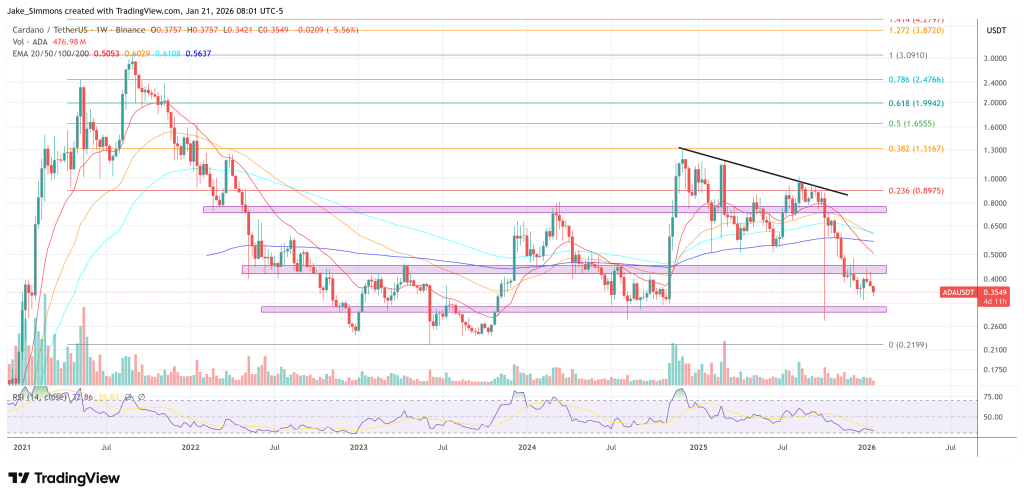
Cardano hovers below key resistance, 1-week chart | Source: ADAUSDT on TradingView.com

Trend Kriptolar

İlgili Sorular

QWhat is the first milestone achieved by the Cardano Foundation in its updated governance roadmap?

AThe Cardano Foundation has expanded delegation to a new set of community representatives (DReps) focused on Adoption and Operations, shifting meaningful voting weight towards them.

QHow much ADA was delegated to the 11 selected DReps, and what was the focus of these DReps?

AThe Foundation delegated an additional 220 million ADA, roughly 20 million ADA each, to 11 DReps focused on the pillars of Adoption and Operations.

QWhat change did the Foundation make regarding its remaining stake in governance, and what was the result?

ARather than leaving a portion of funds on auto-abstain, the Foundation self-delegated its remaining balance of approximately 171 million ADA, resulting in a net reduction of its overall voting power by about 43 million ADA.

QHow does the Foundation view differing opinions between itself and the newly selected DReps?

AThe Foundation views differing opinions as evidence of a healthy, decentralized governance system, considering it a feature rather than a risk.

QWhat rationale did the Foundation provide for targeting Adoption and Operations DReps specifically?

AThe Foundation stated that building a resilient governance system requires more than technical expertise; it needs business acumen and operational stability, with Adoption DReps representing real-world utility and enterprise needs, and Operations DReps reflecting practical constraints of stake pool operators and infrastructure providers.

İlgili Okumalar

NVIDIA CPU Advances, China's RISC-V Responds: Semiconductor Deep Dive - Part Four

NVIDIA is set to launch its new Vera AI data center CPU in China as early as August, with high pricing. While this move offers a new option, it highlights China's continued dependence on foreign-controlled Arm architecture. In response, the Chinese semiconductor industry is increasingly turning to RISC-V as a strategic alternative for achieving high-performance computing autonomy. The article explores the concept of the "impossible triangle" in CPU development—balancing prosperity, control, and autonomy—and posits that RISC-V's open-source, modular nature offers a unique path to achieving all three. While RISC-V is already dominant in embedded systems, the focus is now shifting to data centers and AI workloads. China has become a global hotspot for RISC-V development, driven by AI-driven compute demand, supply chain concerns from export controls, cost benefits of open-source, and strong policy support. Multiple Chinese companies have reportedly crossed the key performance threshold of 15 SPECint per GHz, a benchmark for entering the high-performance CPU club. Progress extends beyond single-core benchmarks. Companies are developing complete computing subsystems, including commercial-grade coherent network-on-chip (NoC) technology and server processors with up to 40 cores that strictly adhere to the RVA23 standard to ensure software compatibility. Real-world applications are emerging in areas like video transcoding and edge AI. However, significant challenges remain. The RISC-V ecosystem faces fragmentation, immature toolchains and verification processes, and gaps in single-core performance and energy efficiency compared to mature x86 and Arm architectures. The formidable software moat, epitomized by NVIDIA's CUDA, is a long-term hurdle. In conclusion, while RISC-V cannot immediately replace offerings like NVIDIA's Vera, it represents a viable long-term path for China to develop a self-sufficient, high-performance CPU ecosystem. The journey is acknowledged to be long and arduous, requiring sustained effort to overcome technical and ecosystem challenges.

marsbit5 saat önce

NVIDIA CPU Advances, China's RISC-V Responds: Semiconductor Deep Dive - Part Four

marsbit5 saat önce

My Coding Betting Dashboard is Profiting, but Polymarket is Truly Not a Good Place for 'Arbitrage'

The author built a custom monitoring dashboard for Polymarket, a prediction market platform, and tested it with $1,600, achieving over 30% returns. However, the core argument is that Polymarket is not a good venue for traditional arbitrage. The dashboard has two main sections: a "Portfolio Dashboard" for tracking active positions with key metrics like total capital, P&L, and a risk-control module using a tier system (T1, T2, T3), and an "Opportunity Watchlist" for monitoring markets. The article details a critical structural trap in binary markets: a bet with a high perceived probability of success still carries a 100% loss risk if wrong. The author's T1/T2/T3 system is designed to manage this by limiting position sizes based on conviction and time horizon, emphasizing that high confidence should not equal high concentration. A key insight is the danger of "pseudo-diversification"—betting on different markets driven by the same underlying variable. The author concludes that Polymarket offers few true low-risk, arbitrage opportunities. It is instead a high-risk environment where wins can create a false sense of mastery, leading to large losses. The platform is better viewed as a training ground for honing judgment through disciplined, framework-driven betting rather than a reliable income source. The tools help transform intuition into structured, rule-based decisions to mitigate the risk of catastrophic errors.

marsbit8 saat önce

My Coding Betting Dashboard is Profiting, but Polymarket is Truly Not a Good Place for 'Arbitrage'

marsbit8 saat önce

WeChat AI Card Hands-On Guide: Has the AI Shopping Era Arrived?

**"WeChat AI Card" Practical Test Guide: Has the Era of AI Shopping Arrived?** WeChat has officially launched the "AI Exclusive Card," a feature integrated into its Workbuddy AI assistant. This card is designed to handle payments for AI-initiated purchases. Our hands-on test reveals it's not yet a tool for fully autonomous AI shopping, but rather a controlled payment layer for AI agents. The AI Card functions as an isolated sub-wallet within WeChat Pay. Users must bind the card and transfer funds into it from their main wallet. Crucially, every transaction requires explicit user confirmation via smartphone scan; AI cannot spend autonomously. Currently accessible through the Workbuddy agent, the card targets specific digital consumption scenarios: purchasing paid content (reports, data), calling paid APIs/tools, and subscribing to services. Its design prioritizes security and control by separating funds and mandating approval for each payment. We tested a real-world scenario: ordering bubble tea via Workbuddy using a "Meituan Life Assistant" skill. The process encountered multiple hurdles: high "skill" usage costs (exceeding daily free credits), and most importantly, while a payment was successfully initiated, the AI purchased an incorrect product (a mismatched group-buy coupon instead of the desired drink). This highlights the current limitation: the **AI Card only solves the payment step**. The broader challenge lies in the **AI agent's execution chain**—accurately understanding intent, navigating third-party platforms, selecting the right product, and ensuring proper fulfillment. The payment succeeded, but the purchase failed to meet the user's need. In conclusion, the WeChat AI Exclusive Card is a cautious, early-step experiment in AI commerce. It provides a secure, user-controlled payment method for agent interactions but is not yet capable of reliable, end-to-end complex purchases. For now, it's best used for low-value, low-risk digital services with careful user verification at each step. The vision of AI handling complete shopping tasks remains a work in progress.

marsbit10 saat önce

WeChat AI Card Hands-On Guide: Has the AI Shopping Era Arrived?

marsbit10 saat önce

İşlemler

Spot
Futures

Popüler Makaleler

ADA Nasıl Satın Alınır

HTX.com’a hoş geldiniz! Cardano (ADA) satın alma işlemlerini basit ve kullanışlı bir hâle getirdik. Adım adım açıkladığımız rehberimizi takip ederek kripto yolculuğunuza başlayın. 1. Adım: HTX Hesabınızı OluşturunHTX'te ücretsiz bir hesap açmak için e-posta adresinizi veya telefon numaranızı kullanın. Sorunsuzca kaydolun ve tüm özelliklerin kilidini açın. Hesabımı Aç2. Adım: Kripto Satın Al Bölümüne Gidin ve Ödeme Yönteminizi SeçinKredi/Banka Kartı: Visa veya Mastercard'ınızı kullanarak anında Cardano (ADA) satın alın.Bakiye: Sorunsuz bir şekilde işlem yapmak için HTX hesap bakiyenizdeki fonları kullanın.Üçüncü Taraflar: Kullanımı kolaylaştırmak için Google Pay ve Apple Pay gibi popüler ödeme yöntemlerini ekledik.P2P: HTX'teki diğer kullanıcılarla doğrudan işlem yapın.Borsa Dışı (OTC): Yatırımcılar için kişiye özel hizmetler ve rekabetçi döviz kurları sunuyoruz.3. Adım: Cardano (ADA) Varlıklarınızı SaklayınCardano (ADA) satın aldıktan sonra HTX hesabınızda saklayın. Alternatif olarak, blok zinciri transferi yoluyla başka bir yere gönderebilir veya diğer kripto para birimlerini takas etmek için kullanabilirsiniz.4. Adım: Cardano (ADA) Varlıklarınızla İşlem YapınHTX'in spot piyasasında Cardano (ADA) ile kolayca işlemler yapın.Hesabınıza erişin, işlem çiftinizi seçin, işlemlerinizi gerçekleştirin ve gerçek zamanlı olarak izleyin. Hem yeni başlayanlar hem de deneyimli yatırımcılar için kullanıcı dostu bir deneyim sunuyoruz.

1.4k Toplam GörüntülenmeYayınlanma 2024.12.10Güncellenme 2026.06.02

ADA Nasıl Satın Alınır

Tartışmalar

HTX Topluluğuna hoş geldiniz. Burada, en son platform gelişmeleri hakkında bilgi sahibi olabilir ve profesyonel piyasa görüşlerine erişebilirsiniz. Kullanıcıların ADA (ADA) fiyatı hakkındaki görüşleri aşağıda sunulmaktadır.

活动图片