Author: Heechang Kang, Four Pillars CSO
Compiled by: Jiahuan, ChainCatcher
This analysis is based on Allium's geographic payment data, covering $15.2 billion in on-chain transfers with identified sending and receiving countries. Since most on-chain transactions currently cannot be attributed to specific countries, this data only reflects the identified sample.
Among the $15.2 billion in identifiable stablecoin transaction volume, domestic transfers account for 62.6%; of the total identifiable transaction volume, 73.0% of the funds ultimately flow back to the sender's region. Therefore, cross-border remittances are actually only part of the current demand for stablecoins.
The Asia-Pacific region is leading, accounting for 41.0% of total outgoing transaction volume and 41.6% of global domestic transaction volume, while also showing net inflows, particularly evident in Indonesia, Singapore, and South Korea.
For institutions evaluating stablecoin payment demand, domestic settlement services and cross-border payment corridors in the Asia-Pacific region are currently the most noteworthy market opportunities.
1. Stablecoin Transactions Are Primarily a 'Domestic Business'
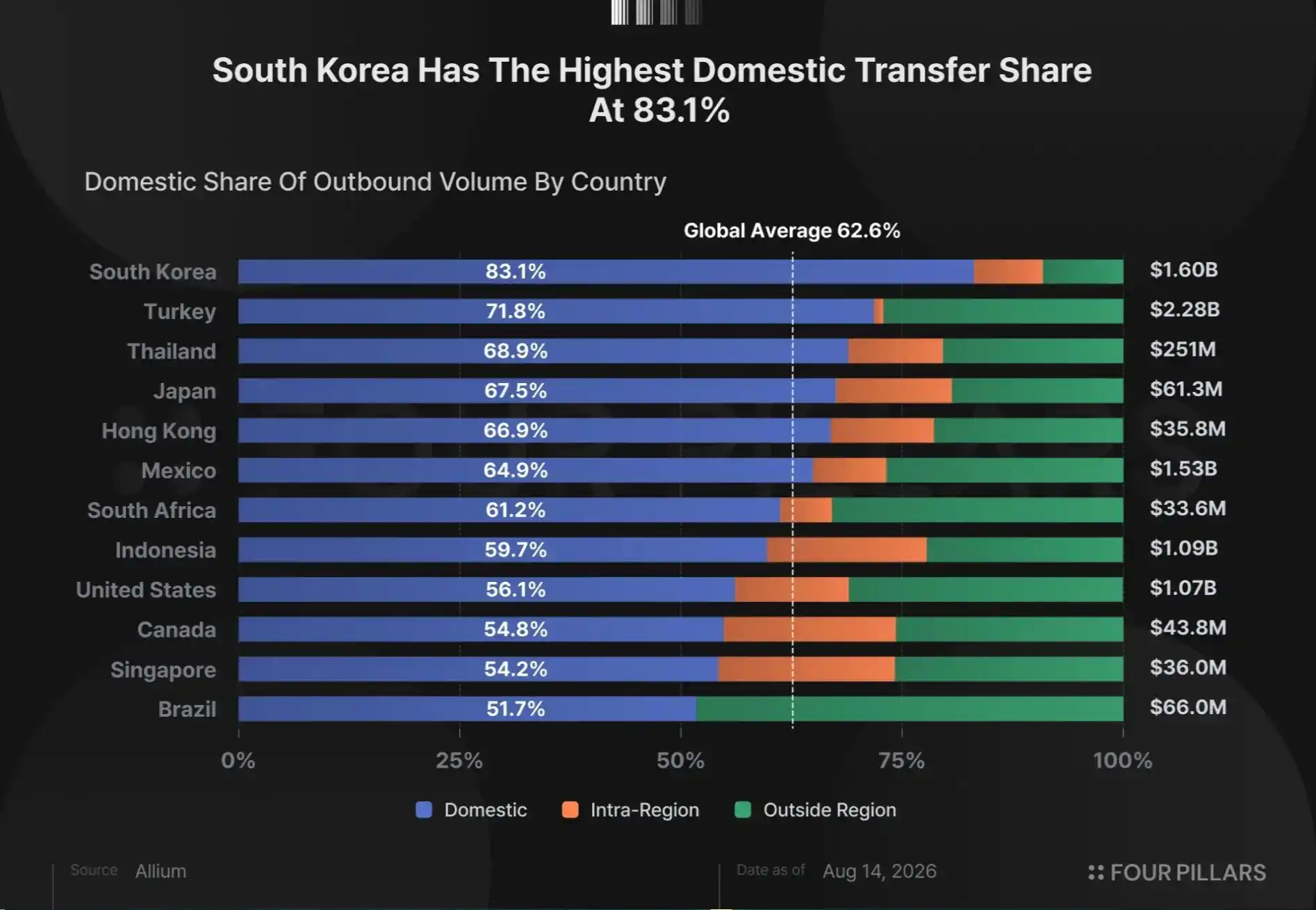
Domestic transfers, i.e., transfers between wallets located in the same country, amount to $9.5 billion, representing 62.6% of the $15.2 billion identifiable transaction volume.
Regardless of region or market size, in most markets with capital outflow activity, domestic transfers are the largest destination for funds.
Turkey ($2.28 billion), South Korea ($1.6 billion), Mexico ($1.53 billion), Indonesia ($1.09 billion), and the United States ($1.07 billion) collectively contribute 79.5% of global domestic stablecoin transaction volume.
These transactions are completed directly between public chain wallets, bypassing card networks or traditional bank payment systems.
Such a large volume of domestic transactions indicates that users are utilizing stablecoins within their own markets for payments, trading, and USD-denominated savings. Therefore, cross-border remittances are only one part of stablecoin use cases.
For institutions designing stablecoin services, domestic payments and settlements currently correspond to a larger actual transaction volume compared to developing products solely focused on cross-border remittances.
2. Post-Cross-Border, Funds Also Tend to Stay Within the Region
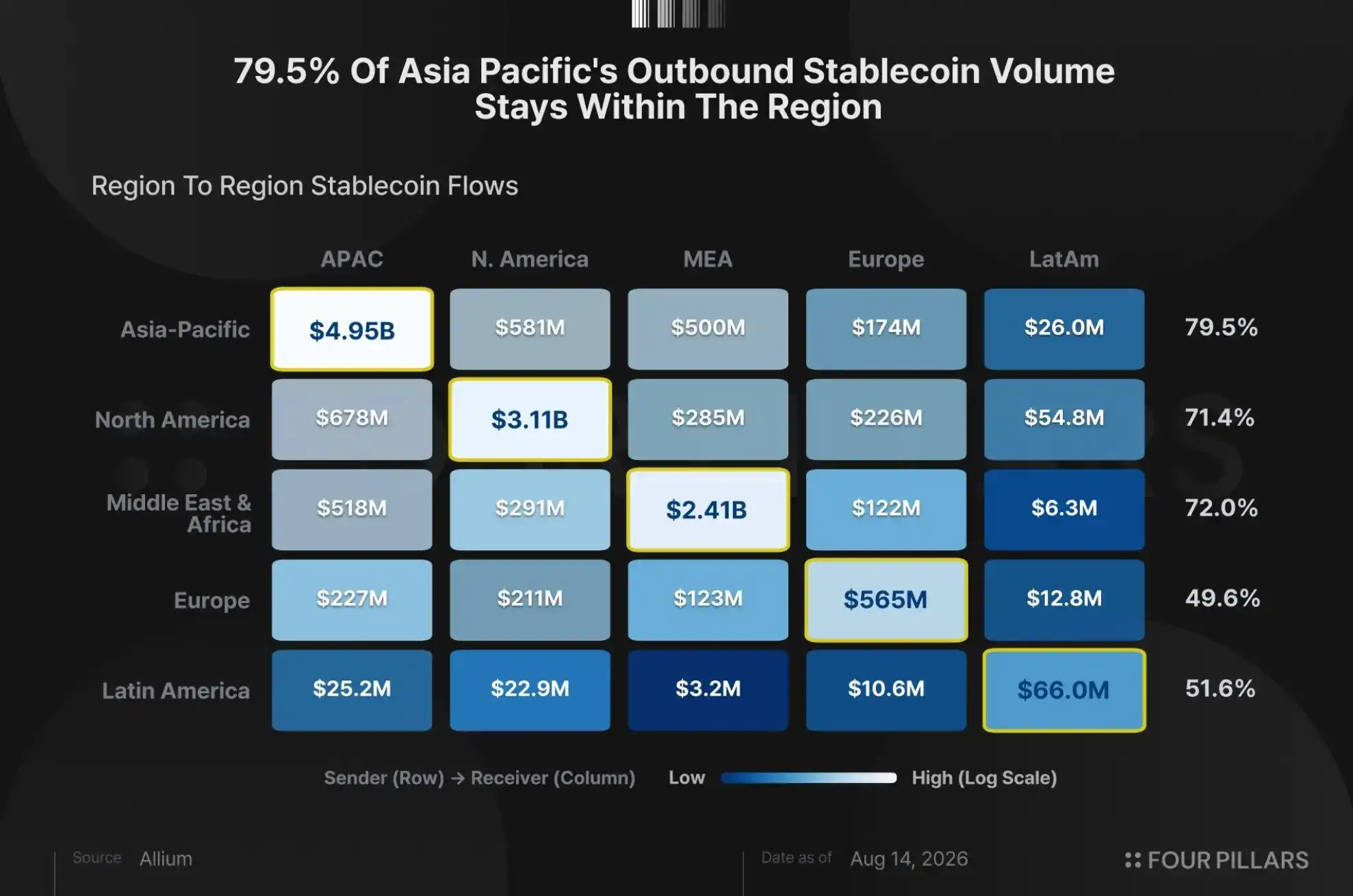
If domestic transfers are included, 73.0% of transaction volume occurs within the sender's region, i.e., within the same continent.
Among these, the Asia-Pacific region retains 79.5% of funds within the region, the Middle East and Africa 72.0%, North America 71.4%, and Europe 49.6%.
Looking at fund flows between regions, transactions are clearly concentrated within regions, meaning most identifiable stablecoin transactions currently still occur within the sender's region.
If domestic transfers are excluded, within the $5.68 billion cross-border transaction volume, the intra-regional share drops to 27.8%.
Among these, the Asia-Pacific region's intra-regional share remains at 43.7%, i.e., $995 million of the $2.28 billion cross-border transactions. In comparison, North America is 27.0%, and the Middle East and Africa only 6.3%.
As the largest market in the Middle East and Africa, most of Turkey's cross-border stablecoin funds flow to Asia and the Americas.
Within the Asia-Pacific region, the transaction volumes from Taiwan to Indonesia ($138 million), Indonesia to Taiwan ($124 million), and Indonesia to South Korea ($89 million) are already quite substantial.
Existing transaction volumes provide a foundation for building regional stablecoin payment infrastructure in the Asia-Pacific region.
Indonesia, Taiwan, South Korea, Australia, and Thailand collectively participate in approximately $1 billion in intra-regional cross-border transactions, while also generating $3.96 billion in domestic transaction volume.
Institutions can prioritize which cross-border payment corridors to develop based on these existing flows and bilateral demands.
For institutions planning to build regional payment infrastructure, cross-border payment corridors such as Taiwan to Indonesia and Indonesia to South Korea have already formed quantifiable bilateral demand, providing a market foundation for early investment.
Currently, the transaction volume for which Allium can identify both sending and receiving countries accounts for only 2.9% of all observed transaction volume. As more transactions' country information becomes identified, the rankings of these cross-border corridors may still change.
3. Asia-Pacific Has Become the Largest Stablecoin Transaction Market
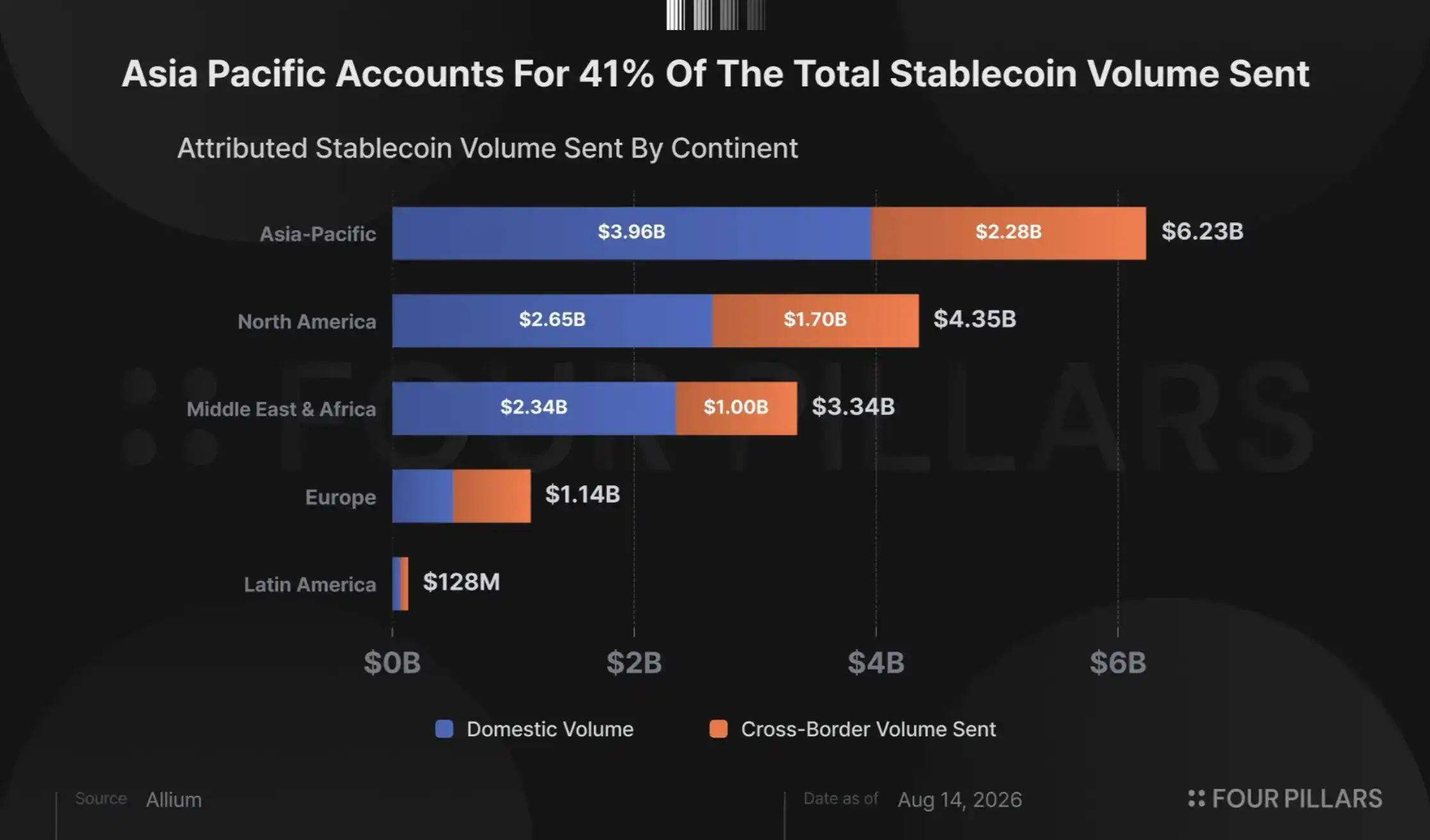
The Asia-Pacific region is the largest in this dataset, sending $6.23 billion in stablecoins, accounting for 41.0% of identifiable volume; receiving $6.4 billion, accounting for 42.1%.
In terms of outgoing transaction volume, the Asia-Pacific region is significantly higher than North America's 28.6%, the Middle East and Africa's 22.0%, Europe's 7.5%, and Latin America's 0.8%.
Simultaneously, the Asia-Pacific region also generated $3.96 billion in domestic transaction volume, equivalent to 41.6% of the global domestic stablecoin transaction total.
This concentration is similarly evident in major cross-border transactions. Among the world's 15 largest cross-border stablecoin payment corridors, 9 involve at least one Asia-Pacific market, and Indonesia alone appears in 6 of these corridors.
Turkey to Indonesia ($206 million) and United States to Mexico ($206 million) are the two largest single-direction cross-border payment corridors.
If combining transaction volumes in both directions, the bilateral volume between Indonesia and Turkey reaches $363 million, between Indonesia and Taiwan $262 million, and between South Korea and Turkey $190 million.
This data shows that substantial fund flows have already been established between Asian markets and markets with high stablecoin adoption rates outside Asia.
Net inflow data shows similar characteristics.
The Asia-Pacific region receives $167 million more funds than it sends, showing an overall net inflow; meanwhile, the United States recorded the largest net outflow in the sample.
Indonesia (+$111 million), Singapore (+$57.9 million), and South Korea (+$31.7 million) are among the markets with the largest net inflows in this sample.
Therefore, for institutions evaluating current stablecoin payment demand, the Asia-Pacific region simultaneously possesses the largest identifiable transaction volume, the highest domestic transaction volume, and positive stablecoin net inflows.