Bitwise Seeks to Acquire Chorus One to Dominate Institutional Staking as BMIC Momentum Builds

bitcoinist2026-02-04 tarihinde yayınlandı2026-02-04 tarihinde güncellendi

Özet

Bitwise, a major asset management firm, is reportedly seeking to acquire Chorus One, a leading European institutional staking provider, signaling a strategic move to dominate the crypto yield infrastructure. This acquisition highlights the growing institutional focus on staking as a key revenue stream. However, this consolidation raises concerns over centralization risks and vulnerabilities, such as potential "Harvest Now, Decrypt Later" quantum attacks. In response, projects like BMIC ($BMIC) are gaining attention for offering a quantum-secure finance stack designed to protect digital assets against future cryptographic threats. BMIC's presale has already raised significant funds, reflecting strong market interest in next-generation security solutions.

The institutional race to capture the crypto yield economy just entered a new, aggressive phase. Reports indicating that asset management giant Bitwise seeks to acquire Chorus One, a leading European institutional staking provider, signal a pivotal shift in market structure.

This isn’t merely about accumulation, it’s a battle for control of the infrastructure itself.

Bitwise (already a heavyweight in the ETF sector) appears to be positioning itself vertically within the crypto stack. By targeting Chorus One, which operates validators for over 60 networks and secures billions in assets, Bitwise is moving beyond simple asset exposure.

They’re aiming to capture the technical ‘yield layer’ of the blockchain ecosystem. Why? Because it validates the thesis that staking, not just trading, is where the next trillion dollars of institutional capital will flow.

With Bitcoin hovering near $76K and Ethereum dominance holding steady, the market appetite for yield-bearing infrastructure is insatiable. But let’s be honest: this consolidation of staking power brings new risks.

As centralized entities amass validator keys, the attack surface for bad actors grows. This centralization paradox is driving capital toward decentralized, next-generation security solutions that can protect assets even as the stakes get higher.

While the giants fight for today’s yields, forward-looking investors are positioning themselves in protocols like BMIC ($BMIC), which addresses the existential threat looming over all digital assets: quantum decryption.

Buy $BMIC here.

The Quantum Threat to Institutional Staking Infrastructure

The potential acquisition of Chorus One by Bitwise underscores a critical reality: digital assets are only as valuable as the cryptography securing them.

As institutions lock up billions in staking contracts, they become prime targets for ‘Harvest Now, Decrypt Later’ (HNDL) attacks. State actors and sophisticated syndicates are already hoarding encrypted data, waiting for quantum computing power to mature enough to shatter current encryption standards like RSA and ECC.

Here is where the narrative shifts from simple accumulation to survival. If the underlying cryptographic signatures of a validator are compromised, the entire stake is at risk. The industry is finally waking up to the fact that legacy wallets and staking mechanisms, regardless of who owns them, are built on math that has an expiration date.

BMIC ($BMIC) tackles this vulnerability head-on.

Unlike traditional wallets that merely store keys, BMIC offers a full quantum-secure finance stack. By integrating ERC-4337 smart accounts with proprietary post-quantum cryptography, the project ensures that user keys are never exposed during transactions or staking activities.

This creates a defensive moat that appeals to both retail users fearing wallet drains and enterprise players looking to future-proof their operations against the inevitability of quantum computing.

Learn more about BMIC here.

BMIC Offers ‘Harvest Now, Decrypt Later’ Protection as Presale Surges

While Bitwise focuses on aggregating current market share, BMIC is engineering the safety rails for the next decade of crypto. The project’s unique value proposition centers on eliminating public key exposure, the primary vector for both current phishing attacks and future quantum breaks.

Through its Quantum Meta-Cloud and AI-enhanced threat detection, the platform creates an ecosystem where users can transact, stake, and govern without the perpetual anxiety of private key management.

The market has responded sharply to this utility. The BMIC presale has already raised over $432K so far, a figure that suggests a significant appetite for security-first infrastructure. With tokens currently priced at $0.049474, early participants are betting on the transition from legacy wallets to quantum-resistant architectures.
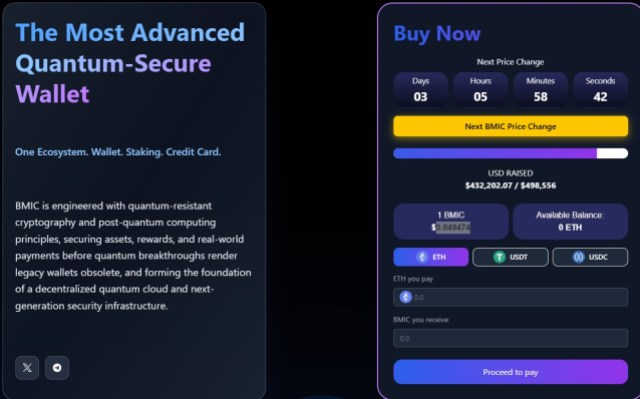
What distinguishes BMIC from standard wallet providers is its recognition of the ‘burn-to-compute’ economy and governance utility. It isn’t just a storage solution; it’s ecosystem fuel designed to power a secure, decentralized computing layer.

As the industry watches giants like Bitwise consolidate the staking layer, the smart money is hedging against the technical debt of that very infrastructure by backing the only platform built to withstand the post-quantum era.

Visit the BMIC presale page.

Disclaimer This article is for informational purposes only and does not constitute financial advice. Cryptocurrency investments carry high risks, including total loss of capital. Always conduct your own due diligence.


Trend Kriptolar

İlgili Sorular

QWhat is the main strategic move by Bitwise discussed in the article, and what is its significance?

AThe article discusses Bitwise's move to acquire Chorus One, a leading European institutional staking provider. This signifies a pivotal shift in market structure, representing a vertical integration into the crypto stack and a battle for control of the yield infrastructure itself, not just asset accumulation.

QAccording to the article, what is the 'Quantum Threat' to institutional staking infrastructure?

AThe 'Quantum Threat' refers to 'Harvest Now, Decrypt Later' (HNDL) attacks, where state actors or sophisticated syndicates hoard encrypted data, waiting for quantum computing to mature enough to break current encryption standards like RSA and ECC, thereby compromising validator signatures and putting entire stakes at risk.

QHow does the BMIC ($BMIC) protocol claim to address the vulnerabilities of traditional staking and wallets?

ABMIC offers a full quantum-secure finance stack by integrating ERC-4337 smart accounts with proprietary post-quantum cryptography. This ensures user keys are never exposed during transactions or staking, creating a defensive moat against both current threats and future quantum decryption.

QWhat market response is cited as evidence of appetite for BMIC's solution?

AThe article cites that the BMIC presale has raised over $432K, suggesting a significant market appetite for its security-first infrastructure, with investors betting on the transition from legacy wallets to quantum-resistant architectures.

QWhat centralization risk does the article associate with the consolidation of staking power by entities like Bitwise?

AThe article states that as centralized entities amass validator keys, the attack surface for bad actors grows. This centralization paradox increases risk and is driving capital toward decentralized, next-generation security solutions.

İlgili Okumalar

Global Stock Market's Storm Center: South Korea's Stock Market De-leveraging Is Largely Complete

Storm's Eye: South Korean Market De-leveraging Nears Completion The recent sharp correction in South Korean equities, with the KOSPI index dropping 32% from its June high, has been a key trigger for global tech stock volatility. The core driver was not a fundamental shift but a forced de-leveraging process within the market's unique structure, which is now largely complete. Two main leverage channels amplified the sell-off: 1. **Leveraged ETFs:** Their size, proportionally four times larger than in the U.S., peaked near $50 billion. Their mandatory daily rebalancing mechanism created a vicious cycle of "price drop → forced selling → further drop." Approximately 75% of this excess has been unwound, shrinking to $26 billion, with regulatory curbs now blocking new inflows. 2. **Hedge Fund Leverage:** Using swaps to magnify exposure, hedge funds saw their net long positioning fall by over 50% from peak levels. The most intense phase of this institutional de-leveraging is over. In contrast, **retail margin debt** poses minimal systemic risk. At 0.5% of market cap, it is far lower than in the U.S. or China, lacks automatic triggers, and is concentrated in smaller stocks. The conclusion: the high-leverage structures most prone to "chain-reaction selling" have been substantially cleared. The market is transitioning from a liquidity-driven crash to one priced more on fundamentals. The article argues that the AI trend—centered on Korean memory chips—remains intact. This episode represents a painful but necessary clearing of crowded trades, not the end of the AI revolution. For investors, the key question is conviction in the long-term AI direction; if the trend is real, current volatility is a cost of entry, not a terminal risk.

链捕手53 dk önce

Global Stock Market's Storm Center: South Korea's Stock Market De-leveraging Is Largely Complete

链捕手53 dk önce

The Eternal Fragments of Money: Third-Party Payment Has No First Principle

"The Enduring Fragments of Money: Third-Party Payments Lack a First Principle" Stripe is reportedly attempting to acquire PayPal, marking a significant shift reminiscent of PayPal's merger with the original X.com 30 years ago. The article analyzes Stripe's strategic challenges and the broader payments industry landscape. Despite its initial success with a developer-friendly API model, Stripe missed its optimal IPO window during the pandemic and has since seen its valuation decline. Its attempts to expand through acquisitions and new ventures, particularly in stablecoins (like its OUSD project) and Agent-focused payments (ACP/MPP protocols), have faced headwinds. The author argues that the payment industry remains highly fragmented and is ultimately an adjunct to the traditional banking system. This structure limits the potential for any single player, including Stripe, to achieve complete dominance. While stablecoins and the future rise of autonomous Agent economies present potential growth avenues, they are not yet mainstream and still require integration with the existing financial system. For now, Agent-based transactions are largely used for speculative "volume boosting" rather than substantive business applications. Stripe's current move to acquire PayPal is seen as an attempt to bolster its weak consumer-facing (C-side) business after its stablecoin-focused strategies faltered. Meanwhile, PayPal is described as structurally outdated, unable to revive itself through new products like Venmo or PYUSD. The future of payments may lie not in payments themselves but in value-added services like more efficient settlement networks. The author suggests that companies like Stripe and Circle, which are building their own blockchains (Tempo, Arc) and stablecoins, are positioning themselves to eventually profit from high-efficiency settlement systems. These new networks could potentially bypass some traditional banking layers. In conclusion, the article posits that third-party payment is a perpetually fragmented battlefield where scale alone cannot ensure victory. Players must find new models, focusing on efficiency to compete with the entrenched banking system. Stripe's acquisition of PayPal represents a bet on this uncertain future.

链捕手1 saat önce

The Eternal Fragments of Money: Third-Party Payment Has No First Principle

链捕手1 saat önce

İşlemler

Spot

Popüler Makaleler

ONE Nasıl Satın Alınır

HTX.com’a hoş geldiniz! Harmony (ONE) satın alma işlemlerini basit ve kullanışlı bir hâle getirdik. Adım adım açıkladığımız rehberimizi takip ederek kripto yolculuğunuza başlayın. 1. Adım: HTX Hesabınızı OluşturunHTX'te ücretsiz bir hesap açmak için e-posta adresinizi veya telefon numaranızı kullanın. Sorunsuzca kaydolun ve tüm özelliklerin kilidini açın. Hesabımı Aç2. Adım: Kripto Satın Al Bölümüne Gidin ve Ödeme Yönteminizi SeçinKredi/Banka Kartı: Visa veya Mastercard'ınızı kullanarak anında Harmony (ONE) satın alın.Bakiye: Sorunsuz bir şekilde işlem yapmak için HTX hesap bakiyenizdeki fonları kullanın.Üçüncü Taraflar: Kullanımı kolaylaştırmak için Google Pay ve Apple Pay gibi popüler ödeme yöntemlerini ekledik.P2P: HTX'teki diğer kullanıcılarla doğrudan işlem yapın.Borsa Dışı (OTC): Yatırımcılar için kişiye özel hizmetler ve rekabetçi döviz kurları sunuyoruz.3. Adım: Harmony (ONE) Varlıklarınızı SaklayınHarmony (ONE) satın aldıktan sonra HTX hesabınızda saklayın. Alternatif olarak, blok zinciri transferi yoluyla başka bir yere gönderebilir veya diğer kripto para birimlerini takas etmek için kullanabilirsiniz.4. Adım: Harmony (ONE) Varlıklarınızla İşlem YapınHTX'in spot piyasasında Harmony (ONE) ile kolayca işlemler yapın.Hesabınıza erişin, işlem çiftinizi seçin, işlemlerinizi gerçekleştirin ve gerçek zamanlı olarak izleyin. Hem yeni başlayanlar hem de deneyimli yatırımcılar için kullanıcı dostu bir deneyim sunuyoruz.

558 Toplam GörüntülenmeYayınlanma 2024.12.12Güncellenme 2026.06.02

ONE Nasıl Satın Alınır

Tartışmalar

HTX Topluluğuna hoş geldiniz. Burada, en son platform gelişmeleri hakkında bilgi sahibi olabilir ve profesyonel piyasa görüşlerine erişebilirsiniz. Kullanıcıların ONE (ONE) fiyatı hakkındaki görüşleri aşağıda sunulmaktadır.

活动图片