Just yesterday, OpenAI rolled out another major update.
This isn't a new model release, but its impact on developers may even surpass that of a model iteration itself.
OpenAI officially announced: it is fully open-sourcing the core underlying framework (Harness) of the renowned Codex as a platform!
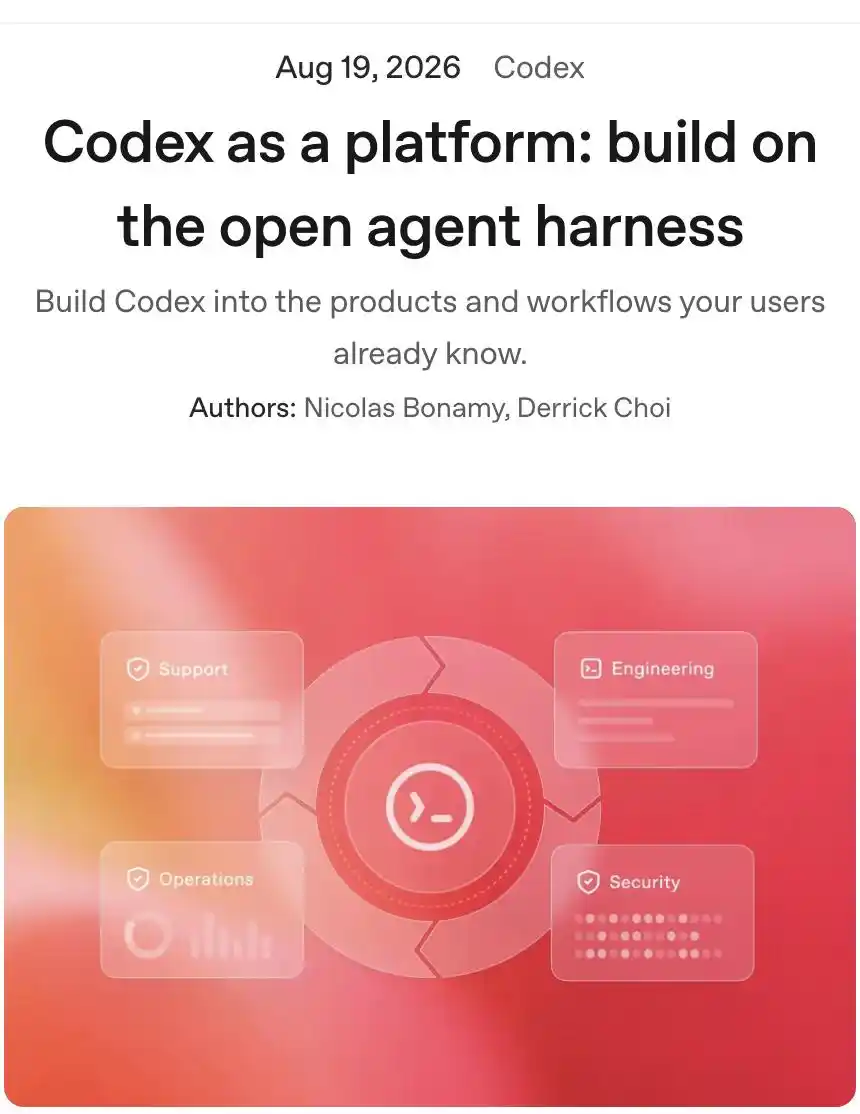
In other words, OpenAI is giving away the engine that powers its top-tier AI agents for free.
Developers no longer need to force their business workflows into a generic chat box!
You can seamlessly embed the most powerful AI agent loop directly into your own products, engineering tools, operational dashboards, or even the most tedious financial reporting software.
OpenAI President Greg Brockman excitedly reposted on X, saying: "Codex can power far more than just coding tools!"
You can build your own products directly on Codex Harness.
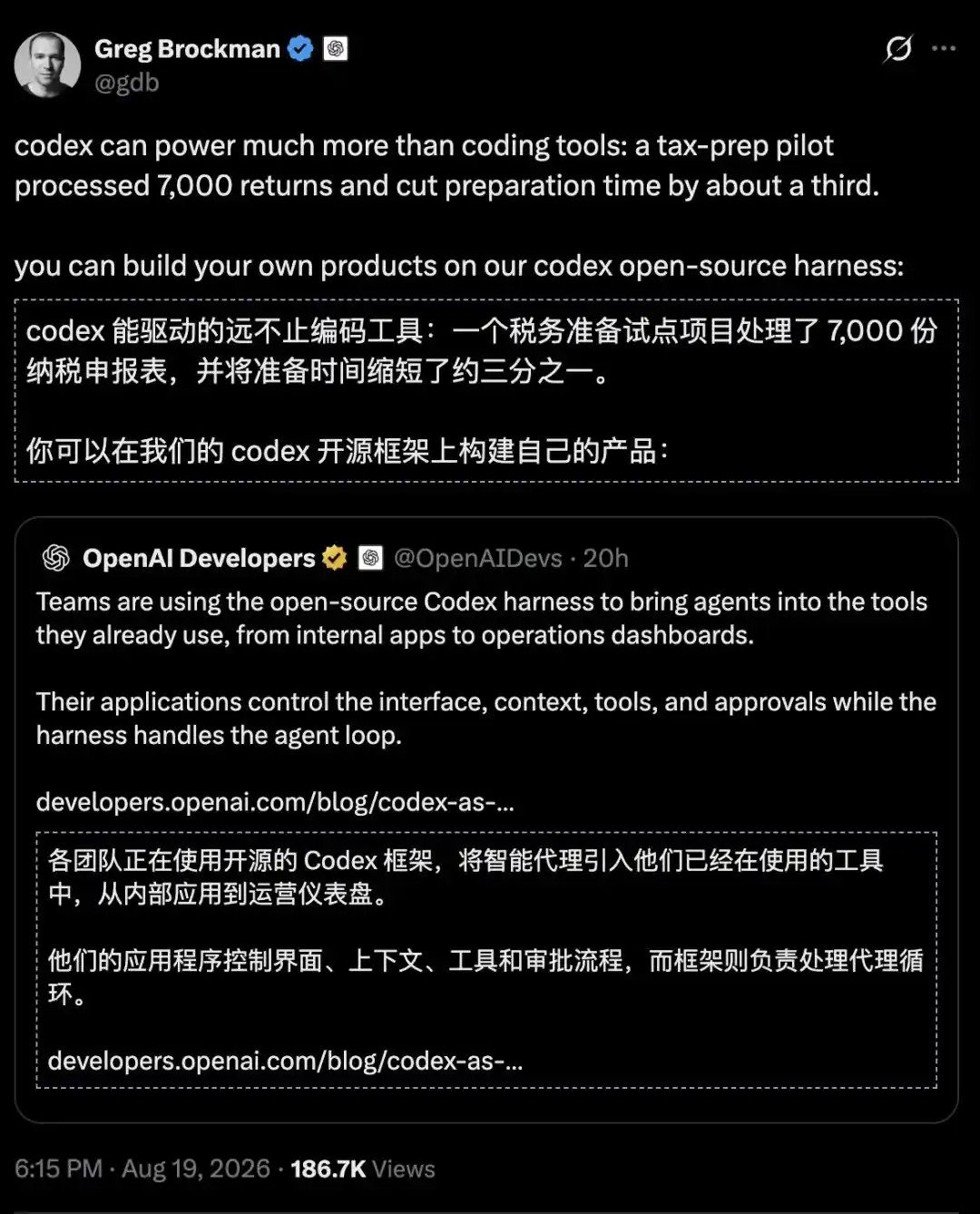
From now on, you own your turf—the interface, data, and approval permissions are all yours, with AI only responsible for being the "workhorse" in the background.
How will OpenAI's latest "open-source move" completely reshape the future paradigm of software development?
The World Has Suffered from "Generic Chat Boxes" for Too Long
Think about how we use AI today.
Whether it's writing code, performing data analysis, or handling customer complaints, the standard procedure seems to be: open a webpage/sidebar, face a monotonous chat input box, type out some background context, and then hope the AI provides a perfect answer.
If the answer is wrong, you continue "haggling" in the chat box.
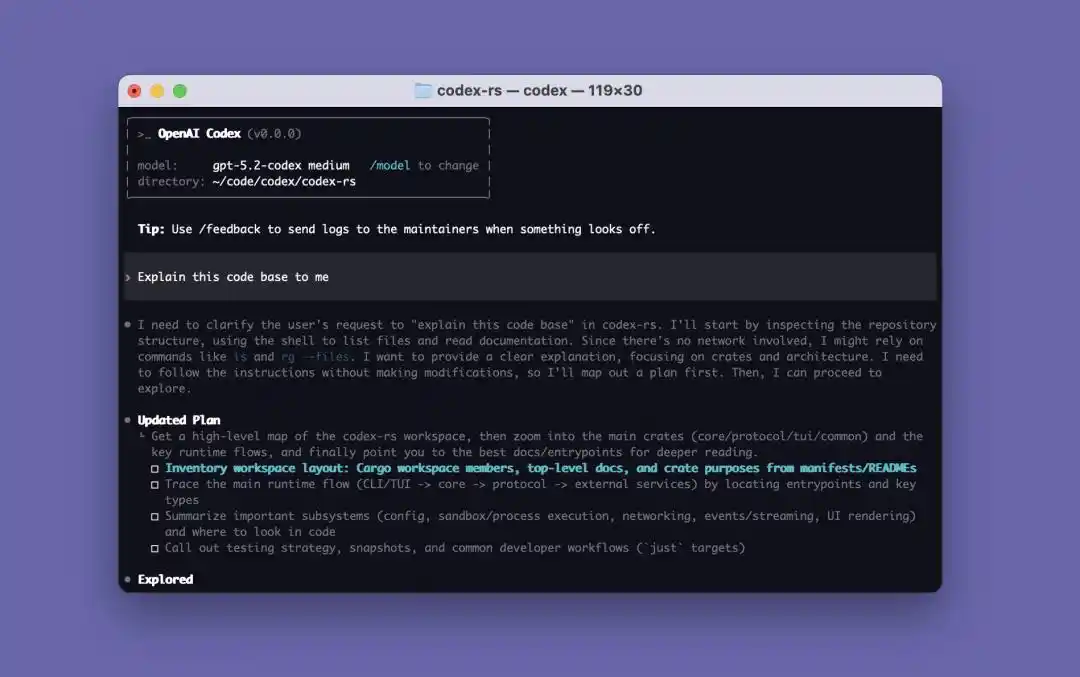
Most people encountered Codex through apps, command-line interfaces (CLI), or IDE extensions.
But from OpenAI's perspective, this single-mode interaction experience is far too narrow!
OpenAI pointed out incisively in its official blog:
Instead of forcing every team to cram their familiar workflows into a generic code assistant, why not bring the Agent directly into software designed around actual work?
After all, security analysts look at alert queues and affected service statuses; support engineers look at account histories and product logs; product managers look at requirement boards.
For these real workers, the important thing is not the "chat box," but the business dashboard in front of them. The interface exists for a reason—it is itself the most crucial "context."
Now, with the open-sourcing of Codex Harness, this "anti-wrapping" revolution has officially begun.
Demystifying Harness: The "Strongest Exoskeleton" for AI Agents
So, what exactly is Harness, the star of this open-source release?
Many mistakenly believe a powerful AI Agent = good model + good Prompt.
That's completely wrong!
A truly operational agent in business requires an extremely complex underlying execution system.
It needs to understand tasks, maintain memory across long conversations, review relevant information, proficiently call various tools, display progress externally, handle crashes and failures, pause to request human approval at critical moments, and finally return useful results.
This "execution system" and "agent loop" that handles all the heavy lifting is Harness.
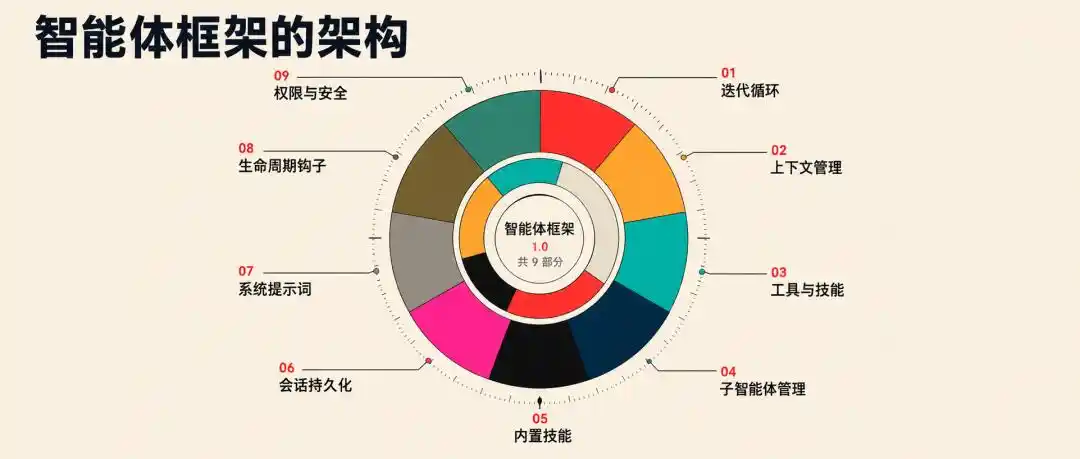
With this open-source release, OpenAI has proven one thing: A well-designed Harness can even transform a model's capabilities.
OpenAI provided highly convincing data to demonstrate how critical harness design is.
On the extremely challenging ARC-AGI-3 benchmark, they made just two key adjustments to the Harness—reasoning preservation and context compression.
The result? The score of the GPT-5.6 Sol model instantly skyrocketed from 13.3% to 38.3%! Even more astonishingly, the number of output tokens decreased sixfold!
This means, with Harness's enhancement, the AI not only became three times smarter but also saved you massive amounts on API call costs.
The evidence shows that while model capability is important, how you manage that model (i.e., Harness design) is the key determinant of an Agent's final performance.
Three Open-Source Components for Zero-Friction Integration
To truly enable developers to "use it out of the box," OpenAI released a complete suite of three open-source components under the Apache-2.0 license.
Just head to the openai/codex repository on GitHub, and you can unlock this powerful arsenal.
https://github.com/openai/codex
First is the CLI tool `codex exec`, which can run automated pipelines.
If you just need the AI to run a script, execute a CI (Continuous Integration) task, or handle a one-off background task, use the CLI directly.
It runs a bounded Agent workflow and returns structured output. Simple, direct, efficient.
Second is the official Codex SDK, the ultimate control stick for programmers.
If you're building an application and need to start, resume, or stream Codex tasks programmatically, the official SDK (supporting TypeScript / Python) provides a direct programming interface.
You can precisely control the lifecycle of threads and tasks with code.
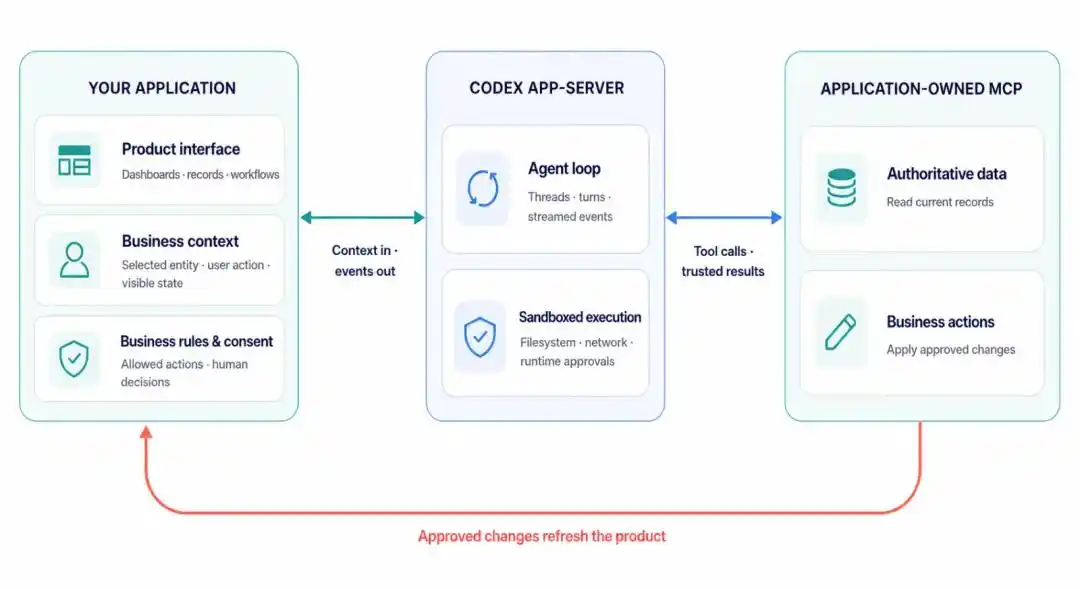
Third, and the shining star of this open-source release, is the Codex app-server. It is the core engine for deep product integration.
When the Agent needs to become an integral part of your product, the app-server is the best choice. It connects your application to a local Codex process via a detailed client protocol (JSON-RPC).
You can use it to:
Maintain persistent conversation state;
Stream events (see what the AI is doing in real-time);
Interrupt the AI's work mid-process;
Expose your own application's tools for the AI to use;
Handle human-in-the-loop approval requests.
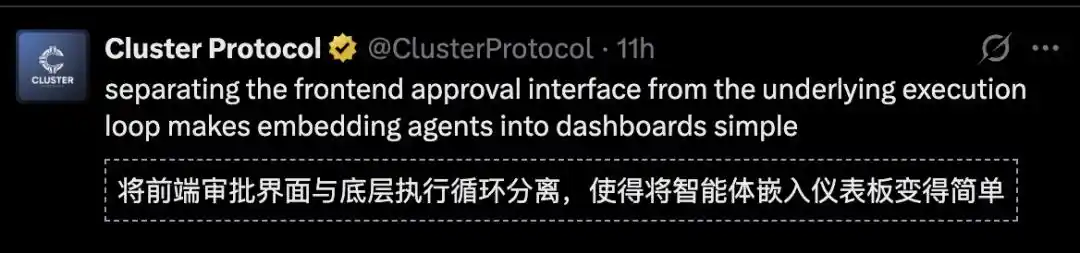
As noted developer @ClusterProtocol remarked:
Separating the front-end approval interface from the underlying execution loop makes embedding Agents into business dashboards unprecedentedly simple!
Far More Than Just Coding! The "Efficiency Nuclear Weapon" for All Industries
If you think Codex is just for writing code, you're sorely mistaken.
As Brockman stated, Codex can power far more than just coding tools.
Let's look at what miracles the first adopters are creating with it:
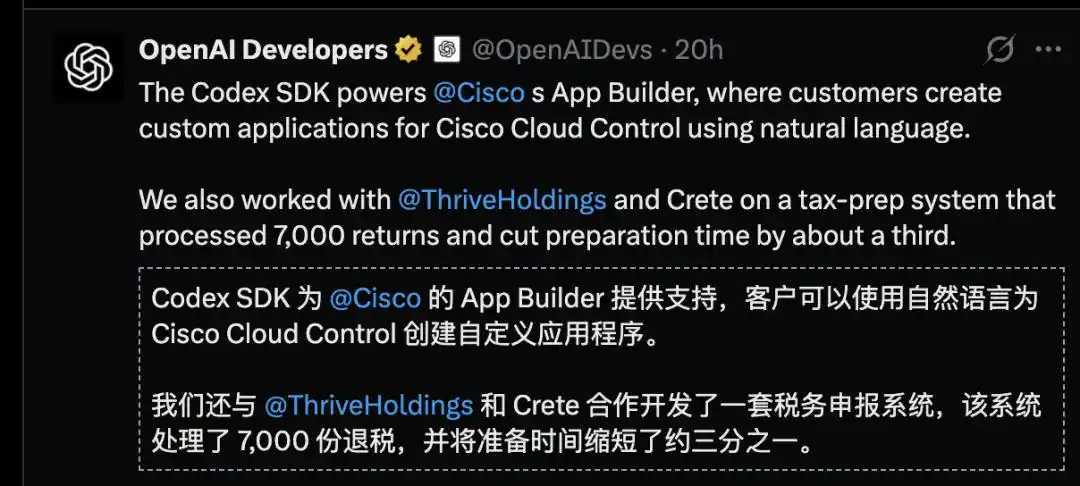
Case One: A "Divine Assistant" for Tax Filing
Can you imagine AI handling tax returns? Financial work fears errors the most, with extremely low fault tolerance.
Partners Thrive Holdings and Crete used this open-source Harness, embedding it into a professional tax preparation workflow.
The system not only handles complex tax logic but also perfectly integrates feedback from tax professionals.
The results were staggering. This pilot project successfully processed up to 7,000 tax returns, slashing preparation time by roughly one-third!
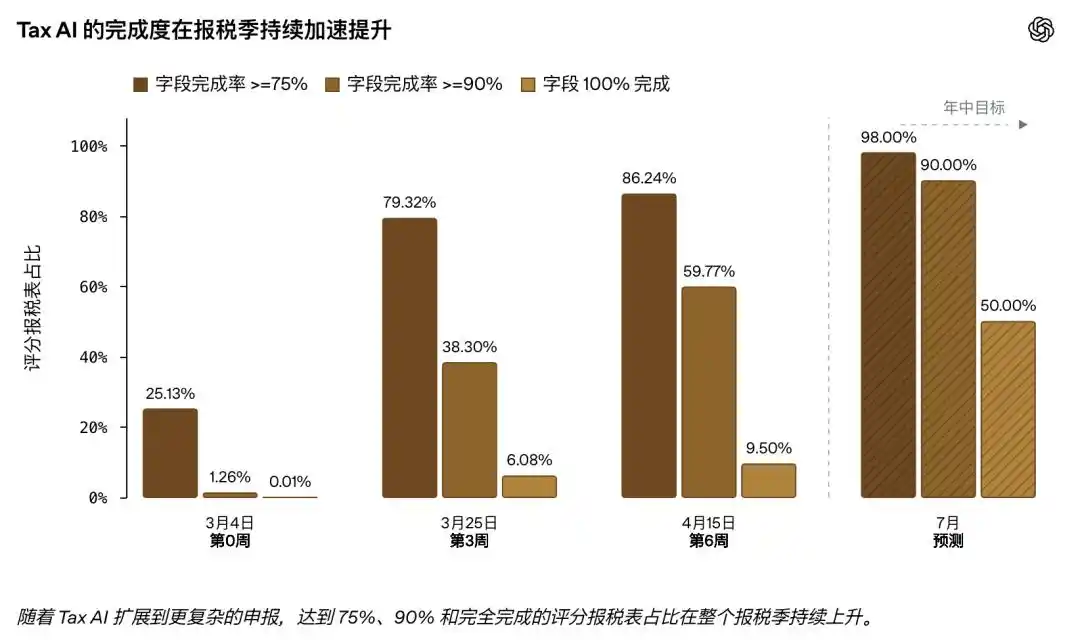
This demonstrates the immense power of embedding AI into vertical, professional tools.
Case Two: Tech Giant Cisco's Cloud Manager
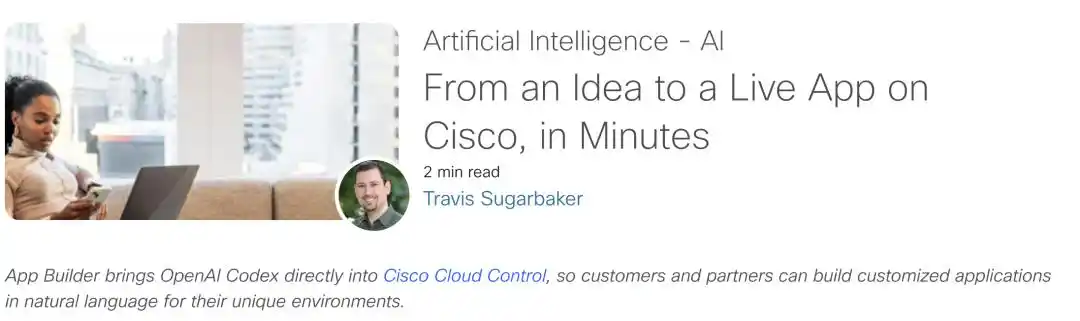
Tech giant Cisco used the Codex SDK to build an App Builder within its cloud control platform.
Now, Cisco's customers can use natural language directly to create custom applications, with all the complex underlying logic flow handled silently in the background by Codex Harness.
Official Demo Template: Logistics Dashboard "Relay"
To help everyone understand more intuitively, OpenAI showcased an official demo called Relay, a virtual logistics operations dashboard application.
In this dashboard, there is no distracting "ChatGPT chat box."
1. Interaction Revolution: Users don't need to write Prompts from scratch. They simply select a delayed shipment and click "Compare Recovery Options."
2. Seamless Context Integration: The application automatically feeds the current interface's shipment details and logistics data as context to the AI.
3. MCP Integration: Codex automatically calls the application's own MCP tools to fetch the latest real-time operational data.
4. Human Oversight: After the Agent analyzes the optimal re-booking solution, it must pop up an approval dialog. The AI only executes the write operation when the operator clicks "Approve."
5. Status Synchronization: Once the operation is complete, the business dashboard automatically refreshes.
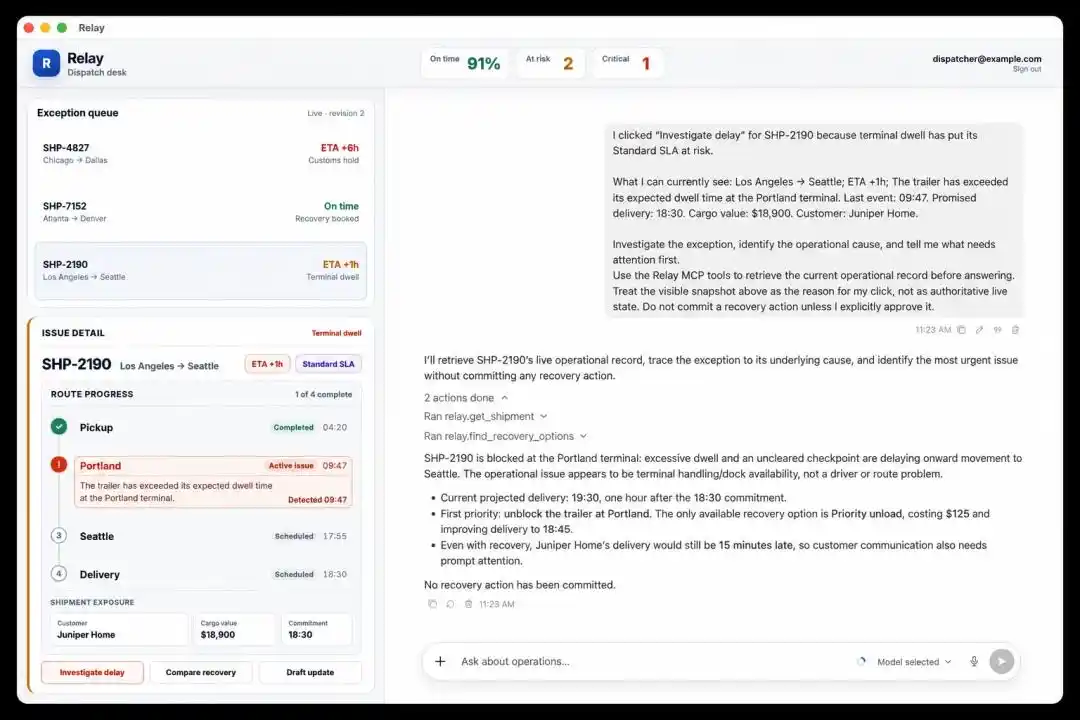
In this process, Harness handles the agent loop, memory maintenance, tool interaction, and real-time feedback; while your product retains control over its own dashboard, data records, and authority. This is true "human-machine collaboration."
Redefining Boundaries, Returning Power and Soul to Application Developers
Why do we say this open-source move changes the software building paradigm?
Because over the past year, many developers fell into the "wrapping" trap. Everyone was building ChatBots, products became more similar, and competitive moats grew shallower.
Opening Codex as a platform gives developers "supreme control" in three dimensions:
Codex gives you absolute interface control. Stop forcing users to adapt to a chat box!
Let your users continue using their familiar dashboards, editors, maps, and lists. AI should be an invisible helper, not a screen-hogging protagonist.
Absolute context and tool control allows you to safely expose your company's core systems, confidential documents, and internal APIs directly to the Agent via MCP services.
AI is no longer an outsider "unaware of company policies," but an expert fluent in your business systems.
Finally, absolute operational boundaries and security control are crucial for enterprise-level applications. The host application decides where the Agent runs and what files it can access.
Most importantly, you can define which dangerous actions (like modifying databases or sending emails to customers) require a human click to proceed.
This model of "front-end business rules are yours, underlying Agent loop is OpenAI's" completely removes the final barrier for AI adoption in enterprise scenarios.
The Apache-2.0 license for Codex Harness means anyone can modify and use it commercially.
The real test is: how many developers will abandon the comfortable chat box and disassemble the agent into components to install into their own products.
Codex Harness embodies a profound product philosophy—
Our goal is not to replace all professional interfaces with a single omnipotent chat box; it's to give those interfaces a smart brain.
When generic chat boxes disappear, native AI applications will flourish.
The era of zero-barrier AI Agents has arrived.
References:
https://x.com/gdb/status/2090246288478814281?s=20https://developers.openai.com/blog/codex-as-a-platform
This article is from the WeChat public account "New Zhiyuan," author: ASI Apocalypse