After a 30x Surge and Then a Collapse, Who Set Up the RIVER Scheme Promoted by Hayes?

marsbit2026-02-03 tarihinde yayınlandı2026-02-03 tarihinde güncellendi

Özet

The native token RIVER of the chain-abstract stablecoin system River experienced an extreme price surge and crash in January 2026, rising over 2700% from around $2 to over $87 in four weeks, before plummeting 87% to around $11 in just six days. The volatility drew scrutiny from analysts, with Bubblemaps identifying a cluster of over 2,000 wallets linked to RIVER’s creators, which allegedly profited around $10 million through coordinated selling on Bitget. The token had gained attention after Arthur Hayes publicly endorsed it and the project raised $12 million in strategic funding. Analysis by CoinGlass highlighted how negative funding rates were exploited to manipulate leverage and liquidity, triggering cascading liquidations. The event underscores risks associated with low-float, high-volatility tokens where concentrated ownership and derivative structures can amplify both gains and losses.

In the first month of 2026, the native token RIVER of the chain-abstracted stablecoin system River experienced an extreme inverted V-shaped reversal within just four weeks. Starting from around $2 in late December 2025, it surged to a historical high of over $87, marking an increase of more than 2700%, only to plummet rapidly within six days to a low of around $11, a drop of 87%.
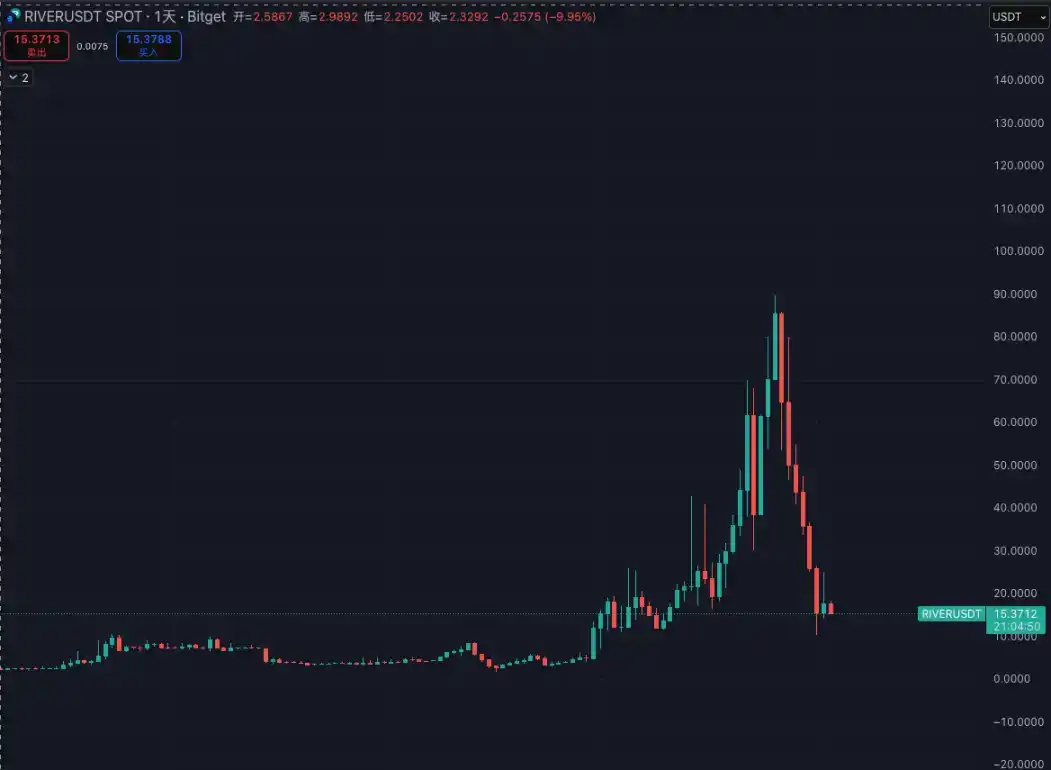
This abnormal market volatility has drawn significant attention from industry observers and on-chain data analysis institutions. As third-party data agencies like Bubblemaps disclosed key evidence on January 27, suspicions surrounding RIVER token price manipulation, highly concentrated early holdings, and profits by associated addresses are growing.

New Funding of $12 Million, Promoted by Arthur Hayes

The River project is developed by the RiverdotInc team, with its main focus on building a chain-abstracted stablecoin system for the multi-chain ecosystem. The system aims to connect assets, liquidity, and yields across different blockchains, enabling seamless cross-chain interactions without relying on traditional bridging or wrapping mechanisms.

On January 6, BitMEX founder Arthur Hayes publicly called for CEXs to list the token and predicted it would explode. Hayes' endorsement provided the first boost for RIVER. Despite most mainstream crypto assets being in a downward trend at the time, RIVER began a unilateral upward trend, with its market cap more than quadrupling in just a few weeks.
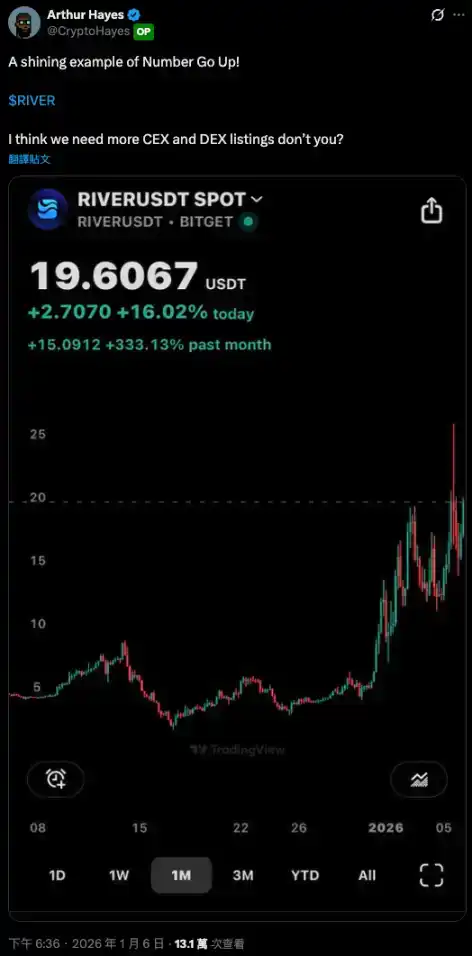
On January 23, River announced the completion of a $12 million strategic funding round. In addition to previously reported participation from Justin Sun and TRON DAO, this round of investors also included Maelstrom Fund (founded by Arthur Hayes), The Spartan Group, and Nasdaq-listed companies and institutions from the United States and Europe.

Officially, the funding will be used to support River's expansion into EVM and non-EVM ecosystems (including TRON, Sui, and major EVM networks) and to continue building on-chain liquidity infrastructure. The funds will accelerate ecosystem deployment, deepen stablecoin liquidity, and promote the integration of satUSD in trading, lending, staking, and yield scenarios. Additionally, River will launch yield products Smart Vault and Prime Vault, providing a unified interface for users and institutions to access cross-ecosystem yields through protocol-native and institutional-grade strategies.

Interestingly, just a couple of days after announcing the large funding round, RIVER's price hit its peak and began to decline.

Funding Rate-Driven Price Manipulation Tactics

CoinGlass once used RIVER as an example to discuss how funding rates can be used in conjunction with leverage structures to drive price volatility, emphasizing that this pattern has appeared in multiple tokens over the past two years, with RIVER being just one case. It stressed that many traders misunderstand funding rates. Funding rates do not provide directional predictive signals; they provide information on the imbalance between long and short positions, indicating which side of the market is more crowded.

Step 1: Suppress the price while pushing the funding rate into deeply negative territory. First, keep the price low or suppressed while pushing the funding rate into a significantly negative range. The result is that short positions become increasingly concentrated, and the market begins to form a consensus expectation that a rebound is imminent due to the negative funding rate.

Step 2: Lure some traders to go long. During the phase of deeply negative funding rates, some traders will open long positions, motivated by the expectation of a rebound and the hope of receiving funding rate payments. The thread refers to this expectation as part of the trap.

Step 3: Price pushes upward can also occur during negative funding rate phases. CoinGlass's key argument is that when funding rates are extremely negative, prices do not need to enter a trend reversal. The market only needs a controlled upward push to trigger a chain reaction among shorts, including liquidations, stop-losses, and passive covering.
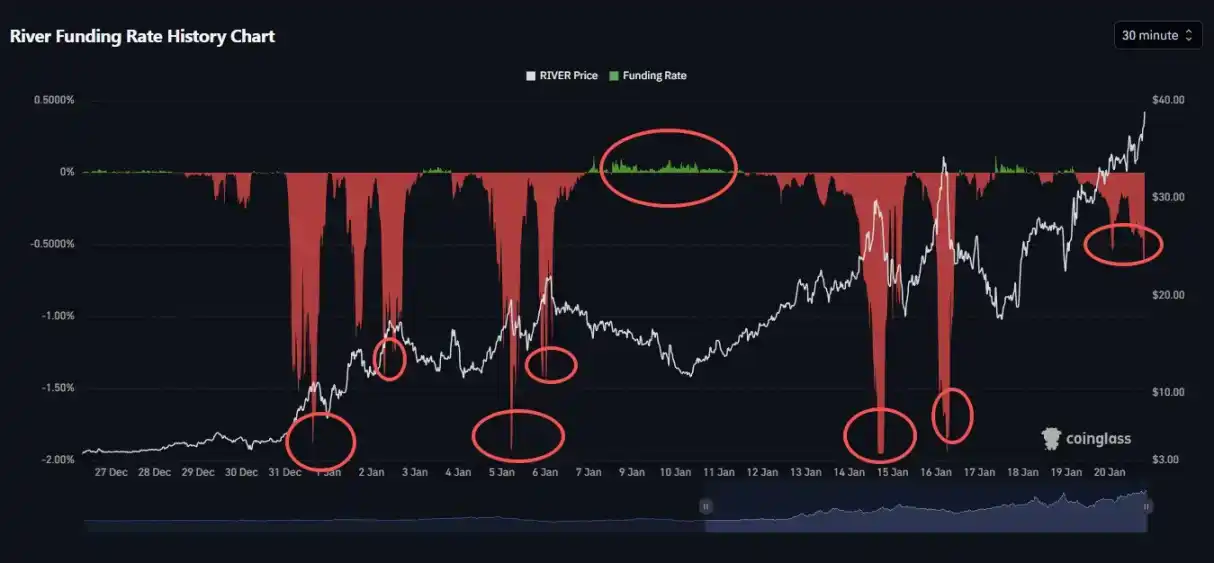
Why does the rally happen when the funding rate is still negative? Many sharp rallies start when funding rates are still negative. The driving force behind the price push comes from the unwinding of leveraged positions, and passive buying in the market amplifies the gains. After the crowded shorts are cleared, funding rates quickly return to more neutral levels. Some traders interpret the normalization of funding rates as a signal of market recovery.

CoinGlass warns that this is actually just the "reset" process of the trap, and manipulators can repeatedly execute the cycle of "creating extreme rates, attracting consistent positions, forcing liquidations, and resetting."

Analysis: RIVER Creators Suspected to Be Directly Related to a Large Cluster of Addresses, Selling RIVER for $10 Million in Profits

According to Bubblemaps monitoring, a large cluster containing over 2,000 wallet addresses is directly related to RIVER.
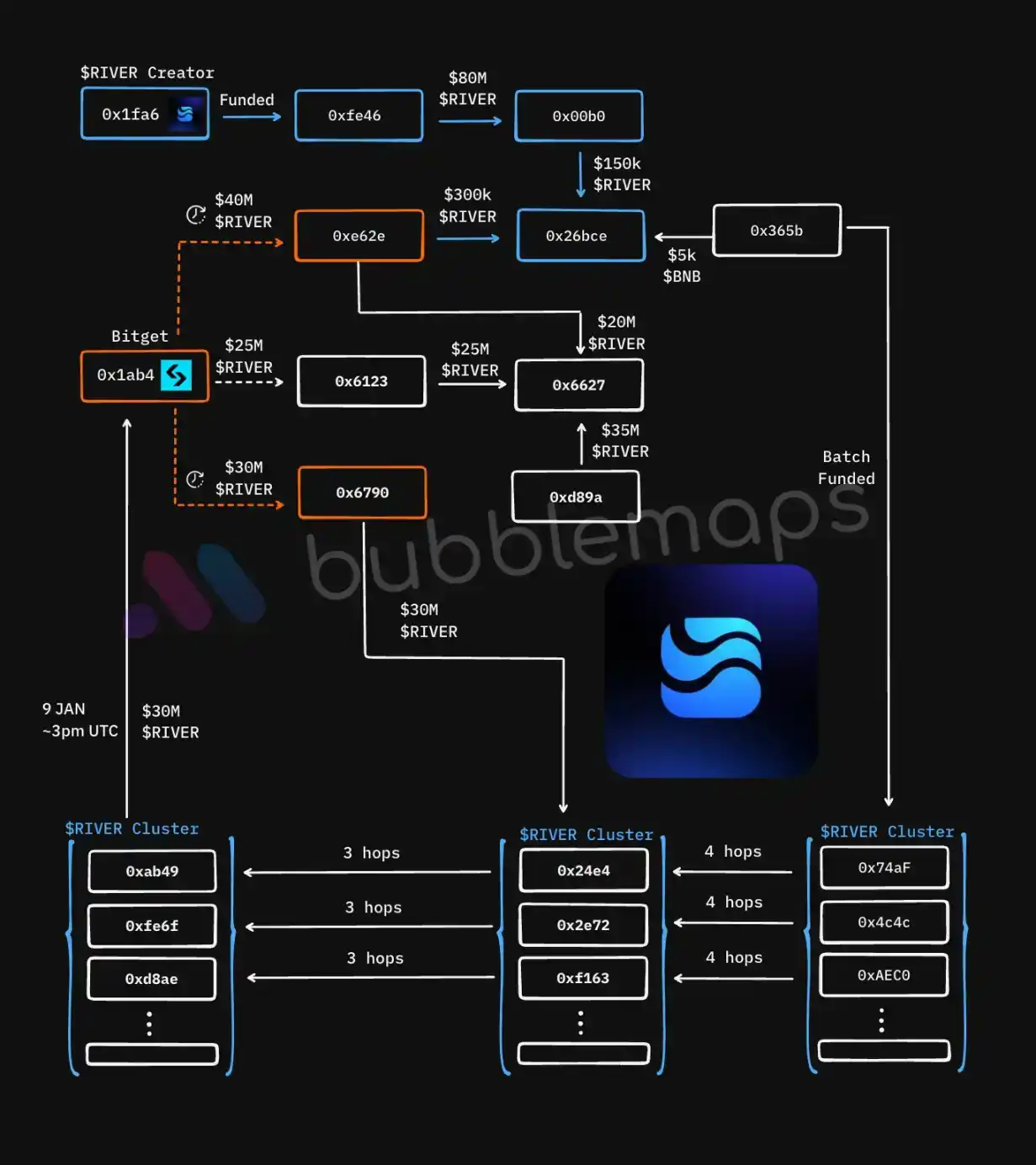
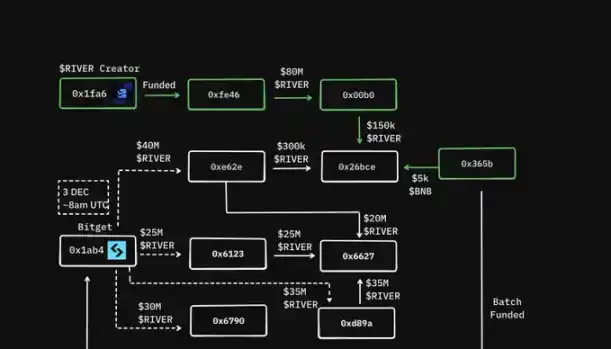
It pointed out that one month after RIVER's launch, seven addresses withdrew 230 million RIVER tokens from Bitget. These wallets had no prior activity and received the tokens within a tight time window on December 3 and 29.
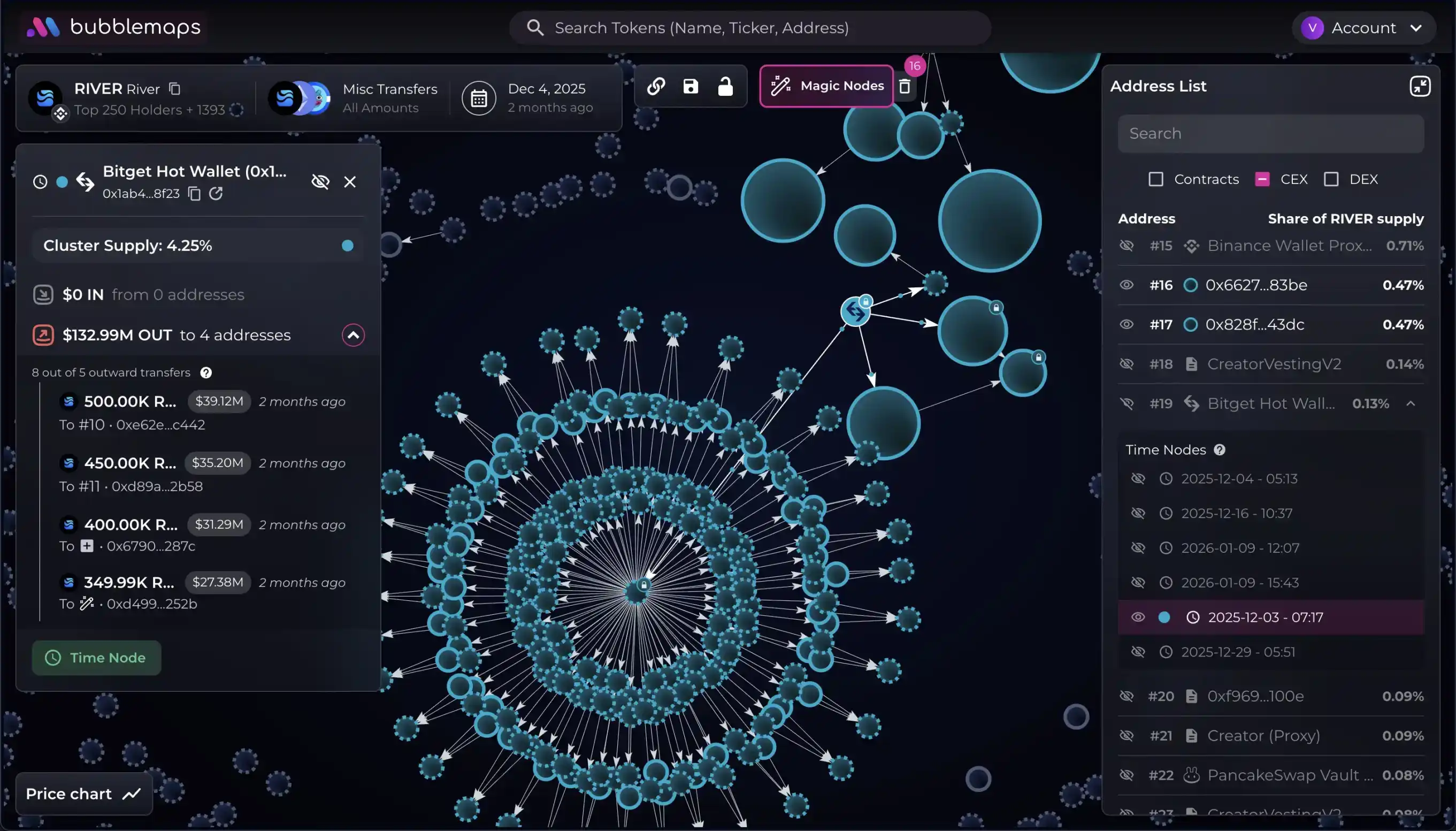
One wallet, 0x6790, distributed 400,000 RIVER across hundreds of wallets. All these receiving wallets showed similar patterns: no prior activity, receiving similar amounts of RIVER, sending tokens to Bitget on January 9 likely for sale, funded by a single source, and经过四层跳转 (after four layers of hopping).
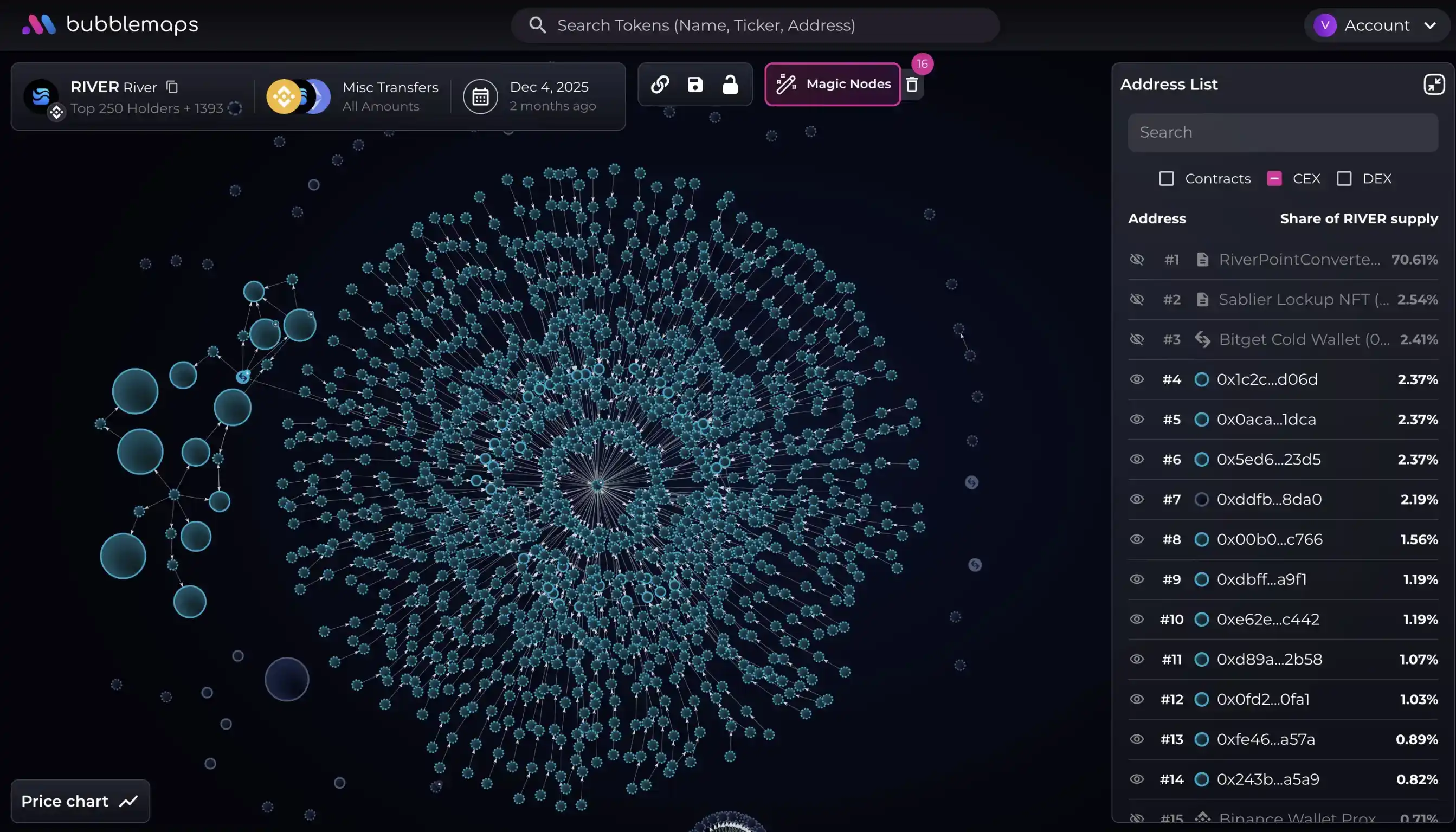
Bubblemaps noted that the wallet funding this cluster is address 0x365b, which is directly connected to the RIVER creator. Additionally, the wallet 0x6790, which distributed RIVER to the cluster, shows links pointing to the RIVER creator. It estimates the cluster's profits at $10 million.
What is certain now is that RIVER completed a drastic repricing from rapid rise to rapid retreat in an extremely short time. Market focus has shifted from narrative and growth expectations to whether there are abnormalities in token distribution and fund flows. The address cluster and associated clues raised by Bubblemaps have amplified suspicions of early concentration of holdings, profits by associated addresses, and selling through exchanges; the funding rate and position crowding mechanism mentioned by CoinGlass provide another explanatory framework, suggesting that derivative structures may have amplified the price swings.

For the market, the RIVER incident once again serves as a reminder that tokens with low circulation and high volatility are prone to extreme price movements when sentiment and structure resonate, and when negative signals emerge in holdings and trading structures, price adjustments often come faster and deeper.


İlgili Sorular

QWhat was the extreme price movement of RIVER token in the first month of 2026?

AThe RIVER token experienced an extreme inverted V-shaped reversal, surging from around $2 in late December 2025 to a high of over $87, a gain of more than 2700%, before crashing down to around $11 in just six days, a drop of 87%.

QWho is a prominent figure that publicly endorsed the RIVER token and what was his prediction?

ABitMEX founder Arthur Hayes publicly called for CEXs to list the token and predicted it would experience a massive breakout.

QAccording to the analysis from Bubblemaps, what was the suspected link between a large cluster of wallets and the RIVER token creators?

ABubblemaps identified a cluster of over 2000 wallet addresses directly linked to RIVER's creators, with evidence showing these wallets received tokens from the creators and later sold them on Bitget, netting an estimated profit of $10 million.

QHow did CoinGlass describe the mechanism of price manipulation involving funding rates, as exemplified by RIVER?

ACoinGlass described a套路 where manipulators first suppress the price to create deeply negative funding rates, lure in long positions expecting a rebound, and then trigger a short squeeze by pushing the price up, forcing liquidations and stop-losses. This cycle of creating extreme rates, attracting one-sided positions, forcing liquidations, and resetting can be repeated.

QWhat was the purpose of the $12 million strategic funding round announced by River, and who were some of the investors?

AThe $12 million strategic funding round was intended to support River's expansion into EVM and non-EVM ecosystems (including TRON, Sui, and major EVM networks), build on-chain liquidity infrastructure, accelerate ecosystem deployment, and launch yield products like Smart Vault and Prime Vault. Investors included Maelstrom Fund (Arthur Hayes), The Spartan Group, Justin Sun, TRON DAO, and Nasdaq-listed companies from the US and Europe.

İlgili Okumalar

The King of Blind Date Attire in Korea: How SK Hynix Made a Comeback Against Samsung?

In South Korea's dating scene, SK Hynix employees are now highly sought after, a status shift fueled by the company's astronomical profits and employee bonuses, projected to reach up to 6.1 million RMB per person by 2027. This marks a dramatic reversal for the long-time second-place player in memory semiconductors, which has now surpassed its rival Samsung in annual operating profit. The turnaround story began in 2008 when a struggling Hynix, emerging from bankruptcy restructuring, took a risky bet by agreeing to develop High Bandwidth Memory (HBM) with AMD. At the time, HBM had no clear market beyond high-end graphics cards and was a costly, complex technology. Major players like Samsung, pursuing its own HMC technology, declined. For Hynix, with only memory as its core business, it was a gamble born of necessity. The pivotal moment came in 2012 when SK Group Chairman Chey Tae-won acquired Hynix. Defying industry downturns, he invested heavily in R&D and fabrication, sustaining the HBM project through over a decade of commercial uncertainty and internal challenges. A key break occurred around 2016-2017 when Samsung faced production issues supplying HBM2 for Google's TPU, allowing SK Hynix to gain a crucial foothold in the data center market. The AI explosion post-ChatGPT in 2022 was the catalyst, turning HBM into a critical bottleneck for AI accelerators like NVIDIA's GPUs. By 2025, SK Hynix captured 62% of the global HBM market, leaving Samsung at 17%. For the first time, its annual operating profit exceeded Samsung's. Analysts point to the "innovator's dilemma" to explain Samsung's miss: its vast, successful business portfolio made it risk-averse, preventing an all-in bet on the initially niche HBM technology. In contrast, SK Hynix, as a challenger with its back against the wall, had no choice but to commit fully. The story highlights how Korea's chaebol system allows for ultra-long-term bets beyond quarterly pressures. However, SK Hynix's lead isn't guaranteed. Samsung is aggressively catching up on HBM4, and challenges like customer concentration (heavy reliance on NVIDIA) and technical hurdles in advanced packaging remain. The narrative underscores a market truth: the greatest alpha often comes from betting on uncertain, long-term directions others dismiss, much like HBM in 2008.

marsbit12 dk önce

The King of Blind Date Attire in Korea: How SK Hynix Made a Comeback Against Samsung?

marsbit12 dk önce

Understanding Hash in One Article: The "Browser Miner" on Ethereum

Hash is an Ethereum-based ERC-20 token described as a "browser-minable post-quantum token." Its key features include enabling browser-based GPU mining without specialized hardware, a fixed supply cap of 21 million tokens, immutable and permissionless smart contracts with no team allocation or pre-mining, and an emphasis on post-quantum security using Keccak256 hashing. The mining mechanism is a simplified on-chain proof-of-work where miners solve unique challenges tied to their wallet address. Key design elements prevent answer theft, with epochs resetting every 100 blocks (~20 minutes) and a per-block minting limit. Emission follows a Bitcoin-like halving schedule every 100,000 mints, starting at 100 tokens per mint. Projections suggest all tokens could be mined within approximately 294 days if a target rate of one mint per minute is sustained. Hash emphasizes "post-quantum" security by leveraging hash-based primitives like Keccak256, which are considered more resistant to quantum attacks compared to elliptic-curve cryptography. While not a fully post-quantum asset, it aligns with Ethereum's broader post-quantum research narrative. The project completed its Genesis sale at $0.03 and began trading on Uniswap, with its price reaching around $0.19. The initial circulating supply is small, with 5% sold in Genesis and 5% allocated to liquidity. The majority (47.6% of total supply) is allocated to early-stage mining, leading to a front-loaded emission schedule. This structure, combined with low initial liquidity, makes Hash a high-volatility, high-risk project dependent on sustained miner participation and market demand to absorb new supply.

marsbit26 dk önce

Understanding Hash in One Article: The "Browser Miner" on Ethereum

marsbit26 dk önce

OpenAI's Largest Internal Wealth Creation: 600 People Cash Out a Total of $6.6 Billion, 75 Take Home the Maximum $30 Million Each

A Wall Street Journal report reveals OpenAI's unprecedented pre-IPO wealth creation. In a single employee stock sale last October, over 600 current and former employees sold shares, collectively cashing out approximately $6.6 billion. Due to high investor demand, the company tripled the individual sale cap to $30 million, with about 75 employees selling the maximum amount. This event represents the largest such transaction in tech industry history for a private company. OpenAI's valuation was $500 billion for this tender offer. Employees with over two years of tenure were eligible, allowing many post-ChatGPT hires their first liquidity event. The company's stock has reportedly grown over 100-fold in seven years. Following a restructuring, employees collectively hold about 26% of OpenAI. The scale of executive wealth is also staggering. In court testimony related to Elon Musk's lawsuit, President and co-founder Greg Brockman confirmed his OpenAI stake is worth around $30 billion. Analysis indicates about 165 current and former employees hold a combined ~$164.9 billion in equity, averaging nearly $1 billion per person in paper wealth. OpenAI's per-employee stock-based compensation is estimated to be 34 times the average of major tech firms before their IPOs. OpenAI continues its rapid ascent, closing a $122 billion funding round at an $852 billion valuation in March. With monthly revenue hitting $2 billion, over 900 million weekly ChatGPT users, and plans for a potential trillion-dollar IPO in late 2026, this wealth-creation engine shows no signs of stopping.

链捕手48 dk önce

OpenAI's Largest Internal Wealth Creation: 600 People Cash Out a Total of $6.6 Billion, 75 Take Home the Maximum $30 Million Each

链捕手48 dk önce

İşlemler

Spot
Futures

Popüler Makaleler

RIVER Nasıl Satın Alınır

HTX.com’a hoş geldiniz! River (RIVER) satın alma işlemlerini basit ve kullanışlı bir hâle getirdik. Adım adım açıkladığımız rehberimizi takip ederek kripto yolculuğunuza başlayın. 1. Adım: HTX Hesabınızı OluşturunHTX'te ücretsiz bir hesap açmak için e-posta adresinizi veya telefon numaranızı kullanın. Sorunsuzca kaydolun ve tüm özelliklerin kilidini açın. Hesabımı Aç2. Adım: Kripto Satın Al Bölümüne Gidin ve Ödeme Yönteminizi SeçinKredi/Banka Kartı: Visa veya Mastercard'ınızı kullanarak anında River (RIVER) satın alın.Bakiye: Sorunsuz bir şekilde işlem yapmak için HTX hesap bakiyenizdeki fonları kullanın.Üçüncü Taraflar: Kullanımı kolaylaştırmak için Google Pay ve Apple Pay gibi popüler ödeme yöntemlerini ekledik.P2P: HTX'teki diğer kullanıcılarla doğrudan işlem yapın.Borsa Dışı (OTC): Yatırımcılar için kişiye özel hizmetler ve rekabetçi döviz kurları sunuyoruz.3. Adım: River (RIVER) Varlıklarınızı SaklayınRiver (RIVER) satın aldıktan sonra HTX hesabınızda saklayın. Alternatif olarak, blok zinciri transferi yoluyla başka bir yere gönderebilir veya diğer kripto para birimlerini takas etmek için kullanabilirsiniz.4. Adım: River (RIVER) Varlıklarınızla İşlem YapınHTX'in spot piyasasında River (RIVER) ile kolayca işlemler yapın.Hesabınıza erişin, işlem çiftinizi seçin, işlemlerinizi gerçekleştirin ve gerçek zamanlı olarak izleyin. Hem yeni başlayanlar hem de deneyimli yatırımcılar için kullanıcı dostu bir deneyim sunuyoruz.

448 Toplam GörüntülenmeYayınlanma 2026.01.16Güncellenme 2026.01.16

RIVER Nasıl Satın Alınır

Tartışmalar

HTX Topluluğuna hoş geldiniz. Burada, en son platform gelişmeleri hakkında bilgi sahibi olabilir ve profesyonel piyasa görüşlerine erişebilirsiniz. Kullanıcıların RIVER (RIVER) fiyatı hakkındaki görüşleri aşağıda sunulmaktadır.

活动图片