a16z Infographic: AI Costs Halved, Usage Doubled, US 30-Year-Olds Enter the Era of 'Delayed Adulthood'

marsbit2026-03-02 tarihinde yayınlandı2026-03-02 tarihinde güncellendi

Özet

This a16z report analyzes four key trends through data visualization. First, while the "DExit" narrative suggests companies are leaving Delaware due to legal shifts, the data reveals a more nuanced picture; Delaware's overall share of businesses has actually grown, though specific entities like Wyoming LLCs are gaining traction. Second, AI sector demonstrates the Jevons Paradox: as the cost of AI tokens halved, their usage doubled, and demand for older GPUs remains strong, indicating the AI-driven economy is still in its early stages. Third, AI capital expenditure is massive, comparable to total US bank lending and significantly larger than corporate tax income or the military budgets of other G7 nations. Finally, prediction markets like Kalshi are now outperforming professional forecasters in predicting Federal Funds Rates. The report concludes with a societal trend: 30-year-olds are increasingly delaying traditional life milestones like marriage, homeownership, and having children, with college enrollment being the only metric that has risen sharply, though its value is now being questioned.

Deep Tide Guide: This edition of a16z's Chart Weekly covers four topics, each worthy of a standalone article: the Jevons Effect triggered by falling AI costs, the true scale of tech giants' capital expenditures, Kalshi prediction markets outperforming professional forecasting agencies, and the comprehensive postponement of life milestones among 30-year-olds in the US. With solid data sources and a calm, restrained perspective, it serves as a high-quality reference for understanding the intersection of current tech and macro trends.

DExit......Real Trend or Illusion?

Delaware remains the preferred state for US corporate registration, but this status is quietly loosening:
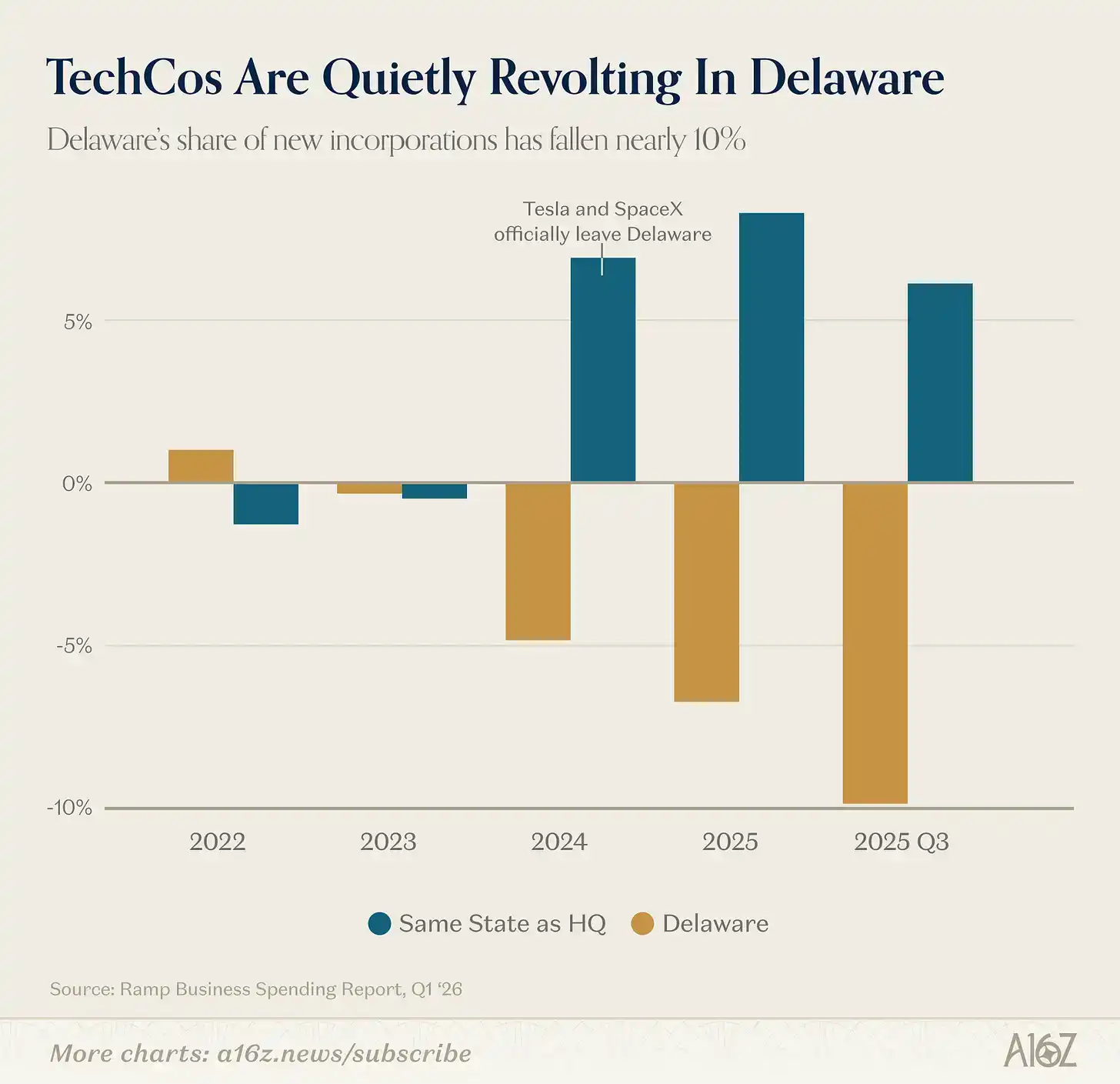
According to Ramp's data, Delaware's share of new company registrations has been declining since 2023, with a drop of about 10% in Q3 2025.

History doesn't repeat itself exactly, but it often rhymes......maybe.

Delaware wasn't always the holy land for corporate registration.

About a century ago, Delaware replaced New Jersey—the original "Mother of Trusts"—as the preferred state for incorporation. New Jersey lost its edge because then-Governor Woodrow Wilson tried to curb "corporate abuses," severely worsening the state's business environment. Delaware's corporate law was modeled on pre-Wilson era New Jersey law and was happy to welcome fleeing businesses. It then spent nearly 100 years, alongside the Delaware Court of Chancery, building a reputation as a mature and fair venue for resolving disputes between companies and investors.

However, what took a century to build began to shake in just a few years. Rightly or wrongly, the Delaware Court of Chancery has recently taken a more lenient stance on shareholder lawsuits (including, but not limited to, several high-profile cases like Tesla), and companies have genuinely started moving their registrations elsewhere. Goodnight, and good luck, Delaware.

This is at least the mainstream narrative, but other data shows a more complex picture.

First, even Delaware's founding myth isn't entirely accurate.

It wasn't until the 1980s (about 60 years after Governor Wilson's term) that Delaware truly surpassed New Jersey to become the number one state for US corporate registrations:
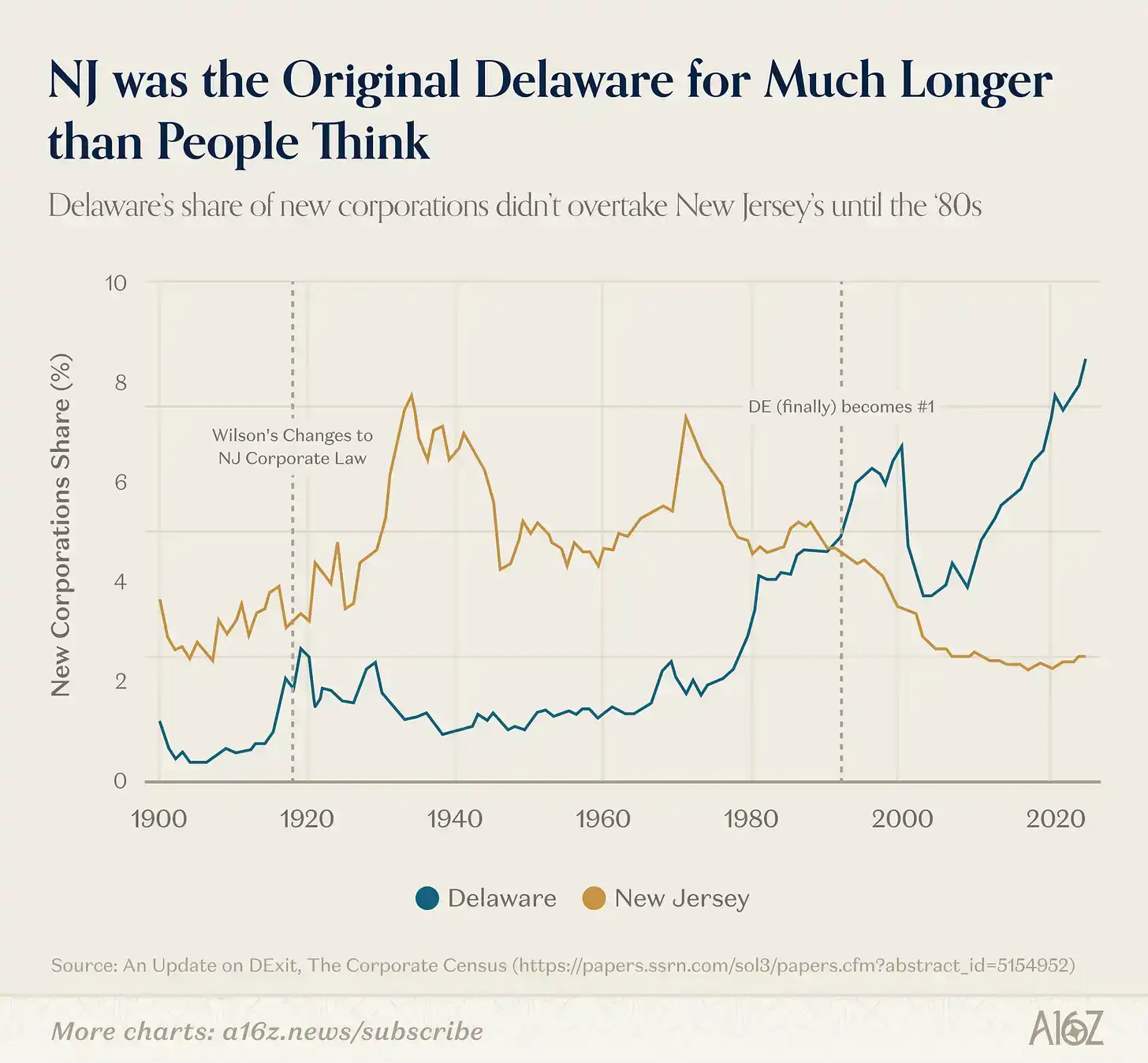
New Jersey's dominance lasted much longer than the mainstream narrative suggests. The catalyst for Delaware's eventual overtaking was likely its passage of a series of laws related to director liability, which were particularly favored by public companies, coupled with self-reinforcing network effects that created their own inertia.

Second, regardless of what's happening with high-profile public companies (and the companies in Ramp's data), Delaware as a whole still seems to be doing well, even more than well:
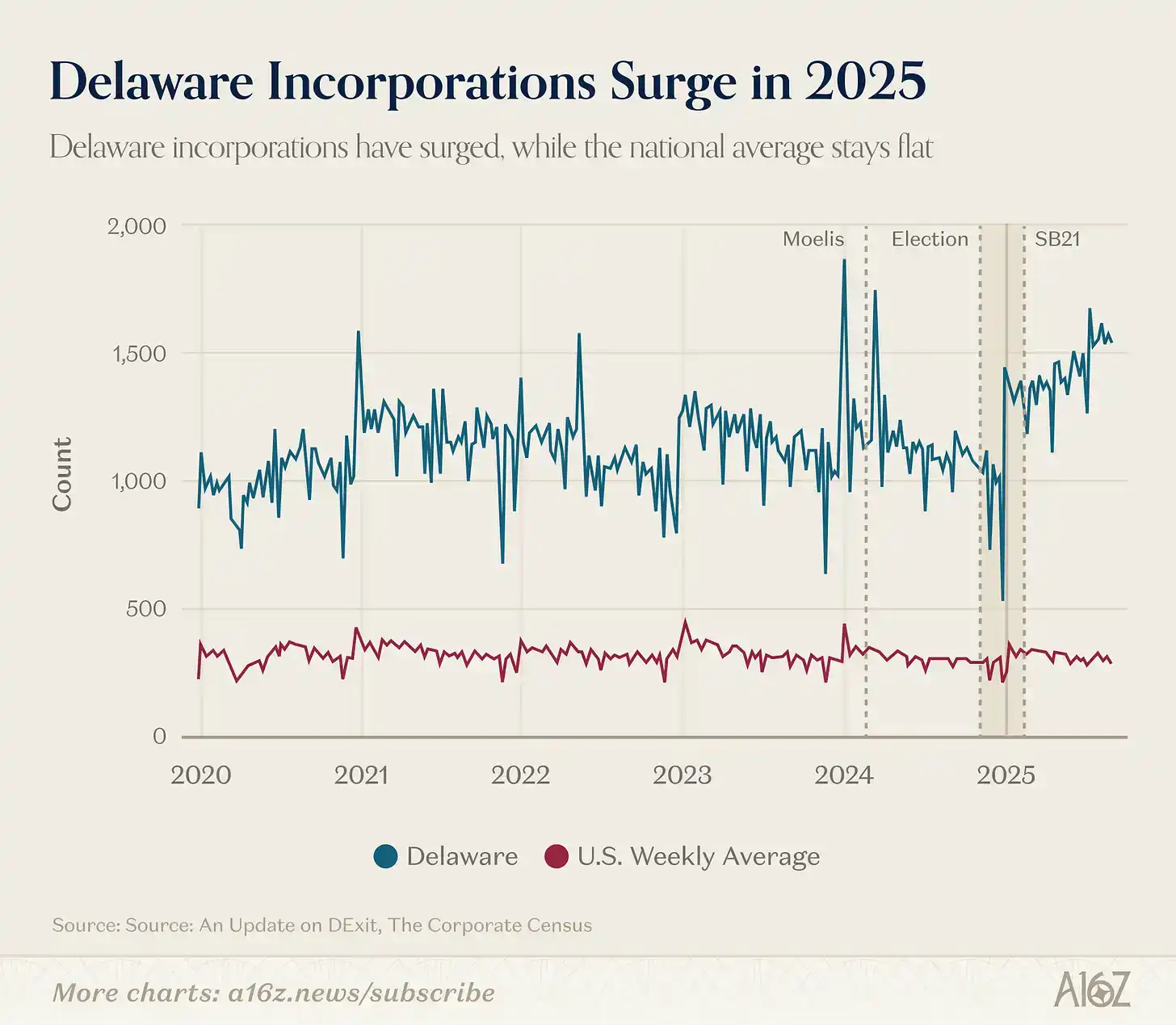
According to data published by the Harvard Law School Forum on Corporate Governance, Delaware's share of the total number of US businesses actually grew significantly from late 2024 into 2025.

In fact, if you're looking for a clear case of "DExit," it's probably this one, and it has nothing to do with Tesla, but rather a specific type of company structure:
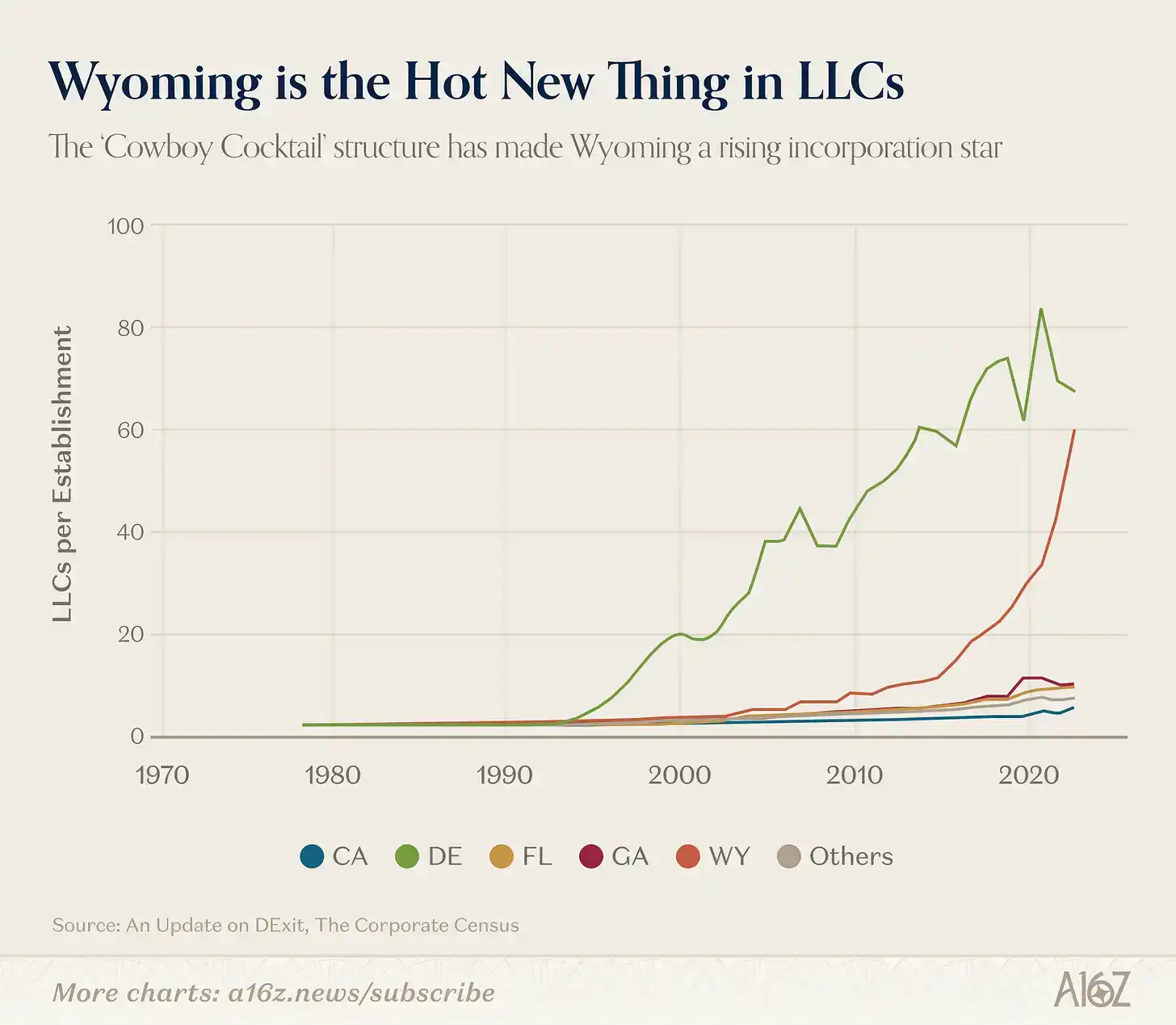
Wyoming LLCs began to surge around 2015.

Why? This is likely related to specific asset protection and privacy provisions in Wyoming's LLC law, which the state itself promotes as a "cowboy cocktail."

In short, the point here isn't that DExit isn't happening (because at least some data suggests it is—even if it's just a few high-profile companies moving out, it's significant), but the reality is certainly more complex than the mainstream narrative presents.

The reality is that Delaware still enjoys the advantage of being the default option, not to mention all the network effects tied to it, and these are very hard to shake.

We published an earlier version of this chart before, but as more data comes in, the effect becomes more striking.

Token costs fall, Token consumption rises:
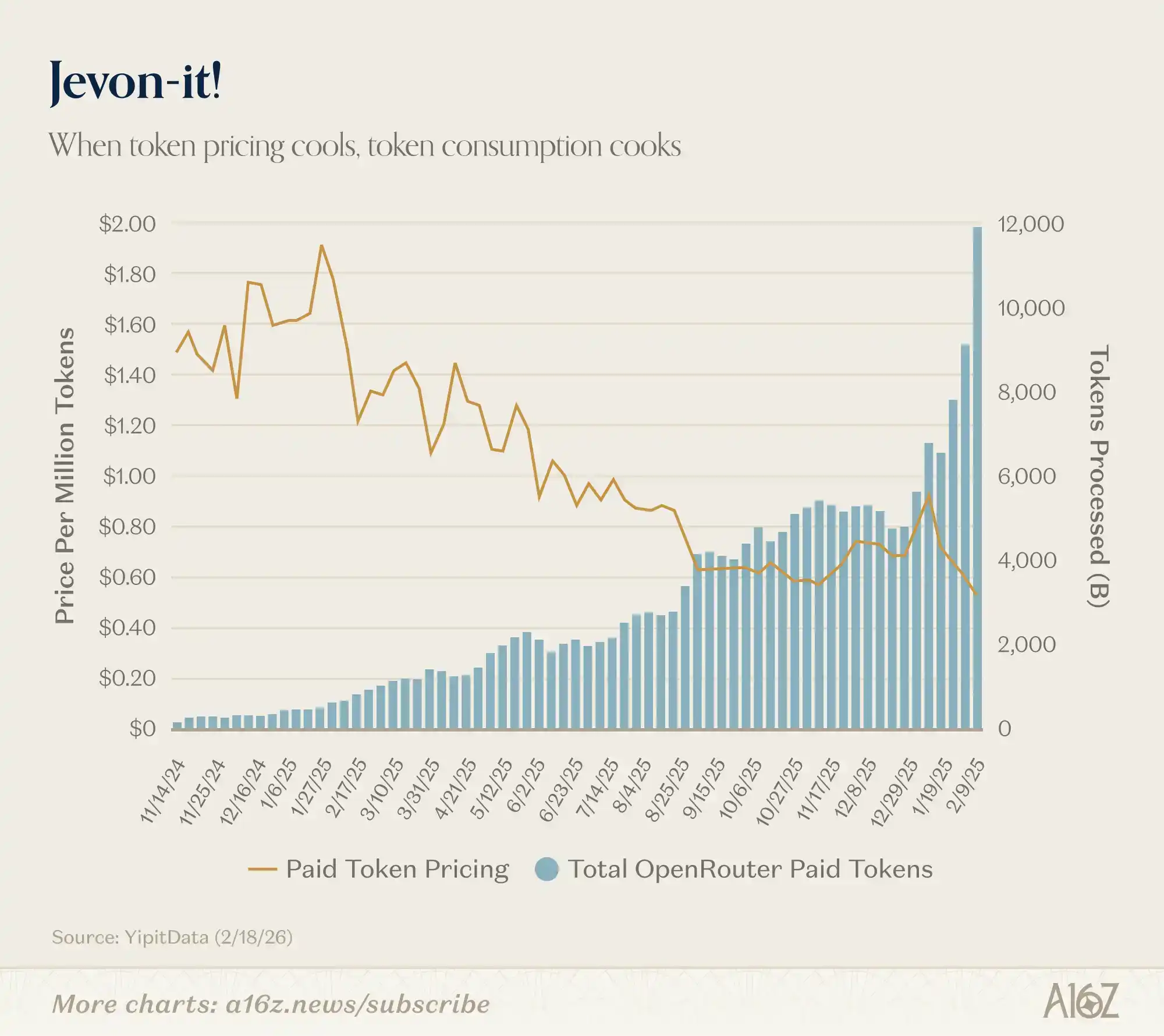
Since the beginning of this year, paid Token pricing has dropped from about 90 cents per million Tokens to 50 cents, while the number of Tokens processed has nearly doubled, from about 6,000 to 12,000.

This is a classic Jevons effect. The cheaper AI gets, the more AI we use. Delightful.

Remember when people said that when newer, better GPUs hit the market, the old ones would become worthless?

That doesn't seem to be the case either:
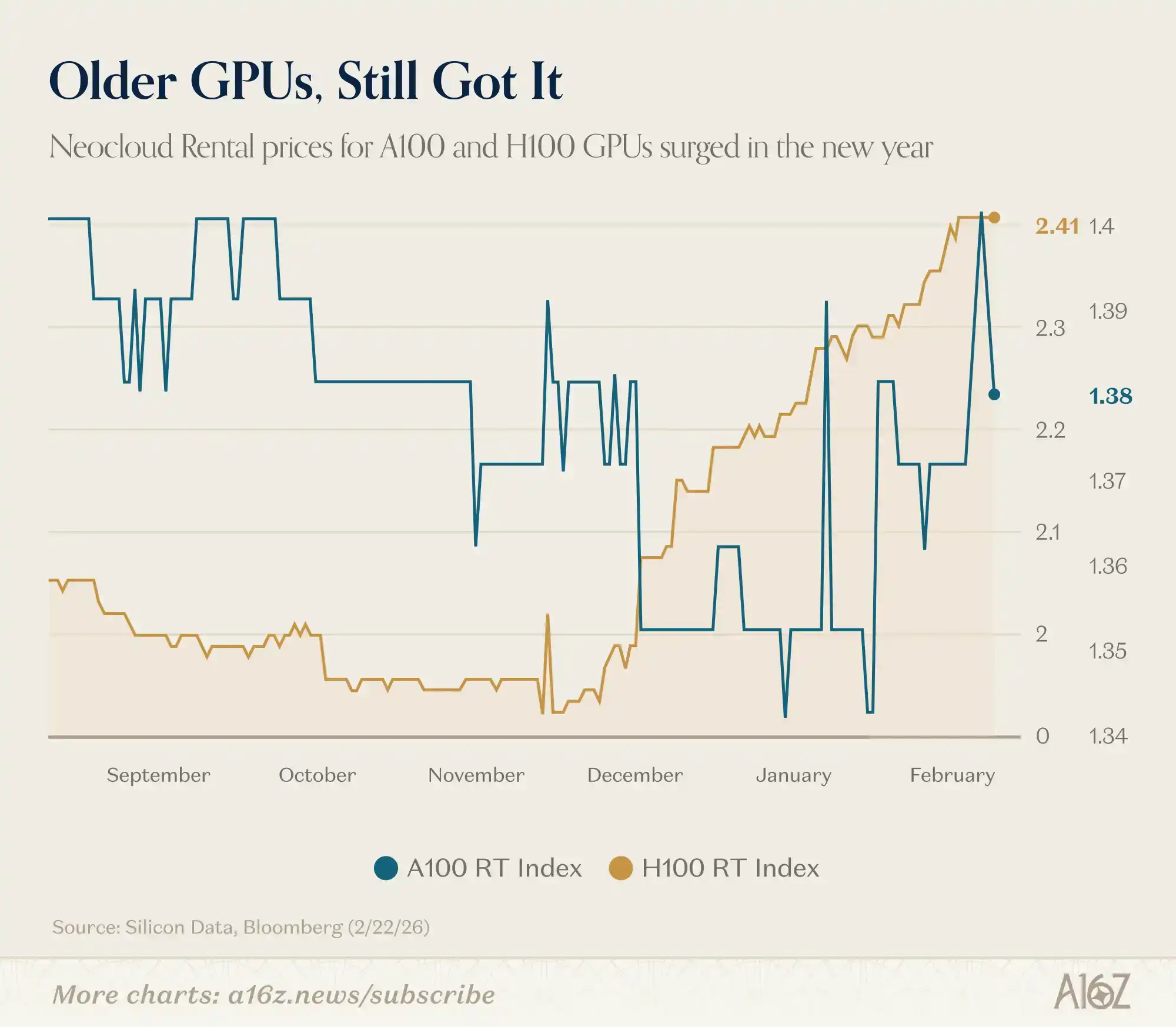
According to Silicon Data, rental prices for NVIDIA's H100 and A100 have both increased this year.

The market is far from showing signs of a compute oversupply; instead, it seems we haven't even scratched the surface of existing demand.

This comparison isn't a perfect analogy, but if history is any guide, it might take us a while longer to truly "see" what an AI-driven "economy" actually looks like:
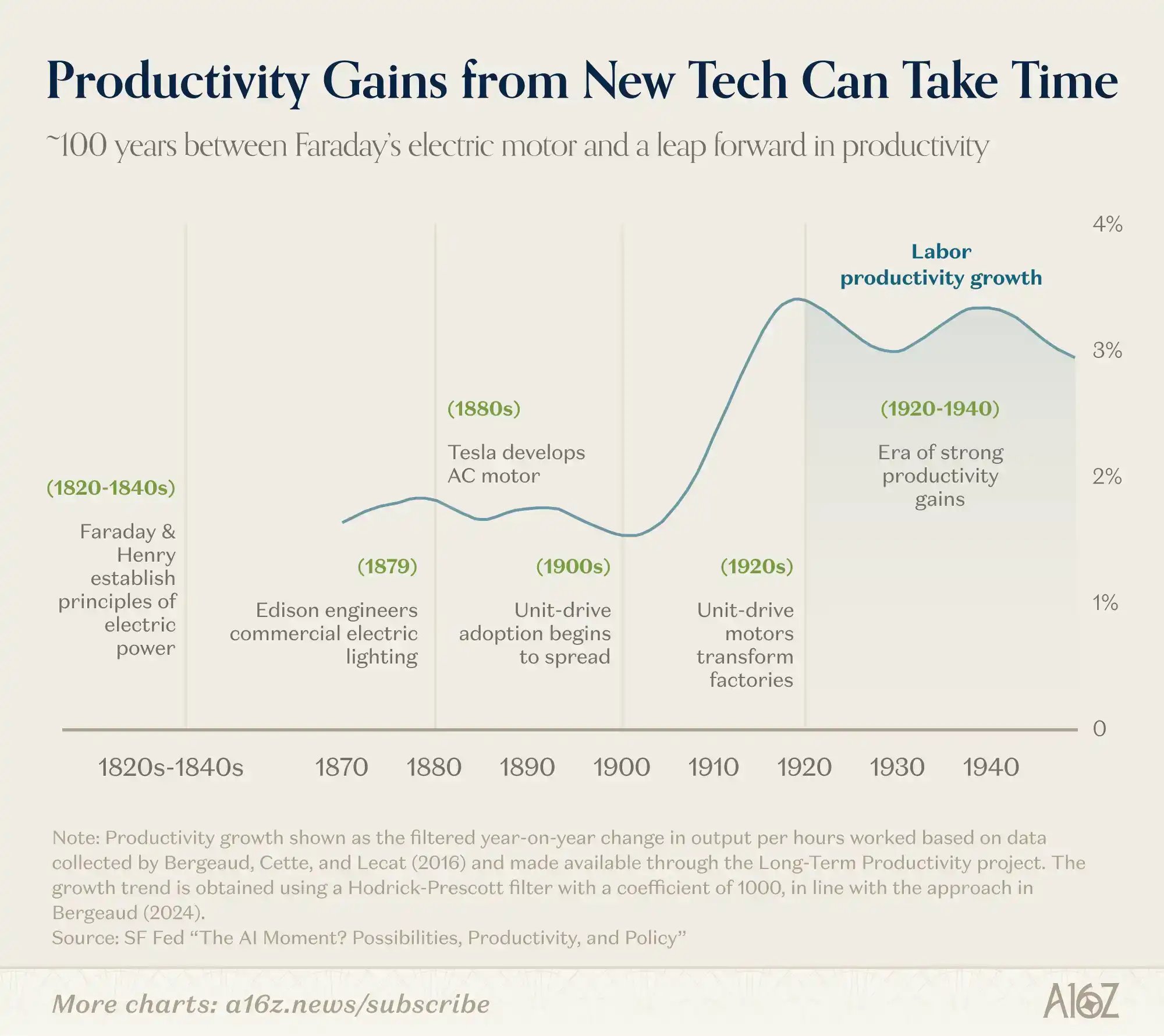
From the initial discussions of electric current by Faraday and Henry to the true explosion of industrial productivity in the first half of the 20th century, it took about 100 years.

Technology iteration cycles have indeed accelerated since the 1820s, but the variables involved in a platform-level shift remain extremely numerous.

Roy Amara famously said: "We tend to overestimate the effect of a technology in the short run and underestimate the effect in the long run."

Capital Expenditure, Put on the Axis

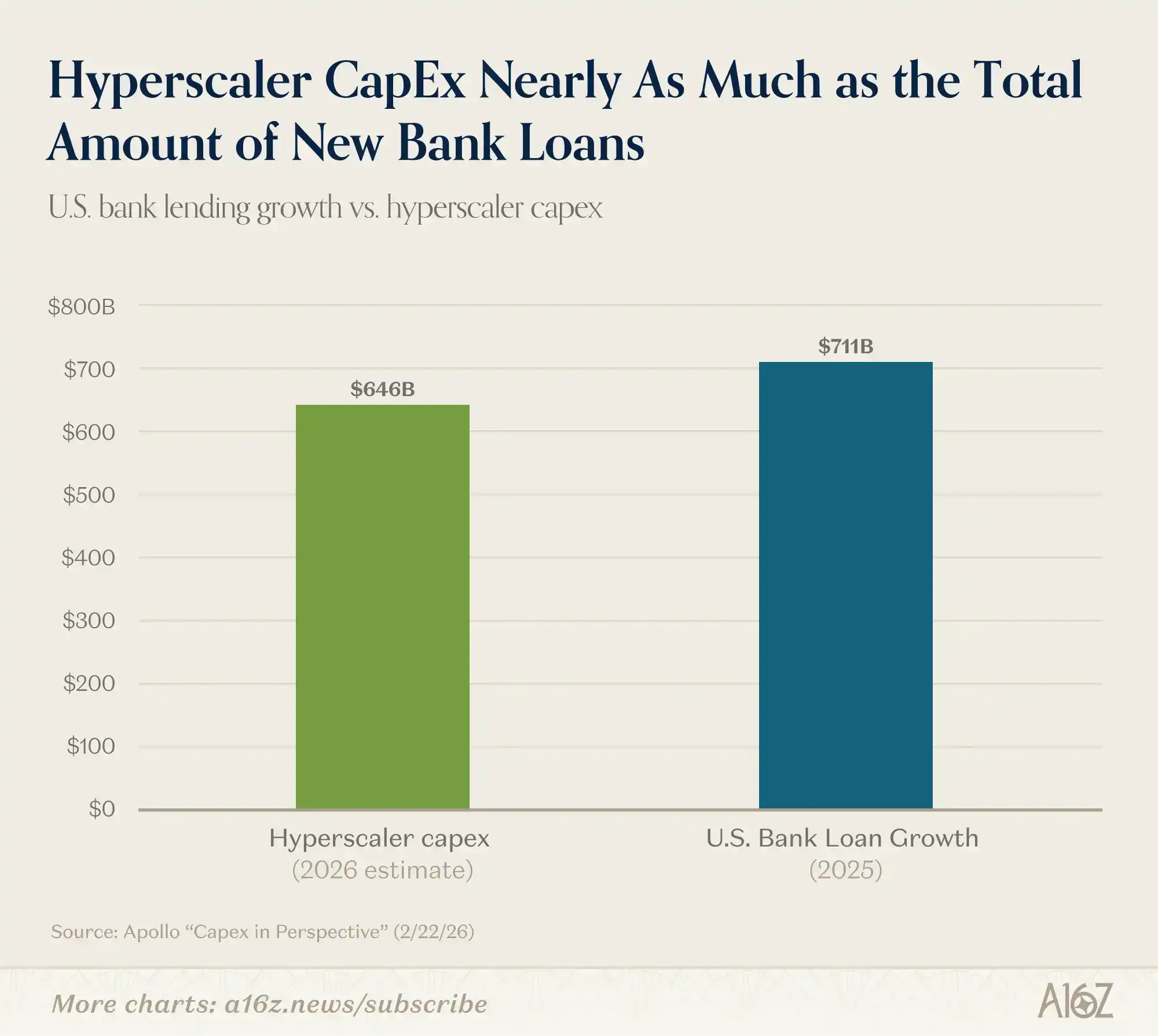
Here's a set of data that will never gets old: AI capital expenditure is huge.

Consider these comparisons:

2026 AI capex is projected to be close to the total net new lending by all US banks in 2025:
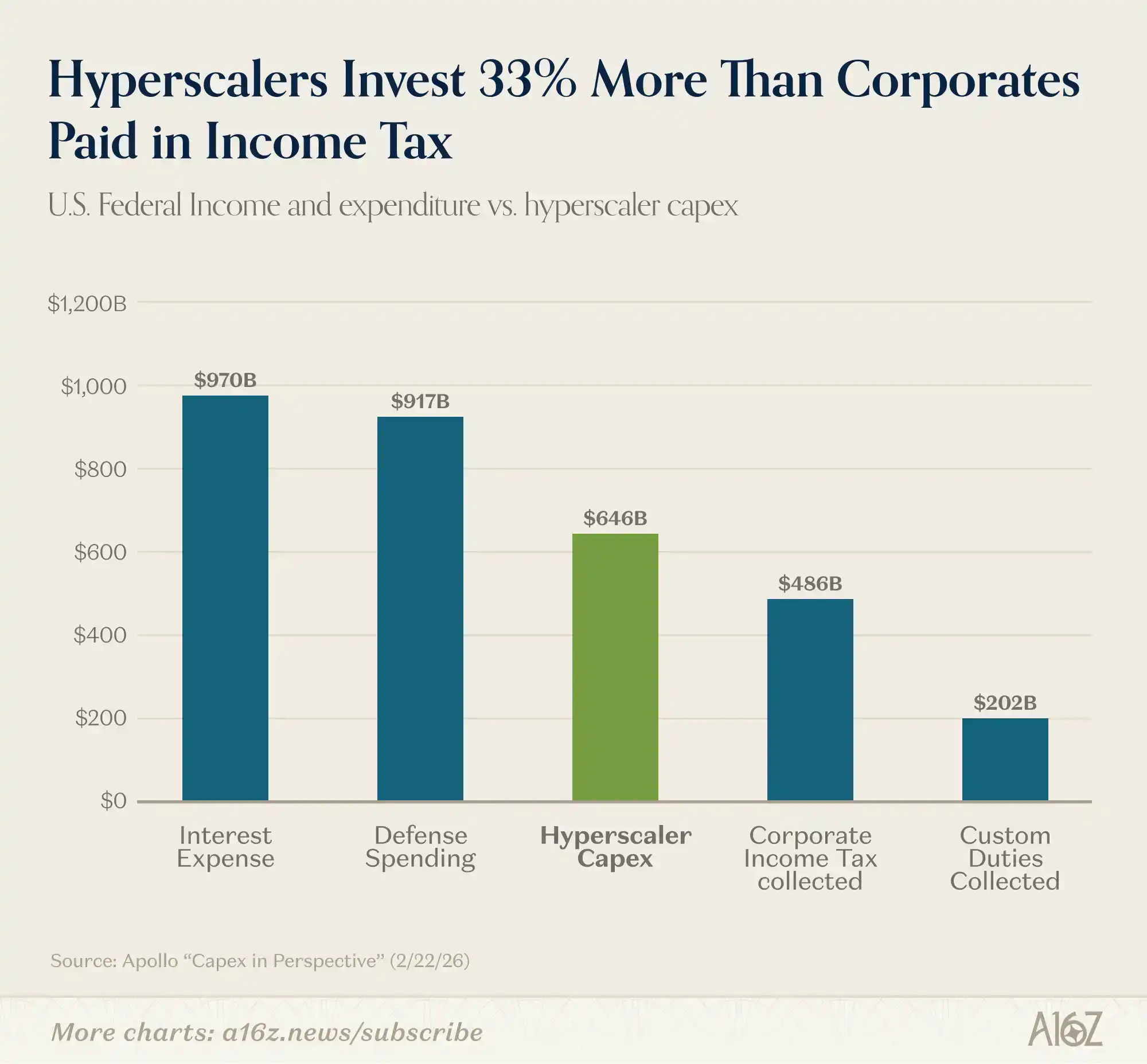
Capex is about 33% higher than total US corporate income tax revenue and about 3 times the total tariff revenue:
Capex is about 6 times the total military budget of any non-US G7 member country:
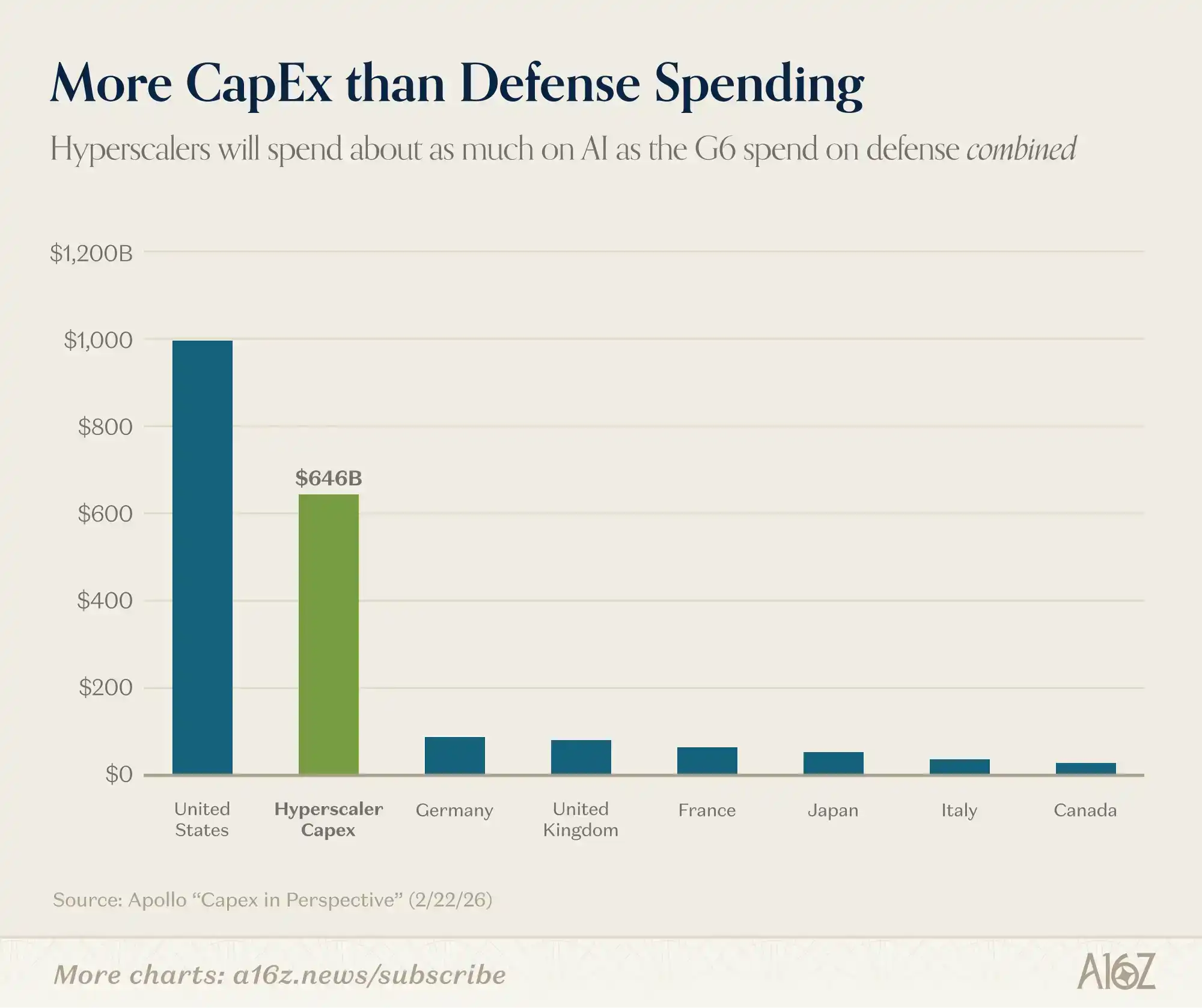
So, yes, capital expenditure is really huge.

Kalshi Moves into Macro Forecasting

Federal Reserve researchers think prediction markets are pretty good.

At least on one metric, Kalshi's predictions for the federal funds rate have already outperformed professional forecasting agencies:
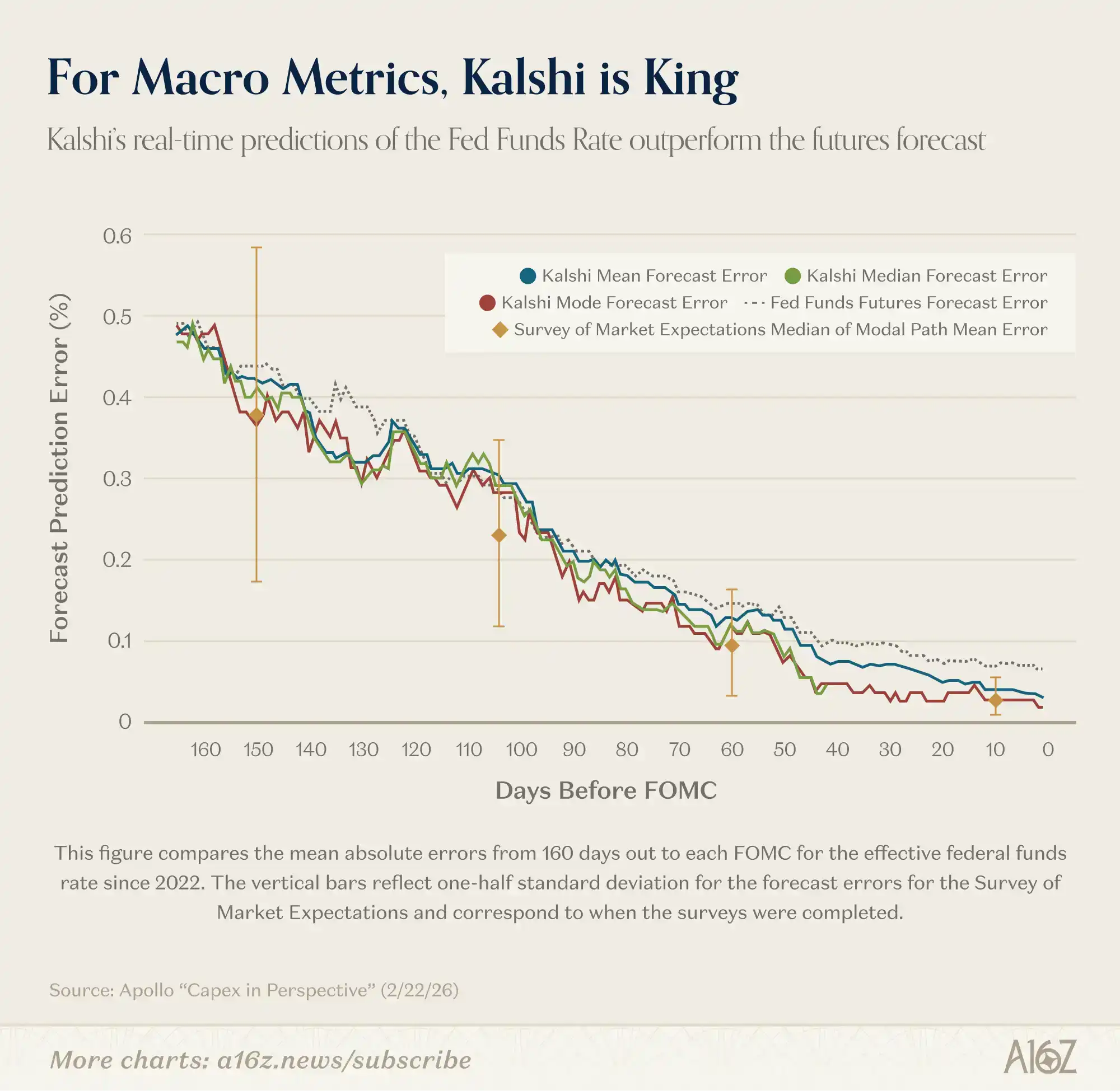
For predictions of the federal funds rate 150 days later (i.e., after 3 FOMC meetings), Kalshi's mean absolute error is very close to that of professional forecasters. But unlike surveys that provide only a snapshot of the modal path every six weeks, Kalshi provides a continuously updated full probability distribution......We find that Kalshi's median and mode predictions have a perfect track record on the day before FOMC meetings, which is a statistically significant improvement over federal funds futures predictions.

In other words, while all predictors start out similar, Kalshi's continuously updated predictions optimize over time, eventually achieving a perfect prediction record the day before the rate is officially announced. Furthermore, Kalshi's performance is also better than predictions from futures markets.

Kalshi's advantage extends beyond the federal funds rate. As the Fed researchers point out, since there are no other options markets for macro indicators like inflation, growth, and unemployment, Kalshi is the only place that provides a "high-frequency, continuously updated, probability distribution-rich 'baseline' reflecting 'crowd' judgments on the direction of these economic indicators.

Sounds pretty important.

The Delay of Adulthood

Here is a thought-provoking chart, with (a little) commentary:
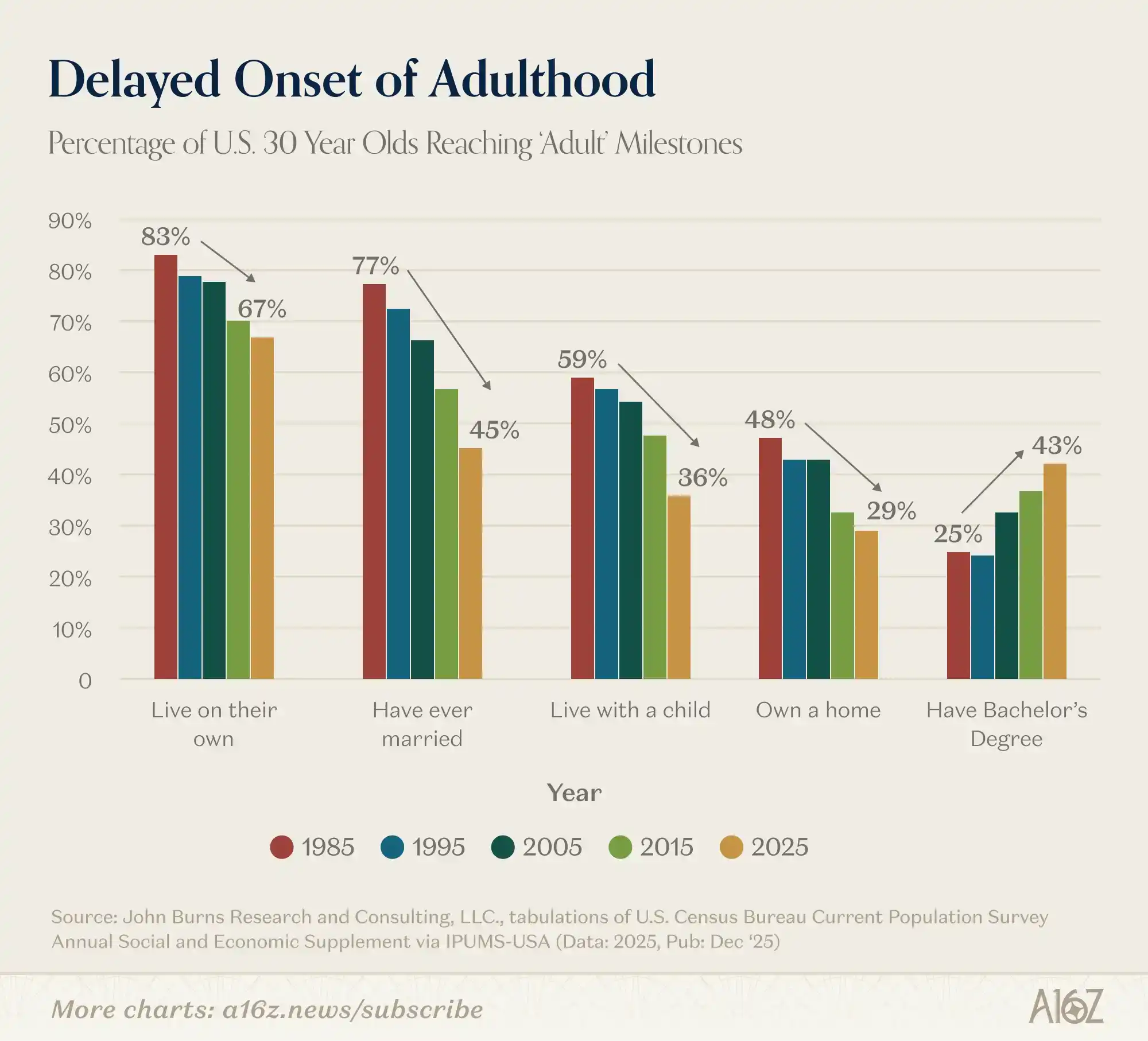
The proportion of 30-year-olds achieving major life milestones has been declining quite steeply since at least the 1980s.

Fewer and fewer 30-year-olds:

Live independently;

Have ever been married;

Live with children;

Own their home.

The only exception is college enrollment—the proportion of 30-year-olds with a bachelor's degree has almost doubled since 1995.

So, is college worth it?
Milestones? More like milestones around the neck, right?!

Maybe, maybe not, but a sense of "buyer's remorse" seems to be in the air.

Trend Kriptolar

İlgili Sorular

QWhat is the Jevons effect in the context of AI, as mentioned in the article?

AThe Jevons effect refers to the phenomenon where as AI becomes cheaper (with token costs dropping from about $0.90 to $0.50 per million tokens), its usage increases significantly (nearly doubling from around 6,000 to 12,000 tokens processed). This demonstrates that lower costs drive higher consumption of AI resources.

QAccording to the article, what is the 'DExit' trend and is it fully supported by data?

AThe 'DExit' trend suggests that companies are increasingly leaving Delaware as their state of incorporation, partly due to perceived looser stances in shareholder litigation by the Delaware Court of Chancery. However, data shows the situation is more complex: while some high-profile companies have moved out, Delaware's overall share of U.S. businesses has actually grown significantly, indicating it remains the default choice for many due to network effects and historical advantages.

QHow does Kalshi's prediction market performance compare to professional forecasting agencies for Federal Funds rates?

AKalshi's prediction market has outperformed professional forecasting agencies for Federal Funds rates. While initial predictions are similar, Kalshi's continuously updated probability distributions improve over time, achieving a perfect prediction record the day before FOMC meetings. This performance is statistically significant and better than futures market predictions.

QWhat major life milestones are declining among 30-year-olds in the U.S., based on the article?

AAmong 30-year-olds in the U.S., there has been a decline in the proportions who are living independently, have ever been married, live with children, and own a home. The only exception is college enrollment, where the rate has nearly doubled since 1995.

QHow does AI capital expenditure in 2026 compare to other major economic metrics mentioned in the article?

AAI capital expenditure in 2026 is projected to be nearly equivalent to the net new lending by all U.S. banks in 2025, about 33% higher than total U.S. corporate income tax revenue, roughly three times the total tariff revenue, and about six times the military budget of any non-U.S. G7 country, highlighting its massive scale.

İlgili Okumalar

STAR 50 Soars 10.73%, Why Did A-Shares Stage a "V-Shaped Reversal"?

After a prolonged decline, the Chinese A-share market staged a strong rally on July 21. The STAR 50 index surged 10.73%, its largest single-day gain in nearly a year, leading a broad-based "V-shaped" reversal. The Shanghai Composite Index rose 1.79%, the Shenzhen Component Index gained 4.81%, and the ChiNext Index jumped 7.05%. Total market turnover reached 2.97 trillion yuan, an increase of 256.1 billion yuan from the previous session, with over 3,100 stocks advancing. The semiconductor sector spearheaded the rebound, with related ETFs posting significant gains. Analysts attribute the surge to three converging factors. First, coordinated capital inflows from "national team" institutions, insurance funds, listed company buybacks, and fund house self-purchases have bolstered market liquidity and confidence. Second, supportive policy signals, including commitments from regulators to ensure stable market operations, provided a favorable backdrop. Third, a stabilization and recovery in overseas markets, notably South Korea, created a positive external environment. Institutions suggest the most severe panic selling phase for the tech sector has likely passed, following a significant digestion of crowded positions and leveraged funds. While short-term volatility may persist, the medium to long-term outlook remains underpinned by enduring trends like AI computing demand expansion and semiconductor localization. The market's focus now shifts to the sustainability of supportive fund flows, earnings reports, and upcoming catalysts from the global AI industry chain.

marsbit28 dk önce

STAR 50 Soars 10.73%, Why Did A-Shares Stage a "V-Shaped Reversal"?

marsbit28 dk önce

U.S. Tech Momentum Stocks Post Largest Single-Day Gain Ever, But Is the Plunge Over?

US tech momentum stocks staged a sharp rebound on Tuesday (July 21st). Morgan Stanley's TMT Momentum Factor surged over 12%, marking its largest single-day gain on record, exceeding even peaks from the 2000 dot-com bubble. Key momentum indices from Goldman Sachs also posted their strongest daily performances in years. The rally was led by semiconductors, with the Philadelphia Semiconductor Index jumping 4.6%. This rebound followed three consecutive down days and a cumulative 33% plunge in momentum stocks, one of the steepest drawdowns since the dot-com era. Analysts attribute the surge largely to a short squeeze. Heavy selling had pushed high-beta momentum stocks into deeply oversold territory, forcing many short sellers, particularly in Asia, to cover their positions, creating a self-reinforcing buying spiral. However, the rebound's internals appear weak. Trading volume was notably low, and advancing stocks still lagged decliners on the S&P 500, indicating a narrow, concentrated rally rather than broad market participation. Diverging views emerge on the outlook. BTIG warns the bounce has hit key resistance and recommends selling into strength, citing extreme volatility and historical parallels to past market tops. Conversely, Goldman Sachs and UBS believe the momentum unwind is nearing its end, suggesting it may be time to gradually add exposure, as positioning has been significantly reduced. They caution, however, that high volatility warrants a measured approach, potentially using defined-risk strategies. The upcoming earnings season, particularly reports from major tech firms like Alphabet, is seen as a critical test for the rally's sustainability. Simultaneously, bond markets flashed a warning, with yields rising partly due to spiking oil prices. Analysts note that if long-term Treasury yields break decisively higher, it could pose a significant headwind for equities, especially growth stocks.

marsbit35 dk önce

U.S. Tech Momentum Stocks Post Largest Single-Day Gain Ever, But Is the Plunge Over?

marsbit35 dk önce

U.S. Tech Momentum Stocks Record Largest Single-Day Gain Ever, but Has the Rout Ended?

U.S. tech momentum stocks staged a dramatic rebound on Tuesday, July 21st. Key momentum indices like the Morgan Stanley TMT Momentum Factor and Goldman Sachs' High Beta Momentum Long Index posted historic or near-historic single-day gains, fueled largely by semiconductor stocks. This sharp rally followed a severe three-day sell-off that saw momentum stocks plunge 33%, marking one of the steepest pullbacks since the dot-com bubble. Analysts attribute the bounce primarily to a short squeeze, as forced covering from over-leveraged traders, particularly in Asia, created a buying spiral. However, the rally's health is questioned due to weak market breadth—overall trading volume was low, and decliners outnumbered advancers in the S&P 500 despite the index's gain—suggesting a narrow, concentrated surge rather than broad recovery. Opinions on the sustainability diverge. BTIG strategists warn the rebound has hit key resistance levels, citing extreme volatility and historic stock dispersion as signs of an ongoing broader correction, and recommend selling into strength. Conversely, Goldman Sachs and UBS view the aggressive momentum unwinding as nearing its end, noting reduced positioning and a lack of new fundamental catalysts. They suggest the sell-off presents a selective opportunity to add exposure, albeit cautiously and gradually using defined-risk strategies. The immediate trajectory hinges on the ongoing earnings season, with market focus on Alphabet's capital expenditure guidance for AI investment clarity. Meanwhile, bond markets present a risk, with rising Treasury yields—potentially heading toward 5.5%—and widening credit spreads for mega-cap tech companies posing a threat to equity valuations. The combination of technical factors, earnings results, and macro conditions leaves the durability of the rebound in doubt.

链捕手38 dk önce

U.S. Tech Momentum Stocks Record Largest Single-Day Gain Ever, but Has the Rout Ended?

链捕手38 dk önce

Long-Divided Must Unite, Long-United Must Divide: When L1 Becomes Its Own Rollup, What Is Ethereum's Endgame?

"The Inevitable Cycle: When L1 Becomes Its Own Rollup – What is Ethereum's Endgame?" For years, the Ethereum community grappled with concerns that L2s were fragmenting the ecosystem and eroding L1's value. While L2s provided cheaper execution, they also splintered liquidity and the unified user experience of a single chain. This has prompted a fundamental reassessment of the relationship between L1 and L2. Ethereum's roadmap is evolving. The "Scale" initiative merges L1 and L2 expansion into a holistic framework. L1 itself is advancing with higher gas limits, statelessness, and zkEVM verification, no longer content to be just a low-throughput settlement layer. Consequently, the primary value proposition of L2s is shifting from merely providing cheap blockspace to offering L1 cannot easily provide: application-specific optimizations, privacy features, and flexible governance models. L2s are becoming a spectrum of execution environments with varying degrees of security inheritance from Ethereum. A critical challenge in this multi-chain future is interoperability. The vision is to make Ethereum "feel like one chain again." This relies on advancements in native account abstraction (like EIP-7702) and intent-based architectures (Open Intents Framework), where users declare desired outcomes, and solvers handle the complex cross-chain execution. Furthermore, shortening Ethereum's finality time from minutes to seconds is crucial, as it underpins trust between chains for bridges, stablecoins, and cross-chain applications. Perhaps the most provocative idea is that Ethereum L1 itself could become a form of "its own Rollup." As zkEVM and proof systems mature, high-performance nodes could execute transactions and generate validity proofs. Regular validators would then verify these proofs instead of re-executing all transactions. This blurs the traditional L1/L2 hierarchy, making "Rollup" more of a general execution-verification architecture. Native Rollup aims to integrate L2 validation more directly into the Ethereum protocol, allowing L2s to inherit L1's security more fully and move away from reliance on security councils. In the end, L2s are not destined to replace L1 or be made obsolete by it. The likely future is a unified system where diverse execution environments—each optimized for specific use cases like DeFi, gaming, or privacy—coexist. They will share a common foundation of security, liquidity, and verifiable state, seamlessly connected to restore a cohesive user experience. The next phase for Ethereum is not just about scaling through separation, but about intelligently reintegrating what was separated back into a coherent whole.

链捕手54 dk önce

Long-Divided Must Unite, Long-United Must Divide: When L1 Becomes Its Own Rollup, What Is Ethereum's Endgame?

链捕手54 dk önce

İşlemler

Spot

Popüler Makaleler

ERA Nasıl Satın Alınır

HTX.com’a hoş geldiniz! Caldera (ERA) satın alma işlemlerini basit ve kullanışlı bir hâle getirdik. Adım adım açıkladığımız rehberimizi takip ederek kripto yolculuğunuza başlayın. 1. Adım: HTX Hesabınızı OluşturunHTX'te ücretsiz bir hesap açmak için e-posta adresinizi veya telefon numaranızı kullanın. Sorunsuzca kaydolun ve tüm özelliklerin kilidini açın. Hesabımı Aç2. Adım: Kripto Satın Al Bölümüne Gidin ve Ödeme Yönteminizi SeçinKredi/Banka Kartı: Visa veya Mastercard'ınızı kullanarak anında Caldera (ERA) satın alın.Bakiye: Sorunsuz bir şekilde işlem yapmak için HTX hesap bakiyenizdeki fonları kullanın.Üçüncü Taraflar: Kullanımı kolaylaştırmak için Google Pay ve Apple Pay gibi popüler ödeme yöntemlerini ekledik.P2P: HTX'teki diğer kullanıcılarla doğrudan işlem yapın.Borsa Dışı (OTC): Yatırımcılar için kişiye özel hizmetler ve rekabetçi döviz kurları sunuyoruz.3. Adım: Caldera (ERA) Varlıklarınızı SaklayınCaldera (ERA) satın aldıktan sonra HTX hesabınızda saklayın. Alternatif olarak, blok zinciri transferi yoluyla başka bir yere gönderebilir veya diğer kripto para birimlerini takas etmek için kullanabilirsiniz.4. Adım: Caldera (ERA) Varlıklarınızla İşlem YapınHTX'in spot piyasasında Caldera (ERA) ile kolayca işlemler yapın.Hesabınıza erişin, işlem çiftinizi seçin, işlemlerinizi gerçekleştirin ve gerçek zamanlı olarak izleyin. Hem yeni başlayanlar hem de deneyimli yatırımcılar için kullanıcı dostu bir deneyim sunuyoruz.

581 Toplam GörüntülenmeYayınlanma 2025.07.17Güncellenme 2026.06.02

ERA Nasıl Satın Alınır

Tartışmalar

HTX Topluluğuna hoş geldiniz. Burada, en son platform gelişmeleri hakkında bilgi sahibi olabilir ve profesyonel piyasa görüşlerine erişebilirsiniz. Kullanıcıların ERA (ERA) fiyatı hakkındaki görüşleri aşağıda sunulmaktadır.

活动图片













