US SEC Closes Biden-Era Investigation Into Ondo Finance Without Charges

bitcoinist2025-12-09 tarihinde yayınlandı2025-12-09 tarihinde güncellendi

Özet

The US Securities and Exchange Commission (SEC) has closed its two-year investigation into Ondo Finance without filing any charges. The probe, initiated in 2024 under the Biden administration, examined whether the platform’s tokenized real-world assets (RWA) and its ONDO token complied with federal securities laws. Ondo Finance described the decision as a "meaningful milestone" for the tokenization industry, reflecting a broader shift in U.S. regulatory policy toward embracing innovation. The SEC has since added tokenization to its formal agenda, recognizing its potential to modernize capital markets. Ondo, a leader in the RWA sector, aims to advance the seamless movement of tokenized assets across blockchains.

The US Securities and Exchange Commission (SEC) concluded its Biden-era probe into DeFi platform Ondo Finance, and whether its tokenized products complied with federal securities laws, without any charges, following the Trump administration’s pro-industry approach and focus on tokenization.

Case Closes: SEC Ends Ondo Finance Probe

On Monday, Ondo Finance announced it had received formal notice that the US SEC’s two-year investigation into the platform, which started during the Biden administration, had concluded in late November with no charges.

The platform now joins the list of crypto companies that have seen their cases and probes dismissed or closed without any enforcement actions this year, including Gemini, Kraken, Ripple, Coinbase, and Uniswap Labs.

The SEC initiated the probe in 2024 to examine whether firms’ tokenization of Real-World Assets (RWA) complied with federal securities laws, the platform explained. Additionally, it sought to determine whether the ONDO token was a security.

“Ondo’s growth and leadership in the emerging tokenization category made us a focus, but not a justified target,” the announcement added. At the time, the US regulatory environment was characterized by a “regulation by enforcement” approach, which led to caution and confusion.

Nonetheless, they “remained steadfast in its conviction that regulated, transparent tokenization models like Ondo’s are not only compatible with investor-protection principles, but can strengthen them.”

To Ondo Finance, this marks a “meaningful milestone” for the broader tokenization industry, which will push innovation, compliance, security, and investor protection forward, as the sector gains momentum and becomes a priority on the federal agency’s agenda.

It’s worth noting that Ondo has solidified its position as a leader in the RWA sector with strategic partnerships, expansions, and the launch of its own Layer-1 blockchain, which aims to bridge the gap between traditional finance and decentralized finance.

As reported by Bitcoinist, the firm aims to advance its mission to “democratize” access to high-quality US financial assets and ensure tokenized assets move seamlessly across major blockchains.

A New Chapter For Tokenized Securities

In the Monday statement, the platform also highlighted that the SEC’s decision reflects a broader shift in US policy, with regulators reassessing the methods used during the Biden era for the crypto industry. Earlier this year, a White House report recognized the sector as foundational to the future of the global financial system and named Ondo Finance among the key players.

Notably, the regulatory agency has added tokenization to its formal agenda. In the SEC’s Investor Advisory Committee meeting last week, the regulatory agency affirmed it is evaluating tokenization to modernize the issuance, trading, and settlement of public equities.

In his remarks, SEC chairman Paul Atkins stated, “Distributed ledger technology and the tokenization of financial assets, including securities, have the potential to transform our capital markets. Our financial markets have long been the envy of the world, and to ensure that they remain so, U.S. firms and investors must have the opportunity to leverage this technology as they lead the future of global capital markets.”

Atkins added that the agency’s role is to enable market participants to operate and innovate under clear guardrails, ensuring that the US markets remain the most dynamic, transparent, and trusted in the world.

“The resolution of the SEC inquiry marks the end of one chapter for Ondo and the beginning of another. Put simply, the time is now for tokenized securities to become a core part of U.S. capital markets. The future of global finance, including U.S. capital markets, will be onchain and Ondo will help lead that transition,” the announcement concluded.
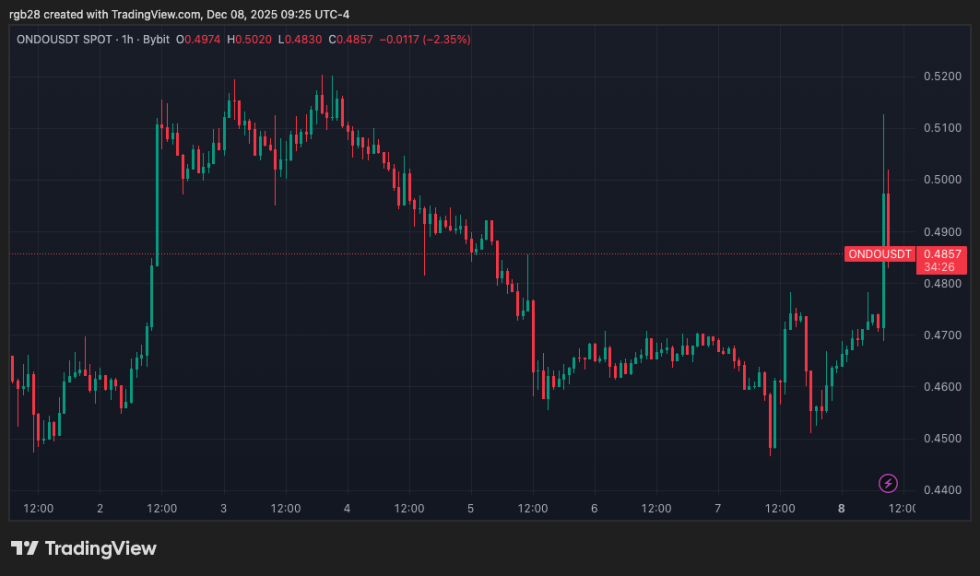
ONDO is trading at $0.48 in the one-week chart. Source: ONDOUSDT on TradingView

İlgili Okumalar

Institutions Are Taking Over the Crypto Market: Is This the End of Decentralization, or the Prelude to a New Cycle?

The cryptocurrency market is undergoing a structural shift in 2025, with institutional investors now accounting for approximately 95% of capital inflows, while retail participation has declined to 5–6%. According to Aishwary Gupta of Polygon Labs, this transition is driven by maturing infrastructure rather than market sentiment. Major asset managers like BlackRock, Apollo, and Hamilton Lane are allocating portions of their portfolios to digital assets via ETFs and on-chain tokenized products, leveraging public blockchains that meet traditional finance compliance standards. Key drivers include yield generation through tokenized treasuries and institutional staking, followed by efficiency gains from faster settlements, shared liquidity, and programmable assets. While retail investors retreated due to losses from meme coin cycles, Gupta believes they will return as more regulated and transparent products emerge. He argues that institutional involvement does not undermine decentralization; instead, it enhances legitimacy and fosters a hybrid financial ecosystem where DeFi, NFTs, and traditional assets coexist on public chains. Although increased compliance may limit some experimentation, it promotes more sustainable innovation. Looking ahead, institutional liquidity is expected to reduce market volatility and accelerate the growth of real-world asset tokenization and cross-chain interoperability infrastructure. This evolution signals crypto’s transition from a speculative asset to a core component of the global financial system.

比推12 dk önce

Institutions Are Taking Over the Crypto Market: Is This the End of Decentralization, or the Prelude to a New Cycle?

比推12 dk önce

World's Richest Man, 'Silicon Valley Iron Man' Musk, to Take SpaceX Public in 2026!

Elon Musk, the world's richest person and CEO of SpaceX, plans to take the company public in 2026 with a target valuation of approximately $1.5 trillion. The IPO is expected to raise "significantly more than $30 billion," potentially making it the largest in history, surpassing Saudi Aramco's 2019 offering. A key driver of this ambitious valuation is a new narrative: **space-based AI computing**. Musk introduced the concept of "space AI compute" at a recent investor conference, arguing that within five years, running AI training and inference in space could become the lowest-cost solution. The core advantages include near-uninterrupted solar power and the vacuum of space acting as an ultimate heat sink. Additionally, with its reusable Starship rockets, SpaceX aims to drastically reduce launch costs to as low as $200–300 per kilogram. This vision, however, faces significant technical hurdles. Challenges include managing extreme heat radiation in direct sunlight, protecting hardware from cosmic radiation, and the economic risks associated with potential launch failures. Competitors are also entering the arena, including Jeff Bezos’ Blue Origin, which is developing its own orbital data centers, and Sam Altman’s OpenAI, which is reportedly considering acquiring a rocket company. Despite the challenges, Wall Street has responded positively. Firms like Ark Invest are now valuing SpaceX as a high-growth AI infrastructure company rather than a traditional aerospace firm, projecting that its space-based compute business could generate $80–120 billion in high-margin revenue by 2030. The success of this new "space dream" hinges on the continued development of Starship, overcoming technical barriers, and navigating future regulatory landscapes.

marsbit26 dk önce

World's Richest Man, 'Silicon Valley Iron Man' Musk, to Take SpaceX Public in 2026!

marsbit26 dk önce

İşlemler

Spot
Futures
活动图片