Teen Accused Of $13M Crypto Scam That Funded Miami Luxury

bitcoinist2026-06-12 tarihinde yayınlandı2026-06-12 tarihinde güncellendi

Özet

A Canadian teenager, Trenton Richard David Johnston, is accused of running a cryptocurrency fraud scheme from the Miami area, allegedly causing over $13 million in losses. The 19-year-old and unnamed co-conspirators are charged with posing as support representatives from a major search engine and crypto companies to gain access to victims' digital accounts and crypto wallets. He was indicted on charges of conspiracy to commit wire fraud and money laundering. Prosecutors allege that Johnston, along with co-defendant Brandon Michael Tardibone, laundered more than $1 million of the illicit funds to finance luxury vehicles, high-end jewelry, and an extravagant nightlife. Tardibone is additionally charged with harboring Johnston, who had overstayed his visa. Both defendants face up to 20 years in prison if convicted. The case is being prosecuted by the U.S. Attorney's Office for the Southern District of Florida.

A Canadian teenager accused of running a multimillion-dollar crypto fraud operation from the Miami area has become the latest young defendant tied to a high-value social-engineering theft case in the US Prosecutors say the scheme caused more than $13 million in losses and helped finance luxury vehicles, jewelry and nightlife spending.

The case centers on Trenton Richard David Johnston, a Canadian national who was 19 when federal prosecutors in the Southern District of Florida announced the indictment on May 11. According to the US Attorney’s Office, Johnston had overstayed his visa and remained in the US unlawfully while allegedly operating a fraud scheme that targeted victims’ digital accounts and crypto wallets.

Federal prosecutors said Johnston and unnamed co-conspirators posed as support representatives from a major search engine and crypto-related companies. The alleged objective was familiar but effective: convince victims that their accounts were at risk or already compromised, obtain access to the accounts, and move the assets before the victims could respond.

The DOJ framed the core allegation bluntly, saying Johnston and others “allegedly impersonated support representatives from a popular search engine and cryptocurrency-related companies.” The agency also cautioned: “An indictment/complaint is merely an allegation. All defendants are presumed innocent until proven guilty beyond a reasonable doubt in a court of law.”

Johnston was charged with conspiracy to commit wire fraud and conspiracy to commit money laundering. A later docket entry listed a plea agreement as to Johnston filed on June 9, indicating the case has already moved beyond the initial indictment stage for at least one defendant.

Crypto Scam: Luxury Spending Becomes Part Of The Case

The alleged theft was not described as a simple wallet-drain operation. Prosecutors also accused Johnston and Brandon Michael Tardibone, 28, of Miami, of laundering proceeds through financial transactions designed to conceal the nature and source of the funds.

According to the DOJ, Johnston and Tardibone allegedly used more than $1 million in illicit proceeds to lease luxury vehicles, buy high-end jewelry and finance what prosecutors called an “extravagant nightlife and entertainment lifestyle.” That spending trail is central to the government’s theory: the alleged crypto theft did not just move across wallets, but into visible luxury assets and services.

Tardibone was separately accused of knowingly harboring Johnston while Johnston was unlawfully present in the US Prosecutors said Tardibone provided lodging at a luxury Miami-area residence in an effort to help Johnston evade immigration authorities. He was charged with conspiracy to commit money laundering and harboring an alien in the United States.

The case is being investigated by HSI Miami, with assistance from the Federal Deposit Insurance Corporation Office of Inspector General, IRS Criminal Investigation, US Customs and Border Protection, and the Golden Beach Police Department. Assistant US Attorneys Jackson K. Dering V and Robert F. Moore are prosecuting the matter.

If convicted on the original charges, Johnston faced up to 20 years in prison on the wire fraud conspiracy and money laundering conspiracy counts. Tardibone also faces up to 20 years on the money laundering conspiracy charge and up to 10 years on the harboring charge.

At press time, the total crypto market cap stood at $2.14 trillion.
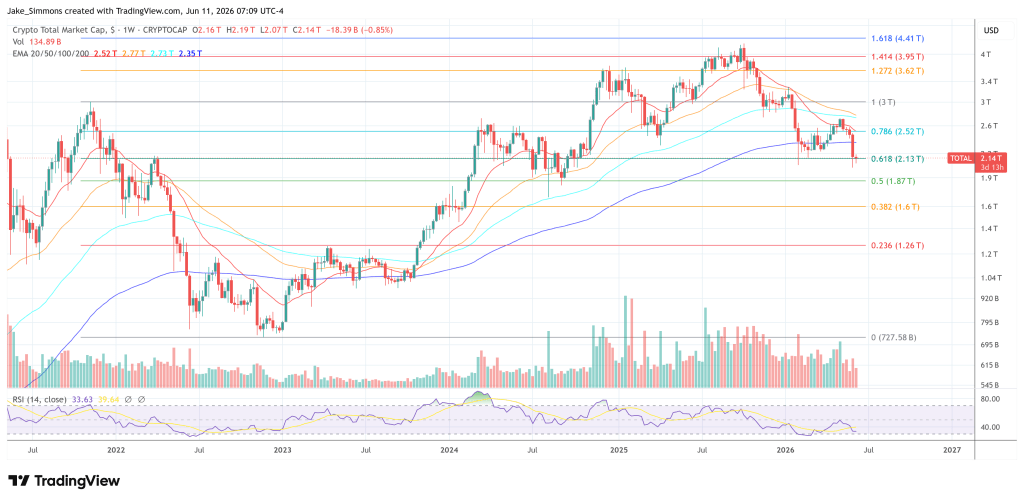
Total crypto market cap must stay above the 0.618 Fib, 1-month chart | Source: TOTAL on TradingView.com

İlgili Sorular

QWhat is the core allegation against Trenton Richard David Johnston according to the US Department of Justice?

AAccording to the DOJ, Johnston and others allegedly impersonated support representatives from a popular search engine and cryptocurrency-related companies to convince victims their accounts were compromised, gain access, and steal assets.

QHow did the defendants allegedly use the proceeds from the crypto scam?

AThey allegedly used over $1 million in illicit proceeds to lease luxury vehicles, buy high-end jewelry, and finance an extravagant nightlife and entertainment lifestyle.

QWhat charges was Brandon Michael Tardibone facing in connection to this case?

ABrandon Michael Tardibone was charged with conspiracy to commit money laundering and harboring an alien (Johnston) in the United States.

QWhat was the status of Johnston's legal case as indicated by a docket entry mentioned in the article?

AA docket entry listed a plea agreement for Johnston filed on June 9, indicating the case had moved beyond the initial indictment stage for at least one defendant.

QWhat agencies were involved in investigating this crypto fraud case?

AThe case was investigated by HSI Miami, with assistance from the Federal Deposit Insurance Corporation Office of Inspector General, IRS Criminal Investigation, U.S. Customs and Border Protection, and the Golden Beach Police Department.

İlgili Okumalar

Huang Xiaoming, Li Bin, Lei Jun, Liang Wenfeng... Who Are the Biggest Winners in the CXMT IPO Feast?

Changxin Technology, a leading Chinese memory chip manufacturer, successfully listed on the Shanghai Stock Exchange's STAR Market (科创板) on July 8, 2026. Its share price surged from the IPO price of 8.66 yuan to close at 49 yuan on the first day, catapulting its market capitalization to 3.28 trillion yuan, making it the most valuable A-share company and triggering a massive wealth creation event. The biggest winners were the company's founder, Zhu Yiming, and its employees. Zhu Yiming's family wealth skyrocketed nearly 300% to approximately $13.9 billion, with his direct stake in Changxin valued at around 80 billion yuan. Additionally, over 6700 employees benefited from stock ownership plans, creating at least 237 new millionaires (in CNY). Zhu also pledged to donate 768 million shares, worth over 37.6 billion yuan, for future employee incentives over a ten-year period. Several prominent investors and corporate clients also reaped significant paper gains from the IPO. Notable figures include: * **Liang Wenfeng**, founder of DeepSeek, whose funds netted a paper profit of approximately 827 million yuan. * **Kong Jianping**, founder of Nano Labs, saw his indirect holdings valued at roughly 940 million yuan. * **Li Bin**, founder of Nio, whose company's strategic investment of 158 million yuan is now worth about 740 million yuan. * **Lei Jun**, founder of Xiaomi, whose subsidiary holds shares currently showing a paper gain of over 736 million yuan. Xiaomi clarified this is a corporate investment, not direct personal wealth. The article notes that while this IPO created immense wealth for insiders and large investors, retail investors who were lucky enough to win an allotment in the lottery typically profited by around 20,000 yuan. The listing solidifies Changxin's position as China's premier domestic memory chipmaker.

marsbit8 dk önce

Huang Xiaoming, Li Bin, Lei Jun, Liang Wenfeng... Who Are the Biggest Winners in the CXMT IPO Feast?

marsbit8 dk önce

IOSG: From Hot Storage to Cold Memory – Decentralized Storage in the AI Era's Storage Boom

This article explores the stark contrast between the booming AI storage sector and the currently undervalued decentralized storage market. It argues their core value propositions differ fundamentally: AI storage is a "hot data efficiency" system designed to maximize computational throughput, GPU utilization, and business monetization by accelerating data flow into processors. In contrast, decentralized storage represents a "cold data trust" system, prioritizing data immutability, censorship resistance, and the preservation of long-term human memory. The analysis details the multi-layered AI storage architecture, from high-bandwidth memory (HBM) and enterprise SSDs for high-performance needs to data lakes for capacity. It highlights how AI has repositioned storage from a cost center to a critical efficiency engine. Decentralized storage, exemplified by Filecoin and Arweave, is examined for its distinct philosophies and current challenges, including product-market fit, retrieval latency, and enterprise adoption hurdles. Despite its current quiet phase, the article posits that decentralized storage holds unique future value for AI data provenance, public dataset archiving, compliance, and safeguarding civilizational records against censorship. The conclusion suggests that while the market currently rewards efficiency, the need for trusted, permanent data layers may eventually lead to a revaluation of decentralized storage's role.

marsbit12 dk önce

IOSG: From Hot Storage to Cold Memory – Decentralized Storage in the AI Era's Storage Boom

marsbit12 dk önce

Exploring ChangXin Technology's Hefei Headquarters: The Rising Campus Ignites Changgang CBD, Grassroots Employees 'Witness' Wealth Creation Myth

"On-the-Ground Visit to CXMT's Hefei Headquarters: Campus Boom Ignites Changgang 'CBD,' While Rank-and-File Employees Watch Wealth Creation Myth from the Sidelines." Following CXMT's (ChangXin Memory Technologies Inc., 688825.SH) explosive stock market debut on July 27, where its share price surged over fivefold, a site visit to its Hefei headquarters reveals a stark contrast. While the company's市值 soared, making it A-share's most valuable firm,基层员工 indicate the wealth creation has largely bypassed them. Employees reveal that股权激励 is restricted to managerial levels (Grade 9科长 and above), with most普通员工 at Grades 11 or 12. Salaries, while considered high for Hefei at around 200,000 RMB annually, fall short of the millions speculated online. Work routines remain demanding, with long hours, phone confiscation in sensitive areas, and strict保密 protocols forbidding unauthorized external communication. Simultaneously, CXMT's expansion is visibly transforming the once-rural Changgang area. Ongoing construction includes multiple new phases, with an industrial chain of supporting companies集聚 around the campus. This growth has spurred local development: housing prices initially skyrocketed, and a vibrant commercial district dubbed "Changgang CBD" now thrives, catering to the潮汐效应 of shift workers. The area has evolved from construction sites to a bustling hub, though the company's stringent安保, including high-voltage perimeter fencing, underscores its sensitive nature. The report concludes that while CXMT's rise fuels regional economic activity, the immediate financial rewards of its上市 are not shared by its frontline workforce.

marsbit13 dk önce

Exploring ChangXin Technology's Hefei Headquarters: The Rising Campus Ignites Changgang CBD, Grassroots Employees 'Witness' Wealth Creation Myth

marsbit13 dk önce

Huang Xiaoming, Li Bin, Lei Jun, Liang Wenfeng... Changxin IPO Feast, Who's the Biggest Winner?

Changxin Technology's IPO on the Shanghai STAR Market created significant wealth for its stakeholders. Founder Zhu Yiming and his family saw their wealth surge nearly 300%, with his stake in Changxin alone valued at approximately 80 billion RMB. Over 6700 employees benefited, creating at least 237 new millionaires. Several prominent figures also profited. Liang Wenfeng, founder of Deepseek, saw a paper gain of 827 million RMB through his funds' participation. Kong Jianping, founder of Nano Labs, holds an indirect stake worth around 940 million RMB, representing a roughly 44x return on his 2020 investment. Former Midea executive Huang Xiaoming gained approximately 503 million RMB. Strategic investors included industry partners. Nio, represented by founder William Li, pledged 158 million RMB for shares now showing a paper gain of about 740 million RMB. Similarly, a Xiaomi subsidiary acquired shares resulting in an over 736 million RMB gain, though the company clarified this is a corporate investment, not directly attributable to founder Lei Jun's personal wealth. Founder Zhu Yiming further plans to donate shares worth over 37.6 billion RMB for future employee incentives. The IPO solidified Changxin's position as a leading domestic memory chip maker, triggering a widespread wealth creation event for its network of founders, employees, and investors.

Odaily星球日报28 dk önce

Huang Xiaoming, Li Bin, Lei Jun, Liang Wenfeng... Changxin IPO Feast, Who's the Biggest Winner?

Odaily星球日报28 dk önce

Aave's Stable Vault

This article explores Aave's recently launched "Stable Vaults," a product designed to bridge the gap between traditional finance users and DeFi yield. It argues that while DeFi offers transparency and potentially higher returns, its complexity and volatility are major barriers for mainstream adoption. The core problem is that users pay for convenience and simplicity, often accepting lower returns to avoid decision-making and technical hurdles. Stable Vaults allow fintech apps, neobanks, or payment platforms (operators) to integrate with Aave's lending markets once and offer their users a "savings account" with a fixed, predictable yield (e.g., 4%). The operator absorbs the underlying market volatility; if Aave's pool pays 6%, the operator pockets the 2% difference, but if it pays only 2%, the operator covers the shortfall to maintain the promised 4% for users. The piece analyzes this model from three perspectives: 1. **The User:** Gains simplicity, a fixed rate, and familiar app features (customer support, account recovery). However, they lose potential upside, accept a lower fixed yield, and take on new counterparty risks from the operator and its proprietary backend systems. 2. **The Operator (e.g., a neobank):** Can monetize idle user balances easily, generating significant fee income (the spread between the fixed rate and the actual yield) with minimal integration effort, turning a cost center into revenue. 3. **Aave:** Gains "sticky," loyalty-based deposits that are less likely to flee during minor yield fluctuations, securing a stable revenue stream crucial for its tokenomics (like buybacks). It becomes a back-end infrastructure provider for the broader consumer finance ecosystem. The author acknowledges that while sophisticated users can access higher yields directly on Aave, most people prefer convenience and security over optimization. They reference behavioral studies showing that too many choices lead to inaction. Therefore, Stable Vaults represent an acceptance of human nature—prioritizing safety, predictability, and ease—and a strategic move for Aave to capture stable, large-scale deposits from mainstream finance applications. Examples like Rise (payroll) and Kraken are already using similar embedded yield models.

marsbit33 dk önce

Aave's Stable Vault

marsbit33 dk önce

İşlemler

Spot
活动图片