IOSG: From Hot Storage to Cold Memory – Decentralized Storage in the AI Era's Storage Boom

marsbit2026-07-28 tarihinde yayınlandı2026-07-28 tarihinde güncellendi

Özet

This article explores the stark contrast between the booming AI storage sector and the currently undervalued decentralized storage market. It argues their core value propositions differ fundamentally: AI storage is a "hot data efficiency" system designed to maximize computational throughput, GPU utilization, and business monetization by accelerating data flow into processors. In contrast, decentralized storage represents a "cold data trust" system, prioritizing data immutability, censorship resistance, and the preservation of long-term human memory. The analysis details the multi-layered AI storage architecture, from high-bandwidth memory (HBM) and enterprise SSDs for high-performance needs to data lakes for capacity. It highlights how AI has repositioned storage from a cost center to a critical efficiency engine. Decentralized storage, exemplified by Filecoin and Arweave, is examined for its distinct philosophies and current challenges, including product-market fit, retrieval latency, and enterprise adoption hurdles. Despite its current quiet phase, the article posits that decentralized storage holds unique future value for AI data provenance, public dataset archiving, compliance, and safeguarding civilizational records against censorship. The conclusion suggests that while the market currently rewards efficiency, the need for trusted, permanent data layers may eventually lead to a revaluation of decentralized storage's role.

Author:0xjacobzhao, IOSG

Recently, CXMT, known as "China's first domestic storage stock," officially listed on the ChiNext board, igniting the market with a staggering 500% surge. Despite the storage sector still experiencing ripple effects from recent corrections, AI storage continues to be frantically revalued by capital within the current wave of tech narratives. Meanwhile, decentralized storage in the Web3 space has fallen into a prolonged period of silence and despondency. Why do both share the "storage" label yet exhibit such a stark contrast in market performance? The fundamental answer lies in a complete divergence in their underlying value functions.

The revaluation of storage in the AI era is essentially a frenzy centered on "hot data efficiency," serving the ultimate maximization of computational utilization and commercial monetization. In contrast, decentralized storage steadfastly upholds the value proposition of "cold data trustworthiness," defending data fairness, censorship resistance, and the long-term memory of human civilization. The former is an efficiency system for hot data, while the latter is a trust system for cold data. The current capital market undoubtedly firmly sides with "efficiency." However, human civilization ultimately still requires an immutable memory foundation. The long-term value of trustworthy cold storage has never disappeared; it merely lies dormant in the dark side of the cycle, awaiting revaluation by the era.

Why Storage Has Re-emerged as a Focal Point in the AI Industry Chain

In the traditional IT era, storage was a "capacity business." Enterprise CIOs focused on unit capacity cost, disk reliability, disaster recovery solutions, archiving strategies, and equipment refresh cycles spanning 3–5 years. Storage was seen as an accessory following server procurement.

This current storage boom is not a traditional cyclical recovery but a revaluation of data flow capabilities driven by AI. In the era of large models, the logic of storage has qualitatively shifted from "capacity-first" to "efficiency-first," relentlessly pursuing extreme metrics like GPU feeding rates, Checkpoint write speeds, and ultra-low latency for RAG. This marks the elevation of storage's value from a "final parking spot for data" to the "high-speed conduit for data entering computation."

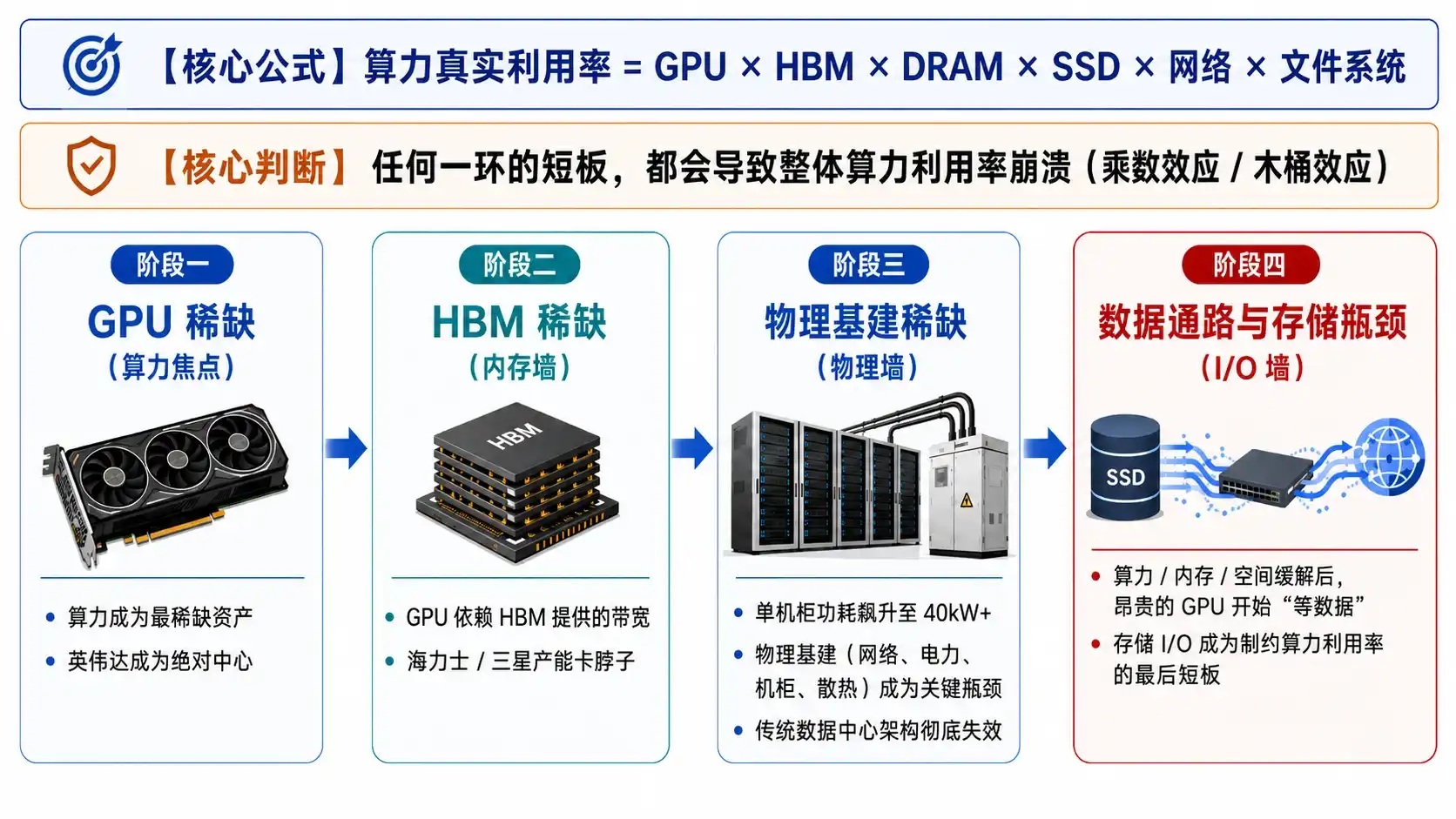
The evolution of resource bottlenecks in AI infrastructure is essentially a battle to fill the "shortest plank" in the barrel. Real computational utilization is not a linear sum of individual assets but a strict multiplicative effect: Real Computational Utilization = GPU × HBM × DRAM × SSD × Network × File System. Any weak link can cause the overall computational utilization rate to collapse. In the AI era, storage has transformed for the first time from a "cost center" into an "efficiency engine." This is the fundamental logic behind storage's revaluation.
AI Storage Architecture Overview: From HBM Bandwidth Organs to Data Lake Foundation

AI storage is by no means a simple stacking of individual hardware components but a tightly coupled, hierarchically scheduled complex system. Within this system, industrial value and capital focus are highly concentrated on HBM, enterprise-grade SSDs, SSD controllers, NVMe/CXL protocols, and high-performance storage systems. To clearly dissect the flow of value, we divide the AI storage architecture into four core layers from top to bottom:
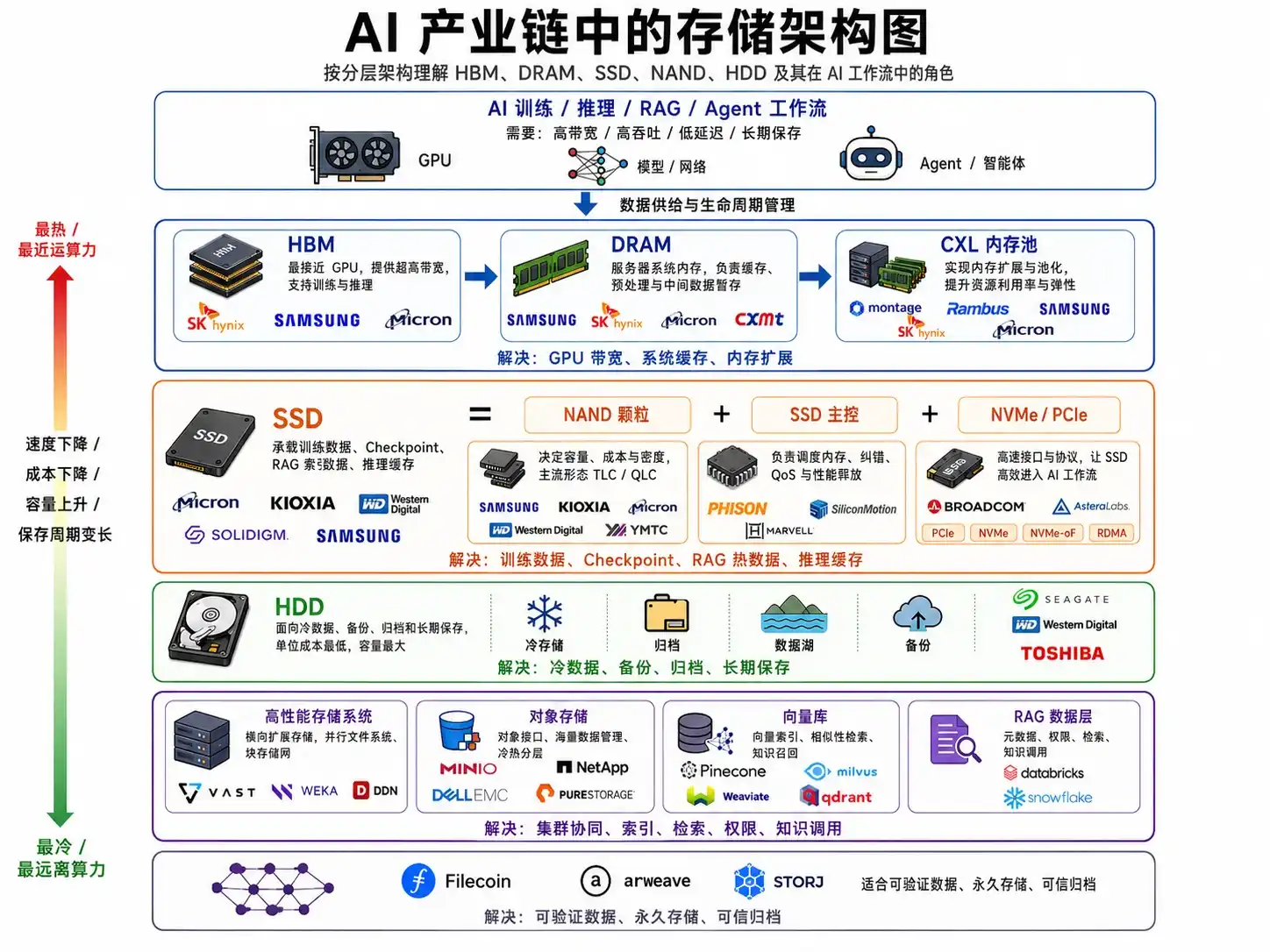
  • Compute-Proximate Memory Layer (Bandwidth Core): Primarily dominated by HBM, supplemented by DRAM and CXL memory pooling technologies. This layer is directly attached to the GPU/CPU package or bus, aiming to break the "memory wall." It is the first critical juncture determining whether computational power can be fully unleashed.

  • High-Speed Persistent Storage Layer (IO Hub): The core logic is Enterprise-grade SSD = NAND flash + SSD controller + NVMe/PCIe data path. This layer handles high-frequency Checkpoint writes, massive training dataset loads, and RAG hot data caching. It represents the most definitive persistent storage increment in AI data centers.

  • Low-Cost High-Capacity Storage Layer (Capacity Foundation): Composed of HDDs, cold storage, and data lake archiving systems. Facing exponentially growing multimodal raw data, historical logs, and compliance backups, this layer still offers an irreplaceable TCO (Total Cost of Ownership) advantage.

  • AI Storage Systems & Data Software (Scheduling Brain): Includes high-performance parallel file systems, distributed object storage, vector databases, and the RAG data governance layer. What AI truly consumes is not raw hardware but the availability of data efficiently organized, indexed, and permissioned by the software stack.

As an ecosystem extension, decentralized storage does not directly engage in the millisecond-level race for AI hot data. Instead, it anchors itself in the niches of public dataset notarization, AI training data provenance, and long-term cold memory archiving, establishing its unique position as the "trustworthy cold layer."

HBM: The "Bandwidth Organ" Closest to Compute in the AI Storage Chain

High Bandwidth Memory (HBM) is not traditional storage but a high-bandwidth memory layer proximate to the GPU. Its core mission is not to preserve data but to continuously "feed" data to the compute units with extremely high bandwidth. HBM is the closest component to compute power in the AI storage chain, with the highest certainty. It directly determines whether GPUs can be "fed adequately" and is currently the most critical supply chain bottleneck.

The core architecture of HBM is "3D DRAM stacking + 2.5D advanced packaging": Through TSV (Through-Silicon Via) vertical stacking and CoWoS (Chip-on-Wafer-on-Substrate) heterogeneous integration, the distance between memory and compute is compressed to the extreme, achieving a generational leap in bandwidth. Its industrial barriers extend beyond DRAM design, encompassing a systems engineering challenge involving DRAM process technology, TSV, ultra-thin stacking, packaging, thermal management, testing, and customer qualification. A flaw in any single step can render an entire HBM stack unusable.

Currently, only three global giants—SK hynix, Samsung, and Micron—can mass-produce HBM stably, constructing a triple moat of top-tier DRAM process, packaging capability, and certification by customers like NVIDIA/AMD.

Generation

Capacity/Stack

Bandwidth

Interface Width

Mass Production Time

Primary Customers

HBM2e

8–16GB

460 GB/s

1024-bit

2019–2020

Mature generation, used in previous-gen AI accelerators like A100

HBM3

24GB

819 GB/s

1024-bit

2022

SK hynix gained significant first-mover advantage in the H100 cycle

HBM3e

24–36GB

1.2 TB/s

1024-bit

2024–2025

Current mainstay for volume AI GPU deployments. Core suppliers are SK hynix, Micron, Samsung.

HBM4

32–48GB

>2 TB/s

2048-bit

2025–2026

Targeting next-generation AI in 2026, in the

mass production qualification/customer certification phase.

HBM4E

64GB+

>2 TB/s

2048-bit+

Post-2027

In planning/R&D for after 2027

DRAM & CXL:System Memory Foundation & Memory Pooling Engine

While HBM tackles GPU-proximate extreme bandwidth, DRAM solidifies the server's system memory foundation, and CXL aims to break physical boundaries, reconfiguring the organization of memory resources within data centers.

  • DRAM: Primarily handles CPU-side caching, data preprocessing, intermediate state buffering, and system operation. It is the most fundamental system memory layer for servers. The global DRAM market is highly concentrated among the three giants: SK hynix, Samsung, and Micron; ChangXin Memory Technologies (CXMT) is a key variable for DRAM domestic substitution in China.

  • CXL (Compute Express Link): A next-generation cache-coherent interconnect protocol for data centers. It aims to break the limitations of traditional DIMM slots, local memory capacity, and server memory silos, driving memory architecture toward expansion, pooling, and sharing. CXL is currently still in the early stages of moving from platform support to scaled deployment, with high long-term architectural value. Core companies include Astera Labs and Montage Technology.
Enterprise-grade SSD: The Data Hub Built on NAND, Controllers & NVMe

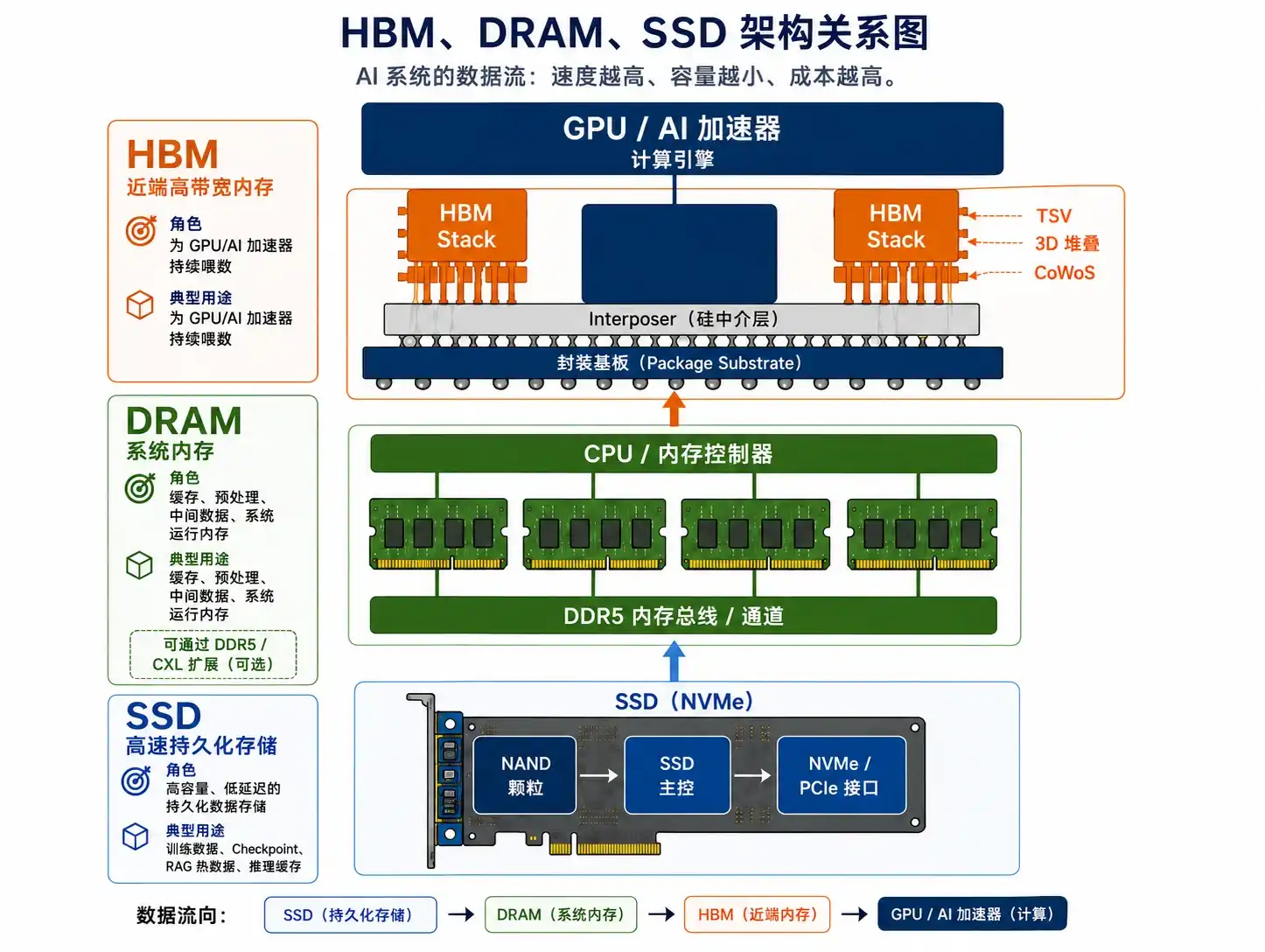
Enterprise-grade SSDs are the most crucial high-throughput persistent storage increment in AI data centers. With extremely high throughput, ultra-low latency, and stable QoS, they continuously "feed" data to GPUs, spanning the entire lifecycle from training data loading and Checkpoint writes to RAG retrieval, inference caching, and log streaming.

Within the AI storage architecture, an SSD is not an isolated hardware component but a highly coupled system, which can be summarized by the industrial formula: Enterprise-grade SSD = NAND Flash + SSD Controller + NVMe/PCIe Data Path. These three layers represent independent industrial chain segments:

  • NAND Flash (Raw Material Layer): Determines storage density and unit cost. Representative companies: Samsung, SK hynix (Solidigm), Micron, Kioxia, Western Digital, YMTC (Yangtze Memory Technologies Co.).

  • SSD Controller (Performance Enabler Layer): Determines performance unlocking, error correction, QoS stability, and wear leveling. Representative companies: Phison, Silicon Motion, Marvell, Maxio.

  • NVMe/PCIe (Data Path Layer): Determines data transfer efficiency from storage to compute. Combined with technologies like GPUDirect Storage, it reduces CPU memory bounce buffers and CPU involvement, significantly alleviating I/O bottlenecks. Representative companies: Broadcom, Marvell, Astera Labs.

HDD / Cold Storage / Archive: The Low-Cost Foundation for AI Data Lakes

AI will not eliminate HDDs. As multimodal large models crave video and image data, and enterprise compliance logs/historical datasets expand exponentially, the demand for low-cost cold data storage is also surging simultaneously. In the AI storage architecture, SSDs and HDDs collaborate based on a tiered division of business value: SSDs handle hot data and high throughput; HDDs handle low cost and long-term preservation. Representative companies include Seagate, Western Digital, Toshiba.

AI Storage Software Stack: The Scheduling Hub for Data Availability

What AI truly consumes has never been bare drives, but "data services" meticulously organized by software stacks. This architecture transforms underlying hardware into knowledge assets directly usable by upper-layer AI, specifically divided into four layers:

  • High-Performance Storage Systems (Feeding System): Core focus is on concurrent throughput and low latency. Parallel file systems address the "data starvation" problem in GPU clusters, ensuring rapid flow for training and inference. Representative companies: VAST Data, WEKA, Pure Storage.

  • Object Storage (Raw Data Lake): Core revolves around Object, Key, and Metadata management, handling massive unstructured data. It does not pursue ultimate low latency but builds a capacity foundation with low cost and cloud-native characteristics. Representative company: AWS S3.

  • Vector Database (Semantic Indexing Layer): Vector databases are responsible for storing, indexing, and retrieving vectors generated by embedding models, enabling AI to precisely locate relevant content from vast knowledge bases. Representative companies: Pinecone, Milvus.

  • RAG Data Layer (Knowledge Invocation Layer): Goes beyond mere retrieval, encompassing data chunking, cleaning, permission control, and citation provenance, ensuring enterprise data can be called by large models safely, accurately, and traceably. Representative company: Databricks.

From AI Hot Storage to Decentralized Cold Memory: Efficiency Maximization vs. Trust Maximization

AI storage is an extreme efficiency-driven system. Its value function focuses on maximizing computational output. HBM bandwidth determines whether GPUs can be fed adequately; SSD throughput determines the efficiency of dataset and Checkpoint read/writes; low latency is crucial for real-time RAG and inference experiences. These metrics ultimately converge into GPU utilization and cost per Token, directly determining the commercial profitability of AI applications. The ultimate goal of AI storage is not preservation but acceleration, serving productivity.

The value function of decentralized storage is entirely different. It questions whether data will still exist in a decade, whether it has been tampered with, and if it can resist centralized censorship. Through cryptographic proofs and distributed networks, it constructs an open-access, permanently preserved public data foundation. Its ultimate goal is to defend the absolute authenticity and sovereign independence of data, serving fairness, censorship resistance, and civilizational memory.

Dimension

AI Hot Storage

Decentralized Cold Storage

Core Value

Efficiency Maximization — Accelerating data into computation

Trust Maximization — Ensuring data is not tampered with or deleted

Data Type

Hot data / Warm data / Real-time inference

Cold data / Permanent archive / Public memory

Key Metrics

Bandwidth, Throughput, Latency, GPU Utilization

Verifiability, Censorship Resistance, Immutability, Permanent Preservation

Payment Source

Cloud providers, AI Labs, Enterprise RAG systems

Public datasets, Long-term archiving, On-chain applications

Ultimate Goal

Not preservation, but acceleration

Not speed, but trustworthiness

Market Status

Hot — Supercycle ongoing

Silent — Valuation collapse, narrative drained

AI storage is the "hot storage" fueling future productivity; decentralized storage is the "cold memory" preserving undeletable historical records for human civilization. The former serves efficiency, pursuing extreme speed; the latter serves trustworthiness, defending silent memory. The former determines how fast models run; the latter determines whether memories will be deleted. Currently, market mechanisms reward efficiency in productivity, placing AI storage at the forefront while decentralized storage seems to be experiencing a silent phase of valuation collapse and narrative drainage.

The Vision and Reality of Decentralized Storage

There are numerous decentralized storage projects, but in terms of industry mindshare and ecosystem depth, the core representatives remain Filecoin and Arweave. Although both fall under "decentralized storage," their underlying architectural philosophies are almost two completely different paths—the former uses market-based contracts to approximate the elasticity of AWS, while the latter uses a one-time social contract to approximate the permanence of a library.

  • Filecoin: Has constructed the most complete verifiable economic system through PoRep and PoSt. It should no longer compete head-on with AWS in the consumer cloud storage market. Instead, it should pivot towards AI data provenance, public dataset hosting, and compliance archiving, providing a verifiable chain for model auditing and copyright proof. Its necessary path is to encapsulate itself into an S3-compatible API supporting fiat payments, upgrading from a "cheap storage market" to "verifiable computation infrastructure."

  • Arweave: With the narrative of "pay once, store forever," its Blockweave and SPoRA mechanisms incentivize miners to preserve and provide quick access to as much data as possible, especially scarce historical data. Its optimal position is as the foundation for humanity's public memory—preserving human rights records, war crime evidence, cultural canons, archiving legal and financial history, and providing permanent, accessible long-term memory for AI Agents. Arweave's value lies not in speed but in its ability to carry civilizational memory across cycles.

Dimension

Filecoin — Verifiable Storage Market

(Data as of June 2026, source Filfox)

Arweave — Permanent Public Memory Layer

(Data as of June 2026, source ViewBlock)

Core Philosophy

"Storage is a Market" — Price discovery, elastic supply, contracts can expire without renewal

"Storage is a Public Good" — One-time social contract, data persistence does not rely on any entity's continuous payment

Underlying Structure

Standard blockchain + IPFS content addressing; data stored separately from the chain

Blockweave — Each new block links to both the previous block and a random historical "recall block"

Consensus Mechanism

Expected Consensus (EC): Proof of Replication (PoRep) + Proof of Spacetime (PoSt)

SPoRA (Succinct Proofs of Random Access, evolved from PoA in 2021)

Storage Proof Logic

PoRep proves the miner generated a unique copy of the data; PoSt continuously proves that copy remains intact and stored.

Mining requires proving the ability to access a random recall block — incentivizes miners to retain as much historical data as possible, including obscure data.

Market Structure

Two-layer market architecture: Storage Market + Retrieval Market; on-chain matching, off-chain data transfer.

Single-layer permanent writes; no independent retrieval market, relies on Gateways (e.g., AR.IO) for retrieval services.

Payment Model

Storage Market / Contract-based — Clients sign periodic lease agreements with Storage Providers (SPs), pay-as-you-go.

Endowment Permanent Fund Model — One-time payment, funds deposited into an interest-earning pool, theoretically paying miners in perpetuity.

Data Availability Guarantee

Guarantees integrity (data not tampered with), but does not inherently guarantee retrieval speed; requires purchasing additional retrieval services.

Guarantees persistence and accessibility; anyone with a transaction ID can permanently view/download, without relying on the original uploader's wallet.

Typical Use Cases

Enterprise cold archiving, compliance notarization, verifiable snapshots of AI training data, elastic on-demand storage.

Permaweb permanent websites, NFT metadata, historical archives, long-term memory for AI Agents (AO computation layer).

Token Model

FIL max supply capped at 2 billion; actual circulation affected by block reward emission, staking, penalties, and burn mechanisms.

AR max supply ~66 million; circulating supply is already near the cap, with minimal inflationary impact from new emissions.

Network Scale

Quality Adjusted Power: Approx. 14,848 PiB

Network Size: Approx. 20.2 PiB

Cumulative Stored Data

Active deals stored data: Approx. 1,110 PiB

Weave Size: Approx. 0.345 PiB

Miners / Nodes

~611 active miners

~100 online nodes

Storage Cost

Filecoin Cloud $2.50/TiB/month/copy

Approx. 10.4–10.7 AR/GiB (≈$20–21)

The dilemma for decentralized storage projects like Filecoin and Arweave does not lie in an erroneous value proposition, but in a long-term misalignment between productization, retrieval experience, real demand, and token incentives. This reveals the vast chasm between geek ideals and mainstream commercial adoption:

  • Supply-Demand Incentive Misalignment: Early networks like Filecoin rapidly expanded capacity via token rewards but failed to build a sufficiently strong paying demand side, leading to vast capacity but low utilization and poor payment conversion. The system rewarded "I can store" rather than "need me to store."

  • Lack of Enterprise-Grade Service Capabilities: AWS's moat is not hard drives, but a "data operating system" comprised of APIs, SLAs, permission management, compliance auditing, and technical support. Enterprises buy "peace of mind," not experimental infrastructure requiring them to manage keys and node selection.

  • Retrieval Experience Shortcomings: "Storing it" does not equal "retrieving it stably and with low latency." Dispersed nodes, complex topology, and a lack of unified SLAs make it difficult to handle AI hot data workflows; better suited for trusted cold archiving and data provenance.

  • Privacy & Compliance Inadequacies: Enterprise private data cannot simply be written to a public, permanent network; the right to erasure is inherently at odds with permanent immutability. Decentralized storage is better suited for public data and long-term archives, not indiscriminately hosting core private data.

  • Token Economics Amplifying Cycles: Financialization during bull markets masked insufficient demand; declining miner ROI during bear markets exposed commercial viability shortcomings. Tokens can cold-start supply but cannot automatically create demand and sustainable revenue.

Other decentralized storage projects often focus on specific ecosystems or niche segments: Storj/Sia have weaker cross-cycle industry mindshare and Web3 narrative influence compared to Filecoin/Arweave; BNB Greenfield/Walrus are tied to specific public chain ecosystems like BNB or SUI; Celestia/EigenDA belong to the Data Availability (DA) layer, serving Rollup transaction confirmation rather than long-term archiving; Projects like 0G, with mixed AI/DA narratives, attempt to integrate storage, data availability, computation, and AI agent settlement into an AI-native modular infrastructure suite, but their real demand, developer adoption, and commercialization loops remain to be validated.

Future Opportunities for Decentralized Storage: The Long-Term Pendulum Between Efficiency and Trust

During periods of technological红利 (bonanza) explosion, capital chases efficiency frantically, assigning extremely high premiums to assets like GPUs and HBM. Decentralized storage, which advocates for "trust and fairness," is naturally marginalized. However, history's pendulum will not rest forever on the side of efficiency. Events such as unreasonable platform bans and content takedowns, AI copyright lawsuits forcing data provenance proof, data sovereignty disputes triggered by geopolitical conflicts, the disappearance of public archives due to data monopolies, and regulatory pressure for auditing model training data compliance could all potentially catalyze a revaluation of "trustworthy storage." The future opportunities for decentralized storage may still manifest unique value in the following directions:

  • AI Data Provenance: Combining cryptographic proofs to construct "data lineage proof," addressing regulatory and audit pressures.

  • Public Datasets & Civilizational Archives: Anchoring censored archives and cultural heritage, building an irreplaceable, undeletable memory layer.

  • Trusted Archiving & Compliance Notarization: Implementing trusted self-attestation through hash notarization, providing high-grade digital notarization services.

  • Integration with ZK/TEE/DID Technologies: Mitigating privacy tensions, upgrading from a mere "storage protocol" to "trusted data infrastructure."

  • Invisible Product Strategy: Providing S3-compatible APIs and fiat billing, allowing users to directly purchase "trusted archiving" services.

AI storage and decentralized storage—one pursues ultimate efficiency, providing the fuel for our rush into the future; the other defends silent memory, safeguarding our right to look back at the past. Currently, the market unreservedly rewards efficiency, making decentralized storage appear silent and even collapsed. However, as the AI era further amplifies issues like data monopolies, copyright disputes, and the fragility of historical memory, decentralized storage may experience a value revaluation as a "trustworthy cold layer." Those memories that cannot be easily erased by platforms, corporations, or any single power might transform from idealistic romance, from fringe belief, into essential infrastructure.


Trend Kriptolar

İlgili Sorular

QAccording to the article, what is the fundamental difference in value proposition between AI storage and decentralized storage?

AAI storage focuses on maximizing 'hot data efficiency' and serves computational productivity, aiming to accelerate data flow into computing. Decentralized storage focuses on 'cold data credibility', safeguarding data fairness, censorship resistance, and long-term human civilization memory.

QWhy has storage become a focal point in the AI industry chain, according to the article? What fundamental shift in logic does this represent?

AStorage has become an AI industry focal point due to its role in re-pricing data flow capabilities. The logic has shifted from 'capacity first' to 'efficiency first', with storage becoming an 'efficiency engine' critical for feeding data to GPUs, impacting GPU utilization and token cost, rather than just being a 'cost center' for data parking.

QDescribe the four-layer hierarchical architecture of AI storage as outlined in the article.

A1) Compute-Proximate Memory Layer (Bandwidth Core): HBM, DRAM, CXL pooling. 2) High-Speed Persistent Storage Layer (I/O Hub): Enterprise SSDs (NAND + SSD Controller + NVMe/PCIe). 3) Low-Cost High-Capacity Storage Layer (Capacity Base): HDDs, cold storage, data lake archival. 4) AI Storage Systems & Data Software (Scheduling Brain): Parallel file systems, object storage, vector databases, RAG data governance.

QHow do the core philosophies and business models of Filecoin and Arweave fundamentally differ, as described in the article?

AFilecoin's philosophy is 'storage as a market' with an elastic, contract-based pay-as-you-go model (storage/retrieval markets). Arweave's philosophy is 'storage as a public good' with a one-time-payment 'endowment' model for permanent storage, aiming to create an immutable, long-term public memory layer.

QWhat are some of the key future opportunities for decentralized storage mentioned in the article, particularly in relation to the AI era?

AKey opportunities include: 1) AI Data Provenance for audit trails, 2) Hosting public datasets and civilizational archives, 3) Trusted archival and compliance attestation, 4) Integration with ZK/TEE/DID technologies for privacy, and 5) Pursuing an 'invisible' product route with S3-compatible APIs and fiat billing.

İlgili Okumalar

Why P2P and Exchangers Are Becoming Obsolete, and What Will Replace Them

Titled "Why P2P and Exchanges Are Becoming Obsolete, and What Will Replace Them," this article discusses the evolution of stablecoins, particularly USDT, from a trading tool to a global payment method. However, converting crypto back to fiat for daily expenses remains a challenge. The process of using P2P platforms or crypto exchanges has become increasingly risky and complex due to stricter banking anti-fraud measures, new legislation in Russia, and rampant fraud schemes like "triangles," where sellers can inadvertently receive stolen funds. The article highlights that while P2P was convenient, banks now scrutinize frequent peer-to-peer transfers, often freezing accounts. Exchanges also pose risks like unfavorable rates and unclear compliance. The market is therefore shifting towards integrated services that eliminate the manual conversion step. It cites OneSix as an example—a crypto wallet accessible via Telegram and web that embeds currency conversion directly into payment and withdrawal scenarios. Users can pay bills or send money as if using a bank app, with the crypto-to-fiat exchange happening seamlessly in the background. It also offers invoicing for freelancers and conducts AML checks, returning suspicious transactions instantly instead of freezing them. In conclusion, as crypto integrates into everyday finance, the demand for manual, risky exchange methods is declining. The future lies in unified platforms that combine storage, compliance, conversion, and payments into a single, secure user experience.

cryptonews.ru6 dk önce

Why P2P and Exchangers Are Becoming Obsolete, and What Will Replace Them

cryptonews.ru6 dk önce

The CEO of MARA Holdings Compares AI Operations to Bitcoin Mining! Which is More Profitable?

Fred Thiel, CEO of MARA Holdings (a major Bitcoin mining company), states that the rapid growth of the artificial intelligence (AI) sector is transforming mining companies' business models. He claims that powering data centers for AI is significantly more profitable than Bitcoin mining. In a recent interview, Thiel explained why many mining firms are diversifying into AI infrastructure. According to Thiel, the energy demands of data centers are surging, especially due to the spread of generative AI applications. This creates new revenue opportunities for Bitcoin mining companies with robust power infrastructure. MARA Holdings is among those monitoring this shift and aims to develop its energy and infrastructure services for AI data centers. Thiel emphasized that this move toward AI does not mean the end of Bitcoin mining. He stated that Bitcoin mining remains a sustainable business model, especially for miners in regions with low electricity costs, and it is still a crucial field for utilizing excess or idle power capacity. In recent years, many Bitcoin mining companies have begun using their energy-intensive infrastructure not just for block production but also for high-performance computing (HPC) and AI applications. This strategy aims to diversify revenue sources and increase resilience against cryptocurrency market volatility. Analysts note that the growing energy demand in the AI sector presents significant transformation opportunities for mining companies. The need for high-power, uninterrupted electricity supply, particularly for large data centers, gives Bitcoin miners with existing energy infrastructure expertise a considerable advantage.

cryptonews.ru17 dk önce

The CEO of MARA Holdings Compares AI Operations to Bitcoin Mining! Which is More Profitable?

cryptonews.ru17 dk önce

Ratio's CEO Says Multi-Currency Stablecoins Could Eliminate Costly FX Conversions in Asia

The CEO of Ratio, John Cho, argues that multi-currency stablecoins could save Asia billions by eliminating costly foreign exchange conversions in regional trade. While USD stablecoins like USDT and USDC work for global settlements, local Asian trade is conducted in local currencies like the Korean won or Singapore dollar. Forcing these transactions through USD intermediaries creates unnecessary costs and currency risk. Cho envisions a complementary ecosystem where local-currency stablecoins work alongside USD stablecoins, enabling seamless cross-border settlements without conversion friction. A key pain point in traditional banking is the need for pre-funded Nostro and Vostro accounts, which lock up vast amounts of working capital. Blockchain-based settlement layers like Ratio offer a 24/7 alternative, using on-chain liquidity to enable instant execution even when traditional channels are closed. Modern Web3 infrastructure providers are focusing on pragmatic integration with existing corporate systems like ERPs, allowing businesses to gradually shift volumes to digital channels for better speed, cost, and reduced slippage. Clear regulation is cited as the critical catalyst for widespread institutional adoption. As jurisdictions like the U.S. advance legislation (e.g., the CLARITY Act) and Asian countries are expected to pass their own stablecoin laws within 12-24 months, regulatory uncertainty is receding. The ultimate vision is for regulated stablecoins to become an invisible settlement layer integrated into national payment systems, where payments simply happen on-chain, erasing the boundary between traditional banking and digital assets.

cryptonews.ru35 dk önce

Ratio's CEO Says Multi-Currency Stablecoins Could Eliminate Costly FX Conversions in Asia

cryptonews.ru35 dk önce

Huang Xiaoming, Li Bin, Lei Jun, Liang Wenfeng... Who Are the Biggest Winners in the CXMT IPO Feast?

Changxin Technology, a leading Chinese memory chip manufacturer, successfully listed on the Shanghai Stock Exchange's STAR Market (科创板) on July 8, 2026. Its share price surged from the IPO price of 8.66 yuan to close at 49 yuan on the first day, catapulting its market capitalization to 3.28 trillion yuan, making it the most valuable A-share company and triggering a massive wealth creation event. The biggest winners were the company's founder, Zhu Yiming, and its employees. Zhu Yiming's family wealth skyrocketed nearly 300% to approximately $13.9 billion, with his direct stake in Changxin valued at around 80 billion yuan. Additionally, over 6700 employees benefited from stock ownership plans, creating at least 237 new millionaires (in CNY). Zhu also pledged to donate 768 million shares, worth over 37.6 billion yuan, for future employee incentives over a ten-year period. Several prominent investors and corporate clients also reaped significant paper gains from the IPO. Notable figures include: * **Liang Wenfeng**, founder of DeepSeek, whose funds netted a paper profit of approximately 827 million yuan. * **Kong Jianping**, founder of Nano Labs, saw his indirect holdings valued at roughly 940 million yuan. * **Li Bin**, founder of Nio, whose company's strategic investment of 158 million yuan is now worth about 740 million yuan. * **Lei Jun**, founder of Xiaomi, whose subsidiary holds shares currently showing a paper gain of over 736 million yuan. Xiaomi clarified this is a corporate investment, not direct personal wealth. The article notes that while this IPO created immense wealth for insiders and large investors, retail investors who were lucky enough to win an allotment in the lottery typically profited by around 20,000 yuan. The listing solidifies Changxin's position as China's premier domestic memory chipmaker.

marsbit46 dk önce

Huang Xiaoming, Li Bin, Lei Jun, Liang Wenfeng... Who Are the Biggest Winners in the CXMT IPO Feast?

marsbit46 dk önce

İşlemler

Spot

Popüler Makaleler

$S$ Nedir

SPERO'yu Anlamak: Kapsamlı Bir Genel Bakış SPERO'ya Giriş İnovasyonun manzarası gelişmeye devam ederken, web3 teknolojilerinin ve kripto para projelerinin ortaya çıkışı dijital geleceği şekillendirmede önemli bir rol oynamaktadır. Bu dinamik alanda dikkat çeken projelerden biri SPERO, $$s$$ olarak adlandırılmaktadır. Bu makale, SPERO hakkında ayrıntılı bilgi toplamak ve sunmak amacıyla, meraklılar ve yatırımcıların web3 ve kripto alanlarındaki temellerini, hedeflerini ve yeniliklerini anlamalarına yardımcı olmayı amaçlamaktadır. SPERO,$$s$$ Nedir? SPERO,$$s$$, kripto alanında merkeziyetsizlik ve blok zinciri teknolojisi ilkelerini kullanarak etkileşimi, faydayı ve finansal kapsayıcılığı teşvik eden bir ekosistem yaratmayı amaçlayan benzersiz bir projedir. Proje, kullanıcıların yenilikçi finansal çözümler ve hizmetler sunarak eşler arası etkileşimleri yeni yollarla kolaylaştırmayı hedeflemektedir. SPERO,$$s$$'nin temel amacı, bireyleri güçlendirmek ve kripto para alanındaki kullanıcı deneyimini artıran araçlar ve platformlar sağlamaktır. Bu, daha esnek işlem yöntemlerini mümkün kılmayı, topluluk odaklı girişimleri teşvik etmeyi ve merkeziyetsiz uygulamalar (dApp'ler) aracılığıyla finansal fırsatlar yaratmayı içermektedir. SPERO,$$s$$'nin temel vizyonu kapsayıcılık etrafında dönmekte olup, geleneksel finansal sistemlerdeki boşlukları kapatmayı ve blok zinciri teknolojisinin faydalarından yararlanmayı hedeflemektedir. SPERO,$$s$$'nin Yaratıcısı Kimdir? SPERO,$$s$$'nin yaratıcısının kimliği bir miktar belirsizdir, çünkü kurucusu(ları) hakkında ayrıntılı arka plan bilgisi sağlayan sınırlı kamuya açık kaynaklar bulunmaktadır. Bu şeffaflık eksikliği, projenin merkeziyetsizlik taahhüdünden kaynaklanabilir—birçok web3 projesinin paylaştığı bir etik anlayışı, bireysel tanınmanın yerine kolektif katkıları önceliklendirmektedir. Topluluk ve onun kolektif hedefleri etrafında tartışmaları merkezileştirerek, SPERO,$$s$$, belirli bireyleri öne çıkarmadan güçlendirme özünü taşımaktadır. Bu nedenle, SPERO'nun etik anlayışını ve misyonunu anlamak, tek bir yaratıcının kimliğini belirlemekten daha önemlidir. SPERO,$$s$$'nin Yatırımcıları Kimlerdir? SPERO,$$s$$, kripto sektöründe yeniliği teşvik etmeye adanmış girişim sermayedarlarından melek yatırımcılara kadar çeşitli yatırımcılar tarafından desteklenmektedir. Bu yatırımcıların odak noktası genellikle SPERO'nun misyonuyla uyumlu olup, toplumsal teknolojik ilerlemeyi, finansal kapsayıcılığı ve merkeziyetsiz yönetimi vaat eden projeleri önceliklendirmektedir. Bu yatırımcı temelleri, yalnızca yenilikçi ürünler sunan projelere değil, aynı zamanda blok zinciri topluluğuna ve ekosistemlerine olumlu katkılarda bulunan projelere de ilgi duymaktadır. Bu yatırımcıların desteği, SPERO,$$s$$'yi hızla gelişen kripto projeleri alanında dikkate değer bir rakip haline getirmektedir. SPERO,$$s$$ Nasıl Çalışır? SPERO,$$s$$, onu geleneksel kripto para projelerinden ayıran çok yönlü bir çerçeve kullanmaktadır. İşte benzersizliğini ve yeniliğini vurgulayan bazı temel özellikler: Merkeziyetsiz Yönetim: SPERO,$$s$$, kullanıcıların projenin geleceğiyle ilgili karar alma süreçlerine aktif olarak katılmalarını sağlayan merkeziyetsiz yönetim modellerini entegre etmektedir. Bu yaklaşım, topluluk üyeleri arasında sahiplik ve hesap verebilirlik duygusunu teşvik etmektedir. Token Kullanımı: SPERO,$$s$$, ekosistem içinde çeşitli işlevler sunmak üzere tasarlanmış kendi kripto para token'ını kullanmaktadır. Bu token'lar, işlemleri, ödülleri ve platformda sunulan hizmetlerin kolaylaştırılmasını sağlayarak genel etkileşimi ve faydayı artırmaktadır. Katmanlı Mimari: SPERO,$$s$$'nin teknik mimarisi, modülerlik ve ölçeklenebilirliği destekleyerek projenin evrimi sırasında ek özelliklerin ve uygulamaların sorunsuz bir şekilde entegrasyonuna olanak tanımaktadır. Bu uyum sağlama yeteneği, sürekli değişen kripto manzarasında geçerliliği sürdürmek için hayati öneme sahiptir. Topluluk Katılımı: Proje, işbirliği ve geri bildirim teşvik eden mekanizmalar kullanarak topluluk odaklı girişimlere vurgu yapmaktadır. Güçlü bir topluluk oluşturarak, SPERO,$$s$$, kullanıcı ihtiyaçlarını daha iyi karşılayabilir ve piyasa trendlerine uyum sağlayabilir. Kapsayıcılığa Odaklanma: Düşük işlem ücretleri ve kullanıcı dostu arayüzler sunarak, SPERO,$$s$$, daha önce kripto alanında yer almamış bireyler de dahil olmak üzere çeşitli bir kullanıcı tabanını çekmeyi hedeflemektedir. Bu kapsayıcılık taahhüdü, erişilebilirlik yoluyla güçlendirme misyonuyla uyumludur. SPERO,$$s$$ Zaman Çizelgesi Bir projenin tarihini anlamak, gelişim yolculuğu ve kilometre taşları hakkında kritik bilgiler sağlar. Aşağıda, SPERO,$$s$$'nin evriminde önemli olayları haritalayan önerilen bir zaman çizelgesi bulunmaktadır: Kavram Geliştirme ve Fikir Aşaması: SPERO,$$s$$'nin temelini oluşturan ilk fikirler, blok zinciri endüstrisindeki merkeziyetsizlik ve topluluk odaklılık ilkeleriyle yakından uyumlu olarak geliştirildi. Proje Beyaz Kağıdının Yayınlanması: Kavramsal aşamayı takiben, SPERO,$$s$$'nin vizyonunu, hedeflerini ve teknolojik altyapısını ayrıntılı bir şekilde açıklayan kapsamlı bir beyaz kağıt yayımlandı ve topluluk ilgisini ve geri bildirimini toplamak amacıyla sunuldu. Topluluk Oluşturma ve Erken Katılımlar: Projenin hedefleri etrafında tartışmalar yürüterek destek toplamak ve erken benimseyenler ile potansiyel yatırımcılar için bir topluluk oluşturmak amacıyla aktif iletişim çabaları gerçekleştirildi. Token Üretim Etkinliği: SPERO,$$s$$, yerel token'larını erken destekçilere dağıtmak ve ekosistem içinde başlangıç likiditesini sağlamak amacıyla bir token üretim etkinliği (TGE) gerçekleştirdi. İlk dApp'in Yayınlanması: SPERO,$$s$$ ile ilişkili ilk merkeziyetsiz uygulama (dApp) faaliyete geçti ve kullanıcıların platformun temel işlevleriyle etkileşimde bulunmalarını sağladı. Sürekli Gelişim ve Ortaklıklar: Projenin tekliflerine sürekli güncellemeler ve iyileştirmeler yapılmakta olup, blok zinciri alanındaki diğer oyuncularla stratejik ortaklıklar, SPERO,$$s$$'yi rekabetçi ve gelişen bir oyuncu haline getirmiştir. Sonuç SPERO,$$s$$, web3 ve kripto paranın finansal sistemleri devrim niteliğinde dönüştürme ve bireyleri güçlendirme potansiyelinin bir kanıtıdır. Merkeziyetsiz yönetime, topluluk katılımına ve yenilikçi tasarlanmış işlevselliğe olan bağlılığıyla, daha kapsayıcı bir finansal manzaraya doğru bir yol açmaktadır. Hızla gelişen kripto alanındaki herhangi bir yatırımda olduğu gibi, potansiyel yatırımcılar ve kullanıcılar, SPERO,$$s$$ içindeki devam eden gelişmelerle ilgili olarak kapsamlı bir araştırma yapmaları ve düşünceli bir şekilde katılmaları teşvik edilmektedir. Proje, kripto endüstrisinin yenilikçi ruhunu sergileyerek, sayısız olasılığını keşfetmeye davet etmektedir. SPERO,$$s$$'nin yolculuğu hala devam ederken, temel ilkeleri, teknoloji, finans ve birbirimizle etkileşim biçimimizi etkileyebilir.

200 Toplam GörüntülenmeYayınlanma 2024.12.17Güncellenme 2024.12.17

$S$ Nedir

AGENT S Nedir

Agent S: Web3'te Otonom Etkileşimin Geleceği Giriş Web3 ve kripto para dünyasında sürekli gelişen manzarada, yenilikler bireylerin dijital platformlarla etkileşim biçimlerini sürekli olarak yeniden tanımlıyor. Bu tür öncü projelerden biri olan Agent S, açık ajans çerçevesi aracılığıyla insan-bilgisayar etkileşimini devrim niteliğinde değiştirmeyi vaat ediyor. Otonom etkileşimlerin yolunu açarak, Agent S karmaşık görevleri basitleştirmeyi ve yapay zeka (AI) alanında dönüştürücü uygulamalar sunmayı hedefliyor. Bu detaylı inceleme, projenin karmaşıklıklarına, benzersiz özelliklerine ve kripto para alanındaki etkilerine dalacaktır. Agent S Nedir? Agent S, bilgisayar görevlerinin otomasyonunda üç temel zorluğu ele almak üzere özel olarak tasarlanmış çığır açıcı bir açık ajans çerçevesidir: Alan Spesifik Bilgi Edinimi: Çerçeve, çeşitli dış bilgi kaynaklarından ve iç deneyimlerden akıllıca öğrenir. Bu çift yönlü yaklaşım, alan spesifik bilgi açısından zengin bir veri havuzu oluşturmasını sağlar ve görev yürütmedeki performansını artırır. Uzun Görev Ufukları Üzerinde Planlama: Agent S, karmaşık görevlerin verimli bir şekilde parçalanmasını ve yürütülmesini kolaylaştıran deneyim artırımlı hiyerarşik planlama kullanır. Bu özellik, çoklu alt görevleri etkili ve verimli bir şekilde yönetme yeteneğini önemli ölçüde artırır. Dinamik, Homojen Olmayan Arayüzlerle Başlama: Proje, ajanlar ve kullanıcılar arasındaki etkileşimi geliştiren yenilikçi bir çözüm olan Ajan-Bilgisayar Arayüzü'ni (ACI) tanıtmaktadır. Çok Modlu Büyük Dil Modellerini (MLLM'ler) kullanarak, Agent S çeşitli grafik kullanıcı arayüzlerini sorunsuz bir şekilde gezinebilir ve manipüle edebilir. Bu öncü özellikler aracılığıyla, Agent S, makinelerle insan etkileşimini otomatikleştirmede karşılaşılan karmaşıklıkları ele alan sağlam bir çerçeve sunarak, AI ve ötesinde birçok uygulama için zemin hazırlıyor. Agent S'nin Yaratıcısı Kimdir? Agent S'nin kavramı temelde yenilikçi olsa da, yaratıcısı hakkında spesifik bilgiler belirsizliğini koruyor. Yaratıcı şu anda bilinmiyor, bu da projenin yeni aşamasını veya kurucu üyeleri gizli tutma stratejik tercihini vurguluyor. Anonimlikten bağımsız olarak, odak çerçevenin yetenekleri ve potansiyeli üzerinde kalıyor. Agent S'nin Yatırımcıları Kimlerdir? Agent S, kriptografik ekosistemde oldukça yeni olduğundan, yatırımcıları ve finansal destekçileri hakkında ayrıntılı bilgiler açıkça belgelenmemiştir. Projeyi destekleyen yatırım temelleri veya organizasyonları hakkında kamuya açık bilgilerdeki eksiklik, finansman yapısı ve gelişim yol haritası hakkında sorular doğuruyor. Destekleyicilerin anlaşılması, projenin sürdürülebilirliğini ve potansiyel pazar etkisini değerlendirmek için kritik öneme sahiptir. Agent S Nasıl Çalışır? Agent S'nin temelinde, çeşitli ortamlarda etkili bir şekilde çalışmasını sağlayan son teknoloji bir sistem yatmaktadır. İşleyiş modeli birkaç ana özellik etrafında inşa edilmiştir: İnsan Benzeri Bilgisayar Etkileşimi: Çerçeve, bilgisayarlarla etkileşimleri daha sezgisel hale getirmeyi amaçlayan gelişmiş AI planlaması sunar. Görev yürütmedeki insan davranışını taklit ederek, kullanıcı deneyimlerini yükseltmeyi vaat eder. Anlatı Belleği: Yüksek düzeyde deneyimlerden yararlanmak için kullanılan Agent S, görev geçmişlerini takip etmek amacıyla anlatı belleğini kullanarak karar verme süreçlerini geliştirir. Episodik Bellek: Bu özellik, kullanıcılara adım adım rehberlik sağlayarak, çerçevenin görevler gelişirken bağlamsal destek sunmasına olanak tanır. OpenACI Desteği: Yerel olarak çalışabilme yeteneği ile Agent S, kullanıcıların etkileşimleri ve iş akışları üzerinde kontrol sağlamasına olanak tanır ve Web3'ün merkeziyetsiz felsefesiyle uyumlu hale gelir. Dış API'lerle Kolay Entegrasyon: Çeşitli AI platformlarıyla uyumluluğu ve çok yönlülüğü, Agent S'nin mevcut teknolojik ekosistemlere sorunsuz bir şekilde entegre olmasını sağlar ve geliştiriciler ile organizasyonlar için cazip bir seçenek haline getirir. Bu işlevsellikler, Agent S'nin kripto alanındaki benzersiz konumuna katkıda bulunarak, karmaşık, çok aşamalı görevleri minimum insan müdahalesi ile otomatikleştirir. Proje geliştikçe, Web3'teki potansiyel uygulamaları dijital etkileşimlerin nasıl gelişeceğini yeniden tanımlayabilir. Agent S'nin Zaman Çizelgesi Agent S'nin gelişimi ve kilometre taşları, önemli olaylarını vurgulayan bir zaman çizelgesinde özetlenebilir: 27 Eylül 2024: Agent S'nin kavramı, “Bilgisayarları İnsan Gibi Kullanan Açık Bir Ajans Çerçevesi” başlıklı kapsamlı bir araştırma makalesi ile tanıtıldı ve projenin temelini sergiledi. 10 Ekim 2024: Araştırma makalesi arXiv'de kamuya açık olarak yayınlandı ve çerçevenin derinlemesine bir incelemesini ve OSWorld benchmark'ına dayalı performans değerlendirmesini sundu. 12 Ekim 2024: Agent S'nin yetenekleri ve özellikleri hakkında görsel bir içgörü sağlayan bir video sunumu yayımlandı ve potansiyel kullanıcılar ve yatırımcılarla daha fazla etkileşim sağlandı. Bu zaman çizelgesindeki işaretler, sadece Agent S'nin ilerlemesini değil, aynı zamanda şeffaflık ve topluluk katılımına olan bağlılığını da göstermektedir. Agent S Hakkında Ana Noktalar Agent S çerçevesi gelişmeye devam ederken, birkaç ana özellik öne çıkmakta ve yenilikçi doğasını ve potansiyelini vurgulamaktadır: Yenilikçi Çerçeve: İnsan etkileşimine benzer bir bilgisayar kullanımı sağlamak üzere tasarlanan Agent S, görev otomasyonuna yeni bir yaklaşım getiriyor. Otonom Etkileşim: GUI aracılığıyla bilgisayarlarla otonom olarak etkileşim kurabilme yeteneği, daha akıllı ve verimli hesaplama çözümlerine doğru bir sıçrama anlamına geliyor. Karmaşık Görev Otomasyonu: Sağlam metodolojisi ile karmaşık, çok aşamalı görevleri otomatikleştirerek süreçleri daha hızlı ve daha az hata payı ile gerçekleştirebilir. Sürekli İyileştirme: Öğrenme mekanizmaları, Agent S'nin geçmiş deneyimlerden öğrenmesini sağlar ve sürekli olarak performansını ve etkinliğini artırır. Çok Yönlülük: OSWorld ve WindowsAgentArena gibi farklı işletim ortamlarında uyumlu olması, geniş bir uygulama yelpazesine hizmet edebilmesini sağlar. Agent S, Web3 ve kripto alanında kendini konumlandırırken, etkileşim yeteneklerini artırma ve süreçleri otomatikleştirme potansiyeli, AI teknolojilerinde önemli bir ilerlemeyi temsil etmektedir. Yenilikçi çerçevesi aracılığıyla, Agent S dijital etkileşimlerin geleceğini örneklemekte ve çeşitli sektörlerde kullanıcılar için daha sorunsuz ve verimli bir deneyim vaat etmektedir. Sonuç Agent S, AI ve Web3'ün birleşiminde cesur bir sıçramayı temsil ediyor ve teknoloji ile etkileşim biçimimizi yeniden tanımlama kapasitesine sahip. Henüz erken aşamalarında olmasına rağmen, uygulama olanakları geniş ve çekici. Kritik zorlukları ele alan kapsamlı çerçevesi ile Agent S, otonom etkileşimleri dijital deneyimin ön plana çıkmasına taşımayı hedefliyor. Kripto para ve merkeziyetsizlik alanlarına daha derinlemesine girdikçe, Agent S gibi projelerin teknoloji ve insan-bilgisayar işbirliğinin geleceğini şekillendirmede önemli bir rol oynayacağı kesin.

672 Toplam GörüntülenmeYayınlanma 2025.01.14Güncellenme 2025.01.14

AGENT S Nedir

S Nasıl Satın Alınır

HTX.com’a hoş geldiniz! Sonic (S) satın alma işlemlerini basit ve kullanışlı bir hâle getirdik. Adım adım açıkladığımız rehberimizi takip ederek kripto yolculuğunuza başlayın. 1. Adım: HTX Hesabınızı OluşturunHTX'te ücretsiz bir hesap açmak için e-posta adresinizi veya telefon numaranızı kullanın. Sorunsuzca kaydolun ve tüm özelliklerin kilidini açın. Hesabımı Aç2. Adım: Kripto Satın Al Bölümüne Gidin ve Ödeme Yönteminizi SeçinKredi/Banka Kartı: Visa veya Mastercard'ınızı kullanarak anında Sonic (S) satın alın.Bakiye: Sorunsuz bir şekilde işlem yapmak için HTX hesap bakiyenizdeki fonları kullanın.Üçüncü Taraflar: Kullanımı kolaylaştırmak için Google Pay ve Apple Pay gibi popüler ödeme yöntemlerini ekledik.P2P: HTX'teki diğer kullanıcılarla doğrudan işlem yapın.Borsa Dışı (OTC): Yatırımcılar için kişiye özel hizmetler ve rekabetçi döviz kurları sunuyoruz.3. Adım: Sonic (S) Varlıklarınızı SaklayınSonic (S) satın aldıktan sonra HTX hesabınızda saklayın. Alternatif olarak, blok zinciri transferi yoluyla başka bir yere gönderebilir veya diğer kripto para birimlerini takas etmek için kullanabilirsiniz.4. Adım: Sonic (S) Varlıklarınızla İşlem YapınHTX'in spot piyasasında Sonic (S) ile kolayca işlemler yapın.Hesabınıza erişin, işlem çiftinizi seçin, işlemlerinizi gerçekleştirin ve gerçek zamanlı olarak izleyin. Hem yeni başlayanlar hem de deneyimli yatırımcılar için kullanıcı dostu bir deneyim sunuyoruz.

1.8k Toplam GörüntülenmeYayınlanma 2025.01.15Güncellenme 2026.06.02

S Nasıl Satın Alınır

Tartışmalar

HTX Topluluğuna hoş geldiniz. Burada, en son platform gelişmeleri hakkında bilgi sahibi olabilir ve profesyonel piyasa görüşlerine erişebilirsiniz. Kullanıcıların S (S) fiyatı hakkındaki görüşleri aşağıda sunulmaktadır.

活动图片