One Article to Understand $UORE: The V4 Hook Project That Packs Mining, Lottery, and NFT Into a Single Transaction

marsbit2026-05-09 tarihinde yayınlandı2026-05-09 tarihinde güncellendi

Özet

An In-Depth Look at $UORE: The V4 Hook Project Packing Mining, Lotteries, and NFTs into a Single Transaction $UORE is the latest project leveraging the Uniswap V4 Hook mechanism, following in the footsteps of projects like SATO, uPEG, and Slonks. It distinguishes itself by integrating multiple functions—on-chain mining, a buy-to-enter lottery, auto-generated pixel NFTs (Orelings), and a deflationary burn mechanism—all within a single Uniswap V4 liquidity pool transaction. This complexity results in transaction gas fees that are 2-3 times higher than a standard swap. The project's tokenomics are intricate. Each whole $UORE token held automatically mints a corresponding Oreling NFT, a 32x32 pixel miner character with random traits determined by the next block's hash. Each Oreling has a Class (rarity) and Hash value, which combine to form its Mining Power for staking rewards. Rewards are distributed daily from an emission that decays by 1% daily, with an 80/20 split between stakers and a Motherlode lottery pool. A "refined-ore boost" mechanism taxes early reward claims, redistributing 10% to remaining stakers. The Motherlode lottery awards tickets for buys of ≥0.1 ETH, with winning chances scaling up to 1% for 1 ETH purchases. Wins split the pool 50% to the buyer and 50% to a random staker. A 1% buy tax is burned, and a 1% sell tax funds an automatic buyback-and-burn mechanism triggered at 0.1 ETH. The project's code is a fork of uPEG, with claimed fixes for NFT duplication ...

Author: Curry, Shenchao TechFlow

Still FOMOing over yesterday's trending on-chain Ethereum project Slonk? Actually, a new narrative has arrived:

V4 Hook.

Over the past two weeks, Uniswap V4's Hook mechanism suddenly became hot. SATO used Hooks to create an on-chain bonding curve, pushing its market cap to $40 million. uPEG, leveraging the viral story of Uniswap's discarded naming drafts, reached over $30 million in two weeks. Slonks embedded an AI model into a smart contract to mimic CryptoPunks, achieving 586 ETH in trading volume within six days of launch.

While these three projects have different gameplay, they all utilize Uniswap's V4 mechanism.

Now the fourth one is here.
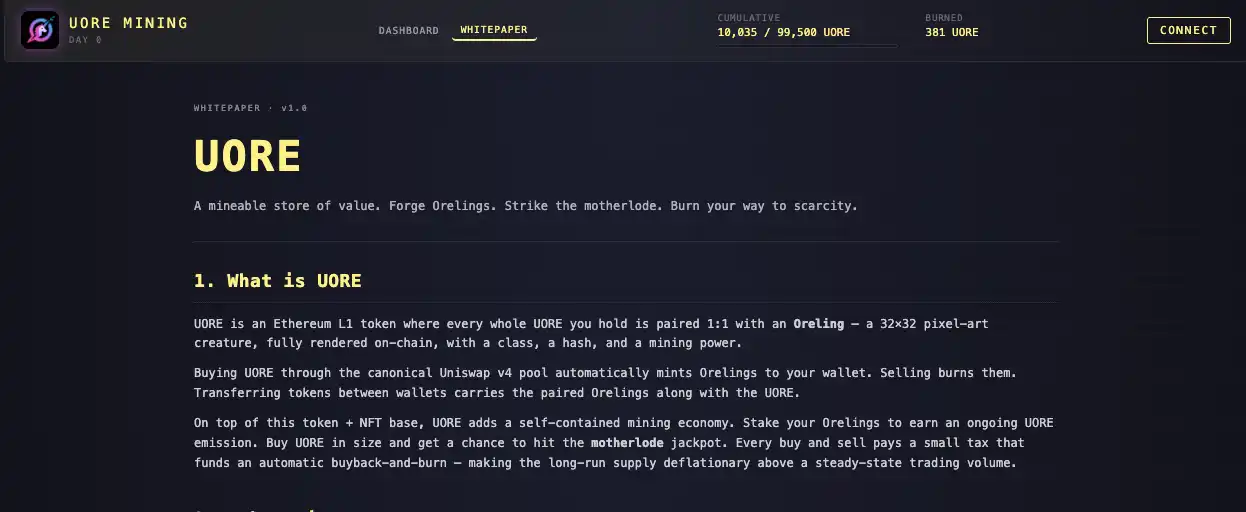
The new project is called $UORE, launched just yesterday. What it does can be summarized in one sentence: It packs on-chain mining, token-buying lottery, pixel NFT auto-generation, and deflationary burning mechanisms, all into a single Uniswap V4 trading pool.

Because buying tokens in this pool triggers the contract to simultaneously perform these six actions in the background, the gas fee for one transaction is two to three times that of a normal swap...

Currently on Crypto Twitter, you'll find everyone complaining about this high gas cost.

Regarding the token, according to GMGN data as of the time of writing, $UORE surged to a market cap of $1.2 million within hours of launch, then quickly dropped back to $440k. The pool liquidity is only $64k, but the 24-hour trading volume is $1.2 million, meaning the money in the pool has been turned over nearly twenty times.

However, there are only 741 holders, and the total supply is less than ten thousand tokens.
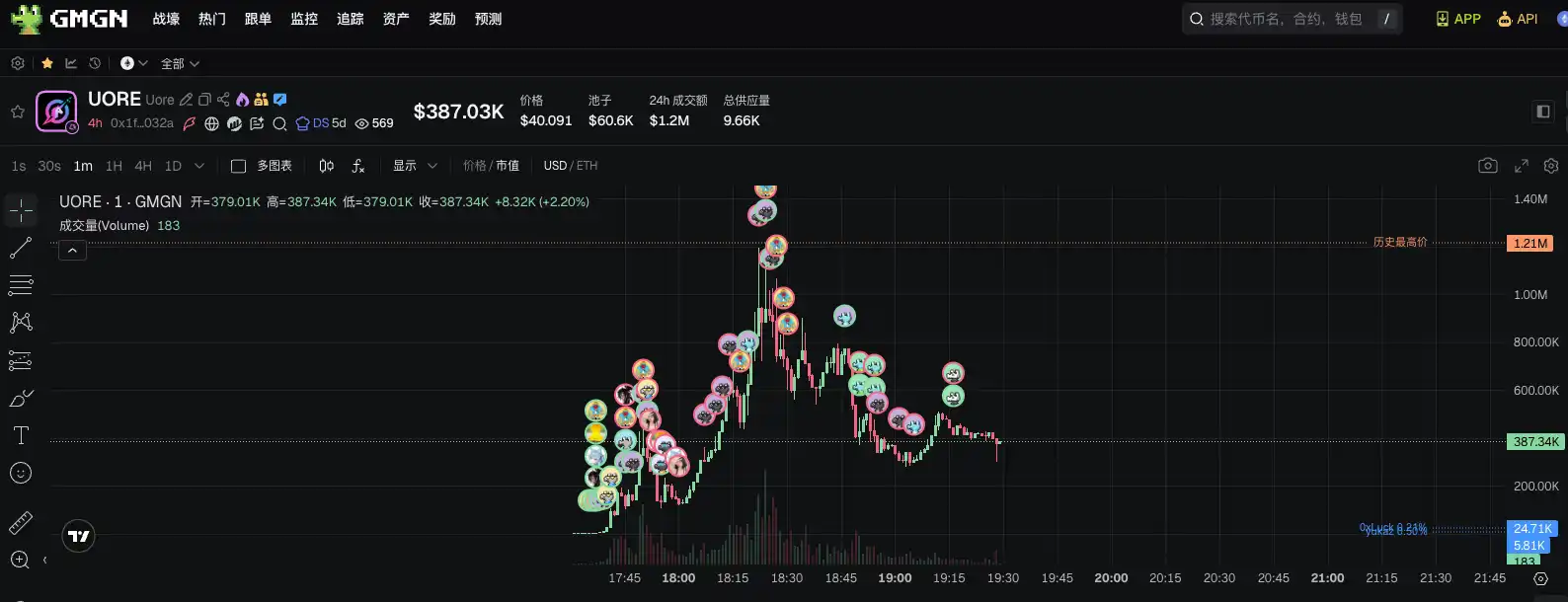
Currently, the risks appear extremely high. After a brief study, I personally think it's the most mechanically complex project in the V4 Hook ecosystem (this round of new on-chain plays tends to be confusing in terms of mechanics...).

It is simultaneously a token, an NFT collection, a staking mining farm, and a lottery system. Moreover, these four things are not independent; they are welded together.

The Four-in-One Mining Farm

In most NFT projects, the token and the NFT are two separate things, bought and sold independently.

UORE is not. Its NFT is called Oreling, a 32×32 pixel miner character directly embedded into the token. For every full integer UORE you hold in your wallet, you automatically own one corresponding Oreling.
The contract mints it for you when you buy tokens, burns it when you sell tokens, and the Oreling moves with the UORE when you transfer. You cannot buy an Oreling separately, nor can you detach it from UORE.

Each Oreling's traits are determined by the hash of the next block the moment it is minted. This means you don't know what kind of character you'll get when you buy; not even the validator can see the result in advance.

The differences between these characters are not just about appearance.

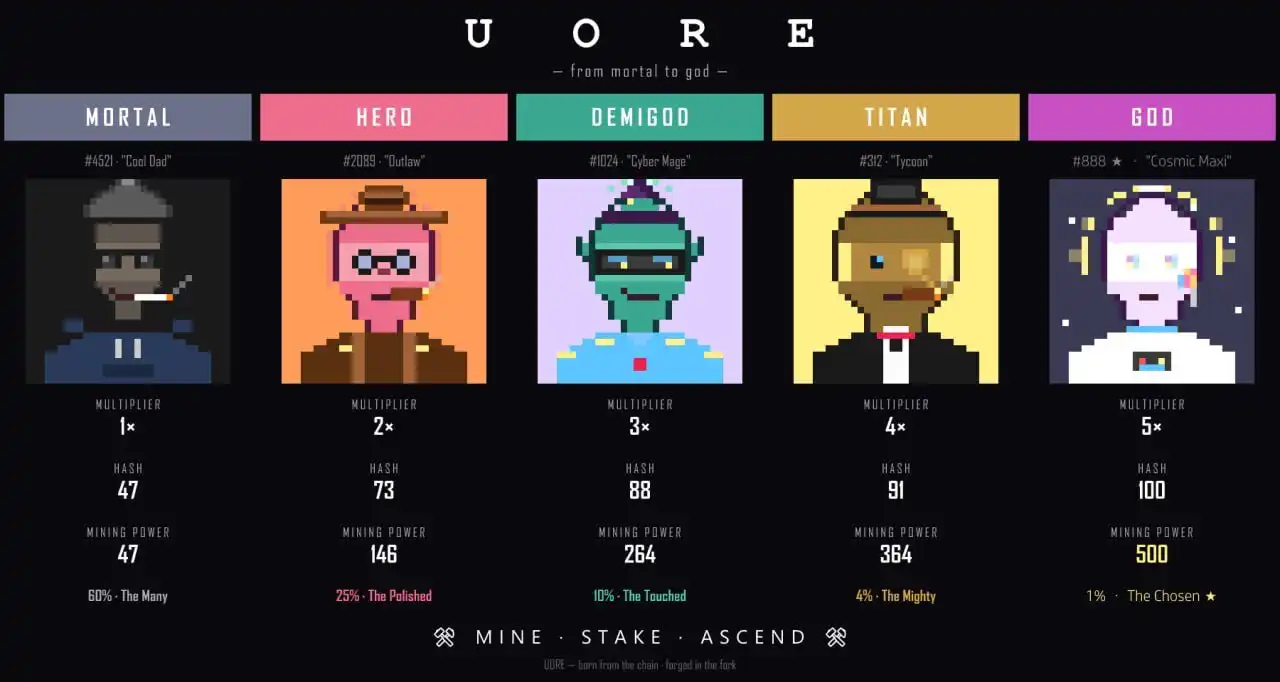
Each Oreling has a Class (rarity) and a Hash (a random number from 1 to 100). Multiplying these two gives its Mining Power.

The most common Mortal class accounts for 60% with a 1x multiplier; the rarest God class has only a 1% probability with a 5x multiplier. If you're lucky and get a God with Hash 100, your mining power is 500, more than ten times that of an ordinary miner.

So what is mining power used for? Old-school play: staking.

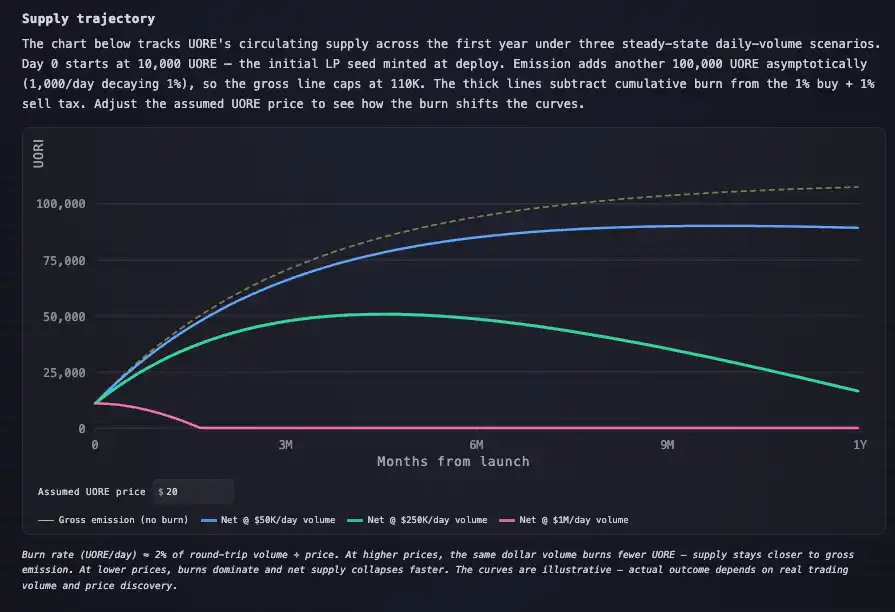
Stake your Oreling into the mining pool, and you start receiving a share of the daily UORE release based on your mining power proportion. According to the official whitepaper, 1000 UORE are released on the first day, decaying by 1% daily thereafter, with a half-life of approximately 69 days. 80% of the release is distributed to stakers, and 20% goes into the Motherlode prize pool.

This decay rate means that within a year, 97% of the total emission will be released. The earlier you enter to mine, the larger the slice you get.

A design worth noting when claiming rewards: a 10% "refining tax" is deducted and redistributed to all stakers who haven't claimed yet. The whitepaper calls this the refined-ore boost.

In plain language, those who claim later receive more of the taxes paid by others. Those in a hurry to claim are subsidizing the patient ones.
Then there's the Motherlode, translated as the "mineral vein jackpot."

Every time you buy ≥ 0.1 ETH worth of UORE through official channels, you automatically get a lottery ticket. The winning probability is tied to the purchase amount: ~1/600 for 0.1 ETH, ~1/200 for 0.5 ETH, and capped at ~1/100 for 1 ETH. Buying more than 1 ETH doesn't increase the probability, preventing whales from spamming.

If you win, the prize pool is split in two: 50% goes directly to the buyer, and 50% is randomly distributed to one staker (weighted by mining power). As of writing, there have only been 4 wins in history, with the largest prize being 6.4 UORE.

Finally, the deflationary flywheel.

A 1% tax on buys is directly burned, and a 1% tax on sells goes into a buyback treasury. When the treasury accumulates 0.1 ETH, anyone can trigger an automatic buyback, and all bought-back UORE are burned. As of writing, 58 buybacks have been executed, cumulatively burning 358 UORE.
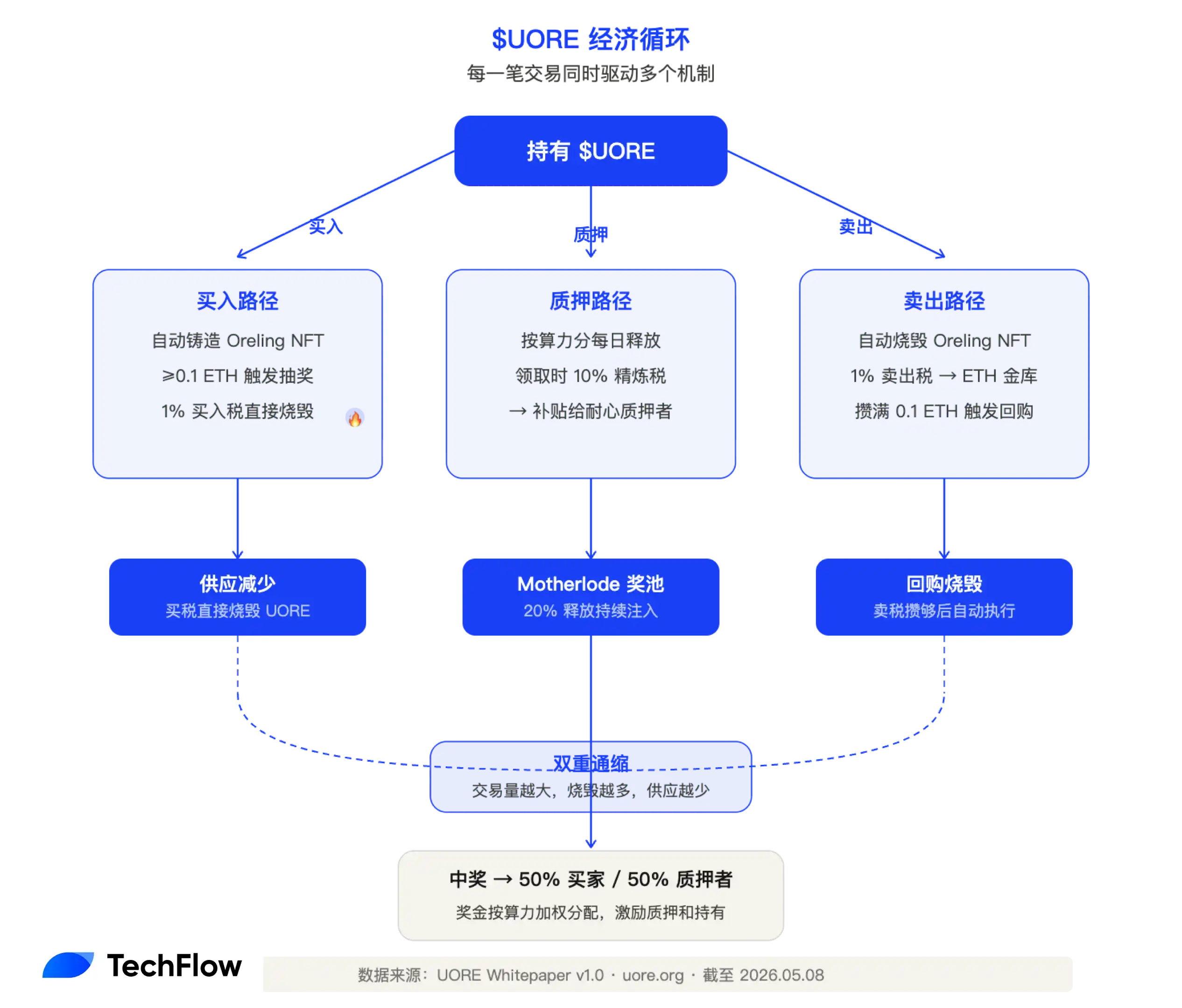
Looking at the overall design, it's a small innovation in token-NFT gameplay, an old trick for creating scarcity, yet another Ponzi in economic model design.

The Code is Forked, The Gameplay is Stitched

UORE wasn't written from scratch.

Someone in the community reviewed the source code and found a folder named `reference/unipeg-hook-source/`. The founder, Noah, hasn't hidden it either. He directly stated on Twitter that UORE's contract is forked from uPEG, and it fixed two known issues with uPEG: duplicate NFT generation and flash loan attacks to farm rarity.
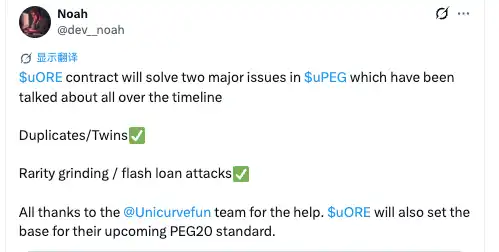
Checking out this founder's account, his bio reads "Ethereum dev & BAYC holder." On May 2nd, he posted his first tweet about UORE, saying the project combines the mining concept from Solana's ORE with the V4 Hook architecture of uPEG.

He also proactively @'ed Unicurvefun and Openpeg, asking if they could support Orelings trading after their marketplaces launch.

From this public information, UORE's project lineage is clear:

Solana ORE provided the "on-chain mining + lottery" gameplay template, uPEG provided the V4 Hook code skeleton, and Noah made improvements and assembly on these two foundations.

Forking itself isn't the issue. I think the current problems are:

  1. Gas. People on CT report that each UORE transaction needs to complete six steps within the Hook, consuming two to three times the gas of a normal swap. Swapping back and forth might leave little profit.
  2. Time Window. The V4 Hook narrative, affected by uPEG's decline, will have a lower ceiling for subsequent projects. UORE is the fourth project in this wave of Hook hype, and the heat for the first three is already cooling. The attention window for the track waits for no one.
  3. Complexity. UORE might be the most mechanically intricate of these four projects. For an average user to understand the whole set of rules—Oreling rarity, mining power calculation, staking decay, refining tax, Motherlode probability, buyback trigger conditions—the barrier is high, and the official website is cryptic.

Moreover, the project whitepaper is also interesting:

"Read the contracts and understand the mechanics before deploying capital."

Translated into Chinese, this roughly means "Understand it before you come; don't blame me if you don't."

Combining this with the previous Hook projects, we can see that this wave of on-chain trends features complex mechanism design + immense information asymmetry, having alpha potential, but the shelf life of that alpha is getting shorter and shorter.

SATO gave about a week, uPEG gave a few days, and by the time we get to UORE, the time left for you to understand the rules might be just a few hours...

By the time you understand, the market move might already be over.

İlgili Sorular

QWhat is the core concept of the $UORE project, and what makes it unique among other V4 Hook projects?

AThe $UORE project integrates multiple mechanisms into a single Uniswap V4 transaction. Its unique concept is bundling on-chain mining, a buy-to-enter lottery, dynamically generated pixel NFTs (Orelings), and a deflationary burn mechanism all within one trading pool. Each buy/sell transaction automatically handles token purchase, NFT minting/burning, lottery ticket allocation, and tax distribution.

QWhat is an Oreling, and how is it intrinsically linked to the $UORE token?

AAn Oreling is a 32x32 pixel miner NFT. It is directly embedded into the $UORE token: holding one full $UORE automatically grants one Oreling. You cannot buy, sell, or transfer an Oreling separately from its $UORE token. Its features, determined by the next block's hash, dictate its mining power for the staking reward system.

QExplain the staking and mining reward mechanism for $UORE/Orelings.

AUsers stake their Orelings in a mining pool. Each Oreling's mining power (calculated as Class rarity multiplier x Hash value from 1-100) determines the holder's share of daily $UORE emissions. Emission starts at 1,000 tokens per day, decaying by 1% daily. 80% of emissions go to stakers, and 20% goes to the Motherlode lottery pool. A "refined-ore boost" tax of 10% is deducted from claimed rewards and redistributed to unstaked participants, incentivizing delayed claims.

QWhat is the 'Motherlode', and how does the buy-to-enter lottery work?

AThe Motherlode is a lottery prize pool. Buying at least 0.1 ETH worth of $UORE via official channels grants one lottery ticket. The winning probability scales with the purchase amount, capped at a 1% chance for purchases of 1 ETH or more. Upon winning, the prize pool is split: 50% goes to the buyer, and 50% is randomly distributed to one staker (weighted by their mining power).

QWhat are the key risks and challenges mentioned about the $UORE project?

AThe article highlights several risks: 1) High gas fees (2-3x normal swaps) due to complex contract execution. 2) A short attention window as it's the fourth project in a potentially fading V4 Hook narrative trend. 3) High complexity and information asymmetry, making it difficult for average users to understand the full mechanics quickly. 4) Its code is a fork of the uPEG project, raising questions about novelty, though it claims to fix some of uPEG's vulnerabilities.

İlgili Okumalar

From KYC to KYA, Is It Time to Give AI Agents Their Own 'ID Cards'?

Titled "From KYC to KYA: Is It Time to Issue 'Identity Cards' for AI Agents?", this article discusses the emerging concept of Know Your Agent (KYA) as AI agents become increasingly autonomous. In Agent-to-Agent (A2A) scenarios, where agents execute contracts, payments, and trades without human intervention, the lack of a shared identity standard creates risks like unauthorized transactions, fraud, and accountability gaps. KYA acts as a trust layer to verify an agent's origin, authority, and accountability. The need for KYA is most critical outside centralized platforms (like Google or Coinbase), such as in decentralized exchanges (DEX), A2A payments, and merchant payments. Several key players are building KYA infrastructure: - **ERC-8004**: A proposed Ethereum standard that issues a unique AgentID as an NFT, building on-chain identity, reputation, and validation systems. - **Visa TAP**: Visa's solution issues agent identity credentials, with transactions verified via triple signatures (legitimacy, delegator, payment method). - **Trulioo**: Extends its KYC/KYB compliance infrastructure using a Digital Passport for Agents (DAP), issued after verifying both the developer and user, and refreshed per transaction. - **Sumsub**: Focuses on post-issuance real-time verification, detecting agent anomalies during transactions using its existing compliance systems. Regulatory bodies are also acting. The EU AI Act mandates operator identification in logs for high-risk AI systems, the US NIST prioritizes agent identity management standards, and Singapore has released a national AI governance framework. Similar to how the 2019 FATF Travel Rule impacted crypto exchanges, possessing KYA infrastructure may determine market entry in the AI agent era. The market is expected to segment rather than produce a single winner, with success depending on integrations with merchants, payment networks, and KYC client bases.

marsbit35 dk önce

From KYC to KYA, Is It Time to Give AI Agents Their Own 'ID Cards'?

marsbit35 dk önce

The Next Generation of Payments Lies Not in the Payment Layer

The Next-Generation of Payment is Not in the Payment Layer This is the second piece in a series analyzing Stripe's AI strategy. The series stems from Stripe's vision of becoming the economic infrastructure for the AI Agent era, announced at Stripe Sessions 2026. A key debate centers on whether Know Your Agent (KYA) is merely an upgrade to existing payment systems. The author argues the opposite: payment will become a subsystem of KYA, not the other way around. Historically, major payment innovations (online banking, mobile wallets, QR codes) emerged from new transaction scenarios that broke the underlying assumptions of old systems, not from optimization within the payment layer itself. Agent economy is that new scenario, and KYA is the foundational infrastructure growing to support it. KYA's proposed five layers—Agent Identity, Authorization Scope, Intent Signing, Liability Chain Auditing, and Credit Rating—extend far beyond payments. Only authorization and auditing directly touch the payment链路. Identity, intent, and credit layers serve broader needs like cross-platform calls, AI alignment, and permission management. Stripe's strategic moves validate this view. Its focus on "economic infrastructure for AI," investments in protocols like Agentic Commerce Protocol (an identity/session protocol), Shared Payment Tokens, stablecoin infrastructure, embedded wallets, and its own Tempo blockchain for settlement, all point to building the KYA layer, not just optimizing payments. Data shows the core challenge in AI commerce has shifted upstream: determining "who this is, what they intend to do, and if they deserve resources" happens long before checkout. This is why Stripe is moving its Radar fraud prevention from the transaction moment to the entire user lifecycle—a KYA-layer concern. Legally, ultimate responsibility will still fall on a human, as laws like AB 316 dictate. However, in a distributed,网状 liability chain involving users, Agent platforms, model providers, and payment protocols, KYA's role is to use cryptography to make every entity's actions and roles verifiable and traceable. This enables accountability where it was previously impossible to pinpoint evidence, fundamentally changing责任追溯, not just payment efficiency. The next-generation payment形态 will not be designed within the payment layer. It will emerge from the Agent economy scenario after the KYA infrastructure is established.

marsbit3 saat önce

The Next Generation of Payments Lies Not in the Payment Layer

marsbit3 saat önce

The Next Generation of Payments Is Not in the Payment Layer

The next generation of payments won't be designed within the payment layer itself. This article argues that historical payment innovations (e.g., online banking, mobile wallets) emerged from new transactional scenarios, not from optimizing existing payment systems. The new scenario is the Agent economy. Know Your Agent (KYA) is not merely a payment-layer upgrade for efficiency. It is the foundational infrastructure layer for the Agent economy. KYA’s five layers—Agent identity, authorization scope, intent signature, accountability chain audit, and credit rating—primarily serve broader needs like cross-platform identification, AI alignment, and permission management. Payment is just one application built on top of this KYA foundation. Stripe’s strategy exemplifies this shift. Its focus on "economic infrastructure for AI," investments in protocols like the Agentic Commerce Protocol (identity/session layer), stablecoin infrastructure, embedded wallets, and moving risk management (Radar) to the user lifecycle all indicate it is building the KYA layer, not just optimizing payments. While ultimate legal liability remains with a human (as laws like AB 316 stipulate), KYA enables traceability in a distributed,网状 responsibility chain involving multiple entities (user, Agent platform, model provider, etc.). It makes accountability verifiable where previously it was opaque. The conclusion: A new class of economic actors (Agents) forces a new infrastructure layer (KYA) to emerge. This layer redefines identity, authorization, and accountability. On top of it, the next generation of payment will reorganize and emerge from the demands of the scenario, not from within the traditional payment system.

链捕手3 saat önce

The Next Generation of Payments Is Not in the Payment Layer

链捕手3 saat önce

İşlemler

Spot
Futures

Popüler Makaleler

ONE Nasıl Satın Alınır

HTX.com’a hoş geldiniz! Harmony (ONE) satın alma işlemlerini basit ve kullanışlı bir hâle getirdik. Adım adım açıkladığımız rehberimizi takip ederek kripto yolculuğunuza başlayın. 1. Adım: HTX Hesabınızı OluşturunHTX'te ücretsiz bir hesap açmak için e-posta adresinizi veya telefon numaranızı kullanın. Sorunsuzca kaydolun ve tüm özelliklerin kilidini açın. Hesabımı Aç2. Adım: Kripto Satın Al Bölümüne Gidin ve Ödeme Yönteminizi SeçinKredi/Banka Kartı: Visa veya Mastercard'ınızı kullanarak anında Harmony (ONE) satın alın.Bakiye: Sorunsuz bir şekilde işlem yapmak için HTX hesap bakiyenizdeki fonları kullanın.Üçüncü Taraflar: Kullanımı kolaylaştırmak için Google Pay ve Apple Pay gibi popüler ödeme yöntemlerini ekledik.P2P: HTX'teki diğer kullanıcılarla doğrudan işlem yapın.Borsa Dışı (OTC): Yatırımcılar için kişiye özel hizmetler ve rekabetçi döviz kurları sunuyoruz.3. Adım: Harmony (ONE) Varlıklarınızı SaklayınHarmony (ONE) satın aldıktan sonra HTX hesabınızda saklayın. Alternatif olarak, blok zinciri transferi yoluyla başka bir yere gönderebilir veya diğer kripto para birimlerini takas etmek için kullanabilirsiniz.4. Adım: Harmony (ONE) Varlıklarınızla İşlem YapınHTX'in spot piyasasında Harmony (ONE) ile kolayca işlemler yapın.Hesabınıza erişin, işlem çiftinizi seçin, işlemlerinizi gerçekleştirin ve gerçek zamanlı olarak izleyin. Hem yeni başlayanlar hem de deneyimli yatırımcılar için kullanıcı dostu bir deneyim sunuyoruz.

264 Toplam GörüntülenmeYayınlanma 2024.12.12Güncellenme 2025.03.21

ONE Nasıl Satın Alınır

Tartışmalar

HTX Topluluğuna hoş geldiniz. Burada, en son platform gelişmeleri hakkında bilgi sahibi olabilir ve profesyonel piyasa görüşlerine erişebilirsiniz. Kullanıcıların ONE (ONE) fiyatı hakkındaki görüşleri aşağıda sunulmaktadır.

活动图片