2nm Chip in Cars, Foldable iPhone Potential Debut: What to Expect from Apple's Autumn Event?

marsbit2026-08-26 tarihinde yayınlandı2026-08-26 tarihinde güncellendi

Özet

Apple is set to hold its Fall 2026 product launch event, likely on September 9, with significant updates across its product lines. The event is expected to introduce the iPhone 18 Pro series, featuring the new A20 Pro chip based on a 2nm process and Apple's custom C2 modem. A major highlight will be the debut of Apple's first foldable iPhone, potentially named iPhone Ultra, which aims to bridge phone and tablet experiences. Beyond the iPhone, Apple is anticipated to refresh the Apple Watch and AirPods, with new Mac models following recent updates to the Mac mini with M6 and M5 Pro chips. A key theme across all hardware is a strong focus on enhancing on-device AI performance and capabilities. Concurrently, Apple is bolstering its AI infrastructure and US supply chain. This includes establishing AI server assembly lines in Texas and advancing domestic semiconductor manufacturing with partners like TSMC in Arizona. These moves aim to secure Apple's computational and supply chain needs for the AI era. This event also marks a leadership transition, with Tim Cook handing the CEO role to hardware lead John Ternus on September 1. The company is strategically repositioning its iPhone lineup, prioritizing high-end models with staggered releases, and integrating AI deeper into its ecosystem of devices and services.

Before Apple's 2026 Autumn New Product Event has even begun, the groundwork for a strategic layout around chips and AI computing power is already underway.

On August 25 local time in the United States, Apple officially released the new Mac mini equipped with the all-new M6 and M5 Pro chips. This update primarily focuses on performance upgrades, particularly a significant boost in AI computing capabilities.
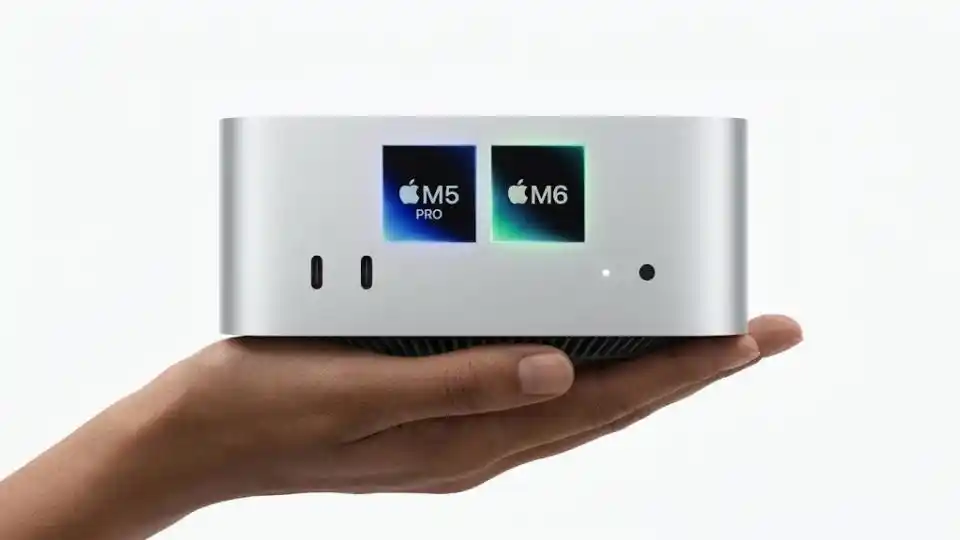
Apple stated that the Mac mini equipped with the M6 chip sees up to a 4x improvement in AI performance, up to 2x improvement in graphics performance and storage speed, and a 40% improvement in CPU performance. The version with the M5 Pro chip is further targeted towards professional users and enterprise AI workflows.

This round of upgrades further highlights Apple's investment in on-device AI. As chip computing power continues to increase, the Mac is taking on more high-load tasks such as local large models and AI Agents, with AI computing gradually becoming a major theme in Apple's hardware upgrades.

This theme will also extend to the Autumn New Product Event in September.

According to Apple's senior analyst Mark Gurman on August 25, Apple is likely to hold its Autumn New Product Event on September 9, with key products including the iPhone 18 Pro series, the first foldable iPhone, as well as the Apple Watch, AirPods, and more.

This year is also special as Apple is at a juncture of management transition. Tim Cook will hand over the CEO position to hardware engineering head John Ternus on September 1. Therefore, this round of September products will also mark Apple's first major product release under its new management cycle.

Furthermore, Apple is readjusting the release schedule for the iPhone: the iPhone 18 Pro, iPhone 18 Pro Max, and the foldable iPhone are still expected to be unveiled at the September event, but the standard iPhone 18, iPhone Air 2, and iPhone 18e may be postponed to early 2027.

Beyond hardware products, Apple is shoring up the infrastructure behind the AI era, including AI server construction and US domestic chip supply chain layout.

The first foldable iPhone is tasked with opening up a new product form factor, the A20 Pro and Apple Intelligence continue to strengthen on-device AI, while servers and the chip supply chain relate to whether Apple can further extend its AI capabilities into the infrastructure.

01 iPhone Begins Rearranging Its Lineup

In recent years, Apple has maintained a relatively stable iPhone update rhythm: releasing a complete product line each autumn, and creating different price tiers through standard and Pro models.

But this year, Apple is adjusting this strategy. According to tech media Digital Trends, in September, Apple may only release three high-end iPhone models.
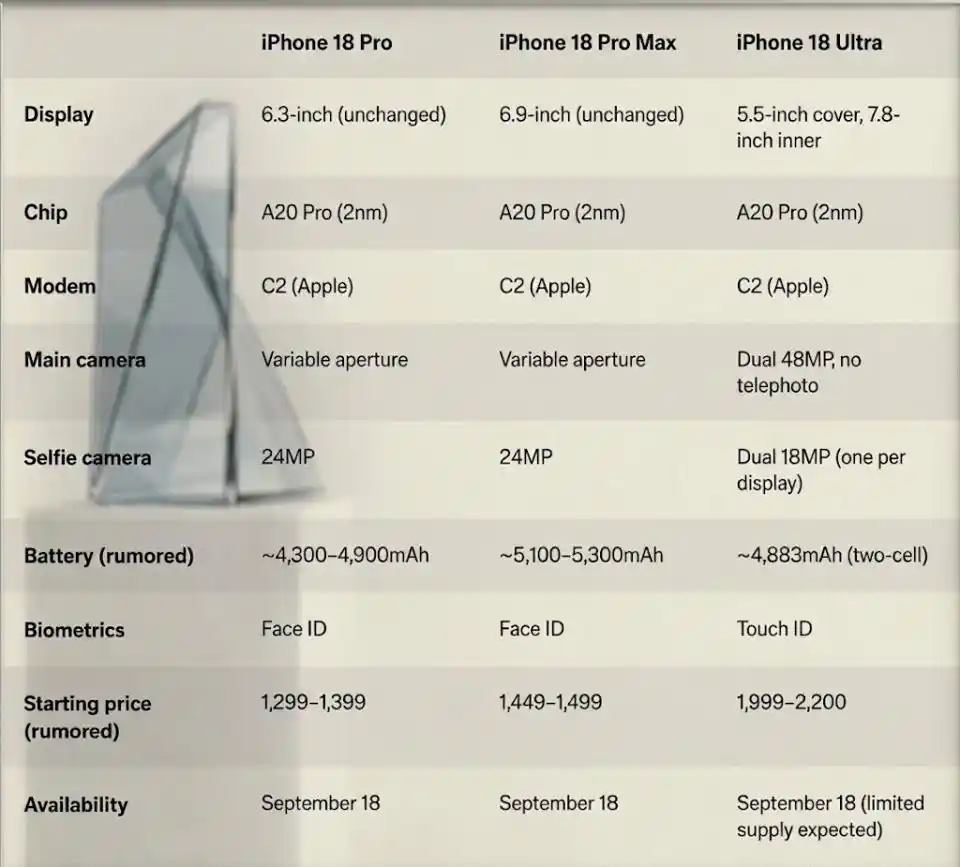
This suggests that Apple may further widen the time gap between the release of high-end models and standard models, concentrating more resources on the Pro series and even higher-end products. In the future, the iPhone lineup may gradually form a tiered model similar to the Mac, with models of different positions taking on different market roles.

Behind this change is the iPhone's growth entering a new phase.

For Apple, the model of driving upgrades through hardware improvements like screens, chips, and cameras is waning. Apple needs high-end products to maintain profit margins while accumulating more room for hardware upgrades in the AI era. Therefore, the iPhone 18 Pro series represents not just a routine update, but also the direction of Apple's next phase of products.

The iPhone 18 Pro series is not expected to undergo major exterior changes, with the focus still on chips, cameras, and AI capabilities. According to disclosures from media like AppleInsider, both models are expected to adopt the A20 Pro chip based on a 2nm process and feature Apple's in-house C2 modem.

Multiple supply chain sources and analysts believe the A20 Pro will be the core of this generation's upgrade. It's reported that Apple is adopting a new wafer-level multi-chip module (WMCM) packaging method, placing the CPU, GPU, neural engine, and memory closer together to improve performance and AI efficiency.
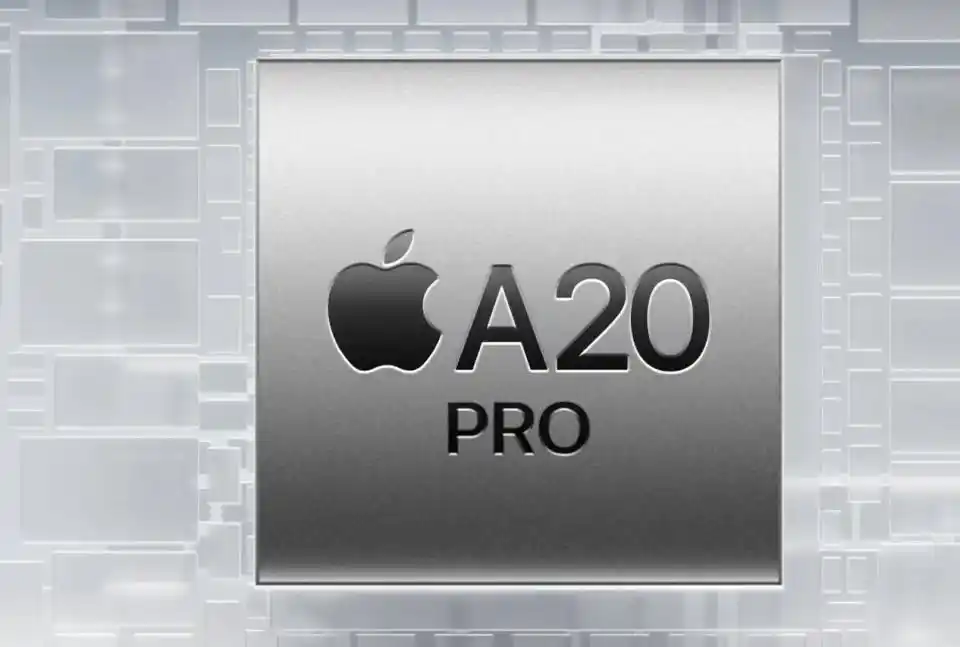
Apple A20 Pro Chip

The imaging system may also see adjustments. The new models are expected to incorporate variable aperture technology for the main camera. Compared to simply increasing pixels, this upgrade is closer to the control logic of professional cameras, allowing users more flexible control over light intake and depth of field.

Meanwhile, price may become the biggest variable for this year's iPhone. Reports from media like The Wall Street Journal show that Apple has already raised prices on multiple product lines this year: the MacBook Air increased by $200, Mac Studio by $500, and iPad Air by $150. The iPhone hasn't seen a price hike yet, but the new generation iPhone could be the next batch to see increases.

Senior Apple analyst Gurman reveals that Apple is still discussing final pricing, with schemes circulating externally including a starting price of around $1199 for the iPhone 18 Pro, and a higher range of $1299 to $1399.

For Apple, price increases are related both to cost changes and the continuation of its strategy to strengthen the high-end market.

In recent years, Apple has continuously widened the gap between the Pro series and the standard version, making consumers willing to pay a premium for stronger chips, better imaging capabilities, and longer product lifecycles. Analysts note: "Entering the AI era, this differentiation may further expand."

In the future, the focus of iPhone competition will gradually shift from traditional hardware specifications to AI capabilities and ecosystem experience. Whether a device can become an important entry point for users' daily AI services may determine the competitive landscape of the smartphone market in the next phase.

This is also the core reason for Apple adjusting its product rhythm: by redefining product positioning, letting high-end iPhones take on more technological innovation and creating space for the development of the future AI ecosystem.

02 Foldable iPhone Potential Debut

Among this year's new product lineup, the most anticipated new category is the potential debut of Apple's first foldable iPhone. It is widely expected that this product may be named iPhone Ultra.

Digital Trends reports that it adopts a book-like folding structure, offering a small tablet experience similar to the iPad mini when unfolded, while maintaining a phone form when folded. What's truly important is Apple's attempt to cover both phone and tablet scenarios with this device, with its size merely being the means to achieve this goal.

US tech media The Information discloses that those who have actually experienced the foldable iPhone have given positive evaluations of its size, hinge feel and durability, as well as the iPad-like app layouts enabled by the large interior screen. Gurman also stated that early testers have generally responded positively to this device.

Apple's focus on foldable screens has long moved beyond the form factor itself, settling on the human-machine interaction method in the folded state. The hinge is one key area. It's said Apple is using solutions like liquid metal and ultra-thin glass to improve the hinge and crease issues.

However, Apple's first foldable is not without its shortcomings, with the most debated being the camera. Messages summarized by MacRumors indicate that the foldable iPhone may only have two rear cameras, lacking a telephoto lens. For a flagship product that may cost over $2000, this is particularly sensitive.

The Information points out that this could be a factor affecting sales. Because the consumers willing to pay a high price for the foldable form factor largely overlap with those who value high-end photography and telephoto capabilities.

Another change is Face ID. Gurman reveals that, due to the folding structure and internal space constraints, the foldable iPhone is reportedly set to use Touch ID instead of Face ID. This represents a step back for Apple users but also indicates that Apple needs to make trade-offs for the first-generation foldable product.

Price is also a high barrier. MacRumors states that current market rumors place the price range of the foldable iPhone roughly between $2000 and $2500. However, Tianfeng International analyst Ming-Chi Kuo believes that even if the final price reaches $2300 to $2500, market demand may remain strong at least until the end of 2026.
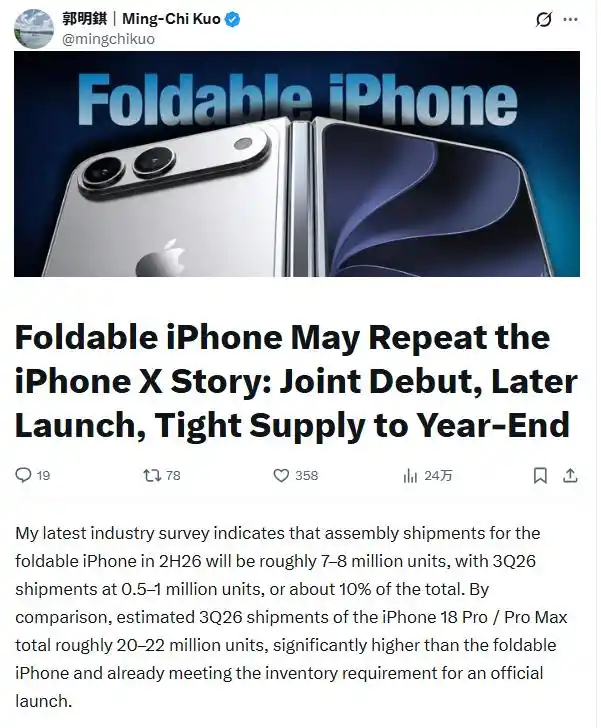
Kuo also believes the first foldable iPhone might replay the supply situation of the 2017 iPhone X. His industry surveys indicate that assembly shipments for the foldable iPhone in the second half of this year are about 7 to 8 million units, with only 500,000 to 1 million units in Q3, while the iPhone 18 Pro and Pro Max are expected to reach 20 to 22 million units in the same period.

This means that even if Apple releases the foldable iPhone in September, it may not be able to achieve large-scale sales simultaneously.

If production preparation is insufficient, the foldable iPhone might, like the iPhone X back then, see a significant time gap between announcement, pre-order, and official sales. Supply shortages could instead amplify initial demand. Kuo expects that the foldable iPhone may sell out quickly after pre-orders open, with waiting times reaching 4 to 6 weeks or even longer, potentially lasting until December.

But truly judging the success of this product will have to wait until late 2026 to Q1 2027. By then, as the initial hype and supply constraints gradually subside, it will become clear whether consumers are buying into the "first foldable iPhone" or are willing to accept this product form factor long-term.

03 Beyond iPhone: Other New Products

The highlights of Apple's Autumn Event this year are not limited to the iPhone.

According to foreign media reports, alongside the two high-end models and the first foldable iPhone, Apple is also preparing to update a series of products, including the Apple Watch, AirPods, and some Mac product lines. Although these devices don't bear the strategic transformation tasks like the iPhone does, they collectively form an important part of Apple's hardware ecosystem.

Prior to the event, Apple has already pre-updated the Mac mini. The new Mac mini, equipped with M6 and M5 Pro chips, focuses on enhancing AI computing power, also signaling updates for subsequent Mac products.

In addition to the Mac mini, the Apple Watch is expected to be one of the important products at the September event.

Information compiled by media like 9to5Mac shows that Apple may launch the Apple Watch Series 12 and a new generation Apple Watch Ultra. The new watches are expected to continue strengthening health monitoring capabilities and receive upgrades in battery life, performance, and connectivity.

In recent years, the Apple Watch has shifted from a simple smartwatch to a health device gateway. As AI capabilities gradually enter Apple's ecosystem, the Apple Watch may also take on more data collection and personal health assistant functions in the future.

AirPods may also see updates. MacRumors, citing informed sources, states that Apple is expected to release AirPods 5 in September, further refining the entry-level and mid-range headphone lineup. Meanwhile, Apple is developing AirPods with cameras, but this product is not expected to debut this year. However, it might take on more complex AI interaction tasks, providing Siri with more contextual support by capturing information about the user's surroundings.

Furthermore, Apple may continue updating the iPad and Mac product lines in the autumn. According to MacRumors, the OLED iPad mini is expected to launch in October, marking the biggest screen upgrade for this product line in years. Simultaneously, new iMac and MacBook Pro models may also be updated in the autumn, equipped with the new generation M-series chips.

Apple is also advancing smart glasses and wearable devices with cameras. The latter can input visual data into the iPhone, then have it processed by AI.

Judging from this round of product updates, AI is gradually moving from a single function within the phone into more of Apple's devices and usage scenarios. Therefore, this year's chip upgrades from Apple also need to pay more attention to on-device AI computing power and the device's ability to run local models and AI Agents.

The A20 Pro emphasizes AI efficiency, the Mac continues to advance the M-series chips, while camera-equipped AirPods, smart glasses, and smart home devices require more complete AI synergy between devices. Hardware gateways are proliferating; the next critical issue for Apple is whether Siri and Apple Intelligence can truly become the unified AI gateway connecting these devices.

04 AI Servers Land, Apple Brings Supply Chain Back to US

Beyond new products, the chips and supply chain supporting this round of product upgrades are also significant parts of Apple's changes this year.

During the PC chip transition phase, Apple gradually freed itself from dependence on Intel processors through in-house chip design, also establishing the advantage of integrated software and hardware. Entering the AI era, the importance of chips has further risen. Whether it's Apple Intelligence on the iPhone or local large models and AI applications on the Mac, they all place higher demands on the CPU, GPU, and neural engine.

Continuously improving on-device computing power has thus become a key driver for Apple advancing its Apple Silicon roadmap.

From the A-series chips in the iPhone, to the M-series chips in the Mac, to future, more powerful on-device AI devices, Apple is building a computing system covering phones, computers, and smart hardware. But AI competition isn't limited to end-user devices. As model capabilities improve, Apple also needs more powerful backend computing power and a manufacturing system.

Recently, a Wall Street Journal reporter conducted a field visit to Apple's US supply chain. The report shows that a Foxconn factory in Houston, Texas, already has an AI server assembly line capable of assembling about 10 servers per hour.
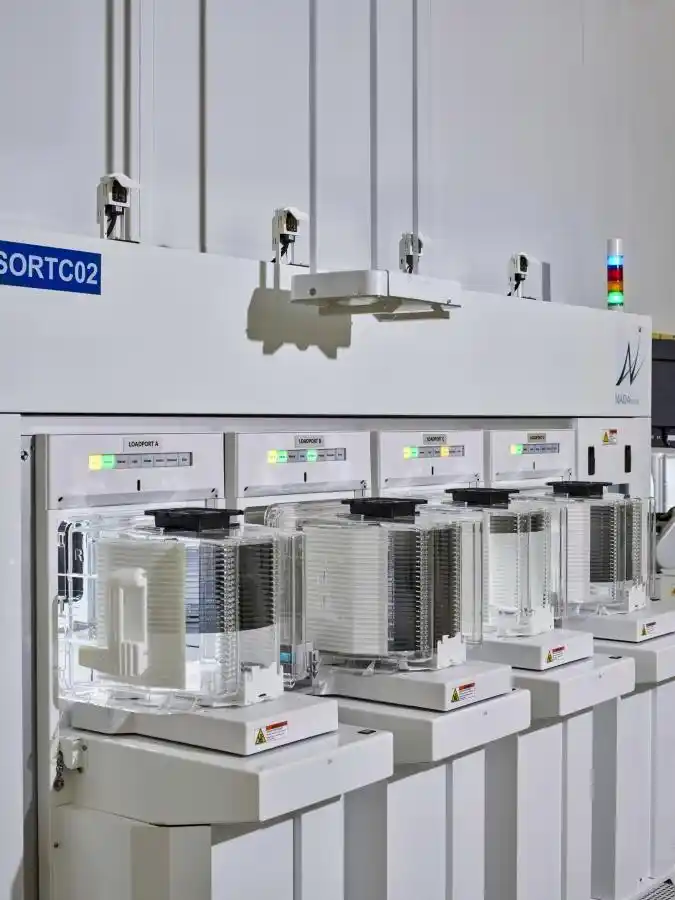
Wafer sorting equipment at the Sherman, Texas factory

The scale of this production line isn't large, but its significance lies in Apple's AI infrastructure extending further from chip design to server manufacturing.

The Houston factory handles the final assembly, test, and pack (FATP) of the servers. Workers install chips and other components on the production line and test the servers.

Simultaneously, Apple is also promoting the construction of a domestic US semiconductor supply chain. GlobalWafers America, located in Sherman, Texas, is responsible for processing silicon raw materials into 12-inch wafers, which are then sent to TSMC's wafer fabs for chip manufacturing.
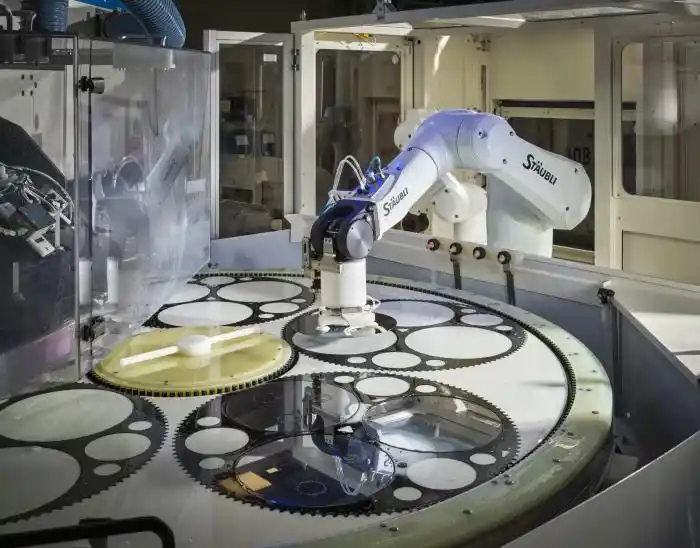
Silicon wafers undergoing polishing treatment inside the Sherman, Texas factory

TSMC's factory in Arizona has already begun producing Apple's A16 chips, and NVIDIA's Blackwell AI chips are also produced there.

However, more advanced manufacturing technologies are still mainly concentrated in Taiwan. It is reported that the advanced process used for the A19 chip in the iPhone 17 is currently only available in Taiwan. Therefore, Apple's strategy for promoting US manufacturing is to start with links in the supply chain where the US has the conditions to complete them, then gradually expand.

TSMC's investment scale in Arizona has reached approximately $165 billion, with plans to build multiple wafer fabs and advanced packaging facilities.

The localization of chip manufacturing恰好 resonates with the expertise of the incoming CEO. John Ternus, set to take over, comes from a hardware engineering background and has led the design of multiple generations of Macs and chips. Cook will hand over the CEO position to him on September 1, but Cook will not leave Apple entirely, transitioning to the role of Executive Chairman.

When Ternus takes over Apple, he will face a complex situation for a company entering a new growth phase. The iPhone remains the most important business, but chips, computing power, servers, and the supply chain are increasingly directly impacting Apple's product competitiveness.

The key to Apple's next phase lies in whether it can integrate chips, end devices, servers, and the manufacturing system into a stable AI capability and ultimately translate it into product advantages. Compared to the sales of a single foldable iPhone, this may better determine Apple's direction in the next phase.

Special thanks to contributing compiler Jin Lu for this article.

This article is from "Tencent Technology," author: Li Hailun, editor: Xu Qingyang

Trend Kriptolar

İlgili Sorular

QWhat is the significance of the M6 and M5 Pro chips in the new Mac mini, as mentioned in the article?

AThe M6 and M5 Pro chips in the new Mac mini, released on August 25, 2026, signify a major performance upgrade focused on enhanced AI computing capabilities. The M6 chip delivers up to 4x improvement in AI performance, up to 2x improvement in graphics performance and storage speed, and a 40% boost in CPU performance. The M5 Pro version is further tailored for professional users and enterprise AI workflows. This update highlights Apple's emphasis on on-device AI, allowing Macs to handle more demanding tasks like local large language models and AI Agents.

QWhat major iPhone lineup changes are expected according to the September 2026 Apple event, as discussed in the article?

AAccording to the article, Apple is adjusting its iPhone release strategy. The September 2026 event is expected to focus on high-end models only: the iPhone 18 Pro, iPhone 18 Pro Max, and the first foldable iPhone (potentially named iPhone Ultra). The standard models like the iPhone 18, iPhone Air 2, and iPhone 18e are anticipated to be delayed until early 2027. This change aims to concentrate resources on premium products and establish a more tiered product line similar to the Mac.

QWhat are the key anticipated features of the rumored foldable iPhone (iPhone Ultra) based on the article?

AThe rumored foldable iPhone (potentially called iPhone Ultra) is described as having a book-like foldable design, offering a tablet-like experience when unfolded and a phone form when folded. Key details include: a focus on hinge durability using liquid metal and ultra-thin glass; potential compromises like only two rear cameras (lacking a telephoto lens) and the use of Touch ID instead of Face ID due to spatial constraints; an estimated high price point between $2,000 and $2,500; and initial supply constraints with projected sales of 700,000 to 800,000 units in the second half of 2026.

QWhat non-iPhone products are expected to be updated during Apple's Fall 2026 event, as per the article?

ABeyond the iPhone, Apple's Fall 2026 event is expected to include updates for several other products. These include the Apple Watch Series 12 and a new Apple Watch Ultra, which will continue to enhance health monitoring and performance. New AirPods 5 are also anticipated to refresh the entry-level and mid-range headphone lineup. Furthermore, updates to the Mac and iPad lineups are expected later in the fall, such as an OLED iPad mini and new iMac and MacBook Pro models with next-generation M-series chips.

QHow is Apple advancing its AI infrastructure and US supply chain, as detailed in the article?

AThe article details Apple's efforts to build AI infrastructure and reshore parts of its supply chain to the United States. Key initiatives include: establishing an AI server assembly line at a Foxconn factory in Houston, Texas, for Final Assembly, Test, and Pack (FATP); sourcing 12-inch silicon wafers from GlobalWafers America in Sherman, Texas; and utilizing chips manufactured at TSMC's fab in Arizona (e.g., A16 and NVIDIA Blackwell chips). This strategy aims to strengthen Apple's backend compute power for AI services and build a more resilient, localized manufacturing ecosystem for critical components under the new CEO, John Ternus.

İlgili Okumalar

NVIDIA Earnings Preview: The Market No Longer Expects a Positive Surprise

NVIDIA's upcoming earnings report has seen market expectations shift from anticipating big positive surprises to seeking clarity on capital allocation and future growth sustainability. While analysts forecast Q2 revenue near doubling year-over-year to $92.18 billion, option markets are pricing in a relatively muted post-earnings stock move of around 5.4%—the lowest implied volatility in two years. This reflects a growing sense that the phase of massive AI-driven earnings beats and stock surges may be ending. This year, NVIDIA's stock has slightly underperformed the S&P 500 and significantly lagged the semiconductor index. Analysts now emphasize the need for more than just beating estimates. Key investor focuses include details on how NVIDIA will deploy its capital, maintain its exceptional gross margins amid rising costs, and use its substantial free cash flow for investments and share buybacks. The forward P/E ratio of about 21x suggests the market is already pricing in a growth deceleration. NVIDIA's recent strategic moves—like facilitating massive AI financing, guaranteeing loans for data center projects (including a major one for OpenAI), and investing in power infrastructure—have positioned it beyond a mere chipmaker. However, this raises questions about potential "circular financing," where revenue might be artificially supported by lending to customers. The health of its AI clients, like OpenAI which reported slowing revenue growth, is now crucial. The report arrives amid a challenging backdrop: political pushback against AI data centers, rising borrowing costs, and massive debt-funded spending by cloud giants. Investors are keenly watching for signals on the transition to the new Blackwell and upcoming Vera Rubin architectures and, ultimately, whether the explosive demand for AI is losing momentum.

marsbit4 dk önce

NVIDIA Earnings Preview: The Market No Longer Expects a Positive Surprise

marsbit4 dk önce

Saylor Pauses Bitcoin Purchases: The World's Largest Bitcoin Holder Is Transforming into a 'Digital Asset Bank'

Saylor's Strategy has paused its long-standing practice of buying Bitcoin, marking a significant shift for the world's largest corporate BTC holder. The company is now prioritizing capital structure management over accumulation. Strategy recently raised $2 billion by selling shares but purchased zero Bitcoin, directing funds instead to a new USD cash reserve, repaying preferred stock, and building its dollar liquidity pool. This follows a series of BTC sales in 2026, totaling around 6,916 coins, often at a loss, to meet its substantial annual dollar obligations of approximately $1.76 billion in dividends and interest payments. The core change is the adoption of a new "Digital Credit Capital Framework." Strategy is transforming from a leveraged Bitcoin proxy into a "digital asset bank." Its focus has shifted from simply increasing its BTC holdings to managing a balance sheet where Bitcoin acts as the reserve asset, common stock as equity, and preferred shares as liabilities. The goal is now to optimize the "Bitcoin per share" metric and maintain stability, even if it means selling BTC at a loss during market stress to protect its financial footing. The market appears to be re-evaluating Strategy, pricing it less as a volatile Bitcoin tracker and more as a capital management firm. Despite its recent sales, Bitcoin's price has surged, indicating Strategy's selling pressure is easily absorbed by broader market flows like ETF inflows. If successful, Strategy could emerge as a novel hybrid: a "Bitcoin bank." However, this path carries major risks, as sustained BTC prices below its average cost could steadily erode its financial safety net.

marsbit34 dk önce

Saylor Pauses Bitcoin Purchases: The World's Largest Bitcoin Holder Is Transforming into a 'Digital Asset Bank'

marsbit34 dk önce

U.S. Stock Market Trend (August 26th): NVIDIA Ends 7-Day Losing Streak, Storage and Optical Communications Rebound Across the Board

U.S. Stock Market Trends (August 26th): Nvidia Ends Seven-Day Losing Streak; Memory and Optical Communication Stocks Rebound Across the Board. On Tuesday, the three major U.S. stock indices closed higher. The tech-heavy Nasdaq gained 0.66% as declining long-term Treasury yields (the 10-year yield fell to 4.625%) provided a valuation relief window for growth stocks. The Philadelphia Semiconductor Index rose 1.44%. Nvidia shares gained 2.19%, ending a seven-session decline ahead of its closely-watched earnings report after Wednesday's close. Memory and optical communication stocks saw a broad rebound, with AMD, Marvell, and Micron among the notable gainers. The 'Magnificent Seven' were mixed, with Tesla being the sole decliner. Oil prices fell for a second consecutive day, with WTI crude dropping 2.4% to $85.01 per barrel. This followed a joint statement from Iran and Oman proposing a secure maritime channel in the Strait of Hormuz, signaling a potential de-escalation of regional tensions. Bitcoin briefly touched $80,000, while gold prices hit a three-month high. The simultaneous strength in both assets was driven by expectations of improved liquidity amid lower yields and persistent concerns about dollar credit. Market focus now shifts to Nvidia's earnings, with investors keenly awaiting guidance on Blackwell chip shipments, data center revenue, and signals on AI capital expenditure.

marsbit59 dk önce

U.S. Stock Market Trend (August 26th): NVIDIA Ends 7-Day Losing Streak, Storage and Optical Communications Rebound Across the Board

marsbit59 dk önce

From Near Zero to New Highs: Zcash Charges Towards a NYSE ETF

From Near-Zero to New Highs: Zcash Eyes NYSE ETF Zcash (ZEC), the privacy-focused cryptocurrency launched in 2016, recently surged past $800, reaching a market cap of over $13 billion. This rally coincides with Grayscale Investments' fifth amended filing to convert its Zcash Trust into a spot ETF on NYSE Arca, backed by major Wall Street firms like Coinbase Custody and Jane Street Capital. The path to this point was dramatic. In May, a critical, four-year-old vulnerability was discovered that could have allowed infinite counterfeit ZEC creation, causing ZEC's price to halve. The development team responded swiftly, deploying a patch and executing the "Ironwood" upgrade in July. This upgrade froze the old, potentially compromised shielded pool (holding ~3.66 million ZEC) and created a new, mathematically verified one, effectively containing the crisis and restoring confidence—a key factor for institutional interest. Zcash's "selective privacy" model, offering both transparent and shielded addresses, is central to the ETF strategy. The proposed ETF would only handle transparent ZEC, allowing traditional finance to gain exposure to the "financial privacy" asset class without directly handling anonymous transactions. This comes as regulatory approaches diverge: the EU plans to ban regulated entities from handling privacy coins by 2027, while the US SEC has paved the way for such ETFs, potentially making Grayscale's fund a unique global access point. Further tightening supply, over 30% of ZEC's circulating supply is locked in shielded pools, and Grayscale's trust already holds a significant portion. An ETF approval could trigger institutional demand against a constrained liquid supply. Grayscale's commitment to reinvest the ETF's first-year 2.5% fee into the Zcash ecosystem and potential capital injections from its parent company, DCG, underscore deep alignment. The fundamental irony remains: an asset designed for anonymity is seeking legitimacy through the most transparent regulated vehicle. Ultimately, Wall Street may not be betting on privacy itself, but on the growing market value of the demand for it.

marsbit1 saat önce

From Near Zero to New Highs: Zcash Charges Towards a NYSE ETF

marsbit1 saat önce

Rubin Takes the Reins: Can Nvidia Break the Curse of Post-Earnings Slumps?

NVIDIA is set to announce its FY2027 Q2 earnings after market close on August 26. As a bellwether for AI investments, market sentiment is unusually divided. While strong results are expected, investors are wary of a post-earnings stock drop, a pattern seen for the last four consecutive quarters. The key variable this time is the market debut of the new Vera Rubin platform. Despite beating expectations consistently, NVIDIA's stock has fallen after each of its last four earnings reports. This "sell the news" trend reflects diminishing "expectation gaps," where future growth is already priced in. The immediate focus is now on the company's Q3 revenue guidance, particularly its first quantitative outlook for Rubin platform sales. The Vera Rubin platform promises a generational leap, especially in inference workloads, reportedly delivering up to 10x lower token cost compared to the previous Blackwell generation. This significant efficiency gain is seen as NVIDIA's strategic defense against growing competition from custom AI chips developed by major cloud customers. Analysts project Rubin could contribute 12% of GPU revenue in Q3, potentially rising to over 40% in Q4, driven by faster ramp-up due to infrastructure compatibility with previous systems. However, risks remain. Supply chain checks indicate potential production delays, and initial bring-up and testing cycles could impact the rollout schedule. Furthermore, rising memory and component costs pose a threat to NVIDIA's industry-leading gross margins, which are a critical metric for investors. The company's financial involvement in funding customer data centers, as seen with OpenAI, also introduces a new variable regarding future capital allocation and risk. In summary, this earnings report hinges on three main points: 1) Q3 revenue guidance, specifically the contribution from Rubin, 2) the ability to maintain gross margins near 75% amidst cost pressures, and 3) management's commentary on the demand outlook, particularly for the Chinese market. A strong Rubin outlook coupled with stable margins could break the post-earnings decline pattern. Otherwise, the "sell the news" trend might continue for a fifth quarter.

marsbit1 saat önce

Rubin Takes the Reins: Can Nvidia Break the Curse of Post-Earnings Slumps?

marsbit1 saat önce

İşlemler

Spot

Popüler Makaleler

CHIP Nasıl Satın Alınır

HTX.com’a hoş geldiniz! USD.AI (CHIP) satın alma işlemlerini basit ve kullanışlı bir hâle getirdik. Adım adım açıkladığımız rehberimizi takip ederek kripto yolculuğunuza başlayın. 1. Adım: HTX Hesabınızı OluşturunHTX'te ücretsiz bir hesap açmak için e-posta adresinizi veya telefon numaranızı kullanın. Sorunsuzca kaydolun ve tüm özelliklerin kilidini açın. Hesabımı Aç2. Adım: Kripto Satın Al Bölümüne Gidin ve Ödeme Yönteminizi SeçinKredi/Banka Kartı: Visa veya Mastercard'ınızı kullanarak anında USD.AI (CHIP) satın alın.Bakiye: Sorunsuz bir şekilde işlem yapmak için HTX hesap bakiyenizdeki fonları kullanın.Üçüncü Taraflar: Kullanımı kolaylaştırmak için Google Pay ve Apple Pay gibi popüler ödeme yöntemlerini ekledik.P2P: HTX'teki diğer kullanıcılarla doğrudan işlem yapın.Borsa Dışı (OTC): Yatırımcılar için kişiye özel hizmetler ve rekabetçi döviz kurları sunuyoruz.3. Adım: USD.AI (CHIP) Varlıklarınızı SaklayınUSD.AI (CHIP) satın aldıktan sonra HTX hesabınızda saklayın. Alternatif olarak, blok zinciri transferi yoluyla başka bir yere gönderebilir veya diğer kripto para birimlerini takas etmek için kullanabilirsiniz.4. Adım: USD.AI (CHIP) Varlıklarınızla İşlem YapınHTX'in spot piyasasında USD.AI (CHIP) ile kolayca işlemler yapın.Hesabınıza erişin, işlem çiftinizi seçin, işlemlerinizi gerçekleştirin ve gerçek zamanlı olarak izleyin. Hem yeni başlayanlar hem de deneyimli yatırımcılar için kullanıcı dostu bir deneyim sunuyoruz.

682 Toplam GörüntülenmeYayınlanma 2026.04.21Güncellenme 2026.06.02

CHIP Nasıl Satın Alınır

Tartışmalar

HTX Topluluğuna hoş geldiniz. Burada, en son platform gelişmeleri hakkında bilgi sahibi olabilir ve profesyonel piyasa görüşlerine erişebilirsiniz. Kullanıcıların CHIP (CHIP) fiyatı hakkındaki görüşleri aşağıda sunulmaktadır.

活动图片