NVIDIA Earnings Preview: The Market No Longer Expects a Positive Surprise

marsbit2026-08-26 tarihinde yayınlandı2026-08-26 tarihinde güncellendi

Özet

NVIDIA's upcoming earnings report has seen market expectations shift from anticipating big positive surprises to seeking clarity on capital allocation and future growth sustainability. While analysts forecast Q2 revenue near doubling year-over-year to $92.18 billion, option markets are pricing in a relatively muted post-earnings stock move of around 5.4%—the lowest implied volatility in two years. This reflects a growing sense that the phase of massive AI-driven earnings beats and stock surges may be ending. This year, NVIDIA's stock has slightly underperformed the S&P 500 and significantly lagged the semiconductor index. Analysts now emphasize the need for more than just beating estimates. Key investor focuses include details on how NVIDIA will deploy its capital, maintain its exceptional gross margins amid rising costs, and use its substantial free cash flow for investments and share buybacks. The forward P/E ratio of about 21x suggests the market is already pricing in a growth deceleration. NVIDIA's recent strategic moves—like facilitating massive AI financing, guaranteeing loans for data center projects (including a major one for OpenAI), and investing in power infrastructure—have positioned it beyond a mere chipmaker. However, this raises questions about potential "circular financing," where revenue might be artificially supported by lending to customers. The health of its AI clients, like OpenAI which reported slowing revenue growth, is now crucial. The report arrive...

After the U.S. market closes on Wednesday, Jensen Huang will pick up the microphone.

The average estimate from analysts is: second-quarter revenue of $92.18 billion, nearly doubling year-on-year, the fastest growth rate in seven quarters, driven by more than doubling growth in the Data Center business. This $5 trillion company has exceeded analyst expectations for 14 consecutive quarters — last quarter's net profit grew 210% year-on-year, while Wall Street's forecast was 126%, falling short by almost half.

In theory, this should be a nerve-wracking evening.

But the pricing in the options market tells a different story.

What Are the Options Saying?

Traders have priced in a volatility of 5.4% for the day after the earnings report, corresponding to a market cap swing of roughly $280 billion — larger than the total market capitalization of 90% of the S&P 500's components.

That sounds scary, but consider the frame of reference: before the May earnings, the market's priced volatility was 6.5%; over the past 12 quarters, its actual average post-earnings volatility was 7.4%. In other words, this is the calmest expectation in the last two years.

Matt Amberson, founder of options analytics firm ORATS, put it bluntly: "This shows a certain complacency with Nvidia, and also means it's become more predictable."

Chris Murphy, co-head of derivatives strategy at market maker Susquehanna, was even more direct: "At the beginning of the AI era, Nvidia always gave everyone a surprise, with moves of 10%, 15%, 20% — that phase is basically over. Very few people in the market genuinely believe they will shock everyone with a massive beat and then see the stock surge."

One piece of evidence is its stock price this year.

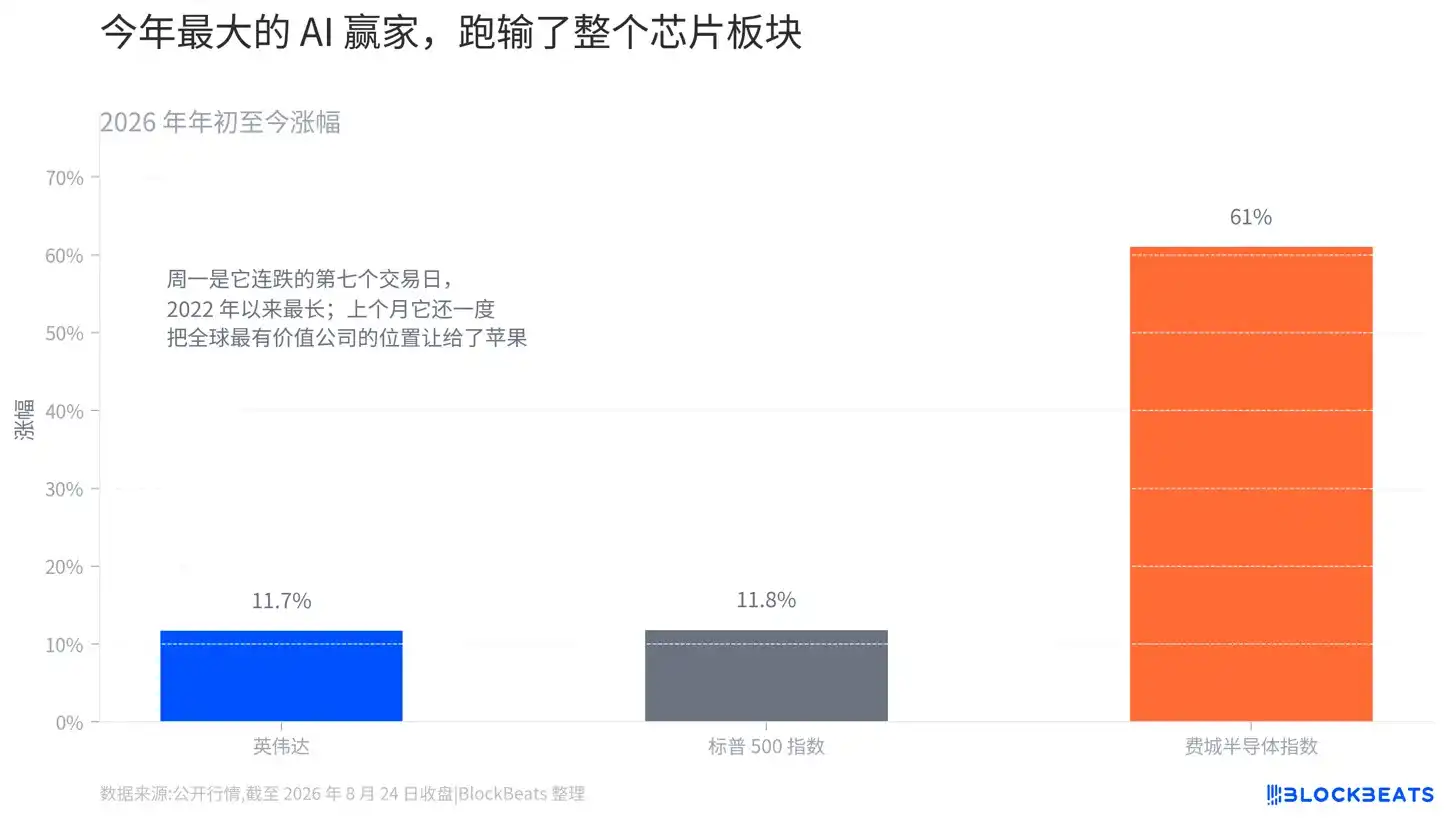
Year-to-date, Nvidia is up 11.7%, while the S&P 500 is up 11.8% — it has slightly underperformed the broader market. Meanwhile, the Philadelphia Semiconductor Index has surged 61%. The biggest seller of shovels in the entire AI construction boom has underperformed the entire shovel industry this year. On Monday, it closed lower for its seventh consecutive session, its longest losing streak since 2022.

Last month, it also temporarily ceded its title as the "world's most valuable company" to Apple.
It rebounded about 1% in pre-market trading Tuesday, potentially ending this losing streak. But the driver of this rebound was less about Nvidia itself and more about Brent crude oil falling to around $89. According to Kathleen Brooks, research director at XTB: "The shift in sentiment is helped by the drop in oil prices."

So What Is the Market Really Waiting For?

Sara Araghi, portfolio manager at Franklin Equity (part of Franklin Templeton), made this requirement very clear on Bloomberg TV Tuesday: Nvidia needs more than just strong earnings; it needs to detail its capital deployment plans and how it will maintain its spending plans.

"More detail on these investments, the value of these investments — I think that's what the market needs to see."

She pointed out a divergence: Nvidia's forward 12-month price-to-earnings ratio is now about 21 times, completely misaligned with its projected revenue and profit growth. This multiple indicates the market is already pricing in a growth slowdown.

"It's phenomenal," she said, "but the deceleration is coming, and unfortunately, the market is looking at next year."

She also gave two specific checkpoints.

First, gross margins: Nvidia's roughly 75% gross margin is highly unusual for a hardware company and will be scrutinized word-for-word amid rising raw material costs. To hedge higher memory costs, Nvidia has already been raising prices: servers based on the Vera Rubin and Grace Blackwell architectures, expected in early 2027, will be priced over 15% higher for key customers.

Second, the use of that money. Profit growth is important because it reassures Wall Street that "the free cash flow they're generating is enough to support the investments they need to make." She added: "And they have to use that money to buy back stock."

Bloomberg Intelligence analysts issued the same warning: a routine "beat and raise" may no longer be enough to boost sentiment.

Where Is the Money Really Flowing?

This is the real question for this earnings report. Over the past month, Nvidia has acted beyond the scope of a chip company:

It teamed up with six of Wall Street's largest financial institutions to arrange a $500 billion AI financing plan, pledging to backstop loans for customers who can't afford its chips.

Last week, it agreed to guarantee up to $105 billion for OpenAI to lease a large data center in Ohio for 20 years — one of its largest AI financing commitments.

Also last week, it took a stake in Cloverleaf Infrastructure, a company focused on securing power for data centers.

It also reached a $60 billion deal with startup Poolside, aiming to develop a powerful open-weight AI model.

Brian Mulberry, chief market strategist at Zacks Investment Management, coined a name for these moves: "This makes them the central bank of AI in a way." He holds Nvidia stock but also noted the risk: "The real risk is full exposure to AI with no diversification at all. For this to work, it's critical that the adoption rate of AI tools continues to grow."

The core doubt here is the "circular trade": If I lend you money to buy my chips, is my revenue real demand, or is it manufactured by myself?

Jensen Huang's defense is straightforward: the logic is simple, the company has ample cash and can use it to support fast-growing but still unprofitable customers in their build-out. He said the Ohio guarantee does not constitute circular financing.

For this argument to hold, the premise is that those customers must eventually become profitable. And recent signals on that front aren't encouraging: OpenAI recently told investors its second-quarter revenue grew only 18%, with losses widening.

Jensen Huang Faces More Than Just Himself Tonight

Nvidia's earnings report arrives against a very unfriendly backdrop.

Political backlash against AI is widening. Over 500 towns across the U.S. have restrictions on data center construction. Bond selling has pushed borrowing costs to multi-year highs, with the 30-year Treasury yield hitting a 19-year high last week. The former cash-printing machines — the hyperscale cloud providers — are increasingly relying on debt to fund their build-out, and total data center spending by big tech companies is projected to exceed $730 billion this year.

Zacks' Mulberry used a metaphor to describe the weight of this earnings report: "This is becoming more like the World Cup final than the Super Bowl. It's just gotten that big."

The answer investors are really looking for boils down to just one thing: How fast can the transition from Blackwell to Vera Rubin be? Shipments are expected to begin this fall.

Russ Mould, investment director at AJ Bell, put it bluntly: "Nvidia's upcoming results have the power to push the whole market up or drag it down. The clue investors are looking for is — is AI demand starting to lose momentum?"


İlgili Sorular

QAccording to the article, what is the market's expected volatility for NVIDIA's stock price after the earnings report, and how does this compare to the past?

AThe options market is pricing in a post-earnings volatility of 5.4%. This is the lowest expected volatility in the past two years, compared to a pricing of 6.5% before the May earnings and an actual average post-earnings volatility of 7.4% over the past 12 quarters.

QWhat specific information does portfolio manager Sara Araghi believe the market needs from NVIDIA's report beyond good earnings?

ASara Araghi states the market needs more details on how NVIDIA intends to deploy its capital and maintain its spending plans. Specifically, it needs to see the details and value of these investments to be confident that the free cash flow generated can support the necessary investments, which should include stock buybacks.

QWhat two specific financial metrics did Sara Araghi highlight as key checkpoints for NVIDIA's upcoming earnings?

ASara Araghi highlighted two key checkpoints: 1) Gross Margins: NVIDIA's unusual ~75% gross margin for a hardware company will be scrutinized, especially in light of rising raw material costs. 2) The use of free cash flow: She emphasized that the earnings growth must be strong enough to generate free cash flow to support necessary investments, which must include stock buybacks.

QHow has NVIDIA's stock performance in 2024 compared to the S&P 500 and the Philadelphia Semiconductor Index?

AYear-to-date in 2024, NVIDIA's stock is up 11.7%, slightly underperforming the S&P 500, which is up 11.8%. More significantly, it has underperformed the Philadelphia Semiconductor Index, which has gained 61%.

QWhat major business move did NVIDIA make recently, and what risk does it introduce according to Brian Mulberry?

ANVIDIA has arranged a $500 billion AI financing plan with major banks, essentially guaranteeing loans for customers who can't afford its chips. According to Brian Mulberry, this puts NVIDIA in a 'central banking role' for AI. The key risk is that it leaves NVIDIA completely exposed to AI with no diversification, and its success depends on the continued growth of AI tool adoption. This raises the 'circular transaction' concern where revenue may be artificially driven by NVIDIA's own financing.

İlgili Okumalar

Bessent's True Agenda

U.S. Treasury Secretary Besant's recent interventions in the bond market are seen by some as an attempt to artificially trigger a massive short squeeze before the midterm elections. The alleged goal is to push the 10-year yield toward 5% initially, then use covering by short sellers to drive it down to around 4.3%, providing political breathing room for the Trump administration. Analysts point to near-record short positions held by CTA trend-following funds. According to Goldman Sachs data, a price rally of two standard deviations could trigger historically large short-covering. Besant's tactics reportedly include bond buybacks, shifting issuance toward shorter-term debt, and potentially canceling ultra-long bond auctions to pressure these market positions. So far, interventions like modest buybacks have had limited effect on yields, with the Treasury later hinting at using its General Account (TGA) cash for support. Critics argue these measures cannot address structural pressures like large deficits and high inflation. Instead, the strategy appears tactical—aimed at buying time and exploiting technical market vulnerabilities rather than reversing the underlying yield trend. The political timeline is clear: achieve lower yields ahead of the midterms to help lower mortgage rates and craft a favorable narrative. However, analysts warn that once the election passes, structural upward pressure on yields and equity valuations could reassert themselves more forcefully. Market signals suggest this potential short-squeeze dynamic could intensify in the coming days.

marsbit28 dk önce

Bessent's True Agenda

marsbit28 dk önce

Jackson Hole Speech Preview: Is the Fed Seeking Justification for a Rate Hike?

"Jackson Hole Speech Preview: Is the Fed Looking for Reasons to Raise Rates?" Ahead of the key Jackson Hole symposium, Federal Reserve officials and the IMF are signaling heightened concern over persistent inflation, with some advocating for tighter policy. Boston Fed President Susan Collins, in a recent article, supported holding rates steady only if evidence of falling inflation continues. Otherwise, she argues for prompt tightening, noting inflation has been above target for over five years and warning that prolonged deviation could entrench consumer expectations. Although not a voting member this year, her stance aligns with several officials; three FOMC voters dissented in July, favoring a rate hike. Richmond Fed's Tom Barkin warned of a future "reckoning" regarding the $40 trillion public debt, while IMF Managing Director Kristalina Georgieva urged central banks to maintain a laser focus on price stability. The core dilemma lies in the sources of inflation: Trump-era tariffs, Middle East conflict-driven oil prices, and surging AI investment. Collins believes the first two factors are fading, but identifies AI infrastructure spending as exerting "upward pressure" on core goods inflation. The problem is that interest rate hikes primarily curb demand, not these supply-side shocks. Georgieva framed it as a "tug of war" between negative supply shocks from the Middle East and positive demand shocks from AI. Meanwhile, economic data shows strain. The August Consumer Confidence Index fell to a seven-month low of 89.4. While the present situation index improved, future expectations plummeted. Consumers expect higher inflation (5.8% vs. 5.6% last month), likely influenced by high gas prices. Other data points are weak: July retail sales saw the largest drop in over a year, and job growth stalled. Key upcoming events include the July PCE inflation data (expected to remain well above the 2% target) and new Fed Chair Kevin Warsh's first major speech at Jackson Hole. Market pricing remains conflicted, showing a high probability of a December hike but expecting no move in September. Gold prices, however, have surged over 7% to near three-month highs, signaling market anxiety.

marsbit43 dk önce

Jackson Hole Speech Preview: Is the Fed Seeking Justification for a Rate Hike?

marsbit43 dk önce

Today, HYPE Activates Its Second Buyback Engine

"Hyperliquid Activates Second Buyback Engine with AQAv2 Launch" On August 26th, Hyperliquid officially activated its Aligned Quote Assets v2 (AQAv2) mechanism, introducing a major new source of revenue and buyback power for its native token, HYPE. Unlike the existing revenue stream from trading fees, AQAv2 generates income by sharing approximately 90% of the adjusted reserve earnings from stablecoins (primarily USDC) circulating on the Hyperliquid chain. This income is settled every 30 days and automatically funneled into the Assistance Fund for HYPE buybacks, with the first expected distribution on October 3rd. Through a partnership with Circle (issuer of USDC) and Coinbase (treasury manager), Hyperliquid leverages its user base and financial infrastructure to share in the yield generated by stablecoin reserves. This transforms its liquidity and distribution capabilities into a scalable business model. Initial estimates project AQAv2 could generate $150-200 million in annual buyback funds, based on the current ~$6.43 billion USDC supply on Hyperliquid and an assumed reserve yield. Crucially, this revenue is weakly correlated with trading activity and grows directly with the platform's stablecoin adoption. With HYPE recently reaching an all-time high, AQAv2 provides a new fundamental support layer. It shifts Hyperliquid's value capture beyond just transaction fees, anchoring HYPE's long-term buyback potential to the expanding scale of its stablecoin ecosystem.

marsbit47 dk önce

Today, HYPE Activates Its Second Buyback Engine

marsbit47 dk önce

Saylor Pauses Bitcoin Purchases: The World's Largest Bitcoin Holder Is Transforming into a 'Digital Asset Bank'

Saylor's Strategy has paused its long-standing practice of buying Bitcoin, marking a significant shift for the world's largest corporate BTC holder. The company is now prioritizing capital structure management over accumulation. Strategy recently raised $2 billion by selling shares but purchased zero Bitcoin, directing funds instead to a new USD cash reserve, repaying preferred stock, and building its dollar liquidity pool. This follows a series of BTC sales in 2026, totaling around 6,916 coins, often at a loss, to meet its substantial annual dollar obligations of approximately $1.76 billion in dividends and interest payments. The core change is the adoption of a new "Digital Credit Capital Framework." Strategy is transforming from a leveraged Bitcoin proxy into a "digital asset bank." Its focus has shifted from simply increasing its BTC holdings to managing a balance sheet where Bitcoin acts as the reserve asset, common stock as equity, and preferred shares as liabilities. The goal is now to optimize the "Bitcoin per share" metric and maintain stability, even if it means selling BTC at a loss during market stress to protect its financial footing. The market appears to be re-evaluating Strategy, pricing it less as a volatile Bitcoin tracker and more as a capital management firm. Despite its recent sales, Bitcoin's price has surged, indicating Strategy's selling pressure is easily absorbed by broader market flows like ETF inflows. If successful, Strategy could emerge as a novel hybrid: a "Bitcoin bank." However, this path carries major risks, as sustained BTC prices below its average cost could steadily erode its financial safety net.

marsbit1 saat önce

Saylor Pauses Bitcoin Purchases: The World's Largest Bitcoin Holder Is Transforming into a 'Digital Asset Bank'

marsbit1 saat önce

İşlemler

Spot
活动图片