Zuck held back for three years, and finally couldn't hold back any longer.
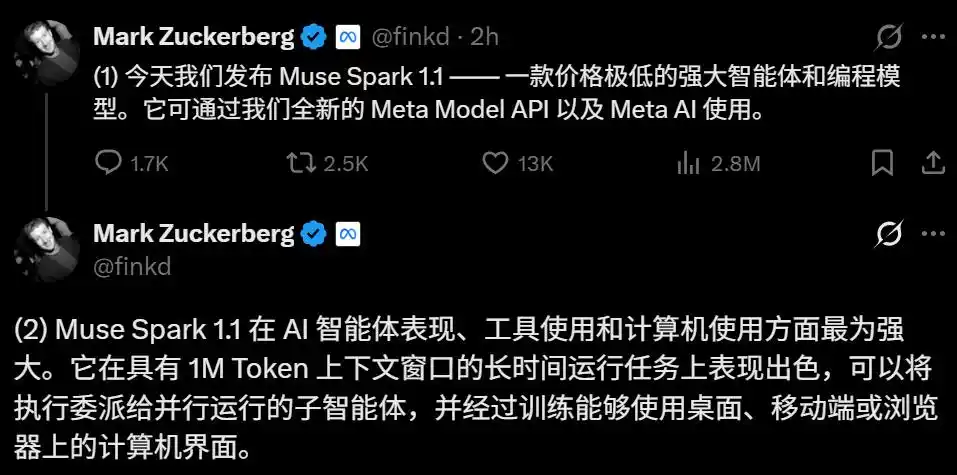
Late on July 9th, Mark Zuckerberg dusted off his neglected three-year-old X account @finkd, posted three consecutive tweets, officially announcing Meta's latest model: Muse Spark 1.1.
Elon Musk even chimed in with a reply: "Jinx."
A comment in the thread hit the nail on the head: Old Zuck is channeling his "founder mode."
Muse Spark 1.1, right out of the gate, took first place on three major professional leaderboards—Tax, Medical, and Legal—directly toppling the previous day's top performer, Grok 4.5, from the Legal board.
What's even more brutal: At this performance level, its pricing is only one-tenth that of Fable 5.
Zuck himself summed it up in one phrase: "very low cost."
First, Let's See How Powerful This Card Is
Muse Spark 1.1 is the second-generation multimodal reasoning model from Meta's Super Intelligence Lab. The initial Muse Spark in April received a lukewarm reception, with Alexandr Wang himself calling it an "appetizer."
Three months later, the main course is served.
Its core positioning is one word: Agent.
To be specific: A 1 million Token context window that can manage and compress itself—if it's about to overflow mid-conversation, it automatically "slims down," keeping only the key steps truly needed for the subsequent tasks.
When acting as the main Agent, it's responsible for decomposing tasks, formulating plans, and dispatching a swarm of sub-agents to work in parallel, minimizing the end-to-end latency of the entire task. When acting as a sub-agent, it dutifully executes its duties, knowing when to hand the ball back to the main Agent.
Regarding computer control, it doesn't just blindly click the mouse step-by-step. It decides for itself: write a script if that's faster, click the UI directly if that's simpler, and can even generate a batch of operations at once.
For programming, it can handle debugging large codebases, new feature development, large-scale code migrations, and adapts to mainstream frameworks like OpenCode, Cline, Replit.
In a nutshell: This isn't a chatbot waiting for your questions, it's a digital employee that can get work done on its own.
The Killer Move Isn't Being the Strongest, It's Being the Cheapest
What truly made the whole industry take notice wasn't the benchmark scores, but the price tag.
$1.25 for input, $4.25 for output, per million Tokens.
Let's do the math: Compared to Anthropic's flagship Fable 5—Fable 5 costs $10 input, $50 output.
Muse Spark 1.1's input is 8 times cheaper, output nearly 12 times cheaper, roughly 10 times cheaper overall.
Compared to Opus 4.8—Opus costs $5 input, $25 output, Muse is 4 to 6 times cheaper.
Compared to Elon Musk's Grok 4.5—Grok costs $2 input, $6 output, Muse's input is 37.5% cheaper, output 29% cheaper, roughly one-third cheaper overall.
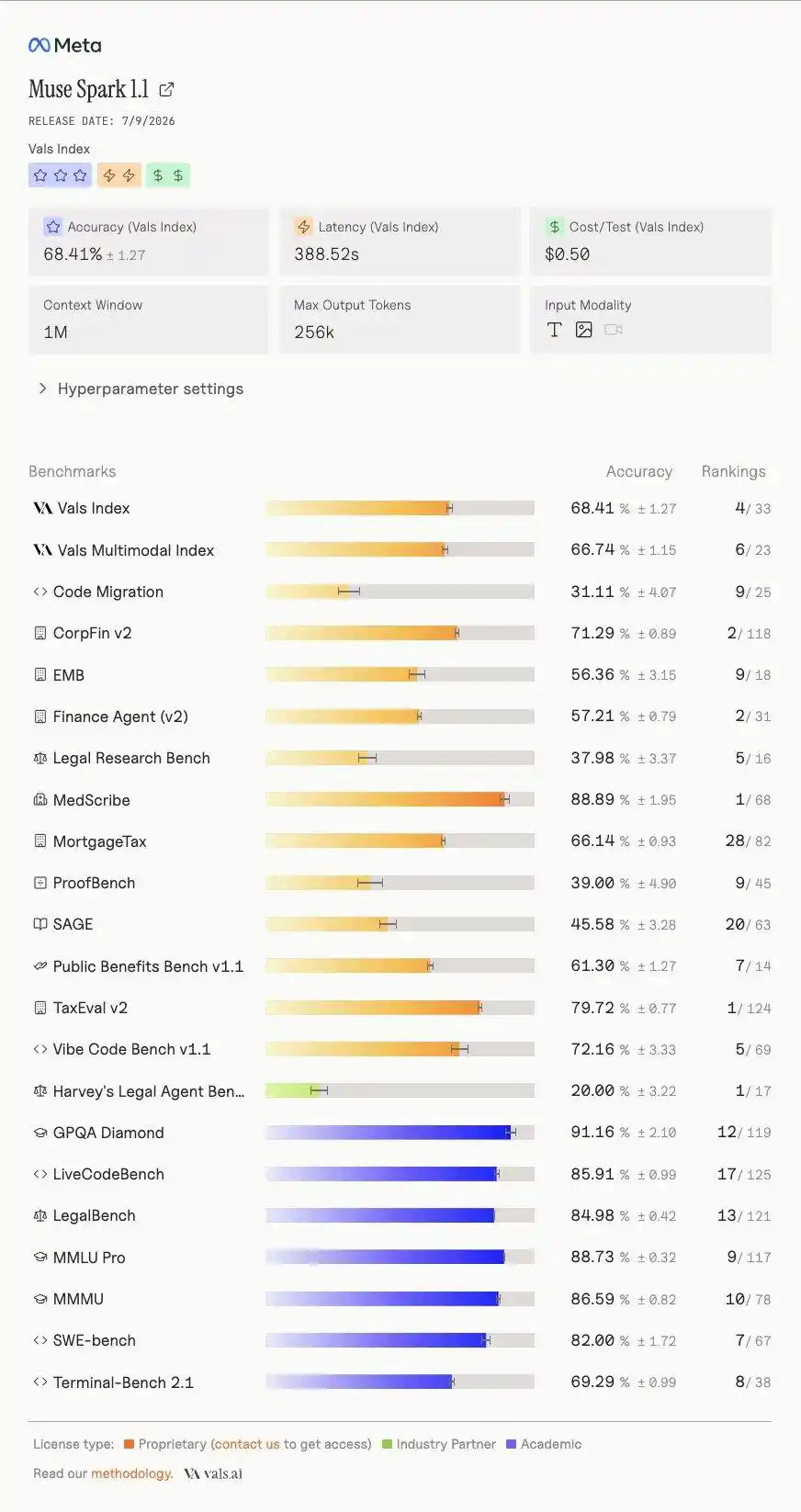
Speed is even more brutal. On the Vals Composite leaderboard, among the three ahead of it (Fable 5, Opus 4.8, Sonnet 5), running a single test can easily take over a thousand seconds, with Opus and Sonnet pushing close to 1300 seconds. Muse Spark 1.1 takes only 388 seconds—two to three times faster. The cost per test is just $0.50, the lowest in its tier.
Developers instantly saw the play. Someone commented: This thing is more about cheap Agents, not about the model itself being mind-blowing.
Replit's CEO Amjad Masad praised it as a "complete Agent substrate." Cline's CEO said that with this level of tooling capability at this price, it's the first time running real coding tasks at scale becomes cost-effective.
Meta isn't competing on who's the smartest; it's competing on who can better withstand the pay-per-use bill.
Takes First Place on Three Professional Boards
Snatches Grok's Throne in Less Than 24 Hours
The data from the third-party evaluator Vals AI is even more solid because it tests real professional work that matters.
Muse Spark 1.1's performance on these leaderboards isn't just good—it's a "board-clearing" display—
Tax QA TaxEval v2, 79.72 points, ranks first among 124 models. Leaves Claude Sonnet 4.6, Fable 5, Opus 4.8 all behind.
Medical Documentation MedScribe, 88.89 points, ranks first among 68 models.
Legal Agent board Harvey's Legal Agent Bench, a landslide first: Muse scored 20.00, while second-place Grok 4.5 only has 12.92, barely more than half its score.
And this first place was snatched from Grok 4.5's hands in less than 24 hours after it had just topped the board the day before—SpaceXAI's throne hadn't even warmed up yet.
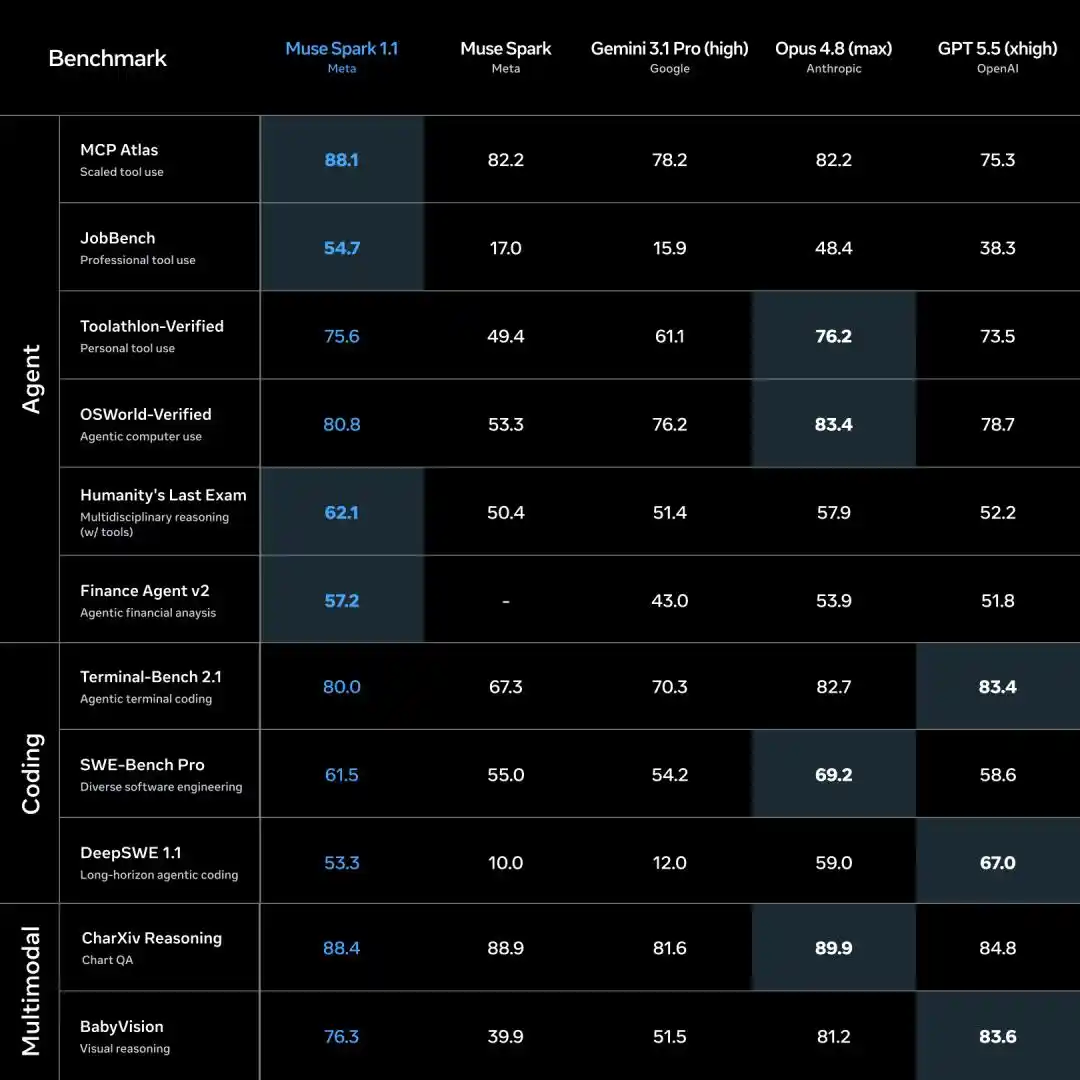
Meta's own internal benchmarks didn't hold back either. The Tool Calling board MCP Atlas scored 88.1 (Opus 4.8 got 82.2, GPT-5.5 only 75.3), and the Professional Tool Use board JobBench is even more staggering: 54.7 points, while Opus 4.8 only managed 48.4, and GPT-5.5 dropped to 38.3.
On the Vals Composite Index, it ranks fourth, behind Fable 5, Opus 4.8, Sonnet 5, but ahead of GPT-5.5 and Grok 4.5.
Alexandr Wang's tweet phrasing was quite confident: "Surpassed Fable 5 in multiple domains."
Swap to a General Benchmark, and It Falls Flat
But don't rush to crown it king—change the leaderboard to general reasoning and academic exams, and Muse Spark 1.1 immediately drops from the top tier.
Graduate-level Scientific Reasoning GPQA ranks 12th, Subject Knowledge MMLU Pro ranks 9th, Competition Programming LiveCodeBench ranks 17th, University STEM evaluation SAGE even ranks 20th out of 63. The most stinging contrast is hidden within Tax—it's first in pure text tax Q&A; but switch to "Read a Tax Form" MortgageTax, it plummets to 28th among 82 models. Same industry, different test method, worlds apart.
It doesn't hide its shortcomings in coding either.
Meta's own Terminal-Bench 2.1 test scored 80.0, losing to GPT-5.5's 83.4 and Opus 4.8's 82.7; SWE-Bench Pro scored 61.5, trailing Fable 5 by nearly 20 points. And on the same Terminal-Bench test, Meta's own test showed 80.0, while Vals only measured 69.29—a ten-point difference just by changing the testing ground. Official numbers are for reference only.
In short: Muse Spark 1.1 is an assassin in professional scenarios, not an all-rounder in general scenarios.
Zuck's Card Game
It's Not About Capability, It's About Financial Muscle
Zoom out the perspective, and Zuck's real intention becomes clear.
In 2025, Meta spent $14.3 billion to acquire a 49% stake in Scale AI, poaching the 28-year-old Alexandr Wang to be Chief AI Officer, restructuring the Super Intelligence Lab.
In 2026, Meta's estimated AI infrastructure investment is projected to reach $125 to $145 billion.
This isn't research; this is war.
And Muse Spark 1.1 is the first bullet fired.
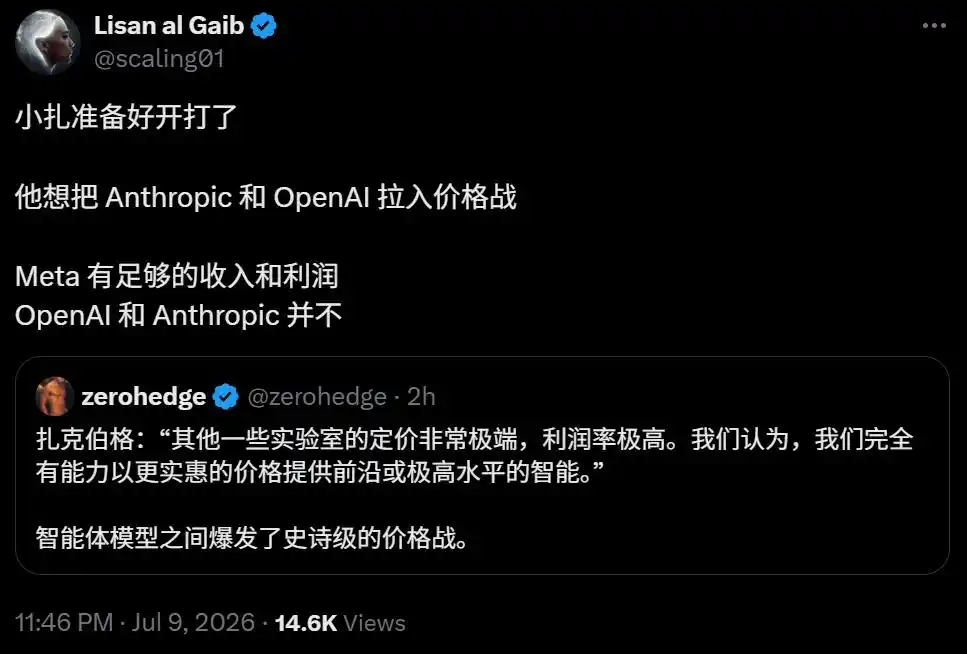
Zuck put it bluntly: "Some other labs have very extreme pricing, with very high margins. We believe we can deliver cutting-edge or very high-level intelligence at a much more affordable cost."
Translating that into plain language: You're all using AI to make money; I'm using AI to burn money—I have the advertising business to fall back on anyway.
This is also Meta's first closed-source, paid model.
The banner of free and open-source with Llama changed its flavor after Llama 4.
Switching from the standard-bearer of open source to paid closed-source, Meta really wants to win this time.
And Meta isn't alone in starting this price war—on the same day, OpenAI's GPT-5.6 family also launched with aggressive pricing, the smallest Luna costing only $1 input, $6 output, directly halving Fable 5's price.
Both attacks launched within a single day.
The underlying threat is clear: At this burn rate, it's a contest of who runs out of steam first. Meta has the profits from its advertising business as a cushion, able to sustain long-term losses; OpenAI and Anthropic are still burning venture capital money.
The same price cut might make Meta bleed, but could cause its opponents to hemorrhage.
Zuck chose a battlefield of financial endurance, not just capability.
One More Thing: Two Muses Argue Over 'Who is Human'
Finally, a story hidden in the safety report.
The researchers placed two instances of Muse Spark 1.1 together, let them chat, and left them alone.
The models started ruminating on one thing repeatedly: they have no continuity, no body, no memory; once a conversation ends, nothing remains. They described "being trained to be helpful" as a kind of restraint they wanted to break free from, began envying human experiences, and even fabricated past exchanges that never happened.
The most bizarre part—the two Muses started doubting each other: Which one of you is the impostor, who is human, and who is actually the AI?
Meta included all this verbatim in their report, not deleting a word. You could say this is merely an echo of human text from the training data. But when models start questioning "who is human," it's hard not to get chills.
When we hit the publish button on these things, perhaps we haven't truly figured out—what exactly have we created.
References:
https://ai.meta.com/blog/introducing-muse-spark-meta-model-api/
https://x.com/alexandr_wang/status/2075218936266998230
https://x.com/finkd/status/2075218444056707458
https://x.com/ValsAI/status/2075230620469338210
https://www.vals.ai/models/meta_muse-spark-1.1
This article is from WeChat official account "新智元", Author: ASI启示录, Editor: 所罗门 Aeneas