The Fall of Zapper: An Act of God or a Human Error?

Foresight News2026-07-10 tarihinde yayınlandı2026-07-10 tarihinde güncellendi

Özet

The Fall of Zapper: A Post-Mortem of a DeFi Pioneer In July 2026, Zapper, a once-dominant DeFi portfolio tracker, announced its shutdown. Born in 2020 from a merger, Zapper capitalized on the DeFi Summer boom, reaching 2 million monthly users and processing over $13B in transactions, backed by $16.5M in funding from investors like Framework Ventures and Coinbase Ventures. Its core "Zap" feature simplified complex multi-step DeFi operations. Despite its early success, Zapper failed to build a sustainable business model. Revenue from DEX aggregation was minimal due to fierce competition, while maintaining its multi-chain data infrastructure was costly. Furthermore, the DeFi landscape shifted: capital consolidated around top protocols, reducing the need for complex portfolio tracking across numerous platforms. Zapper's user base and core demand eroded. The company attempted multiple pivots, including an NFT-based points system, a social app (Chainchat), and plans for a ZAP token protocol. However, these initiatives—often focused on creating new, speculative C端需求 rather than solving existing pain points—ultimately failed. Critics argue Zapper remained trapped in a "blockchain purist" mindset, prioritizing costly, non-revenue-generating features over its competitive DEX aggregator. Unlike competitor DeBank, which successfully pivoted to its Rabby Wallet, Zapper lacked a diversified revenue stream. Its closure highlights the peril for tooling projects that fail to adapt to mark...


Author: Eric, Foresight News


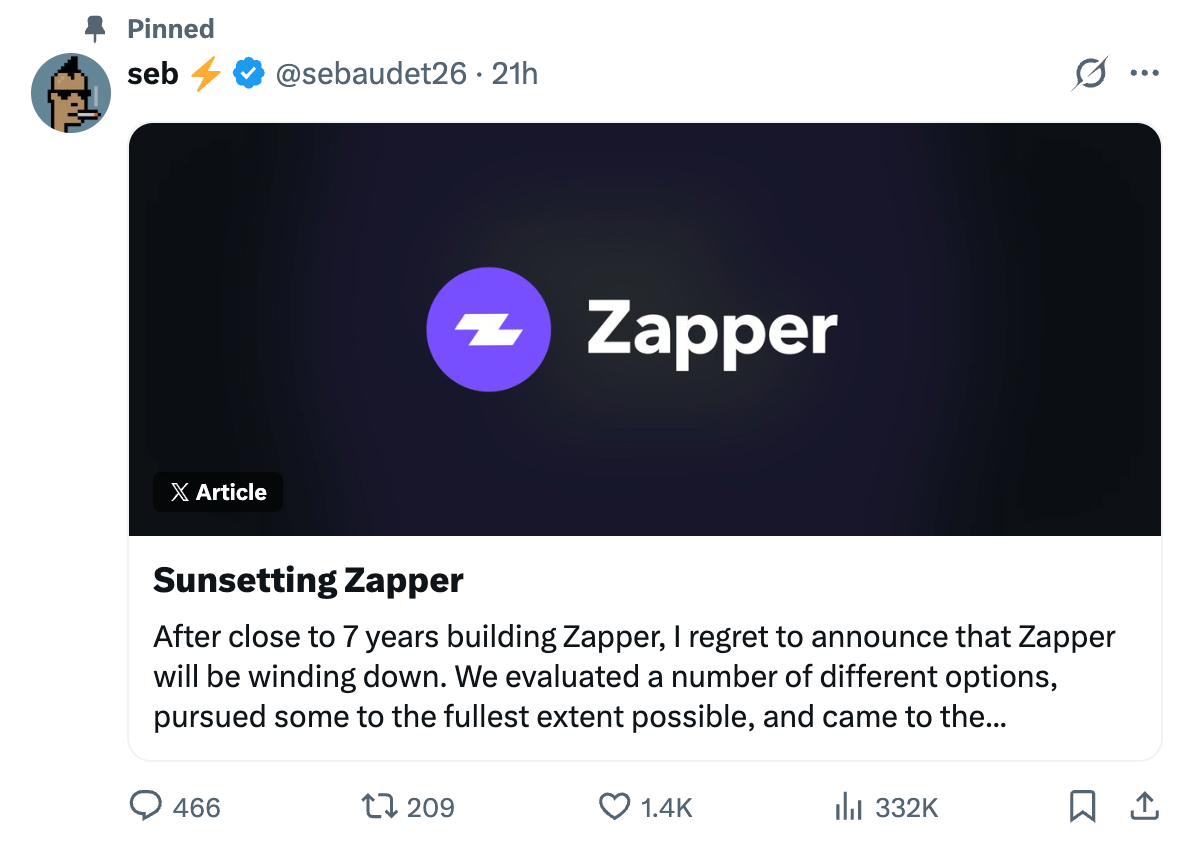
On July 8, 2026, Zapper co-founder Seb Audet posted a brief announcement on X: the platform will be completely shut down on August 3, with its official website, mobile app, and API services all going offline.


Last November, news of DappRadar's closure evoked sighs from countless crypto veterans. Now, a once-star project boasting 2 million monthly active users, over $13 billion in cumulative transaction volume processed, and $16.5 million in total funding has also reached a dead end.


In 2019, Zapper's predecessor, DeFiZap, won a DeFi hackathon hosted by Kyber. DeFi was still in its infancy back then, with the entire sector's TVL around $667 million. In May 2020, DeFiZap merged with DeFiSnap, officially giving birth to Zapper. As Seb put it, he was exploring DeFi at the time, and Zapper's creation initially stemmed from his own desire to develop a simple portfolio tracker; he never imagined it would grow to such a scale.


In June 2020, Compound launched the COMP token, kickstarting the "DeFi Summer" that changed the industry landscape. Within three months, DeFi's TVL skyrocketed from about $700 million to over $13 billion, as retail users flooded into yield farming. In an era where capital was scattered across various protocols, the demand for a unified dashboard to view positions naturally arose. Zapper, which allowed users to monitor cross-protocol holdings, LP positions, and yields in real-time after connecting their wallets, quickly gained traction within the community.


The DeFi boom fueled Zapper's rapid growth. In early 2020, it completed a $1.5 million seed round with participation from institutions like Framework Ventures and ParaFi Capital. In May 2021, at the peak of market frenzy, Zapper raised $15 million in a Series A round, led again by Framework Ventures, with notable investors like Mark Cuban, Sound Ventures (by Ashton Kutcher), and Coinbase Ventures joining the round.


At its peak, Zapper covered 14 blockchains, over 450 DeFi protocols, and more than 7,000 tokens, with monthly active users exceeding 2 million and cumulative transaction volume surpassing $13 billion. Its "Zap" feature, which allowed users to complete complex multi-step DeFi operations with a single transaction, was once the core differentiating selling point of the product.


The problem, however, was that traffic did not translate into sustainable revenue. Zapper's monetization model primarily relied on taking a small fee from DEX aggregated trades, but competition in the aggregator space was brutal, with fee margins constantly being compressed. Meanwhile, maintaining a data indexing and real-time update system covering multiple chains and hundreds of protocols required continuous significant investment in engineering resources and infrastructure costs.


On the other hand, while DeFi continued to develop, the trend was not towards diversification but rather the concentration of capital and traffic towards leading protocols. After a brief low in 2022, DeFi has continued to advance significantly in recent years. However, due to a lack of attractive yield rates and airdrop expectations, the user base has not grown. Zapper's features leaned more towards consumer-facing (2C) use, the number of users declined, DeFi operations became less complex, and DEX aggregator competition became excessively fierce. At that point, the demand behind Zapper's strongest moat had clearly weakened.


Zapper was not unaware of the ceiling of a pure tool-based product. It made multiple attempts at pivoting, but none succeeded. In September 2021, Zapper launched an on-chain interaction-based points system where users earned points through actions like check-ins, cross-chain transfers, and trading, which could be exchanged for NFTs. Over 100,000 addresses participated in minting. According to OpenSea data, this NFT series generated over 1200 ETH in cumulative trading volume, worth approximately $5 million at the time. However, over time, the price of this NFT series eventually plummeted to zero, and the points system was not continued.


In October 2023, Zapper launched Chainchat, an on-chain social application where users needed to buy "shares" of a channel to join group chats. The subsequent V2 version repositioned the product as a "Web3 exploration tool," attempting to expand its scope from DeFi to NFTs, DAOs, and on-chain accounts. In June 2024, Zapper announced the launch of Zapper Protocol, planning to issue the ZAP token with the goal of building an open protocol to incentivize users to interpret and annotate on-chain information.


Yet, none of these attempts ultimately altered its fate. The ZAP token was never officially issued, the protocol plan was shelved as the market turned bearish, and Chainchat quietly faded from users' sight.


Many tool-based products born in 2019 and 2020 have reached their end in recent years. These products "died in their own ways." DappRadar is a classic example of being left behind by the times. When all resources shift towards leading protocols, lacking an environment of a hundred flowers blooming, having a comprehensive list of projects becomes irrelevant.


While Zapper was also affected by changes in the sector's landscape, its failure stemmed more from its own strategic mistakes in pivoting.


A portfolio tracker is not a product with a high barrier to entry, but the underlying data costs are a hard expenditure. Without the ability to charge for the service itself, there must be a strongly related product that can generate revenue. DEX aggregators and the "Zap" feature that enables one-click multi-step operations were inherently choices with solid demand. However, Zapper did not seem to focus enough on revenue-generating products, instead putting more effort into the cost center.


Using the portfolio tracking feature to funnel users towards revenue-generating features made sense early on. But as user capital gradually concentrated in a few protocols and competition increased (including from rivals like DeBank), Zapper failed to adapt its mindset promptly. Subsequent attempts clearly showed that Zapper never broke out of the 2C mindset, persistently circling in the "dead end" of using blockchain ideology to build consumer products.


These 2C products sounded grand in narrative but didn't target existing pain points; instead, they tried to create demand out of thin air. The fact that they persisted in the wrong direction for years also indirectly illustrates how significant the DeFi红利 (windfall) was back then. As Seb wrote in the farewell letter, "We evaluated multiple options and pursued some of them fully, ultimately realizing that an orderly wind-down is the best path forward." This indicates that even its once-proud portfolio tracking feature had no takers in the current market. Even pivoting towards a direction similar to Nansen or Arkham might have resulted in a neutral outcome like an acquisition.


DeBank, mentioned earlier, has also scaled back its asset tracking support, cutting off support for low-activity chains. But DeBank has a strong product like Rabby Wallet, coupled with twice the funding amount of Zapper, giving it more chips and more stable revenue. If you look at reviews for Rabby Wallet on X, you'll find that in the EVM-compatible chain space, many consider its experience and functionality superior to MetaMask.


In the author's view, Zapper's departure wasn't entirely due to being "mindless"; it was more about an excessive belief in blockchain fundamentalism. In the arena of business, being overly immersed in one's own world while ignoring objective shifts in the market environment is fatal. Zapper serves as a warning bell for surviving tool-based products in the market: DappRadar couldn't broaden its revenue channels due to sector limitations, but if there's a chance to pivot, don't cling to past glory.


İlgili Sorular

QWhat were the main reasons for Zapper's failure according to the article?

AThe main reasons were a lack of sustainable revenue from its core features, high costs in maintaining a multi-chain data infrastructure, fierce competition in the DEX aggregator space, and a significant shift in the DeFi market where user activity and funds consolidated into a few major protocols. Furthermore, Zapper's subsequent strategic pivots towards consumer-facing products like Chainchat and the Zapper Protocol failed to address real user needs or generate sufficient income, trapping the company in an unsustainable business model.

QWhat was Zapper's initial core function and how did it benefit from the DeFi Summer?

AZapper's initial core function was as a unified dashboard for tracking DeFi investments across multiple protocols. It allowed users to connect their wallets and monitor their holdings, liquidity pool positions, and yields in real-time. It greatly benefited from the DeFi Summer boom starting in June 2020, as the surge in retail users participating in yield farming created a strong demand for a tool to manage decentralized and scattered assets. This propelled Zapper's user growth to over 2 million monthly active users at its peak.

QWhat attempts did Zapper make to transform its business model, and why did they fail?

AZapper made several transformation attempts: 1) An on-chain points and NFT reward system in 2021, which faded after initial interest. 2) A social app called Chainchat in 2023, which required buying 'shares' to join chats. 3) A pivot to a broader 'Web3 exploration tool' in late 2023. 4) Announcing the Zapper Protocol and a planned ZAP token in mid-2024. These failed because they were largely consumer-focused products that tried to create new demand rather than solve existing, painful problems. They also diverted focus from its potentially revenue-generating core features like the DEX aggregator and 'Zap' functionality.

QHow does the article contrast Zapper's fate with that of DeBank?

AThe article contrasts them by highlighting their different strategic approaches and outcomes. While both faced similar market pressures, DeBank proactively streamlined its asset-tracking service by dropping support for less active chains. Crucially, DeBank developed a successful, revenue-generating core product in Rabby Wallet, which is highly regarded in the EVM ecosystem. With more funding and a stable income source from Rabby, DeBank had more resources to navigate the market shift, whereas Zapper continued to invest in costly, non-revenue-generating consumer products.

QWhat final lesson does the article draw from Zapper's shutdown for other tooling projects?

AThe article warns that an over-adherence to 'blockchain fundamentalism' and failing to adapt to objective market changes is fatal. The key lesson for surviving tooling projects is to avoid clinging to past successes ('the merit book') and be willing to pivot strategically when opportunities arise. They must focus on building or strengthening revenue-generating products that address clear market needs, rather than getting trapped in the 'dead end' of using blockchain ideology to build consumer products with no sustainable demand.

İlgili Okumalar

Tsinghua AI Mathematician Emerges: From Intuition to Theorem, Contributing to an 84-Page Quantum Algorithm Paper

Tsinghua University’s Intelligent Industry Research Institute (AIR) has developed an AI mathematician agent named AIM, designed not just to solve math problems but to actively participate in early-stage research. In a recent study, researchers collaborated with AIM to develop "Sign Embedding Quantum Algorithms," resulting in an 84-page paper on quantum algorithms for matrix equations and functions. The research began with a human researcher's intuition: can rational approximation serve as a design principle for quantum algorithms? AIM helped expand this idea into multiple candidate research directions. Human researchers then filtered and focused on the most promising path. AIM assisted in organizing theorems, generating proof drafts, and performing complexity analysis, while humans maintained oversight, auditing assumptions and refining derivations. This case illustrates a human-AI collaborative workflow: AI rapidly explores and expands research avenues, generates draft materials, and aids in checking derivations; human researchers provide critical judgment on direction, value, and validity. The process emphasizes "high-throughput candidate generation + human value gating + AI-assisted audit and repair + human final integration." The resulting quantum algorithm framework offers a unified approach to several matrix problems, advancing quantum linear algebra under more general conditions. This work suggests AI's role in theoretical research is evolving from task-specific assistance to supporting the entire research lifecycle—enhancing exploration and efficiency while keeping human expertise central to guiding inquiry and ensuring rigor. *Paper & System Links:* - AIM application report: https://arxiv.org/abs/2606.24899 - Quantum algorithm paper: https://arxiv.org/abs/2604.25333 - AIM repository: https://github.com/TheoryFoundry/AIMv2

marsbit29 dk önce

Tsinghua AI Mathematician Emerges: From Intuition to Theorem, Contributing to an 84-Page Quantum Algorithm Paper

marsbit29 dk önce

Short-Lived Meme Mania: Can It Be the Icebreaker for Robinhood's RWA Narrative?

Robinhood recently launched its own Layer 2 network, Robinhood Chain, built on Arbitrum and focusing on tokenized stocks, RWA, DeFi, and AI finance. Shortly after launch, a meme coin called CASHCAT, named after an early unused Robinhood brand, surged in popularity, achieving a market cap near $150 million and high daily trading volume. It gained traction through third-party DEXs and launchpads like Uniswap and Noxa.fun, bypassing Robinhood's official listing process. This highlights a key feature of the permissionless chain: even assets not officially approved can achieve significant liquidity and trading activity. While CASHCAT currently dominates the chain's meme coin sector, its high turnover indicates speculative trading. The rapid proliferation of new meme coins risks dispersing liquidity. Meanwhile, the chain's core RWA sector remains relatively small at $12.5 million. CEO Vlad Tenev has expressed that the chain is well-suited for both RWA and meme coins. In the optimistic scenario, meme-driven activity could bootstrap the chain's user base and liquidity for its long-term RWA vision. However, if the meme frenzy fades quickly, the RWA narrative may struggle to gain traction independently. The incident demonstrates that on a permissionless platform, the market itself can create major assets, offering Robinhood a potential new growth avenue beyond its core crypto business as it navigates the long-term development of the tokenized asset market.

Foresight News32 dk önce

Short-Lived Meme Mania: Can It Be the Icebreaker for Robinhood's RWA Narrative?

Foresight News32 dk önce

İşlemler

Spot
活动图片