Bitcoin price recovers – But ONE hurdle keeps BTC bulls on edge

ambcrypto2026-07-10 tarihinde yayınlandı2026-07-10 tarihinde güncellendi

Özet

Bitcoin is showing signs of demand recovery after weeks of selling pressure, with the 30-day cumulative demand rebounding sharply. However, the recovery is uneven: futures market demand has recovered to neutral levels, while spot market demand remains weak, indicating long-term investors are still hesitant. This divergence suggests traders are positioning for price increases before significant capital enters the spot market. Downside fears in the options market have eased compared to previous sell-offs, indicating expectations are shifting from a sharp capitulation to a slower bottoming process. Despite this calmer sentiment, the recovery faces headwinds from long-term holders distributing coins and taking profits. Data shows supply is rotating from experienced holders to newer participants, and until this selling pressure subsides and spot accumulation strengthens, Bitcoin's recovery is likely to remain gradual rather than accelerating into a sustained bullish trend.

Bitcoin [BTC] is beginning to regain demand. This comes after weeks of persistent selling pressure weakened participation across both spot and derivatives markets.

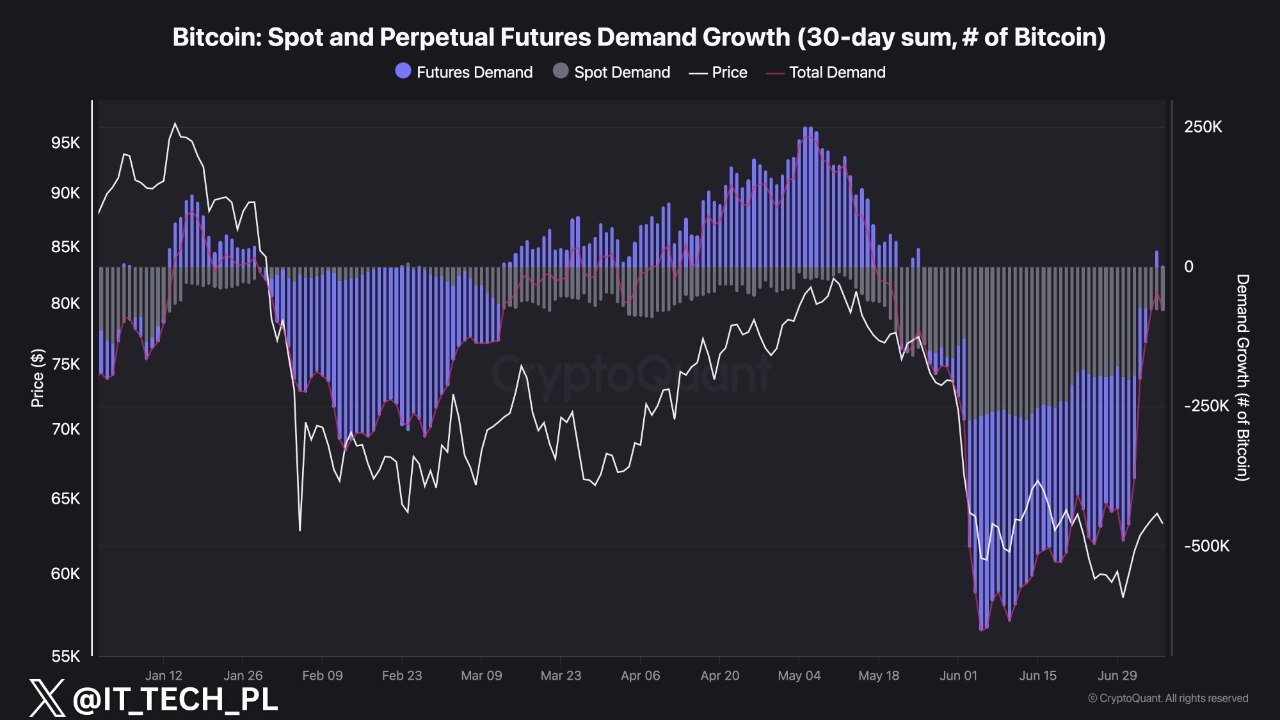
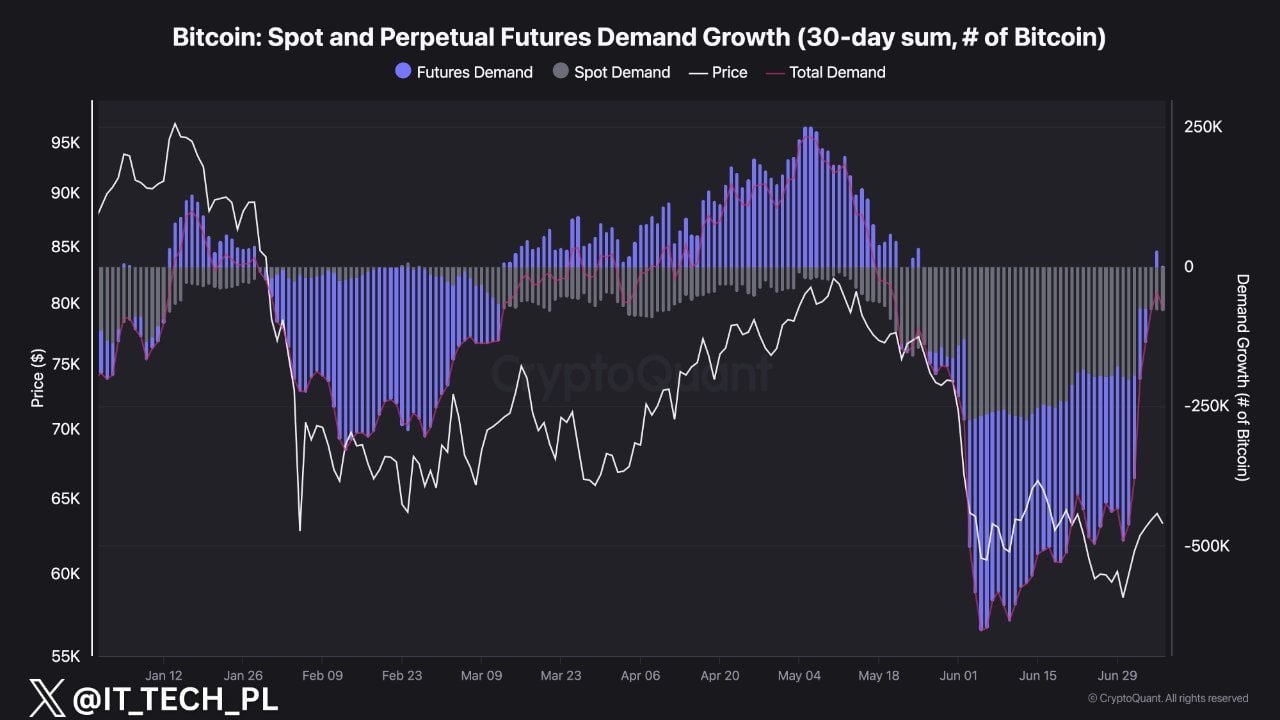
Over the past week, the 30-day cumulative demand rebounded sharply from nearly -500,000 BTC to around -75,000 BTC. This shift signaled that risk appetite is gradually returning.
Source: CryptoQuant

Notably, futures demand recovered from roughly -295,000 BTC to slightly above neutral. Despite that, spot demand remained weak near -78,000 BTC, showing long-term investors are still waiting for stronger confirmation. Moreover, that divergence suggests traders are positioning for higher prices before meaningful capital enters the spot market.

Although sentiment has clearly improved, Bitcoin’s recovery will remain vulnerable until spot accumulation strengthens, reinforcing derivatives-driven momentum with broader investor conviction.

Downside fears begin to ease

Bitcoin’s options market nuances cautious spot participation, although investors are no longer pricing downside risk as aggressively compared to the previous sell-offs.

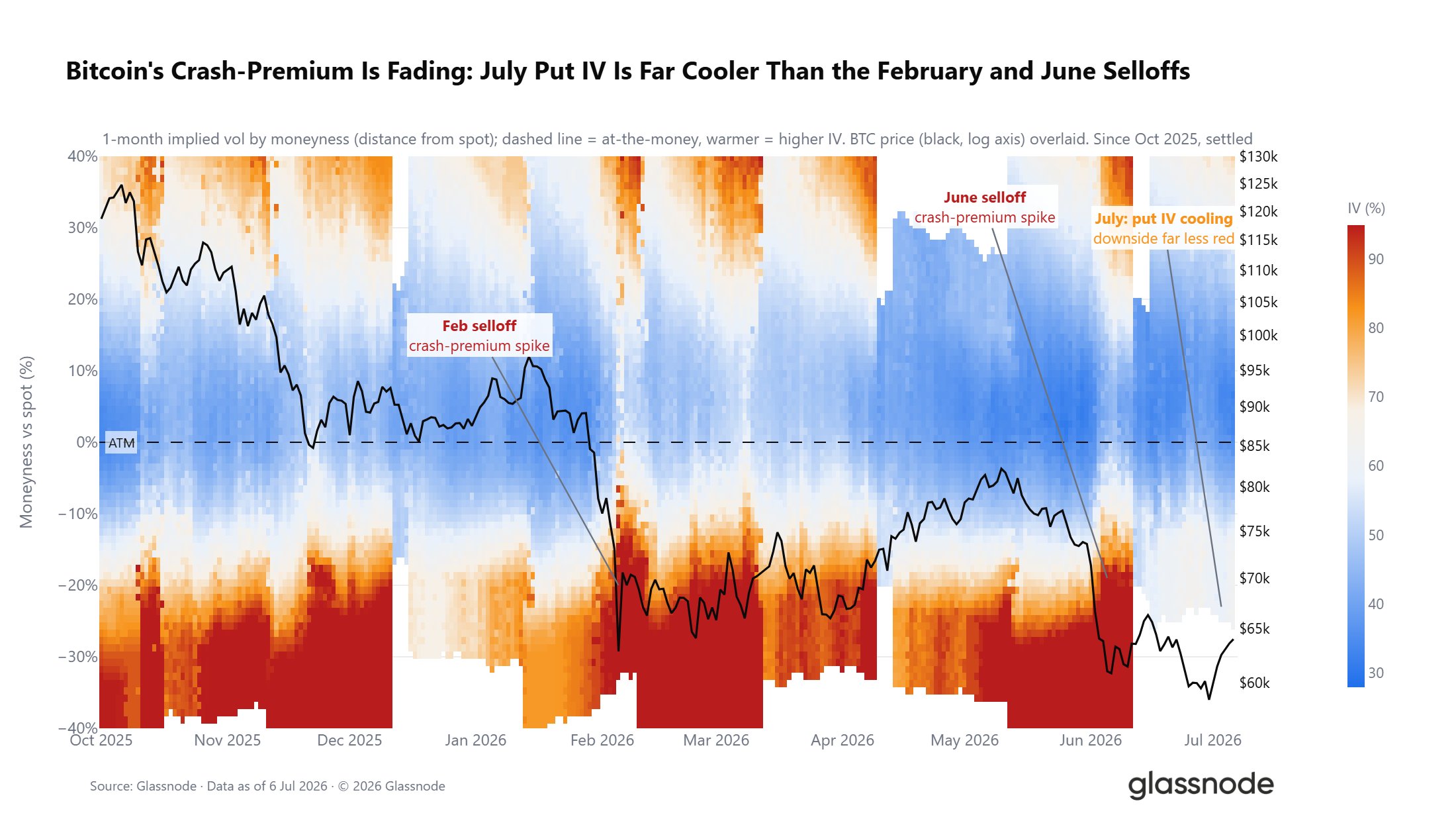
During the February and June selloffs, put implied volatility surged as traders rushed to hedge against deeper losses. July presents a different picture. In contrast, in July, as Bitcoin traded between $60,000 and $65,000, downside premiums have cooled noticeably.

Such a divergence indicates that expectations are shifting from another capitulation toward a slower bottoming process.
Source: Glassnode

This shift reflects a market that has already experienced significant declines over several months. As a result, reducing the urgency for costly downside protection. Even so, investors should be cautious since calmer options pricing does not necessarily translate to renewed conviction.

Additionally, ETF participation remains inconsistent while spot accumulation has fallen behind derivative demand. Therefore, until fresh capital flows back into spot markets, improved sentiment could face challenges in generating widespread buying needed for a durable recovery.

Distribution remains a market headwind

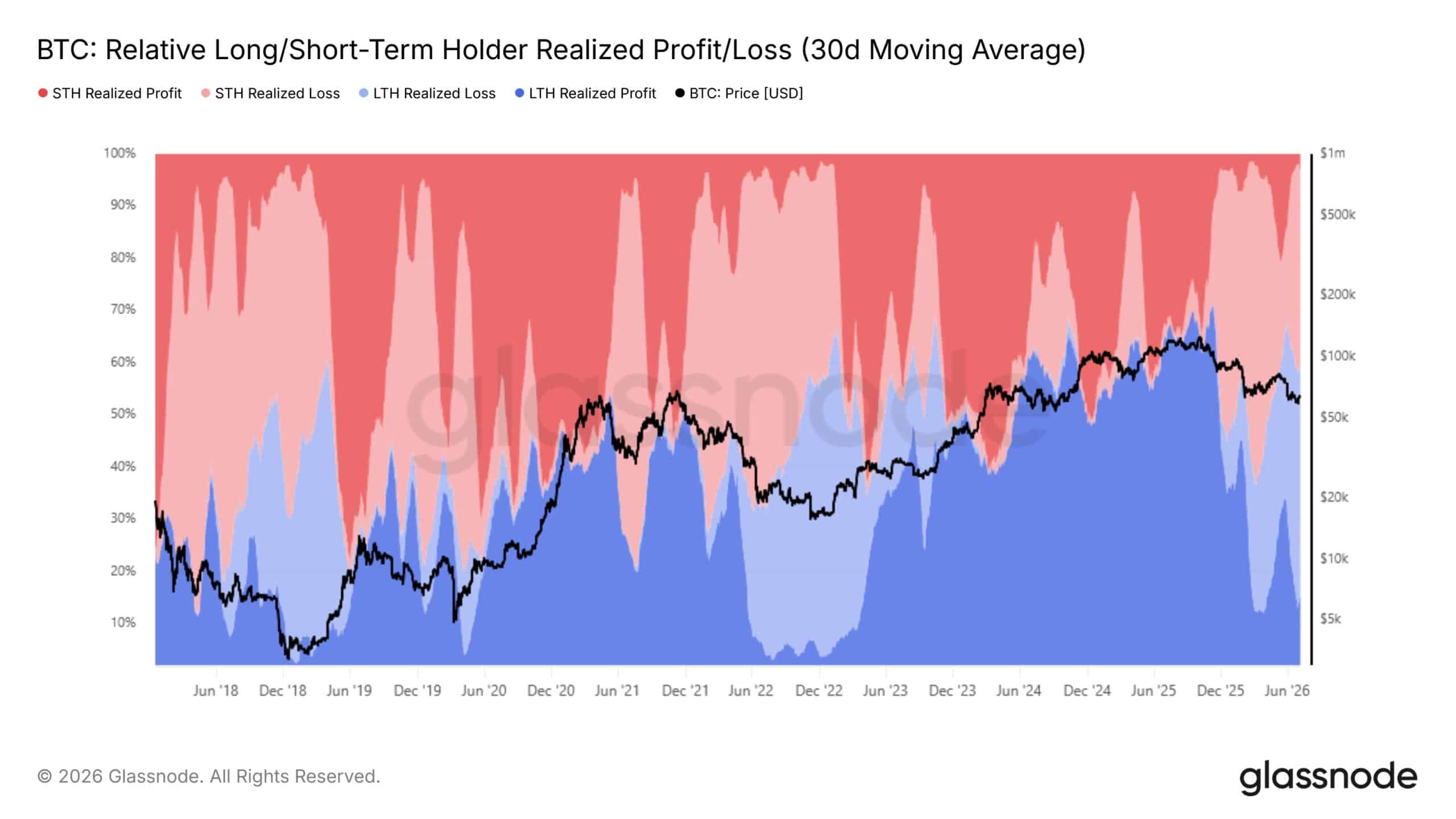
Even as downside fears continue easing, Bitcoin’s recovery is still meeting resistance from holders taking profits accumulated during the previous cycle. Long-term holder realized losses remain elevated on the 30-day Moving Average, although they have moderated from the extreme spikes recorded during the 2022 bear market.
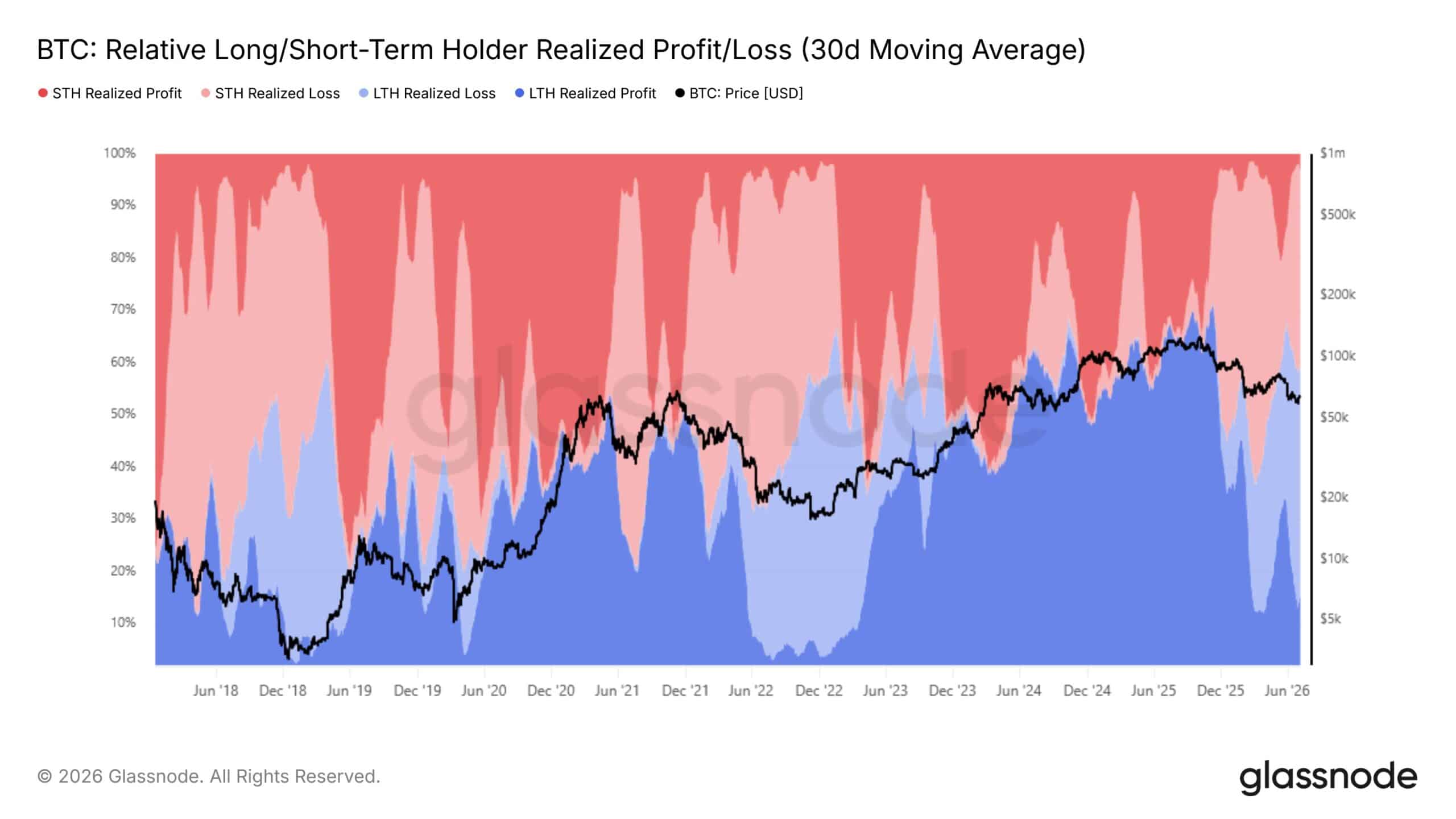
Source: Glassnode

Meanwhile, realized profit and loss data shows short-term holders continue accounting for a larger share of market activity, reflecting uncertainty among newer investors as prices stabilize.

That combination suggests supply is gradually rotating from experienced holders to fresh participants rather than disappearing altogether. Furthermore, an increase in demand for bitcoin is absorbing most of the distribution of supply.

However, until long-term holder selling slows further, Bitcoin’s recovery is likely to remain gradual instead of accelerating into a sustained bullish trend.


Final Summary

  • Bitcoin recovery remains incomplete as spot demand continues trailing derivatives activity.
  • BTC still faces long-term holder selling despite easing downside fears and improving market sentiment.


Trend Kriptolar

İlgili Sorular

QAccording to the article, what is the key factor limiting the robustness of Bitcoin's price recovery?

AThe key limiting factor is the weakness in spot market demand and accumulation. While futures/derivatives demand has recovered, spot demand remains weak, indicating long-term investors are waiting for stronger confirmation. The recovery remains vulnerable until spot accumulation strengthens.

QWhat does the change in Bitcoin's options market in July indicate compared to the selloffs in February and June?

AThe change indicates that downside fears are easing. During the February and June selloffs, put implied volatility surged as traders aggressively hedged against losses. In July, with Bitcoin trading between $60k and $65k, downside premiums have cooled noticeably, suggesting expectations are shifting from another capitulation to a slower bottoming process.

QWhat source of supply is creating a headwind for Bitcoin's price recovery?

AThe headwind comes from long-term holders who are distributing (selling) coins, likely taking profits accumulated during the previous cycle. This selling pressure, along with ongoing uncertainty among newer short-term holders, prevents the recovery from accelerating into a sustained bullish trend.

QWhat specific metric showed a sharp rebound from nearly -500,000 BTC to around -75,000 BTC, signaling returning risk appetite?

AThe 30-day cumulative demand metric showed this sharp rebound. This shift signaled that risk appetite is gradually returning to the Bitcoin market.

QWhy might improved market sentiment alone be insufficient for a durable Bitcoin recovery, according to the article?

AImproved sentiment alone might be insufficient because ETF participation remains inconsistent and, crucially, spot accumulation (actual buying of Bitcoin) has fallen behind derivative demand. Without fresh capital flowing back into the spot markets, the improved sentiment may not generate the widespread buying needed for a durable recovery.

İlgili Okumalar

Zcash's ETF Gilding: How a Privacy Coin Was Packaged by Wall Street into a Compliant Asset

The article traces the decade-long path of Zcash (ZEC), a privacy-focused cryptocurrency, to its potential launch as the first privacy coin spot ETF, with Grayscale's ZCSH filing in August 2026. It argues ZEC's suitability stemmed not from regulatory acceptance of its privacy technology, but from its centralized, institutional structure from inception—a commercial company (ECC) with venture capital backing and a Founder's Reward—making it easier to package than decentralized alternatives. Three key institutions, intertwined in a network, drove the process: Grayscale (owned by DCG, an early ZEC investor), which had held ZEC in a trust since 2017; Coinbase, providing custody, prime brokerage, derivatives, and venture investment; and ZODL, a new for-profit entity formed in 2026 when ECC's core development team split from the non-profit foundation. The major regulatory hurdle was SEC scrutiny (2023-2026) over ZEC's historical structure, which resembled an unregistered investment contract due to automatic block rewards to ECC and the Foundation. This was resolved through governance changes (NU6 upgrade in 2024) that ended direct funding and shifted control to community voting, coinciding with a broader shift in SEC enforcement policy. Notably, the law firm Davis Polk represented both the Zcash Foundation in its SEC defense and Grayscale in the ETF filing. The push is also driven by DCG's dire financial needs amid Genesis bankruptcy lawsuits, seeking high-fee products (the ZEC ETF charges 2.5%). Concurrently, major mining operations by entities like Cypherpunk Technologies (backed by Winklevoss Capital) and DCG's Fortitude Mining expanded, motivated by profitability and aiming to influence the network. The article concludes with irony: to become a compliant ETF asset, ZEC must shed its core privacy feature for the fund's holdings, which will be held in transparent, auditable addresses. Wall Street is not adopting privacy technology but packaging the *concept* of privacy into a tradable, fee-generating financial product. The transformation was not a single master plan but the result of a network of aligned interests capitalizing on regulatory, governance, and market shifts over ten years.

marsbit7 dk önce

Zcash's ETF Gilding: How a Privacy Coin Was Packaged by Wall Street into a Compliant Asset

marsbit7 dk önce

Bitcoin Core Developer Warns That Bitcoin Payments Are Disappearing at 'Bitcoin Beach'

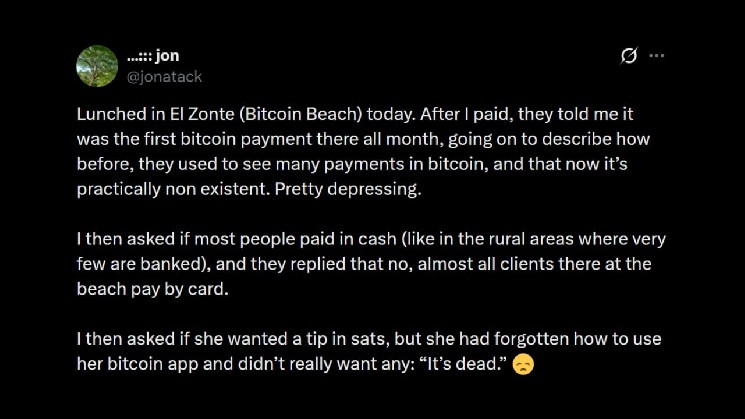
A Bitcoin Core developer, John Atack, who has lived in El Salvador since 2022, shared a concerning anecdote about Bitcoin adoption in the country. While dining at El Zonte, a region known as "Bitcoin Beach," he paid with Bitcoin and was told it was the first such payment the establishment had received in a month. Staff explained Bitcoin payments, once common, have now virtually disappeared, with nearly all customers using cards. An employee even declined a Bitcoin tip, stating she had forgotten how to use her wallet and declaring "It's already dead." Atack emphasized this was a single observation but noted the employee had witnessed the payment evolution over three years. His comments sparked mixed reactions. Some disputed his experience, with one user confirming successful Bitcoin payments in the same area. However, Bitcoin reporter Juan Galt acknowledged an underlying "economic problem," arguing that expecting price appreciation makes using Bitcoin for everyday transactions counterintuitive to economic incentives needed for a circular crypto economy. Despite the concerning report, Atack also reflected that El Salvador remains a global leader in cryptocurrency adoption and progressive legislation, sometimes causing locals to take these advancements for granted. The story highlights the ongoing challenges of mainstream Bitcoin adoption for daily commerce, even in pioneering nations.

cryptonews.ru10 dk önce

Bitcoin Core Developer Warns That Bitcoin Payments Are Disappearing at 'Bitcoin Beach'

cryptonews.ru10 dk önce

A Huge 'Sleeping' Wave of New Bitcoin Buyers Has Not Even Bought Bitcoin Yet

A recent study by the Federal Reserve Bank of Cleveland, titled "Do You Even Crypto, Bro? Cryptocurrencies in Household Finance," reveals that Bitcoin and other crypto assets are less understood than other financial assets in US households. The primary reasons for not owning crypto are a lack of knowledge and the perception that it is a poor investment. Even among owners, the main motivations are profit-seeking and portfolio diversification rather than an understanding of the underlying technology's benefits, such as independence from banks. The research found that showing respondents Bitcoin's past 12-month performance increased their desired portfolio allocation by about 47%, indicating investment decisions are driven more by recent returns than fundamental comprehension. Crypto gains are often treated like lottery winnings, leading to one-off luxury purchases rather than sustained increases in spending. While non-owners largely view crypto as high-risk, owners are somewhat less likely to do so, though they exhibit greater uncertainty about future returns compared to traditional assets like stocks or gold. This ambiguity about Bitcoin's nature and valuation contributes directly to its price volatility. The study concludes that this volatility will persist, but education efforts combined with price appreciation could convert today's uninformed non-owners into future Bitcoin holders.

cryptonews.ru12 dk önce

A Huge 'Sleeping' Wave of New Bitcoin Buyers Has Not Even Bought Bitcoin Yet

cryptonews.ru12 dk önce

Grain Prices Haven't Taken Off Yet, So Why Have Fertilizer Prices Risen First?

Fertilizer prices are rising ahead of a potential global food price surge, driven primarily by supply-side constraints rather than current agricultural demand. While a strong El Niño is forecast for late 2026, its impact is expected to be initially limited to specific crops like palm oil and rubber, not leading to immediate, broad-based grain shortages. The fertilizer market is currently propelled by its own dynamics: **Urea** faces domestic oversupply in China, with its price reliant on the potential to export to higher-priced international markets. **Phosphate fertilizers** are experiencing a rare "supply-led" cycle due to global sulfur shortages, shipping disruptions, and production cuts overseas, placing Chinese producers with integrated resources and export channels in a key position. **Potash** supply is tightening due to planned maintenance and production cuts at major global producers, underpinning its long-term resource scarcity narrative. Looking ahead to 2027, a prolonged El Niño could shift the market into a second phase of "demand-supply resonance." If extreme weather significantly impacts crop yields and global grain inventories, rising food prices and farmer income would boost fertilizer application demand. This potential demand surge, layered onto the existing supply constraints, could amplify the price cycle. The overarching theme is that **food security is redefining the strategic value of fertilizers**, particularly for resource-constrained phosphate and potash. Policy priorities balancing domestic supply guarantees with export opportunities, coupled with resource ownership and global supply chain access, are becoming critical determinants of profitability beyond short-term weather cycles.

marsbit15 dk önce

Grain Prices Haven't Taken Off Yet, So Why Have Fertilizer Prices Risen First?

marsbit15 dk önce

İşlemler

Spot

Popüler Makaleler

EDGE Nasıl Satın Alınır

HTX.com’a hoş geldiniz! edgeX (EDGE) satın alma işlemlerini basit ve kullanışlı bir hâle getirdik. Adım adım açıkladığımız rehberimizi takip ederek kripto yolculuğunuza başlayın. 1. Adım: HTX Hesabınızı OluşturunHTX'te ücretsiz bir hesap açmak için e-posta adresinizi veya telefon numaranızı kullanın. Sorunsuzca kaydolun ve tüm özelliklerin kilidini açın. Hesabımı Aç2. Adım: Kripto Satın Al Bölümüne Gidin ve Ödeme Yönteminizi SeçinKredi/Banka Kartı: Visa veya Mastercard'ınızı kullanarak anında edgeX (EDGE) satın alın.Bakiye: Sorunsuz bir şekilde işlem yapmak için HTX hesap bakiyenizdeki fonları kullanın.Üçüncü Taraflar: Kullanımı kolaylaştırmak için Google Pay ve Apple Pay gibi popüler ödeme yöntemlerini ekledik.P2P: HTX'teki diğer kullanıcılarla doğrudan işlem yapın.Borsa Dışı (OTC): Yatırımcılar için kişiye özel hizmetler ve rekabetçi döviz kurları sunuyoruz.3. Adım: edgeX (EDGE) Varlıklarınızı SaklayınedgeX (EDGE) satın aldıktan sonra HTX hesabınızda saklayın. Alternatif olarak, blok zinciri transferi yoluyla başka bir yere gönderebilir veya diğer kripto para birimlerini takas etmek için kullanabilirsiniz.4. Adım: edgeX (EDGE) Varlıklarınızla İşlem YapınHTX'in spot piyasasında edgeX (EDGE) ile kolayca işlemler yapın.Hesabınıza erişin, işlem çiftinizi seçin, işlemlerinizi gerçekleştirin ve gerçek zamanlı olarak izleyin. Hem yeni başlayanlar hem de deneyimli yatırımcılar için kullanıcı dostu bir deneyim sunuyoruz.

556 Toplam GörüntülenmeYayınlanma 2026.03.31Güncellenme 2026.06.02

EDGE Nasıl Satın Alınır

Tartışmalar

HTX Topluluğuna hoş geldiniz. Burada, en son platform gelişmeleri hakkında bilgi sahibi olabilir ve profesyonel piyasa görüşlerine erişebilirsiniz. Kullanıcıların EDGE (EDGE) fiyatı hakkındaki görüşleri aşağıda sunulmaktadır.

活动图片