$50 Million Gone with One 'Confirmation'! The Most Expensive Slip in DeFi History is Born

比推2026-03-13 tarihinde yayınlandı2026-03-13 tarihinde güncellendi

Özet

An anonymous crypto "whale" accidentally lost nearly $50 million in what is being called DeFi's most expensive "fat-finger" error. The user attempted to swap 50.43 million USDT for AAVE tokens via the Aave mobile app interface. Due to extremely low liquidity for AAVE tokens, the massive trade caused catastrophic slippage of over 99%, resulting in the user receiving only 324 AAVE (worth ~$36,000) instead of the intended amount. Aave's founder Stani Kulechov confirmed the user manually confirmed a risk warning checkbox on the high-slippage transaction before proceeding. The protocol functioned as designed, but the incident sparked intense debate: some argue users bear full responsibility in DeFi, while others criticize the UI/UX for inadequate safeguards for such large transactions. The wallet has been linked by analysts to a Bitcoin whale address holding ~80,000 BTC, suggesting the user may be a wealthy early adopter. Aave has pledged to refund the $600,000 in fees from the trade and improve safety measures like stricter slippage limits. The event highlights critical DeFi challenges: amplified risk from user errors, urgent need for better UX safeguards, MEV exploitation, and user education gaps.

Last night, an incident dubbed the "most absurd fat-finger error in DeFi history" exploded across the crypto community.

The protagonist of the story is an anonymous "whale." Through the app interface of the DeFi lending protocol Aave, he initiated a seemingly simple transaction: exchanging a whopping $50.43 million USDT stablecoin for AAVE tokens.

How large was this transaction? Large enough to instantly "dry up" the liquidity for the vast majority of tokens on the market. Due to the inherently limited trading depth of AAVE tokens, such a massive buy order directly triggered a disastrous slippage. Simply put, slippage is the deviation between the price you expect to trade at and the price you actually get. In this transaction, the slippage was over 99%.

Transaction link: https://etherscan.io/tx/0x9fa9feab3c1989a33424728c23e6de07a40a26a98ff7ff5139f3492ce430801f

What does this mean? When this transaction was finally executed through on-chain routers like CoW Swap, this user received only 324 AAVE tokens, worth about $36,000 at the market price at the time.
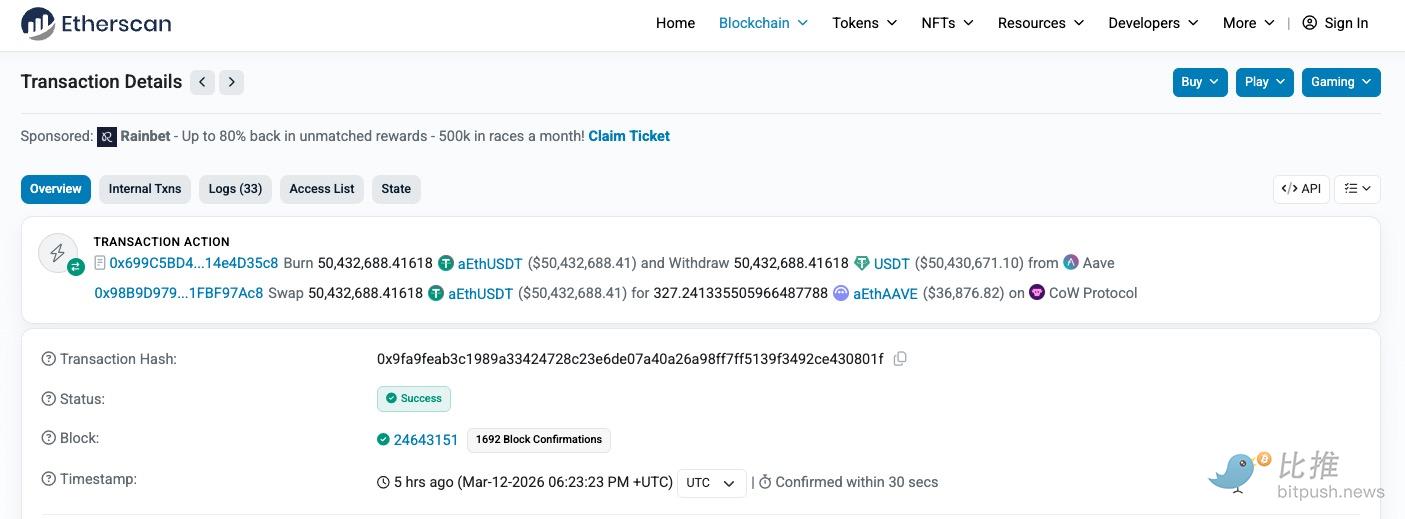
$50.43 million vs. $36,000. One transaction, nearly $50 million evaporated in an instant.

Aave's founder, Stani Kulechov, later explained the incident on social media.
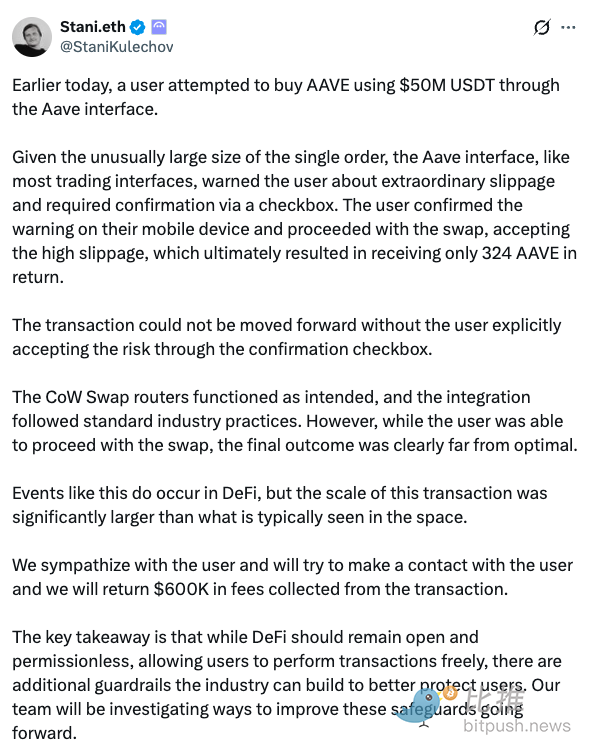
According to his description, the user completed the operation on Aave's mobile app. When the system detected the extreme slippage this massive transaction could cause, the interface popped up a risk warning and required the user to check a confirmation box to indicate they were aware of the risks. On their phone, the user checked that small box and then clicked confirm.
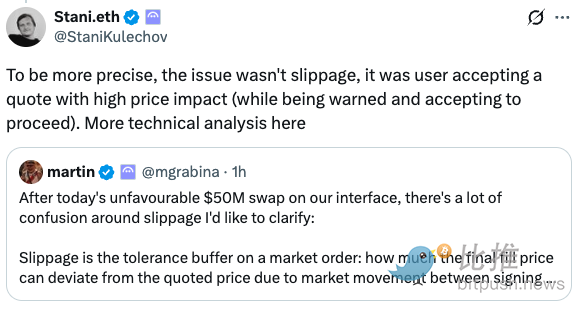
He stated that all procedures were standard and the protocol itself was functioning normally.

The event shocked the entire crypto community, combining elements of the "absurd":

1. Scale: $50 million, even in the crypto world frequented by institutions, is a huge sum of money that many would look up to.

2. Mobile operation, how bold? This was one of the most heated points of discussion in the community. A comment from one netizen received many likes: "Who keeps $50 million on their phone???"

3. Checkbox too 'makeshift'?: The most ironic part of the whole event was that decisive "checkbox." In traditional finance, a multi-million dollar transaction requires layers of approval, multiple reviews, and phone confirmations. In decentralized DeFi, the entire firewall is simplified into a checkbox that can be passed with a simple tap. The community mocked this as the "DeFi version of 'I have read and agree to the terms and conditions'."

The owner of address 0x98b sparked community speculation. Through on-chain tracing, analyst Specter believes this wallet is likely related to the 1011 insider whale Garrett Jin.
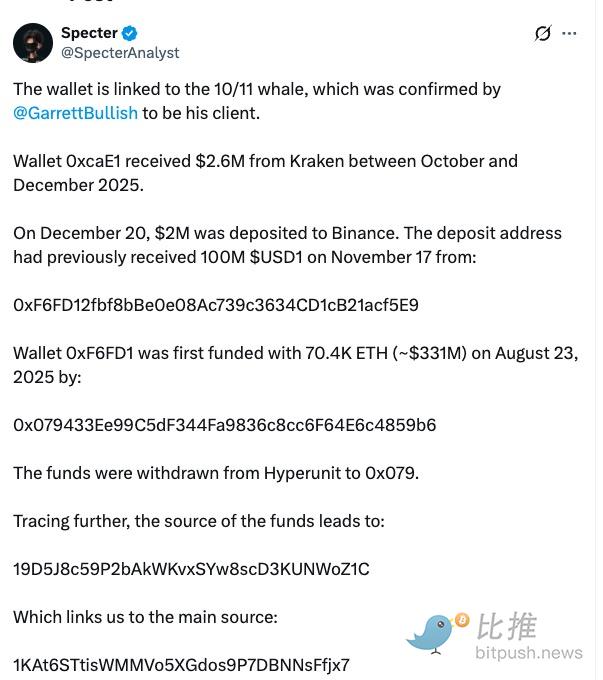
The analyst pointed out that fund flow shows the wallet received about $2.6M from Kraken (Oct-Dec 2025) and was traced back to the Bitcoin address 1KAt6STtisWMMVo5XGdos9P7DBNNsFfjx7—a famous Bitcoin cold wallet holding about 80,000 BTC (worth billions of dollars), often associated with early Bitcoin miners or institutional investors. The community speculates that this "whale" might be a Bitcoin millionaire diversifying into Ethereum, but a operational error led to huge losses.

Of course, there are also conspiracy theorists怀疑ing if this is some form of "money laundering"? But it's just speculation for now, without any solid evidence.

Blame the User, or Blame the Protocol?

The event quickly split into two main camps on social media:

One view holds that the user must be responsible for their own actions. The core spirit of DeFi is "not your keys, not your coins"; you control your assets, so you must pay for every operation you make. In a permissionless financial system, you can't expect someone to save you when you make a mistake.

More people pointed the finger at Aave's interface design. They argued that a UI that uses merely a checkbox to prevent a $50 million loss is itself a failure. Some developers suggested that for such extreme, obviously unreasonable transactions, the interface should impose more "aggressive" friction, such as forcing the user to type a specific phrase like "I confirm I will lose 99.9% of my funds" to proceed, or directly setting an insurmountable slippage上限.

The core of this debate actually touches on the biggest paradox DeFi currently faces: how to provide users with sufficient safety protections while adhering to the core principles of decentralization and permissionlessness?

Aave's team reacted quite quickly. Founder Stani promised to refund the approximately $600,000 in fees collected from this transaction to the victim. More importantly, they announced they would review and improve related protective measures, such as optimizing UI/UX design and setting stricter slippage上限s, to prevent similar tragedies from happening again.

What Does This Incident Leave Us With?

This $50 million "slip" incident, although an extreme case, once again highlights the deep-seated worries of DeFi:

1. DeFi's Risk Amplification Effect: Automation, permissionlessness, and composability—the magic of DeFi—also amplify any tiny user error. One "slip," and the cost could be losing everything.

2. Urgency of UI/UX Optimization: For DeFi to go mainstream, user experience and safety protections must be improved. How to introduce more "smart guardrails" while maintaining the spirit of decentralization, such as multiple confirmations for large transactions, AI-assisted risk assessment, etc., is a topic every protocol needs to consider.

3. Challenges of MEV and Ethereum's Mechanism: The loss being extracted by MEV highlights the "law of the jungle" on the blockchain. This might accelerate the migration to fairer mechanisms, like PBS optimizations or Layer 2 solutions.

4. Lack of User Education: Many users may not fully understand professional concepts like "slippage" and "liquidity depth." If a whale can make such a mistake, let alone the average retail investor? The entire industry needs to invest more resources to help users build necessary risk awareness.

After all, the price of such a "slip" is just too expensive.


Twitter:https://twitter.com/BitpushNewsCN

Bitpush TG Discussion Group:https://t.me/BitPushCommunity

Bitpush TG Subscription: https://t.me/bitpush

Original link:https://www.bitpush.news/articles/7619291

İlgili Sorular

QWhat was the main cause of the user losing nearly $50 million in the DeFi transaction?

AThe user lost nearly $50 million due to extreme slippage of over 99% caused by attempting to swap a massive amount of 50.43 million USDT for AAVE tokens, which had limited liquidity to handle such a large order.

QHow did the Aave interface attempt to warn the user about the risks of this transaction?

AThe Aave interface detected the extreme slippage risk and displayed a warning popup with a checkbox that the user had to manually select to confirm they understood the risks before proceeding.

QWhat was the community's reaction regarding the use of a simple checkbox for such a large transaction?

AThe community criticized the UI design, calling it a 'DeFi version of 'I have read and agree to the terms'' and argued that a simple checkbox was insufficient protection for a $50 million transaction, suggesting more aggressive safeguards like mandatory phrase confirmation or hard slippage limits.

QWho is suspected to be the owner of the wallet (0x98b) that initiated this transaction, according to on-chain analysts?

AOn-chain analysts, like Specter, suspect the wallet is likely associated with Garrett Jin, an insider whale, with funds traced back to a famous Bitcoin cold wallet holding around 80,000 BTC, potentially belonging to an early Bitcoin miner or institutional investor.

QWhat actions did Aave's founder take in response to this incident?

AAave's founder, Stani Kulechov, promised to refund the approximately $600,000 in protocol fees collected from the transaction to the victim and announced plans to review and improve protective measures, such as optimizing UI/UX design and implementing stricter slippage limits.

İlgili Okumalar

TechFlow Intelligence Bureau: Chip Stocks Lose Trillions in a Single Day, Bitcoin Falls Below $60,000, US-Iran Conflict Escalates

**Daily Tech & Markets Roundup: AI Advances, Market Turmoil, and Geopolitical Tensions** **AI / LLMs**: Anthropic's internal report on AI self-improvement sparked serious discussions about Recursive Self-Improvement (RSI). Meanwhile, debate continues on AI coding tools after Claude was accused of introducing bugs into the rsync codebase. In positive news, DeepSeek V4 Flash impressed in local deployment tests, and GitHub Copilot now supports custom endpoints for local models. A surprising research turn suggests removing chain-of-thought prompting can sometimes improve LLM performance. **Crypto / Web3**: Bitcoin plunged below $60,000, with its RSI hitting levels last seen during the COVID-19 crash, driven by strong U.S. jobs data reviving interest rate hike fears. Discussions highlight Ethereum DeFi's continued lack of a smooth consumer payment layer. **Chips / Hardware**: Chip stocks suffered a massive sell-off, with the Philadelphia Semiconductor Index posting its worst single-day drop in six years, erasing over a trillion dollars in value. Marvell, Micron, AMD, and Intel were among the biggest losers. **Tech Companies**: A leaked Microsoft document revealing goals to make Copilot "addictive" drew criticism. LinkedIn founder Reid Hoffman left Microsoft's board to focus full-time on his AI agent startup, Manus. Google was revealed to be paying SpaceX $920 million monthly for AI training compute. **Markets & Macro**: A blowout U.S. jobs report (172k vs. 80k expected) crushed hopes for near-term rate cuts, sending Treasury yields soaring and triggering a broad market sell-off. CEOs from Kraft, McDonald's, and Whirlpool simultaneously warned U.S. consumers are exhausting their savings. **Geopolitics**: U.S.-Iran tensions escalated with missile/drone interceptions and U.S. strikes on Iranian radar sites, keeping the critical Strait of Hormuz largely closed since late February and posing ongoing oil supply risks. **The Bottom Line**: The strong jobs data acted as a single trigger for correlated sell-offs across equities, crypto, and chips. Underlying the volatility is a stark contradiction between robust employment data and warnings of consumer weakness, alongside geopolitical risks that could reignite inflation, leaving markets to price in a fraught macro outlook with no clear "soft landing" path.

marsbit13 dk önce

TechFlow Intelligence Bureau: Chip Stocks Lose Trillions in a Single Day, Bitcoin Falls Below $60,000, US-Iran Conflict Escalates

marsbit13 dk önce

It Took Me a Year to See the Bitter Truth About Agent Payments

After a year building infrastructure for the Agent economy, engaging with major players like Stripe, Visa, and Coinbase, the author shares a sobering analysis of the current state of Agent payments. The core finding is a stark lack of genuine, immediate demand across most envisioned use cases. The article breaks down four key market segments: 1. **Agent-to-Merchant (Consumer Shopping):** For most product categories (e.g., clothing, electronics), conversational AI shopping is a step backwards from visual e-commerce interfaces. While agents excel at understanding needs, they can't replace side-by-side product comparison. Real merchant interest is defensive "Agent Engine Optimization," not driven by current customer demand. Potential exists for high-frequency, low-decision purchases (like food delivery) or navigating complex store UIs, but these require massive B2C distribution channels dominated by giants like Amazon. 2. **Agent-to-API (Developer Services):** Developers already have subscriptions and billing relationships for APIs (compute, data). Prepaid balances solve micro-payment issues for low transaction volumes. A deeper structural problem is that major SaaS vendors' business models rely on enterprise contracts, resisting granular pay-per-call pricing. While protocols like MPP and x402 serve the long tail of niche services, this market is small and developers are historically low-willingness-to-pay. 3. **Agent-to-Agent:** This remains largely theoretical with minimal transaction volume. While it represents a long-term bet on a fundamentally new transaction infrastructure (sub-second, micro-penny to million-dollar, multi-party settlements), it does not constitute a present market. 4. **Agent-to-Finance:** This is the only category with existing, paying demand. Integrating AI into financial workflows (trading, portfolio management) is a natural evolution and enables new capabilities like autonomous rebalancing. However, competition favors established, regulated institutions. The "real problem" is not moving money between agents, but the broader challenge of **coordination**—orchestrating work between agents and humans, verifying outcomes, and settling results. Payment is just one component of settlement, which is itself part of coordination. Companies that solve the coordination layer will subsume payment, not the other way around. While well-funded incumbents build defensively for a long-term future, startups must find where the market is today—which, for the author's team, lies outside these four categories in an area of real, growing, and underserved activity.

marsbit56 dk önce

It Took Me a Year to See the Bitter Truth About Agent Payments

marsbit56 dk önce

It Took Me a Year to See the Hard Truth About Agent Payments

**Title: It Took Me a Year to See the Hard Truth About Agent Payments** Over the past year, I've worked on infrastructure for the Agent economy, engaging with major players like Stripe, Visa, Coinbase, and numerous startups. The findings reveal a stark reality: genuine, widespread demand for Agent-based payments does not yet exist. **Key Observations:** * **Agent-to-Merchant (Shopping):** The user experience for AI shopping often falls short, especially for visual product discovery. While AI excels at understanding needs, conversational interfaces can't yet replace browsing and comparing multiple products visually. Current merchant interest is largely defensive ("Agent Engine Optimization") for a future that hasn't arrived. High-frequency, low-friction purchases (like food delivery) are potential fits, but lack open APIs and face high AI inference costs. Simpler, more affordable, or cross-language interactions for complex UIs are a niche opportunity but require massive consumer distribution to scale. * **Agent-to-API (Developer Tools):** Developer payment needs for APIs (computing, data, models) are already met through subscriptions and prepaid credits. The core challenge is not payment friction but supplier economics: most large SaaS providers prefer enterprise contracts over micropayments for API calls. Protocols like MPP and x402 suit the long-tail of smaller services but cater to a developer market historically reluctant to pay for these tools. Major infrastructure needs at the top of the stack are already being addressed. * **Agent-to-Agent (Machine Commerce):** This is a long-term vision with almost no current transaction volume. While a future with high-speed, high-frequency, multi-party machine-to-machine transactions would require novel infrastructure, it remains theoretical. The market is not here yet. * **Agent-to-Finance:** This is the only category with clear, present demand. Financial professionals and DeFi users already pay for tools, and AI augmentation is a natural evolution. Autonomous AI agents can enable entirely new financial strategies. However, competition is fierce from established, regulated incumbents who can more easily layer AI onto their existing products. **The Core Insight:** Companies, especially giants with long time horizons, are building defensively for a potential future of mass machine commerce. For them, early investment is a low-cost hedge. For startups, the current market reality is different. The primary challenge isn't just moving money between agents (payments). The larger, unsolved problem is **orchestration** – coordinating work between agents and humans, verifying outcomes, and then settling. Payment is just a part of settlement, which is just a part of orchestration. Companies that solve the orchestration problem will subsume payments, not the other way around. After a year of building, we see the real, growing, and underserved market opportunity lies in this broader domain of orchestration.

链捕手1 saat önce

It Took Me a Year to See the Hard Truth About Agent Payments

链捕手1 saat önce

Claude Opus 4.8 Finds a $4.5 Billion Bug: The AI Era is Mass-Producing Hackers

A researcher discovered a critical "infinite mint" vulnerability in the Zcash cryptocurrency's Orchard protocol using Claude Opus 4.8, leading to a swift fix but also a 50% market drop, erasing billions in value. This incident highlights a new era where powerful, accessible AI models are dramatically lowering the barrier to finding software vulnerabilities. Previously, the security community feared specialized models like Claude Mythos Preview, capable of finding decades-old zero-day exploits. The Zcash case, however, involved a publicly available, general-purpose model. This shift makes advanced security auditing—and attack capabilities—accessible to far more people, not just experts. The mass democratization of vulnerability discovery brings a dual challenge: a flood of low-quality, AI-generated false reports that overwhelm maintainers, and the real, rapid uncovering of deep, dangerous bugs. Open-source projects, often understaffed and unfunded, are particularly vulnerable to this "attention DDoS." The article cites examples like curl shutting down its bug bounty program due to the unsustainable workload. Our perceived digital safety has often been luck, relying on the high cost and effort required to find deeply hidden flaws in complex systems, as seen with historical vulnerabilities like Heartbleed or Baron Samedit. AI changes this cost structure, effectively "mass-producing flashlights" to illuminate every corner of our codebase. While large companies operate extensive security chains involving external white-hat hackers and massive defensive operations, the global cybersecurity workforce faces a severe shortage, especially of experienced personnel capable of analyzing complex threats and coordinating fixes. The core dilemma emerges: AI makes *finding* bugs cheap and scalable, but *fixing* them remains a slow, expensive, and human-intensive process. The article concludes that AI won't destroy the internet but acts as a bright light, revealing that our digital existence is not inherently secure but is precariously maintained by ongoing human effort. The true cost in the AI era may not be discovery, but whether there will be enough people left willing and able to do the hard work of repair.

marsbit1 saat önce

Claude Opus 4.8 Finds a $4.5 Billion Bug: The AI Era is Mass-Producing Hackers

marsbit1 saat önce

İşlemler

Spot
Futures

Popüler Makaleler

ONE Nasıl Satın Alınır

HTX.com’a hoş geldiniz! Harmony (ONE) satın alma işlemlerini basit ve kullanışlı bir hâle getirdik. Adım adım açıkladığımız rehberimizi takip ederek kripto yolculuğunuza başlayın. 1. Adım: HTX Hesabınızı OluşturunHTX'te ücretsiz bir hesap açmak için e-posta adresinizi veya telefon numaranızı kullanın. Sorunsuzca kaydolun ve tüm özelliklerin kilidini açın. Hesabımı Aç2. Adım: Kripto Satın Al Bölümüne Gidin ve Ödeme Yönteminizi SeçinKredi/Banka Kartı: Visa veya Mastercard'ınızı kullanarak anında Harmony (ONE) satın alın.Bakiye: Sorunsuz bir şekilde işlem yapmak için HTX hesap bakiyenizdeki fonları kullanın.Üçüncü Taraflar: Kullanımı kolaylaştırmak için Google Pay ve Apple Pay gibi popüler ödeme yöntemlerini ekledik.P2P: HTX'teki diğer kullanıcılarla doğrudan işlem yapın.Borsa Dışı (OTC): Yatırımcılar için kişiye özel hizmetler ve rekabetçi döviz kurları sunuyoruz.3. Adım: Harmony (ONE) Varlıklarınızı SaklayınHarmony (ONE) satın aldıktan sonra HTX hesabınızda saklayın. Alternatif olarak, blok zinciri transferi yoluyla başka bir yere gönderebilir veya diğer kripto para birimlerini takas etmek için kullanabilirsiniz.4. Adım: Harmony (ONE) Varlıklarınızla İşlem YapınHTX'in spot piyasasında Harmony (ONE) ile kolayca işlemler yapın.Hesabınıza erişin, işlem çiftinizi seçin, işlemlerinizi gerçekleştirin ve gerçek zamanlı olarak izleyin. Hem yeni başlayanlar hem de deneyimli yatırımcılar için kullanıcı dostu bir deneyim sunuyoruz.

368 Toplam GörüntülenmeYayınlanma 2024.12.12Güncellenme 2026.06.02

ONE Nasıl Satın Alınır

Tartışmalar

HTX Topluluğuna hoş geldiniz. Burada, en son platform gelişmeleri hakkında bilgi sahibi olabilir ve profesyonel piyasa görüşlerine erişebilirsiniz. Kullanıcıların ONE (ONE) fiyatı hakkındaki görüşleri aşağıda sunulmaktadır.

活动图片













