Tencent Reaps a Paper Profit of 50 Billion

marsbit2026-08-17 tarihinde yayınlandı2026-08-17 tarihinde güncellendi

Özet

A decade ago, China held no share in the global DRAM market. Today, Changxin Technology, after listing on the STAR Market, has become the most valuable A-share company. Its landmark IPO has generated historic returns for investors. Among them, Tencent, which invested approximately 2 billion RMB in 2022 through its entity Beijing Fengyi, now holds an estimated paper gain of around 50 billion RMB based on Changxin's current market valuation of approximately 4 trillion RMB. Alibaba also made significant bets. Its affiliates invested a total of roughly 7.6 billion RMB across two funding rounds in 2022 and 2025. Their combined stake is now worth an estimated 170 billion RMB—a paper profit surpassing Alibaba's entire net profit for fiscal year 2026. The shareholder registry reveals a who's who of Chinese capital. Major state-backed funds like the National Integrated Circuit Industry Investment Fund (Big Fund II) and Anhui provincial capital hold stakes worth hundreds of billions. Early and crucial support came from the Hefei municipal government, which played a foundational role in the company's establishment and growth. Strategic industrial investor GigaDevice, under the same leadership as Changxin, invested about 2.3 billion RMB, now worth roughly 53 billion. Home appliance giant Midea's 1 billion RMB investment has ballooned to an estimated 22 billion RMB. Virtually all major domestic financial institutions, venture capital, and private equity firms participated. However, t...

Ten years ago, when Changxin was founded, China had not yet claimed a single inch of territory on the global DRAM map.

Ten years later, Changxin Technology landed on the STAR Market, becoming the company with the highest market capitalization on the A-share market.

As the bell rang, the heroes of the old days all stepped forward.

The investors behind the scenes all reaped their single largest return to date. The Hefei state-owned capital, having bet right, earned trillions, a feat that will go down in history.

Yet Tencent has rarely been mentioned by the outside world: having invested around 2 billion yuan, its paper profit amounts to approximately 50 billion yuan based on today's market capitalization of 4 trillion yuan.

From Tencent to Alibaba, Accompanying Changxin Past 4 Trillion

Tencent entered the picture at Changxin in 2022.

In February of that year, Changxin's shareholder list saw changes, with a group of institutions including Tencent, Alibaba, and Yunfeng Fund appearing simultaneously.

Tencent's investment vehicle was Beijing Fengyi. The prospectus disclosed that Beijing Fengyi held 901 million shares of Changxin Technology, representing a 1.50% stake before the IPO issuance, diluted to 1.35% after the issuance of new shares.

At that time, Changxin was still nearly three years away from mass-producing its first domestic DRAM chip and had not yet emerged from a period of massive investment. In the first full year disclosed after Tencent's investment, 2023, Changxin's revenue was about 9 billion yuan, while its net loss reached 19.2 billion yuan.

There were no profits, nor a clear timeline for going public, but Tencent still invested 2 billion yuan.

Four years later, Changxin went public on the STAR Market. Based on the market capitalization of approximately 4 trillion yuan as of August 17th, Tencent's paper profit reached 50 billion yuan.

Alibaba was also part of that round. The prospectus disclosed that Alibaba Network invested approximately 1.5 billion yuan to subscribe for new shares, obtaining about 676 million shares of Changxin Technology.

Three years later, the Alibaba system made another move.

In June 2025, Changxin completed its final pre-IPO financing round. Alibaba Cloud invested 6.1 billion yuan at a price of 2.6302 yuan per share, acquiring 2.319 billion shares.

With these two bets, the Alibaba system invested a total of about 7.6 billion yuan, holding 2.995 billion shares of Changxin. After dilution from the IPO issuance of new shares, Alibaba Cloud and Alibaba Network held 3.47% and 1.01% respectively, for a combined stake of approximately 4.48%.

Calculated based on Changxin's market cap of 4 trillion yuan, this shareholding is worth about 170 billion yuan, representing an astounding paper profit.

What does this number mean? Alibaba's net profit for fiscal year 2026 was 102.1 billion yuan. In other words, the paper profit from this single investment in Changxin alone is equivalent to more than a year's net profit for Alibaba.

Joy and Regret

Opening Changxin's shareholder register reveals a vivid portrait of China's capital landscape.

A partner at a well-known domestic industrial capital firm once revealed to investors that when Changxin Technology was preparing for a certain financing round, there were 220 investment institutions queuing up to get in. They had to conduct three reverse roadshows and then select just over 10 potential investors for further consideration, setting a high bar.

The group portrait unfolds one by one.

Post-IPO, the National Integrated Circuit Industry Investment Fund Phase II holds 7.86%, Anhui Provincial Investment Group holds 7.12%, and China Structural Reform Fund holds 1.01%. At 49 yuan per share, their combined shareholding value exceeds 520 billion yuan.

Even earlier, Hefei state-owned capital had been deeply involved in Changxin's construction through multiple platforms. From project landing and factory construction to successive rounds of capital increases, Hefei built the city, fortified the walls, and supplied the provisions for Changxin. Without this city's unwavering bet over the years, the later story of a trillion-yuan market cap would have been impossible.

Among industrial investors, GigaDevice is another major backer.

As a leading storage design company also led by Zhu Yiming, GigaDevice has deep ties with Changxin. In 2020, GigaDevice invested 300 million yuan in Hefei Changxin Integrated via convertible bonds. In 2021, it invested 500 million yuan in Ruili Integration. In 2024, it participated in Changxin Technology's capital increase with 1.5 billion yuan. Summing these principal investments simply totals about 2.3 billion yuan.

Calculated at the closing price of 49 yuan per share on July 27, 2026, the first day of listing, this shareholding is worth about 53 billion yuan.

In 2021, Midea invested approximately 1 billion yuan in Changxin. Post-IPO, Midea holds a 0.67% stake, corresponding to a market value of about 22 billion yuan.

Bank-affiliated capital has almost all shown up, and the insurance capital camp is also well represented. RMB funds are crowded—National Integrated Circuit Industry Investment Fund Phase II, China Structural Reform Fund, CICC Capital, Cornerstone Capital, Legend Capital, Yanchuang Venture Capital, China Merchants Capital, Walden International, Qianhai FOF, Shenzhen Investment Holdings, CCB International, Yunfeng Fund, Guangdong-Hong Kong-Macao Greater Bay Area Fund, CCB Trust, China Life Investment, Hengxu Capital, Wan Investment Group, Junhe Capital, Orient Asset Management, Hexie Health, Sunshine Insurance, Guangzhou Xinde, Lanpu Investment, Xinke Venture Capital, Huafu Jiaye, Advantage Capital, New Ding Capital, Gaoxin Capital, Pro Capital...

In this feast, if there is one story that evokes the deepest regret, it must be Country Garden.

In 2021, Country Garden Venture Capital invested about 900 million yuan to acquire a stake in Changxin. At the end of 2024, Huibi V, under Country Garden, transferred its 901 million Changxin shares to Hefei Jianchang for a transaction price of 2 billion yuan.

For the same 901 million shares, based on Changxin's closing price of 49 yuan per share on its first trading day, the value is about 44 billion yuan.

Some entered the city on a cold night; some left the table before dawn. Country Garden took away 2 billion yuan, solving its predicament at that time.

The curtain fall of the real estate cycle and the rise of the semiconductor cycle happened to intersect at this juncture.

A matter of timing, a matter of fate.

This article is from the WeChat public account "投资界" (ID: pedaily2012), author: Chen Jia

İlgili Sorular

QAccording to the article, how much did Tencent initially invest in ChangXin Technology, and what is its approximate paper profit after the company's IPO?

ATencent initially invested approximately 2 billion RMB (about 20 billion yuan) and has a paper profit of around 50 billion RMB (about 500 billion yuan) based on ChangXin's market valuation of about 4 trillion RMB.

QWhat were the key financial details of Alibaba's investment in ChangXin Technology as described in the article?

AAlibaba invested twice. First, Alibaba Network invested about 1.5 billion RMB (15 billion yuan) in 2022. Second, Alibaba Cloud invested 6.1 billion RMB (61 billion yuan) in a pre-IPO round in 2025. Their total combined stake, post-IPO, is about 4.48%, valued at approximately 1.7 trillion RMB, representing a massive paper profit.

QWhy is Country Garden (BGY) mentioned as a source of regret in the context of ChangXin's investment story?

ACountry Garden's venture capital arm invested about 900 million RMB in 2021. However, in late 2024, due to financial pressures in the real estate sector, it sold its 901 million shares for 2 billion RMB. Those same shares would have been worth about 44 billion RMB at ChangXin's IPO price, meaning it missed out on enormous gains by exiting just before the company went public.

QWhat role did the Hefei municipal government play in the development of ChangXin Technology?

AThe Hefei state-owned capital played a foundational and continuous role. It was deeply involved from the project's inception, providing support for land, factory construction, and multiple rounds of funding. The article states that without Hefei's long-term strategic bet, the later story of ChangXin's trillion-RMB market value would not have been possible.

QWhich other major domestic industry player, besides Tencent and Alibaba, made a significant early investment in ChangXin, and what was the outcome?

AGigaDevice (Zhaoyi Innovation), a memory design leader also chaired by Zhu Yiming, made significant early investments totaling approximately 2.3 billion RMB through convertible bonds and direct equity. Post-IPO, this stake was valued at around 53 billion RMB, representing a substantial return.

İlgili Okumalar

U.S. 'Operation Economic Outcast' Targets Iran's Crypto Sector, Over $100 Million in Oil-Related Payments Allegedly Facilitated via Cryptocurrency

U.S. Treasury Launches "Operation Economic Outcast," Sanctions Iran's Crypto Sector On August 24, the U.S. Treasury Department initiated "Operation Economic Outcast," a government-wide economic campaign against Iran. As part of this, the Office of Foreign Assets Control (OFAC) issued a sectoral sanctions determination targeting digital assets under Executive Order 13902, significantly expanding its authority. The Treasury stated that Iran is increasingly using cryptocurrency as a "tool of choice" to evade sanctions and support transactions linked to the Islamic Revolutionary Guard Corps (IRGC). Concurrently, OFAC sanctioned Ukrainian-Emirati broker Ivan Obukhov and his company, Foscom FZE. The Treasury alleges that since 2023, Obukhov has processed over $100 million in cryptocurrency payments to facilitate oil sales on behalf of the IRGC-Quds Force. Nearly 60 other entities, individuals, and vessels involved in nuclear procurement, cyber operations, and oil revenue networks were also sanctioned. This move marks an escalation from prior actions against specific exchanges, now establishing a broad basis to sanction any foreign entity deemed to operate in or support Iran's digital asset sector. Treasury Secretary Scott Bessent warned that any entity engaging economically with the Iranian regime will face the full reach of U.S. power, calling the operation an "economic D-Day" aimed at isolating Tehran.

marsbit8 dk önce

U.S. 'Operation Economic Outcast' Targets Iran's Crypto Sector, Over $100 Million in Oil-Related Payments Allegedly Facilitated via Cryptocurrency

marsbit8 dk önce

Is Your Account Still Blocked? Rosfinmonitoring Gets Direct Access to SBP and 'Mir'

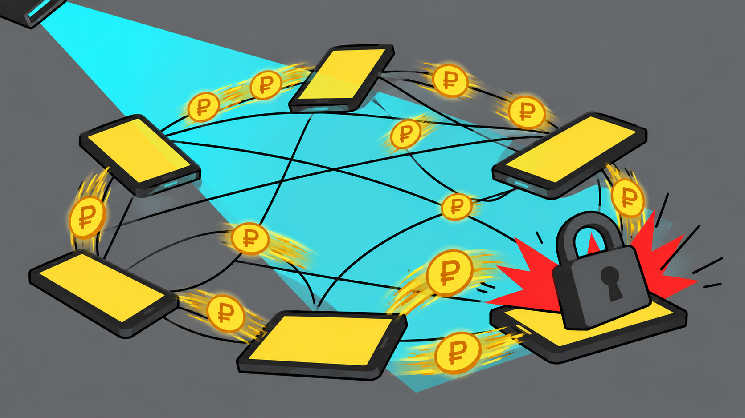
Starting September 1, 2026, Russia's Federal Law No. 461-FZ grants Rosfinmonitoring (the Federal Financial Monitoring Service) direct access to transaction data from the National Payment Card System (NSPK), the operator of the Mir payment card system and the Faster Payments System (SBP). This allows the agency to bypass individual banks when reconstructing transaction trails for anti-money laundering (AML) purposes. The data, provided free of charge and without requiring customer consent or court orders, includes information on operations via SBP, the unified QR-code, and Mir cards, with no minimum transaction threshold. Customers will not be notified when their data is shared. The law does not introduce new taxes, automatic account freezes, or new enforcement powers. If suspicious activity is identified under existing AML laws, existing procedures with banks and law enforcement will apply. The agreement's specific terms between Rosfinmonitoring and NSPK, including the scope and historical depth of accessible data, are not public. The change centralizes access to a vast volume of domestic payments, potentially speeding up financial investigations. However, it also creates a single point of concentration for sensitive data and reduces transparency for cardholders, as customers are not informed about data requests. Observers note a global trend of expanding supervisory powers, with differences in the Russian model being the non-public agreement and the lack of customer notification.

cryptonews.ru11 dk önce

Is Your Account Still Blocked? Rosfinmonitoring Gets Direct Access to SBP and 'Mir'

cryptonews.ru11 dk önce

Solana Price Forecast Hits $110 as Bitwise's BSOL Posts Record Trading Volume

Solana (SOL) price is testing a critical resistance zone between $102-$103, having recently risen above $100 and now trading at $101.36. Technical analysis indicates a bullish but cautious trend, with the Parabolic SAR signaling a bullish short-term trend and the MACD gaining momentum. The price is within a rising wedge pattern, suggesting a potential breakout or sharper pullback. Key bullish factors include sustained, record-high network activity, with Solana processing over 1 billion transactions for the fourth consecutive week. Strong institutional demand is also evident, as Bitwise's Solana ETF (BSOL) recorded its highest-ever daily trading volume of over $108 million, contributing to significant daily inflows into SOL ETFs. However, caution is warranted. A major whale unstaked and transferred over 45,000 SOL, realizing a $3.3 million loss. Additionally, long-dated futures are trading at a discount to spot prices, indicating some long-term trader skepticism. **Price Forecast:** * **Bullish Case (Target: $110):** A confirmed daily close above the $102-$103 wedge resistance, supported by strong network usage and ETF inflows, could propel SOL towards $110. * **Bearish Risk (Support: $93-$95):** A rejection at resistance and a breakdown from the rising wedge's support could see the price retreat to the $93-$95 zone, especially if the whale's exit signals broader caution. In conclusion, the outlook is balanced between strong fundamental demand and emerging caution from large holders. The price action around the $102-$103 resistance will be decisive in determining the next significant move.

cryptonews.ru11 dk önce

Solana Price Forecast Hits $110 as Bitwise's BSOL Posts Record Trading Volume

cryptonews.ru11 dk önce

İşlemler

Spot
活动图片