Why Draper University is Investing $70,000 in an In-Person Accelerator Program

cryptonews.ru2026-08-25 tarihinde yayınlandı2026-08-25 tarihinde güncellendi

Özet

Draper University has launched the Apex Growth Accelerator, a 10-week in-person residency program in Silicon Valley in partnership with Cardano Foundation and Orion Fund. It offers up to $70,000 in seed funding for a 3.5% equity stake, targeting early-stage Web3 startups building on Cardano. Applications close September 1, with the program starting October 12 in San Mateo. The accelerator focuses on high-growth sectors like real-world asset (RWA) tokenization, institutional DeFi, and enterprise blockchain infrastructure. Executives emphasize that these areas are merging into foundational infrastructure for asset ownership and trading. The focus is on building the base layer for institutional and mainstream financial adoption, moving beyond just proving tokenization works. Despite industry trends toward remote programs, Draper University mandates the core 10-week in-person residency, arguing it creates greater intensity, faster decision-making, and quicker investor connections than remote work. The cohort aims for 10 companies, culminating in a Demo Day. Success metrics prioritize founders' ability to raise capital, acquire customers, and sustain growth post-program, rather than just graduation numbers. The equity-based model aims to align founder success with the long-term health and total value locked (TVL) of the Cardano ecosystem.

Draper University announced the launch of the Apex Growth Accelerator — a 10-week in-person residency program in Silicon Valley, created in partnership with the Cardano Foundation and Orion Fund to scale early-stage Web3 startups. Offering up to $70,000 in startup capital in exchange for a target equity stake of 3.5%, this residency is specifically designed for investment-ready teams building on the Cardano network. Applications are open until September 1, with the core in-person phase of the program beginning October 12 at the Draper University campus in San Mateo.

The accelerator focuses on high-growth financial segments, particularly Real World Asset (RWA) tokenization, institutional Decentralized Finance (DeFi), and enterprise-grade blockchain infrastructure.

"These are no longer separate categories," said Byron Murphy, Head of Growth at Cometa Labs, Draper Dragon's in-house venture studio. "RWA tokenization and institutional DeFi are increasingly becoming the infrastructure through which consumers access, own, and trade assets."

Murphy noted that moving traditional asset classes — such as securities, commodities, and physical assets — onto the blockchain removes barriers and reduces costs. "We have moved past proving that tokenization works. The question now is what can be built on top of it," Murphy said. "The next wave of adoption will happen at the intersection of traditional finance (TradFi) and DeFi, and we want to invest in that transition right now."

While Draper Dragon remains interested in consumer-facing Web3 applications, representatives emphasized that the priority of the current program is building the foundational infrastructure for technology adoption in the institutional sector and the mass financial market.

The Case for an In-Person Accelerator

Contrary to the industry trend towards fully remote programs, Draper University requires founders to undergo the core 10-week residency on-site, with the option for an additional four-week extension afterward.

"We've always emphasized in-person format because we consistently see it provides a completely different level of intensity," said Daria Nikolaeva, Head of Growth and Marketing at Draper University. "Founders are surrounded by people who push them, motivate them, and give honest feedback... When you gather a community of high-performing people in one building, they naturally push each other to move faster."

Nikolaeva emphasized that physical proximity is crucial for distributed decentralized teams, allowing founders to make decisions faster and accelerate relationship-building with investors, which typically takes months in a remote setting.

The program plans to graduate a cohort of 10 companies, culminating in a Demo Day presentation session before Web3 venture funds and institutional investors. However, program representatives insist that the number of graduates is not the primary measure of success.

"Graduating 10 companies is a starting point, not the end goal," said Aaliyah Barker, Program Manager at Draper University. "For us, success starts with the founders themselves: are they raising capital, are they acquiring customers, and are they building companies that continue to grow six or twelve months after the program ends?"

Barker noted that unlike accelerator models based on grants, the program's equity model directly ties founder outcomes to the ecosystem's long-term health, aiming to increase Cardano's Total Value Locked (TVL) and on-chain activity over time. "Because it's equity, the real return is in creating long-term value," Barker said. "The goal represents one continuous chain: founders raise capital and grow their businesses, that growth fuels further economic and on-chain activity, and successful companies ultimately create value that can flow back into the ecosystem."

İlgili Sorular

QWhat is the main focus of the Draper University Apex Growth Accelerator's investment strategy in the Web3 space?

AThe accelerator focuses on high-growth financial segments, specifically tokenization of real-world assets (RWA), institutional decentralized finance (DeFi), and enterprise-level blockchain infrastructure.

QWhy does Draper University insist on an in-person residency for its accelerator program despite the industry trend towards remote programs?

ADraper University believes the in-person format provides a unique level of intensity. Founders are surrounded by peers who push, motivate, and offer honest feedback, enabling faster decision-making and relationship-building with investors compared to remote work.

QWhat is the deal structure for startups accepted into the Apex Growth Accelerator program?

AThe program offers up to $70,000 in seed capital in exchange for a targeted 3.5% equity stake in the startup.

QAccording to the program managers, what defines the true success of the accelerator, rather than the number of graduates?

ASuccess is defined by whether the founders secure follow-on capital, acquire customers, and build companies that continue to grow six or twelve months after the program ends, rather than just the number of companies graduating.

QWhich organizations has Draper University partnered with to launch the Apex Growth Accelerator?

ADraper University launched the program in partnership with the Cardano Foundation and the Orion Fund.

İlgili Okumalar

Upbit Accelerates Token Listings: Total Trading Volume Halved, New Tokens Support Nearly 30% Share

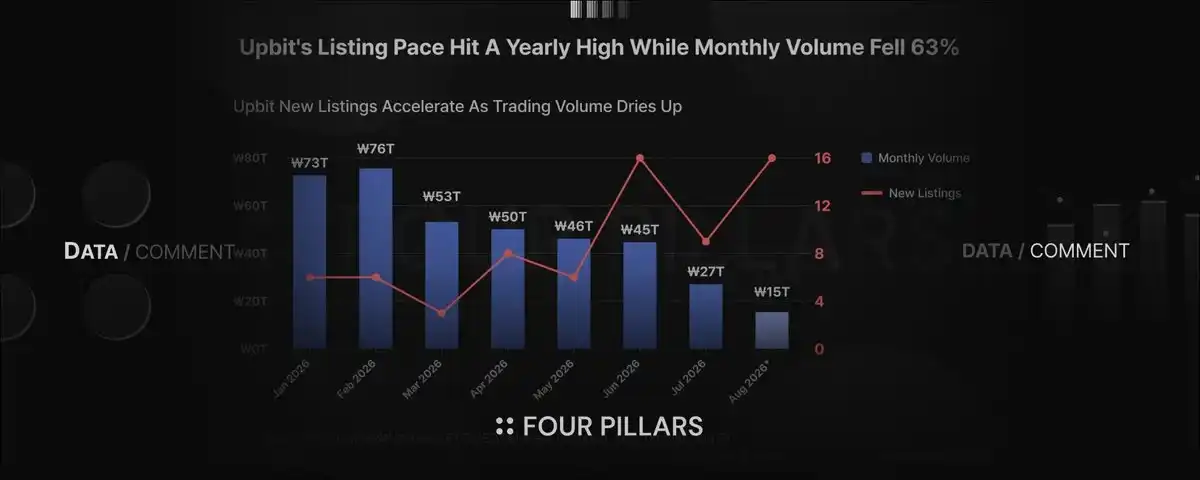
In the second half of 2026, Upbit significantly accelerated its pace of listing new cryptocurrencies, even as the overall Korean won-denominated trading market cooled rapidly. Monthly trading volume on Upbit plunged 63%, from KRW 72.7 trillion in January to KRW 27.1 trillion in July, with Bitcoin prices also falling. Contrary to the conventional logic of listing more during bull markets, Upbit intensified new listings during this downturn. New listings have become a crucial lever for Upbit to sustain trading activity in a bear market. By August, 61 new tokens listed in 2026 were collectively contributing nearly 30% of Upbit's total won trading volume, up from just 5% in January. This means roughly a quarter of the platform's fee revenue now comes from these newly listed assets. Standout performers like CHIP, RE, SLX, and CAP achieved significant individual market share shortly after listing, while new stablecoin listings contributed negligible volume. This strategy highlights a shift: the "Upbit listing premium," once a sought-after event to attract new capital, is increasingly used as a defensive tool to stabilize fee income amid shrinking overall volume. While the premium effect persists, indicating remaining genuine demand, its frequent use risks diluting the long-term strategic value and scarcity of Korean won liquidity access. Upbit's approach reflects a broader challenge for Asian centralized exchanges: relying on short-term listing tools to maintain operations during macro weakness, potentially at the cost of eroding long-term competitive foundations.

marsbit5 dk önce

Upbit Accelerates Token Listings: Total Trading Volume Halved, New Tokens Support Nearly 30% Share

marsbit5 dk önce

İşlemler

Spot
活动图片