Ethereum's Narrative Is Being Rewritten: When L1 zkEVM Becomes the Endgame, When Will the Next Revolution Arrive?

marsbit2026-03-07 tarihinde yayınlandı2026-03-07 tarihinde güncellendi

Özet

Ethereum's narrative is undergoing a significant rewrite, shifting from a programmable ledger (2015-2020) to an L2-centric settlement layer (2021-2023), and now toward becoming a verifiable computer with L1 zkEVM as its endgame (2024 onward). The newly proposed Strawmap roadmap outlines an ambitious technical direction, targeting faster L1 confirmation, "Gigagas"-level throughput (10,000 TPS), quantum resistance, and native privacy. This transformation is driven by eight core technical workstreams: formalizing EVM specifications, replacing Keccak with ZK-friendly hashes, transitioning to Verkle Trees, enabling stateless clients, standardizing ZK proof systems, decoupling execution and consensus layers, implementing recursive proof aggregation, and ensuring developer toolchain compatibility. L1 zkEVM aims to integrate zero-knowledge proofs directly into Ethereum’s consensus layer, fundamentally upgrading its trust model. While full implementation may take until 2028-2029, this shift repositions Ethereum as the verifiable trust root for the entire Web3 ecosystem—enhancing scalability without compromising decentralization. The move also redefines the role of L2s, evolving them from scaling solutions to specialized execution environments. Ethereum’s structured, multi-year effort reflects its unique capacity for coordinated innovation and may ultimately establish it as a global settlement layer—fast, secure, and private.

From a purely experiential perspective, since 2025, the update frequency of the Ethereum core developer community has been unusually intense.

From the Fusaka upgrade to Glamsterdam, and then to long-term planning around issues like kEVM, quantum-resistant cryptography systems, and Gas Limit over the next three years, Ethereum has densely released multiple roadmap documents covering three to five years within just a few months.

This pace itself is a signal.

If you carefully read the latest roadmap, you will find a clearer and more radical direction emerging: Ethereum is transforming itself into a verifiable computer, and the end point of this path is L1 zkEVM.

I. The Three Shifts in Ethereum's Narrative Focus

On February 26, Ethereum Foundation researcher Justin Drake posted on a social platform stating that the Ethereum Foundation had proposed a roadmap draft named Strawmap, outlining the upgrade direction for the Ethereum L1 protocol in the coming years.

This roadmap proposes five core goals: a faster L1 (second-level finality), a "Gigagas" L1 achieving 10,000 TPS through zkEVM, high-throughput L2 based on Data Availability Sampling (DAS), a quantum-resistant cryptography system, and native private transaction functionality; the roadmap also plans for seven protocol forks by 2029, averaging about one every six months.
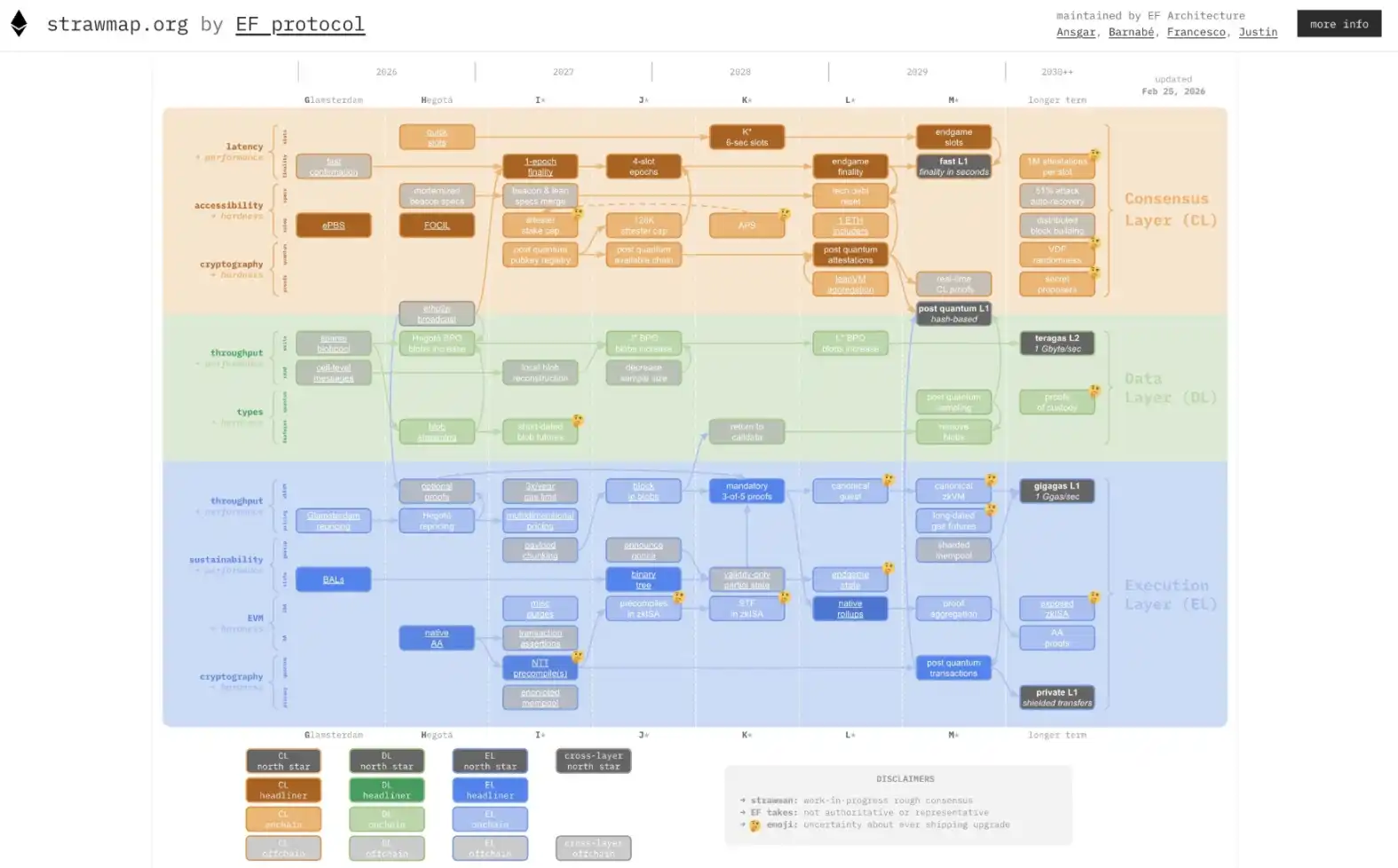
It can be said that over the past decade, Ethereum's development has always been accompanied by the continuous evolution of its narrative and technical路线.

The first stage (2015–2020) was the programmable ledger.

This was the initial core narrative of Ethereum, namely "Turing-complete smart contracts." At that time, Ethereum's biggest advantage was that it could do more things compared to Bitcoin, such as DeFi, NFTs, and DAOs, all products of this narrative. A large number of decentralized financial protocols began operating on-chain, from lending and DEXs to stablecoins. Ethereum gradually became the main settlement network for the crypto economy.

The second stage (2021–2023) saw the narrative taken over by L2.

As Gas fees on the Ethereum mainnet soared, making transaction costs unaffordable for ordinary users, Rollups began to take the lead in scaling. Ethereum also gradually repositioned itself as a settlement layer, aiming to be the foundational base providing security for L2s.

Simply put, this involved migrating most of the execution layer's computation to L2, scaling through Rollups, while L1 was only responsible for data availability and final settlement. During this period, The Merge and EIP-4844 served this narrative, aiming to make L2s cheaper and safer to use Ethereum's trust.

The third stage (2024–2025) focused on narrative introspection and reflection.

As is well known, the prosperity of L2 brought an unexpected problem: Ethereum L1 itself became less important. Users began operating more on Arbitrum, Base, Optimism, etc., rarely interacting directly with L1. The price performance of ETH also reflected this anxiety.

This led the community to debate: if L2s capture all the users and activity, where is the value capture for L1? It wasn't until the internal turbulence within Ethereum in 2025 and the series of roadmaps laid out in 2026 that this logic began to evolve profoundly.

In fact,梳理 (sorting out) the core technical directions since 2025, Verkle Trees, Stateless Clients, EVM Formal Verification, native ZK support, etc., have repeatedly appeared. These technical directions all point to the same thing: making Ethereum L1 itself verifiable. It is important to note that this is not just about allowing L2 proofs to be verified on L1, but about enabling every step of L1's state transition to be compressed and verified via zero-knowledge proofs.

This is the ambition of L1 zkEVM. Different from L2 zkEVM, L1 zkEVM (in-protocol zkEVM) means integrating zero-knowledge proof technology directly into the Ethereum consensus layer.

It is not a replica of L2 zkEVMs (like zkSync, Starknet, Scroll), but rather transforming Ethereum's execution layer itself into a ZK-friendly system. So, if L2 zkEVM is about building a ZK world on top of Ethereum, then L1 zkEVM is about turning Ethereum itself into that ZK world.

Once this goal is achieved, Ethereum's narrative will upgrade from being L2's settlement layer to the "root trust for verifiable computation."

This will be a qualitative change, not the quantitative change of the past few years.

II. What is the True L1 zkEVM?

It's worth reiterating a common point: in the traditional model, validators need to "re-execute" every transaction to verify a block, whereas in the zkEVM model, validators only need to verify a ZK Proof. This allows Ethereum to increase the Gas Limit to 100 million or even higher without increasing the burden on nodes (Further reading: 'The Dawn of the ZK Route: Is the Roadmap for Ethereum's Endgame Accelerating?').

However, transforming Ethereum L1 into a zkEVM is by no means a matter of a single breakthrough; it requires simultaneous progress in eight directions, each being a multi-year engineering effort.

Workstream 1: EVM Formalization

The prerequisite for any ZK proof is that the object being proven has a precise mathematical definition. However, today's EVM behavior is defined by client implementations (Geth, Nethermind, etc.), not by a strict formal specification. The behavior of different clients might be inconsistent in edge cases, making it extremely difficult to write ZK circuits for the EVM—after all, you can't write proofs for an ambiguously defined system.

Therefore, the goal of this workstream is to write every EVM instruction, every state transition rule, into a machine-verifiable formal specification. This is the foundation of the entire L1 zkEVM project. Without it, everything that follows is building on sand.

Workstream 2: ZK-Friendly Hash Function Replacement

Ethereum currently uses Keccak-256 extensively as its hash function. Keccak is extremely unfriendly to ZK circuits, with huge computational overhead, significantly increasing proof generation time and cost.

The core task of this workstream is to gradually replace the use of Keccak inside Ethereum with ZK-friendly hash functions (like Poseidon, Blake series), especially on the state tree and Merkle proof paths. This is a change that affects everything, as the hash function permeates every corner of the Ethereum protocol.

Workstream 3: Verkle Tree Replacing Merkle Patricia Tree

This is one of the most anticipated changes in the 2025–2027 roadmap. Ethereum currently uses the Merkle Patricia Tree (MPT) to store the global state. Verkle Trees replace hash linkages with vector commitments, which can compress witness size by tens of times.

For L1 zkEVM, this means the amount of data needed to prove each block is drastically reduced, and proof generation speed is significantly improved. It also means the introduction of Verkle Trees is a key infrastructure prerequisite for the feasibility of L1 zkEVM.

Workstream 4: Stateless Clients

Stateless clients refer to nodes that, when verifying blocks, do not need to locally store the complete Ethereum state database; they only need the witness data附带 (attached) with the block itself to complete verification.

This workstream is deeply bound with Verkle Trees because stateless clients are only practically feasible if the witness is small enough. Thus, the significance of stateless clients for L1 zkEVM is twofold: on one hand, it greatly reduces the hardware threshold for running nodes, aiding decentralization; on the other hand, it provides a clear input boundary for ZK proofs, allowing the prover to only need to process the data contained in the witness, not the entire world state.

Workstream 5: ZK Proof System Standardization and Integration

L1 zkEVM needs a mature ZK proof system to generate proofs for block execution. However, the current technical landscape in the ZK field is highly fragmented, with no公认 (consensus) optimal solution. The goal of this workstream is to define a standardized proof interface at the Ethereum protocol layer, allowing different proof systems to接入 (access/be integrated) through competition, rather than designating a specific one.

This maintains technological openness while also leaving room for the continuous evolution of proof systems. The Ethereum Foundation's PSE (Privacy and Scaling Explorations) team has substantial preliminary积累 (accumulation) in this direction.

Workstream 6: Decoupling Execution Layer and Consensus Layer (Engine API Evolution)

Currently, Ethereum's Execution Layer (EL) and Consensus Layer (CL) communicate via the Engine API. Under the L1 zkEVM architecture, every state transition of the execution layer requires generating a ZK proof, and the generation time for this proof may far exceed a block's出块间隔 (block time).

The core problem this workstream needs to solve is how to decouple execution and proof generation without breaking the consensus mechanism—execution can be completed quickly first, proof generation can be滞后异步 (generated asynchronously later), and then validators can complete final confirmation at an appropriate time. This involves a deep改造 (overhaul) of the block finality model.

Workstream 7: Recursive Proofs and Proof Aggregation

The cost of generating a ZK proof for a single block is high, but if proofs for multiple blocks can be recursively aggregated into one proof, the verification cost can be significantly reduced. Progress in this workstream will directly determine how低成本 (low-cost) L1 zkEVM can operate.

Workstream 8: Developer Toolchain and EVM Compatibility Guarantee

All underlying technical transformations must ultimately be transparent to smart contract developers on Ethereum. The existing hundreds of thousands of contracts cannot fail due to the introduction of zkEVM. Developers' toolchains cannot be forced to rewrite.

This workstream is the most easily underestimated but often the most time-consuming. Historically, every EVM upgrade required extensive backward compatibility testing and toolchain adaptation work. The scale of changes for L1 zkEVM is far greater than previous upgrades, so the workload for toolchains and compatibility will be an order of magnitude higher.

III. Why is Now the Right Time to Understand This?

The release of Strawmap coincides with a time when the market has doubts about ETH's price performance. From this perspective, the most important value of this roadmap lies in redefining Ethereum as "infrastructure."

For builders, represented by developers, Strawmap provides directional certainty. For users, these technical upgrades will ultimately translate into perceptible experiences: transactions finalized within seconds, assets seamlessly flowing between L1 and L2, privacy protection becoming a built-in feature rather than a plugin.

Objectively speaking, L1 zkEVM is not a product that will be launched in the near future; its complete implementation may take until 2028-2029 or even later.

But at least it redefines Ethereum's value proposition. If L1 zkEVM succeeds, Ethereum will no longer be just the settlement layer for L2, but the verifiable trust root for the entire Web3 world, allowing any on-chain state to ultimately be traced back mathematically to Ethereum's ZK proof chain. This is decisive (决定性) for Ethereum's long-term value capture.

Secondly, it also affects the long-term positioning of L2. After all, when L1 itself possesses ZK capabilities, the role of L2 will change—evolving from "secure scaling solutions" to "specialized execution environments." Which L2s can find their place in this new landscape will be the most值得观察 (worth observing) ecological evolution in the coming years.

Most importantly, the author feels it is also an excellent window to observe Ethereum's developer culture—the ability to simultaneously advance eight interdependent technical workstreams, each being a multi-year engineering effort, while maintaining a decentralized coordination method, is itself Ethereum's unique capability as a protocol.

Understanding this helps to more accurately assess Ethereum's true position in various competitive narratives.

Overall, from the "Rollup-centric" approach of 2020 to the Strawmap of 2026, the evolution of Ethereum's narrative reflects a clear trajectory: scaling cannot rely solely on L2; L1 and L2 must co-evolve.

Therefore, the eight workstreams of L1 zkEVM are the technical mapping of this cognitive shift. They collectively point to one goal: enabling the Ethereum mainnet to achieve an order-of-magnitude performance improvement without sacrificing decentralization. This is not a negation of the L2 route, but its perfection and supplement.

In the next three years, this "Ship of Theseus" will undergo seven forks and replace countless "planks." When it arrives at the next stop in 2029, we may see a truly "global settlement layer"—fast, secure, private, and as open as ever.

Let's wait and see together.

İlgili Sorular

QWhat is the ultimate goal of Ethereum's latest roadmap, Strawmap, as described in the article?

AThe ultimate goal is to transform Ethereum into a verifiable computer, with L1 zkEVM as the endgame. This involves making Ethereum L1 itself a ZK-friendly system, turning it into the root of verifiable trust for the entire Web3 world, rather than just a settlement layer for L2s.

QWhat are the three major shifts in Ethereum's narrative focus from 2015 to the present?

A1. 2015-2020: Programmable Ledbger - Focus on Turing-complete smart contracts enabling DeFi, NFTs, and DAOs. 2. 2021-2023: L2 Narrative - Ethereum repositioned as a settlement layer for L2 Rollups to scale. 3. 2024-2025: Introspection and Inward Focus - A shift towards making L1 itself verifiable with zkEVM to address value capture concerns.

QWhat is the key difference between an L2 zkEVM and the proposed L1 zkEVM?

AAn L2 zkEVM (like zkSync or Starknet) builds a ZK world on top of Ethereum. In contrast, L1 zkEVM (in-protocol zkEVM) integrates zero-knowledge proof technology directly into Ethereum's consensus layer, transforming Ethereum itself into that ZK world.

QName at least three of the eight key workstreams required to implement L1 zkEVM.

AThree of the eight workstreams are: 1. EVM Formalization: Creating a precise mathematical definition of the EVM. 2. ZK-Friendly Hash Function Replacement: Substituting Keccak-256 with ZK-friendly alternatives like Poseidon. 3. Verkle Tree Replacement: Replacing the Merkle Patricia Tree with Verkle Trees to compress witness data.

QHow does the article suggest the role of L2s will change if L1 zkEVM is successfully implemented?

AThe role of L2s will evolve from being security and scaling solutions to becoming specialized execution environments. Their long-term positioning will shift as L1 itself takes on the core role of providing verifiable trust.

İlgili Okumalar

Deconstructing the Capital Game of Public Chain Pharos: A $950 Million Valuation Propped Up by Photovoltaic and Other Assets, A Shell Transaction Under Layers of Betting?

The article investigates the recent $247.3 million investment by Hong Kong-listed GCL New Energy into the Layer 1 blockchain project Pharos at a $950 million valuation. It reveals the deal is not a straightforward investment but a complex, multi-stage transaction bound by stringent performance milestones. The core of the agreement is a set of mutual, conditional investments. Pharos must first purchase up to $1.5 billion HKD worth of GCL shares. However, GCL's reciprocal investment in Pharos tokens is contingent upon a series of strict, performance-based vesting conditions. The entire deal is split into five tranches, each unlocking only if the Pharos token lists on an exchange without falling below its issue price and maintains a high fully diluted valuation (FDV) over successive three-month periods. If any condition fails, the entire agreement can be terminated. The article questions the legitimacy of the $950 million valuation, which was calculated based on a purported $250 million in Total Value Locked (TVL). Notably, over half of this TVL is claimed to be from real-world assets (RWA), specifically photovoltaic and power station assets linked to GCL—a highly unconventional method for valuing a Layer 1 blockchain. Furthermore, the mainnet is not yet live, and the TVL figure is unverified by independent data platforms. The author suggests the deal is a "capital game" designed to boost GCL's stock price, which saw suspicious pre-announcement surges, and to create hype for the upcoming Pharos token launch, ultimately passing the risk onto the market and future investors.

marsbit1 saat önce

Deconstructing the Capital Game of Public Chain Pharos: A $950 Million Valuation Propped Up by Photovoltaic and Other Assets, A Shell Transaction Under Layers of Betting?

marsbit1 saat önce

Comprehensive Analysis of Canton Network: Wall Street's Blockchain Ambition

Canton Network is positioned at the convergence of key crypto trends, including real-world asset tokenization, institutional blockchain adoption, privacy infrastructure, and stablecoin settlements. It has attracted major financial institutions like DTCC, Nasdaq, and Broadridge, which are deploying real workflows such as treasury tokenization, repo financing, and collateral management. The network is designed for regulated entities, offering granular transaction privacy and validator-level control while maintaining interoperability. Its architecture separates execution from coordination, using validator nodes operated by participants and synchronizers for atomic settlement. Key adoptions include DTCC tokenizing U.S. Treasuries, Broadridge processing trillions in repo transactions, and Nasdaq integrating its Calypso platform. Tokenomics are usage-driven, with weekly CC burns increasing by 216% since TGE, and the burn-to-mint ratio rising to 0.90, nearing a deflationary state. Despite generating the highest revenue among L1s in February, Canton trades at a discount to peers, possibly due to high emissions and its perception as financial infrastructure. Catalysts include regulatory clarity from the Clarity Act and DTCC’s broader tokenization platform launch in late 2026. Risks include token concentration, with 54% of CC held by a few entities, though these are largely operational holdings. Canton aims to become a core coordination layer for tokenized financial markets.

marsbit1 saat önce

Comprehensive Analysis of Canton Network: Wall Street's Blockchain Ambition

marsbit1 saat önce

Which Areas Still Have Moats in the AI Era?

In the AI era, certain moats remain despite rapid technological advancement. The author, a former hedge fund manager, argues that the true inflection point occurred when AI models like ChatGPT’s o1 began generating functional code—even with imperfections—enabling recursive self-optimization and fundamentally altering software development. Key short-term moats identified include: 1. **Proprietary Data**: Firms with unique, inaccessible data (e.g., multi-strategy hedge funds) can fine-tune models, creating defensible advantages. 2. **Regulatory Friction**: Industries requiring human approval (e.g., traditional finance) face slower disruption due to compliance and legal barriers. 3. **Authority-as-a-Service**: Human trust in institutional authority (e.g., legal or audit services) persists even if AI outperforms humans technically. 4. **Physical World Lag**: Hardware-dependent sectors evolve slower, delaying full AI integration. However, these moats only delay, not prevent, disruption. The author emphasizes acting on signals rather than waiting for certainty: identify directional trends, place asymmetric bets (limited downside, high upside), and iterate through action. As AI accelerates, windows of opportunity close quickly. To remain relevant, humans must excel in long-term strategy, complex system-level thinking, and collaboration—areas where AI still lags. The time to act is now, before markets price in the obvious.

marsbit2 saat önce

Which Areas Still Have Moats in the AI Era?

marsbit2 saat önce

İşlemler

Spot
Futures

Popüler Makaleler

$S$ Nedir

SPERO'yu Anlamak: Kapsamlı Bir Genel Bakış SPERO'ya Giriş İnovasyonun manzarası gelişmeye devam ederken, web3 teknolojilerinin ve kripto para projelerinin ortaya çıkışı dijital geleceği şekillendirmede önemli bir rol oynamaktadır. Bu dinamik alanda dikkat çeken projelerden biri SPERO, $$s$$ olarak adlandırılmaktadır. Bu makale, SPERO hakkında ayrıntılı bilgi toplamak ve sunmak amacıyla, meraklılar ve yatırımcıların web3 ve kripto alanlarındaki temellerini, hedeflerini ve yeniliklerini anlamalarına yardımcı olmayı amaçlamaktadır. SPERO,$$s$$ Nedir? SPERO,$$s$$, kripto alanında merkeziyetsizlik ve blok zinciri teknolojisi ilkelerini kullanarak etkileşimi, faydayı ve finansal kapsayıcılığı teşvik eden bir ekosistem yaratmayı amaçlayan benzersiz bir projedir. Proje, kullanıcıların yenilikçi finansal çözümler ve hizmetler sunarak eşler arası etkileşimleri yeni yollarla kolaylaştırmayı hedeflemektedir. SPERO,$$s$$'nin temel amacı, bireyleri güçlendirmek ve kripto para alanındaki kullanıcı deneyimini artıran araçlar ve platformlar sağlamaktır. Bu, daha esnek işlem yöntemlerini mümkün kılmayı, topluluk odaklı girişimleri teşvik etmeyi ve merkeziyetsiz uygulamalar (dApp'ler) aracılığıyla finansal fırsatlar yaratmayı içermektedir. SPERO,$$s$$'nin temel vizyonu kapsayıcılık etrafında dönmekte olup, geleneksel finansal sistemlerdeki boşlukları kapatmayı ve blok zinciri teknolojisinin faydalarından yararlanmayı hedeflemektedir. SPERO,$$s$$'nin Yaratıcısı Kimdir? SPERO,$$s$$'nin yaratıcısının kimliği bir miktar belirsizdir, çünkü kurucusu(ları) hakkında ayrıntılı arka plan bilgisi sağlayan sınırlı kamuya açık kaynaklar bulunmaktadır. Bu şeffaflık eksikliği, projenin merkeziyetsizlik taahhüdünden kaynaklanabilir—birçok web3 projesinin paylaştığı bir etik anlayışı, bireysel tanınmanın yerine kolektif katkıları önceliklendirmektedir. Topluluk ve onun kolektif hedefleri etrafında tartışmaları merkezileştirerek, SPERO,$$s$$, belirli bireyleri öne çıkarmadan güçlendirme özünü taşımaktadır. Bu nedenle, SPERO'nun etik anlayışını ve misyonunu anlamak, tek bir yaratıcının kimliğini belirlemekten daha önemlidir. SPERO,$$s$$'nin Yatırımcıları Kimlerdir? SPERO,$$s$$, kripto sektöründe yeniliği teşvik etmeye adanmış girişim sermayedarlarından melek yatırımcılara kadar çeşitli yatırımcılar tarafından desteklenmektedir. Bu yatırımcıların odak noktası genellikle SPERO'nun misyonuyla uyumlu olup, toplumsal teknolojik ilerlemeyi, finansal kapsayıcılığı ve merkeziyetsiz yönetimi vaat eden projeleri önceliklendirmektedir. Bu yatırımcı temelleri, yalnızca yenilikçi ürünler sunan projelere değil, aynı zamanda blok zinciri topluluğuna ve ekosistemlerine olumlu katkılarda bulunan projelere de ilgi duymaktadır. Bu yatırımcıların desteği, SPERO,$$s$$'yi hızla gelişen kripto projeleri alanında dikkate değer bir rakip haline getirmektedir. SPERO,$$s$$ Nasıl Çalışır? SPERO,$$s$$, onu geleneksel kripto para projelerinden ayıran çok yönlü bir çerçeve kullanmaktadır. İşte benzersizliğini ve yeniliğini vurgulayan bazı temel özellikler: Merkeziyetsiz Yönetim: SPERO,$$s$$, kullanıcıların projenin geleceğiyle ilgili karar alma süreçlerine aktif olarak katılmalarını sağlayan merkeziyetsiz yönetim modellerini entegre etmektedir. Bu yaklaşım, topluluk üyeleri arasında sahiplik ve hesap verebilirlik duygusunu teşvik etmektedir. Token Kullanımı: SPERO,$$s$$, ekosistem içinde çeşitli işlevler sunmak üzere tasarlanmış kendi kripto para token'ını kullanmaktadır. Bu token'lar, işlemleri, ödülleri ve platformda sunulan hizmetlerin kolaylaştırılmasını sağlayarak genel etkileşimi ve faydayı artırmaktadır. Katmanlı Mimari: SPERO,$$s$$'nin teknik mimarisi, modülerlik ve ölçeklenebilirliği destekleyerek projenin evrimi sırasında ek özelliklerin ve uygulamaların sorunsuz bir şekilde entegrasyonuna olanak tanımaktadır. Bu uyum sağlama yeteneği, sürekli değişen kripto manzarasında geçerliliği sürdürmek için hayati öneme sahiptir. Topluluk Katılımı: Proje, işbirliği ve geri bildirim teşvik eden mekanizmalar kullanarak topluluk odaklı girişimlere vurgu yapmaktadır. Güçlü bir topluluk oluşturarak, SPERO,$$s$$, kullanıcı ihtiyaçlarını daha iyi karşılayabilir ve piyasa trendlerine uyum sağlayabilir. Kapsayıcılığa Odaklanma: Düşük işlem ücretleri ve kullanıcı dostu arayüzler sunarak, SPERO,$$s$$, daha önce kripto alanında yer almamış bireyler de dahil olmak üzere çeşitli bir kullanıcı tabanını çekmeyi hedeflemektedir. Bu kapsayıcılık taahhüdü, erişilebilirlik yoluyla güçlendirme misyonuyla uyumludur. SPERO,$$s$$ Zaman Çizelgesi Bir projenin tarihini anlamak, gelişim yolculuğu ve kilometre taşları hakkında kritik bilgiler sağlar. Aşağıda, SPERO,$$s$$'nin evriminde önemli olayları haritalayan önerilen bir zaman çizelgesi bulunmaktadır: Kavram Geliştirme ve Fikir Aşaması: SPERO,$$s$$'nin temelini oluşturan ilk fikirler, blok zinciri endüstrisindeki merkeziyetsizlik ve topluluk odaklılık ilkeleriyle yakından uyumlu olarak geliştirildi. Proje Beyaz Kağıdının Yayınlanması: Kavramsal aşamayı takiben, SPERO,$$s$$'nin vizyonunu, hedeflerini ve teknolojik altyapısını ayrıntılı bir şekilde açıklayan kapsamlı bir beyaz kağıt yayımlandı ve topluluk ilgisini ve geri bildirimini toplamak amacıyla sunuldu. Topluluk Oluşturma ve Erken Katılımlar: Projenin hedefleri etrafında tartışmalar yürüterek destek toplamak ve erken benimseyenler ile potansiyel yatırımcılar için bir topluluk oluşturmak amacıyla aktif iletişim çabaları gerçekleştirildi. Token Üretim Etkinliği: SPERO,$$s$$, yerel token'larını erken destekçilere dağıtmak ve ekosistem içinde başlangıç likiditesini sağlamak amacıyla bir token üretim etkinliği (TGE) gerçekleştirdi. İlk dApp'in Yayınlanması: SPERO,$$s$$ ile ilişkili ilk merkeziyetsiz uygulama (dApp) faaliyete geçti ve kullanıcıların platformun temel işlevleriyle etkileşimde bulunmalarını sağladı. Sürekli Gelişim ve Ortaklıklar: Projenin tekliflerine sürekli güncellemeler ve iyileştirmeler yapılmakta olup, blok zinciri alanındaki diğer oyuncularla stratejik ortaklıklar, SPERO,$$s$$'yi rekabetçi ve gelişen bir oyuncu haline getirmiştir. Sonuç SPERO,$$s$$, web3 ve kripto paranın finansal sistemleri devrim niteliğinde dönüştürme ve bireyleri güçlendirme potansiyelinin bir kanıtıdır. Merkeziyetsiz yönetime, topluluk katılımına ve yenilikçi tasarlanmış işlevselliğe olan bağlılığıyla, daha kapsayıcı bir finansal manzaraya doğru bir yol açmaktadır. Hızla gelişen kripto alanındaki herhangi bir yatırımda olduğu gibi, potansiyel yatırımcılar ve kullanıcılar, SPERO,$$s$$ içindeki devam eden gelişmelerle ilgili olarak kapsamlı bir araştırma yapmaları ve düşünceli bir şekilde katılmaları teşvik edilmektedir. Proje, kripto endüstrisinin yenilikçi ruhunu sergileyerek, sayısız olasılığını keşfetmeye davet etmektedir. SPERO,$$s$$'nin yolculuğu hala devam ederken, temel ilkeleri, teknoloji, finans ve birbirimizle etkileşim biçimimizi etkileyebilir.

89 Toplam GörüntülenmeYayınlanma 2024.12.17Güncellenme 2024.12.17

$S$ Nedir

AGENT S Nedir

Agent S: Web3'te Otonom Etkileşimin Geleceği Giriş Web3 ve kripto para dünyasında sürekli gelişen manzarada, yenilikler bireylerin dijital platformlarla etkileşim biçimlerini sürekli olarak yeniden tanımlıyor. Bu tür öncü projelerden biri olan Agent S, açık ajans çerçevesi aracılığıyla insan-bilgisayar etkileşimini devrim niteliğinde değiştirmeyi vaat ediyor. Otonom etkileşimlerin yolunu açarak, Agent S karmaşık görevleri basitleştirmeyi ve yapay zeka (AI) alanında dönüştürücü uygulamalar sunmayı hedefliyor. Bu detaylı inceleme, projenin karmaşıklıklarına, benzersiz özelliklerine ve kripto para alanındaki etkilerine dalacaktır. Agent S Nedir? Agent S, bilgisayar görevlerinin otomasyonunda üç temel zorluğu ele almak üzere özel olarak tasarlanmış çığır açıcı bir açık ajans çerçevesidir: Alan Spesifik Bilgi Edinimi: Çerçeve, çeşitli dış bilgi kaynaklarından ve iç deneyimlerden akıllıca öğrenir. Bu çift yönlü yaklaşım, alan spesifik bilgi açısından zengin bir veri havuzu oluşturmasını sağlar ve görev yürütmedeki performansını artırır. Uzun Görev Ufukları Üzerinde Planlama: Agent S, karmaşık görevlerin verimli bir şekilde parçalanmasını ve yürütülmesini kolaylaştıran deneyim artırımlı hiyerarşik planlama kullanır. Bu özellik, çoklu alt görevleri etkili ve verimli bir şekilde yönetme yeteneğini önemli ölçüde artırır. Dinamik, Homojen Olmayan Arayüzlerle Başlama: Proje, ajanlar ve kullanıcılar arasındaki etkileşimi geliştiren yenilikçi bir çözüm olan Ajan-Bilgisayar Arayüzü'ni (ACI) tanıtmaktadır. Çok Modlu Büyük Dil Modellerini (MLLM'ler) kullanarak, Agent S çeşitli grafik kullanıcı arayüzlerini sorunsuz bir şekilde gezinebilir ve manipüle edebilir. Bu öncü özellikler aracılığıyla, Agent S, makinelerle insan etkileşimini otomatikleştirmede karşılaşılan karmaşıklıkları ele alan sağlam bir çerçeve sunarak, AI ve ötesinde birçok uygulama için zemin hazırlıyor. Agent S'nin Yaratıcısı Kimdir? Agent S'nin kavramı temelde yenilikçi olsa da, yaratıcısı hakkında spesifik bilgiler belirsizliğini koruyor. Yaratıcı şu anda bilinmiyor, bu da projenin yeni aşamasını veya kurucu üyeleri gizli tutma stratejik tercihini vurguluyor. Anonimlikten bağımsız olarak, odak çerçevenin yetenekleri ve potansiyeli üzerinde kalıyor. Agent S'nin Yatırımcıları Kimlerdir? Agent S, kriptografik ekosistemde oldukça yeni olduğundan, yatırımcıları ve finansal destekçileri hakkında ayrıntılı bilgiler açıkça belgelenmemiştir. Projeyi destekleyen yatırım temelleri veya organizasyonları hakkında kamuya açık bilgilerdeki eksiklik, finansman yapısı ve gelişim yol haritası hakkında sorular doğuruyor. Destekleyicilerin anlaşılması, projenin sürdürülebilirliğini ve potansiyel pazar etkisini değerlendirmek için kritik öneme sahiptir. Agent S Nasıl Çalışır? Agent S'nin temelinde, çeşitli ortamlarda etkili bir şekilde çalışmasını sağlayan son teknoloji bir sistem yatmaktadır. İşleyiş modeli birkaç ana özellik etrafında inşa edilmiştir: İnsan Benzeri Bilgisayar Etkileşimi: Çerçeve, bilgisayarlarla etkileşimleri daha sezgisel hale getirmeyi amaçlayan gelişmiş AI planlaması sunar. Görev yürütmedeki insan davranışını taklit ederek, kullanıcı deneyimlerini yükseltmeyi vaat eder. Anlatı Belleği: Yüksek düzeyde deneyimlerden yararlanmak için kullanılan Agent S, görev geçmişlerini takip etmek amacıyla anlatı belleğini kullanarak karar verme süreçlerini geliştirir. Episodik Bellek: Bu özellik, kullanıcılara adım adım rehberlik sağlayarak, çerçevenin görevler gelişirken bağlamsal destek sunmasına olanak tanır. OpenACI Desteği: Yerel olarak çalışabilme yeteneği ile Agent S, kullanıcıların etkileşimleri ve iş akışları üzerinde kontrol sağlamasına olanak tanır ve Web3'ün merkeziyetsiz felsefesiyle uyumlu hale gelir. Dış API'lerle Kolay Entegrasyon: Çeşitli AI platformlarıyla uyumluluğu ve çok yönlülüğü, Agent S'nin mevcut teknolojik ekosistemlere sorunsuz bir şekilde entegre olmasını sağlar ve geliştiriciler ile organizasyonlar için cazip bir seçenek haline getirir. Bu işlevsellikler, Agent S'nin kripto alanındaki benzersiz konumuna katkıda bulunarak, karmaşık, çok aşamalı görevleri minimum insan müdahalesi ile otomatikleştirir. Proje geliştikçe, Web3'teki potansiyel uygulamaları dijital etkileşimlerin nasıl gelişeceğini yeniden tanımlayabilir. Agent S'nin Zaman Çizelgesi Agent S'nin gelişimi ve kilometre taşları, önemli olaylarını vurgulayan bir zaman çizelgesinde özetlenebilir: 27 Eylül 2024: Agent S'nin kavramı, “Bilgisayarları İnsan Gibi Kullanan Açık Bir Ajans Çerçevesi” başlıklı kapsamlı bir araştırma makalesi ile tanıtıldı ve projenin temelini sergiledi. 10 Ekim 2024: Araştırma makalesi arXiv'de kamuya açık olarak yayınlandı ve çerçevenin derinlemesine bir incelemesini ve OSWorld benchmark'ına dayalı performans değerlendirmesini sundu. 12 Ekim 2024: Agent S'nin yetenekleri ve özellikleri hakkında görsel bir içgörü sağlayan bir video sunumu yayımlandı ve potansiyel kullanıcılar ve yatırımcılarla daha fazla etkileşim sağlandı. Bu zaman çizelgesindeki işaretler, sadece Agent S'nin ilerlemesini değil, aynı zamanda şeffaflık ve topluluk katılımına olan bağlılığını da göstermektedir. Agent S Hakkında Ana Noktalar Agent S çerçevesi gelişmeye devam ederken, birkaç ana özellik öne çıkmakta ve yenilikçi doğasını ve potansiyelini vurgulamaktadır: Yenilikçi Çerçeve: İnsan etkileşimine benzer bir bilgisayar kullanımı sağlamak üzere tasarlanan Agent S, görev otomasyonuna yeni bir yaklaşım getiriyor. Otonom Etkileşim: GUI aracılığıyla bilgisayarlarla otonom olarak etkileşim kurabilme yeteneği, daha akıllı ve verimli hesaplama çözümlerine doğru bir sıçrama anlamına geliyor. Karmaşık Görev Otomasyonu: Sağlam metodolojisi ile karmaşık, çok aşamalı görevleri otomatikleştirerek süreçleri daha hızlı ve daha az hata payı ile gerçekleştirebilir. Sürekli İyileştirme: Öğrenme mekanizmaları, Agent S'nin geçmiş deneyimlerden öğrenmesini sağlar ve sürekli olarak performansını ve etkinliğini artırır. Çok Yönlülük: OSWorld ve WindowsAgentArena gibi farklı işletim ortamlarında uyumlu olması, geniş bir uygulama yelpazesine hizmet edebilmesini sağlar. Agent S, Web3 ve kripto alanında kendini konumlandırırken, etkileşim yeteneklerini artırma ve süreçleri otomatikleştirme potansiyeli, AI teknolojilerinde önemli bir ilerlemeyi temsil etmektedir. Yenilikçi çerçevesi aracılığıyla, Agent S dijital etkileşimlerin geleceğini örneklemekte ve çeşitli sektörlerde kullanıcılar için daha sorunsuz ve verimli bir deneyim vaat etmektedir. Sonuç Agent S, AI ve Web3'ün birleşiminde cesur bir sıçramayı temsil ediyor ve teknoloji ile etkileşim biçimimizi yeniden tanımlama kapasitesine sahip. Henüz erken aşamalarında olmasına rağmen, uygulama olanakları geniş ve çekici. Kritik zorlukları ele alan kapsamlı çerçevesi ile Agent S, otonom etkileşimleri dijital deneyimin ön plana çıkmasına taşımayı hedefliyor. Kripto para ve merkeziyetsizlik alanlarına daha derinlemesine girdikçe, Agent S gibi projelerin teknoloji ve insan-bilgisayar işbirliğinin geleceğini şekillendirmede önemli bir rol oynayacağı kesin.

269 Toplam GörüntülenmeYayınlanma 2025.01.14Güncellenme 2025.01.14

AGENT S Nedir

S Nasıl Satın Alınır

HTX.com’a hoş geldiniz! Sonic (S) satın alma işlemlerini basit ve kullanışlı bir hâle getirdik. Adım adım açıkladığımız rehberimizi takip ederek kripto yolculuğunuza başlayın. 1. Adım: HTX Hesabınızı OluşturunHTX'te ücretsiz bir hesap açmak için e-posta adresinizi veya telefon numaranızı kullanın. Sorunsuzca kaydolun ve tüm özelliklerin kilidini açın. Hesabımı Aç2. Adım: Kripto Satın Al Bölümüne Gidin ve Ödeme Yönteminizi SeçinKredi/Banka Kartı: Visa veya Mastercard'ınızı kullanarak anında Sonic (S) satın alın.Bakiye: Sorunsuz bir şekilde işlem yapmak için HTX hesap bakiyenizdeki fonları kullanın.Üçüncü Taraflar: Kullanımı kolaylaştırmak için Google Pay ve Apple Pay gibi popüler ödeme yöntemlerini ekledik.P2P: HTX'teki diğer kullanıcılarla doğrudan işlem yapın.Borsa Dışı (OTC): Yatırımcılar için kişiye özel hizmetler ve rekabetçi döviz kurları sunuyoruz.3. Adım: Sonic (S) Varlıklarınızı SaklayınSonic (S) satın aldıktan sonra HTX hesabınızda saklayın. Alternatif olarak, blok zinciri transferi yoluyla başka bir yere gönderebilir veya diğer kripto para birimlerini takas etmek için kullanabilirsiniz.4. Adım: Sonic (S) Varlıklarınızla İşlem YapınHTX'in spot piyasasında Sonic (S) ile kolayca işlemler yapın.Hesabınıza erişin, işlem çiftinizi seçin, işlemlerinizi gerçekleştirin ve gerçek zamanlı olarak izleyin. Hem yeni başlayanlar hem de deneyimli yatırımcılar için kullanıcı dostu bir deneyim sunuyoruz.

760 Toplam GörüntülenmeYayınlanma 2025.01.15Güncellenme 2025.03.21

S Nasıl Satın Alınır

Tartışmalar

HTX Topluluğuna hoş geldiniz. Burada, en son platform gelişmeleri hakkında bilgi sahibi olabilir ve profesyonel piyasa görüşlerine erişebilirsiniz. Kullanıcıların S (S) fiyatı hakkındaki görüşleri aşağıda sunulmaktadır.

活动图片