Dogecoin Whales Add 400 Million To Their Stash, Here’s How Much They Hold

bitcoinist2024-09-13 tarihinde yayınlandı2024-09-14 tarihinde güncellendi

Özet

Dogecoin whales are starting to increase their holdings in what is a general uptick in activity on the Dogecoin blockchain....

Dogecoin whales are starting to increase their holdings in what is a general uptick in activity on the Dogecoin blockchain. According to the latest on-chain data, addresses with large Dogecoin balances saw a remarkable surge in their holdings, with an approximate 960% increase occurring within just 24 hours. This accumulation by large holders coincides with a critical moment for the meme-based cryptocurrency, as it recently managed to break through a persistent downward-sloping trendline. 

Dogecoin Whales Add Millions To Their Stash

According to data from the IntoTheBlock dashboard, Dogecoin large holders (also known as whales) recently saw their holdings increase by a massive 446.9 million DOGE tokens on September 11. This data was revealed through the ‘Large Holders Inflow,’ a metric that tracks the number of DOGE tokens entering addresses holding at least 0.1% of the total circulation supply of Dogecoin. Particularly, this data shows that the large holders increased their inflow from 46.25 million to 493.15 million DOGE on Sept. 11.  

Related Reading: Bitcoin Vs. Ethereum: Legendary Analyst Says He’s ‘Pretty Confident’ ETH Will Outperform

Furthermore, the netflow data shows a corresponding increase from -395.88 million DOGE on the previous day to 414.97 million DOGE on September 11. Netflow is determined by subtracting the outflows (tokens leaving addresses) from inflows (tokens entering addresses) over a given period. A positive netflow indicates that whales are accumulating more Dogecoin, while negative values typically signal a selloff.
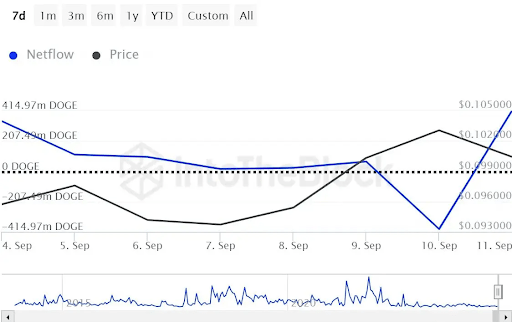
Dogecoin
Source: IntoTheBlock

On the exchange front, IntoTheBlock data also shows a notable decline in the amount of DOGE held by wallet addresses linked to cryptocurrency exchanges. The ‘Aggregated Exchanges Netflow’ metric highlights a net outflow of -104.31 million DOGE over the past 24 hours and a total of -108.89 million DOGE across the last seven days. These negative figures suggest that more Dogecoin is being withdrawn from exchanges than is being deposited. This shift is significant because it marks a change in market sentiment, given that previous data pointed to heightened selling pressure from whale addresses.

DOGE Price Movement

At the time of writing, DOGE is trading at $0.1031 and is up by 0.69% in the past 24 hours. A recent rally means DOGE is now trading 15% above a low of $0.08969 which it traded at earlier in the week. According to an analysis by crypto analyst Javon Marks, this rally puts DOGE on a little breakout above the upper trendline in a multi-month falling wedge price formation. 

However, the breakout is yet to be complete because DOGE bulls have found it hard to break above $0.104 for over three days now. In his analysis, he predicts that a successful breakout would likely result in a substantial 100% price increase that will drive DOGE up to around $0.22. From there, the stage could be set for an even larger bullish move for a major target of $0.6533.

Dogecoin price chart from Tradingview.com
DOGE price continues to recover | Source: DOGEUSDT on Tradingview.com
Featured image created with Dall.E, chart from Tradingview.com
Scott Matherson

Scott Matherson

Scott Matherson is a leading crypto writer at Bitcoinist, who possesses a sharp analytical mind and a deep understanding of the digital currency landscape. Scott has earned a reputation for delivering thought-provoking and well-researched articles that resonate with both newcomers and seasoned crypto enthusiasts. Outside of his writing, Scott is passionate about promoting crypto literacy and often works to educate the public on the potential of blockchain.

İlgili Okumalar

I've Been a Divorce Lawyer for 26 Years: How Has Cryptocurrency Become a New Tool for the Wealthy to Hide Assets?

Natalie Brunell reports on insights from divorce lawyer James Sexton, who has 26 years of experience. He argues that money itself is not the root of marital breakdown; rather, emotional disconnection is the core issue. While financial hardship increases divorce risk, excessive wealth can also make divorce easier by reducing the incentive to work on the relationship. Sexton discusses financial management in marriages, advocating for transparency and a "yours, mine, and ours" system that balances shared finances with individual autonomy and privacy. He notes the growing normalization of prenuptial agreements, especially among younger generations. A significant portion focuses on cryptocurrency's role in divorce. Sexton explains that crypto became a new tool for hiding assets due to its early anonymity and complexity. He highlights that many lawyers and spouses lack understanding, allowing knowledgeable parties to gain advantages. He cites a New York legal form that only added a specific crypto disclosure field in 2026. On saving relationships, Sexton emphasizes small, consistent acts of reconnection, affirmation, and expressing appreciation, which he finds more effective than criticism. He concludes that fostering warmth and kindness is a simple yet powerful way to strengthen bonds and, in his words, "put divorce lawyers out of business."

marsbit16 dk önce

I've Been a Divorce Lawyer for 26 Years: How Has Cryptocurrency Become a New Tool for the Wealthy to Hide Assets?

marsbit16 dk önce

Turing Award Laureate Sutton's New Work: Using a Formula from 1967 to Solve a Major Flaw in Streaming Reinforcement Learning

New research titled "Intentional Updates for Streaming Reinforcement Learning" (arXiv:2604.19033v1), involving Turing Award laureate Richard Sutton, addresses a core challenge in deep reinforcement learning (RL): the "stream barrier." Current deep RL methods typically rely on replay buffers and batch training for stability, failing catastrophically when learning online from single data points (streaming). The authors propose a fundamental shift: instead of prescribing how far to move parameters (a fixed step size), their "Intentional Updates" method specifies the desired change in the function's output (e.g., a 5% reduction in value prediction error). It then calculates the step size needed to achieve that intent. This idea is inspired by the Normalized Least Mean Squares (NLMS) algorithm from 1967. Applied to value and policy learning, this yields algorithms like Intentional TD(λ) and Intentional AC. The method inherently stabilizes learning by adapting the step size based on the local gradient landscape, preventing overshooting/undershooting. In experiments on MuJoCo continuous control and Atari discrete tasks, Intentional AC achieved performance rivaling batch-based algorithms like SAC in a streaming setting (batch size=1, no replay buffer), while being ~140x more computationally efficient per update. The work demonstrates significant robustness, reducing reliance on numerous stabilization tricks. A remaining challenge is bias in policy updates due to action-dependent step sizes. Overall, this approach advances efficient, online, "learn-as-you-go" RL, enabling adaptive systems without massive data buffers or compute clusters.

marsbit24 dk önce

Turing Award Laureate Sutton's New Work: Using a Formula from 1967 to Solve a Major Flaw in Streaming Reinforcement Learning

marsbit24 dk önce

From KYC to KYA, Is It Time to Give AI Agents Their Own 'ID Cards'?

Titled "From KYC to KYA: Is It Time to Issue 'Identity Cards' for AI Agents?", this article discusses the emerging concept of Know Your Agent (KYA) as AI agents become increasingly autonomous. In Agent-to-Agent (A2A) scenarios, where agents execute contracts, payments, and trades without human intervention, the lack of a shared identity standard creates risks like unauthorized transactions, fraud, and accountability gaps. KYA acts as a trust layer to verify an agent's origin, authority, and accountability. The need for KYA is most critical outside centralized platforms (like Google or Coinbase), such as in decentralized exchanges (DEX), A2A payments, and merchant payments. Several key players are building KYA infrastructure: - **ERC-8004**: A proposed Ethereum standard that issues a unique AgentID as an NFT, building on-chain identity, reputation, and validation systems. - **Visa TAP**: Visa's solution issues agent identity credentials, with transactions verified via triple signatures (legitimacy, delegator, payment method). - **Trulioo**: Extends its KYC/KYB compliance infrastructure using a Digital Passport for Agents (DAP), issued after verifying both the developer and user, and refreshed per transaction. - **Sumsub**: Focuses on post-issuance real-time verification, detecting agent anomalies during transactions using its existing compliance systems. Regulatory bodies are also acting. The EU AI Act mandates operator identification in logs for high-risk AI systems, the US NIST prioritizes agent identity management standards, and Singapore has released a national AI governance framework. Similar to how the 2019 FATF Travel Rule impacted crypto exchanges, possessing KYA infrastructure may determine market entry in the AI agent era. The market is expected to segment rather than produce a single winner, with success depending on integrations with merchants, payment networks, and KYC client bases.

marsbit1 saat önce

From KYC to KYA, Is It Time to Give AI Agents Their Own 'ID Cards'?

marsbit1 saat önce

The Next Generation of Payments Lies Not in the Payment Layer

The Next-Generation of Payment is Not in the Payment Layer This is the second piece in a series analyzing Stripe's AI strategy. The series stems from Stripe's vision of becoming the economic infrastructure for the AI Agent era, announced at Stripe Sessions 2026. A key debate centers on whether Know Your Agent (KYA) is merely an upgrade to existing payment systems. The author argues the opposite: payment will become a subsystem of KYA, not the other way around. Historically, major payment innovations (online banking, mobile wallets, QR codes) emerged from new transaction scenarios that broke the underlying assumptions of old systems, not from optimization within the payment layer itself. Agent economy is that new scenario, and KYA is the foundational infrastructure growing to support it. KYA's proposed five layers—Agent Identity, Authorization Scope, Intent Signing, Liability Chain Auditing, and Credit Rating—extend far beyond payments. Only authorization and auditing directly touch the payment链路. Identity, intent, and credit layers serve broader needs like cross-platform calls, AI alignment, and permission management. Stripe's strategic moves validate this view. Its focus on "economic infrastructure for AI," investments in protocols like Agentic Commerce Protocol (an identity/session protocol), Shared Payment Tokens, stablecoin infrastructure, embedded wallets, and its own Tempo blockchain for settlement, all point to building the KYA layer, not just optimizing payments. Data shows the core challenge in AI commerce has shifted upstream: determining "who this is, what they intend to do, and if they deserve resources" happens long before checkout. This is why Stripe is moving its Radar fraud prevention from the transaction moment to the entire user lifecycle—a KYA-layer concern. Legally, ultimate responsibility will still fall on a human, as laws like AB 316 dictate. However, in a distributed,网状 liability chain involving users, Agent platforms, model providers, and payment protocols, KYA's role is to use cryptography to make every entity's actions and roles verifiable and traceable. This enables accountability where it was previously impossible to pinpoint evidence, fundamentally changing责任追溯, not just payment efficiency. The next-generation payment形态 will not be designed within the payment layer. It will emerge from the Agent economy scenario after the KYA infrastructure is established.

marsbit3 saat önce

The Next Generation of Payments Lies Not in the Payment Layer

marsbit3 saat önce

İşlemler

Spot
Futures
活动图片