如果卡玛拉·哈里斯选择加里·根斯勒担任美国证券交易委员会主席,将会发生什么

币界网2024-08-21 tarihinde yayınlandı2024-08-21 tarihinde güncellendi

币界网报道:

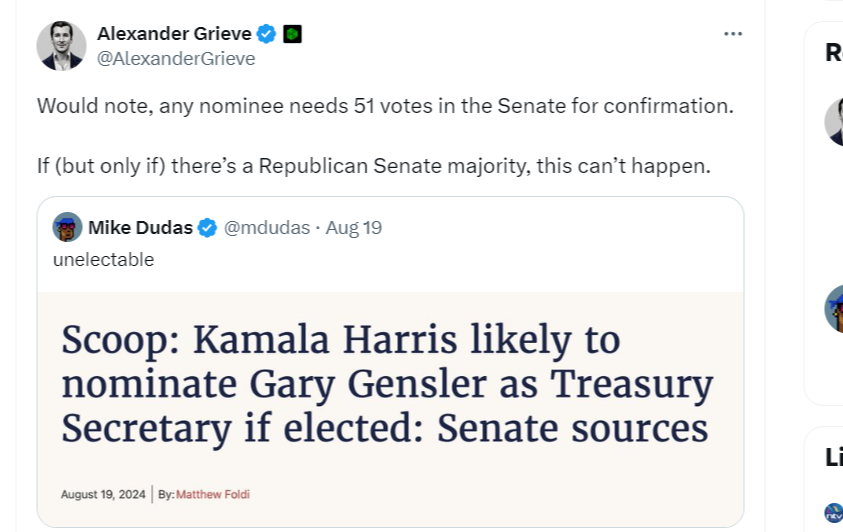
未经证实的报道称,如果副总统卡玛拉·哈里斯赢得11月的总统选举,她可能会任命美国证券交易委员会主席加里·金斯勒为财政部长。引用的消息来源是参议院高级职员和共和党消息人士。

根据《华盛顿报道》的初步报道,几名参议院高级职员表示,卡玛拉·哈里斯正在考虑让Gensler担任未来政府的财政部职位。这与著名共和党人过去的警告是一致的,特别是众议员汤姆·埃默(明尼苏达州共和党人),他建议不要采取这样的行动。

明尼苏达州众议员Tom Emmer此前曾警告称,卡玛拉·哈里斯可能会选择Gensler,或者在最坏的情况下,选择参议员伊丽莎白·沃伦担任她的财政部长。他说,这样的举动“对经济来说将是一场灾难”。

他一直在各地提起诉讼,但都输了。那个时代已经过去了。加里·詹斯勒需要继续前进。他在政府的职业生涯应该结束了。众议员Emmer

鉴于Gary Gensler在美国证券交易委员会的严格监督历史,他在卡玛拉·哈里斯政府下担任财政部长的潜在候选资格可能会对加密监管产生重大影响。他的提名可能会导致针对加密实体的更严格的政策和执法措施,从而可能改变监管格局。

卡玛拉选择担任美国证券交易委员会主席将给她带来麻烦

据消息人士透露,如果卡玛拉·哈里斯击败特朗普,共和党参议院高级工作人员预计“共和党统一反对”詹斯勒,但他很可能会得到民主党的压倒性支持。

实际上,加密货币行业可能面临更严格的审查和合规要求,这可能会阻碍该行业的创新和扩张,但也可能导致更大的主流采用,如果,也许只有在制定更明确的法规的情况下。

政治谣言并没有就此结束。还有报道称,Gensler可能会辞去美国证券交易委员会主席一职。这将使拜登政府能够在11月大选前任命一位新主席。

民主党全国委员会周日发布了2024年党纲。这份概述民主党在下一次选举前未来政治抱负的文件没有提到加密货币。
美国财政部长负责监督该国的经济政策,管理政府资金,并监管金融机构,特别是那些处理加密货币的金融机构。该职位还包括打击金融犯罪和在国际金融事务中代表美国。

拜登任命的Gensler表示强烈反对加密监管。众议院颁布FIT21法案后,他强烈反对该法案。

Mark Cuban等知名人士甚至表示,Gensler与加密货币相关的行动可能会产生深远的政治影响,威胁到拜登总统退出竞选时的连任机会。现在卡玛拉·哈里斯已经填补了这些空缺。

İlgili Okumalar

From KYC to KYA, Is It Time to Give AI Agents Their Own 'ID Cards'?

Titled "From KYC to KYA: Is It Time to Issue 'Identity Cards' for AI Agents?", this article discusses the emerging concept of Know Your Agent (KYA) as AI agents become increasingly autonomous. In Agent-to-Agent (A2A) scenarios, where agents execute contracts, payments, and trades without human intervention, the lack of a shared identity standard creates risks like unauthorized transactions, fraud, and accountability gaps. KYA acts as a trust layer to verify an agent's origin, authority, and accountability. The need for KYA is most critical outside centralized platforms (like Google or Coinbase), such as in decentralized exchanges (DEX), A2A payments, and merchant payments. Several key players are building KYA infrastructure: - **ERC-8004**: A proposed Ethereum standard that issues a unique AgentID as an NFT, building on-chain identity, reputation, and validation systems. - **Visa TAP**: Visa's solution issues agent identity credentials, with transactions verified via triple signatures (legitimacy, delegator, payment method). - **Trulioo**: Extends its KYC/KYB compliance infrastructure using a Digital Passport for Agents (DAP), issued after verifying both the developer and user, and refreshed per transaction. - **Sumsub**: Focuses on post-issuance real-time verification, detecting agent anomalies during transactions using its existing compliance systems. Regulatory bodies are also acting. The EU AI Act mandates operator identification in logs for high-risk AI systems, the US NIST prioritizes agent identity management standards, and Singapore has released a national AI governance framework. Similar to how the 2019 FATF Travel Rule impacted crypto exchanges, possessing KYA infrastructure may determine market entry in the AI agent era. The market is expected to segment rather than produce a single winner, with success depending on integrations with merchants, payment networks, and KYC client bases.

marsbit35 dk önce

From KYC to KYA, Is It Time to Give AI Agents Their Own 'ID Cards'?

marsbit35 dk önce

The Next Generation of Payments Lies Not in the Payment Layer

The Next-Generation of Payment is Not in the Payment Layer This is the second piece in a series analyzing Stripe's AI strategy. The series stems from Stripe's vision of becoming the economic infrastructure for the AI Agent era, announced at Stripe Sessions 2026. A key debate centers on whether Know Your Agent (KYA) is merely an upgrade to existing payment systems. The author argues the opposite: payment will become a subsystem of KYA, not the other way around. Historically, major payment innovations (online banking, mobile wallets, QR codes) emerged from new transaction scenarios that broke the underlying assumptions of old systems, not from optimization within the payment layer itself. Agent economy is that new scenario, and KYA is the foundational infrastructure growing to support it. KYA's proposed five layers—Agent Identity, Authorization Scope, Intent Signing, Liability Chain Auditing, and Credit Rating—extend far beyond payments. Only authorization and auditing directly touch the payment链路. Identity, intent, and credit layers serve broader needs like cross-platform calls, AI alignment, and permission management. Stripe's strategic moves validate this view. Its focus on "economic infrastructure for AI," investments in protocols like Agentic Commerce Protocol (an identity/session protocol), Shared Payment Tokens, stablecoin infrastructure, embedded wallets, and its own Tempo blockchain for settlement, all point to building the KYA layer, not just optimizing payments. Data shows the core challenge in AI commerce has shifted upstream: determining "who this is, what they intend to do, and if they deserve resources" happens long before checkout. This is why Stripe is moving its Radar fraud prevention from the transaction moment to the entire user lifecycle—a KYA-layer concern. Legally, ultimate responsibility will still fall on a human, as laws like AB 316 dictate. However, in a distributed,网状 liability chain involving users, Agent platforms, model providers, and payment protocols, KYA's role is to use cryptography to make every entity's actions and roles verifiable and traceable. This enables accountability where it was previously impossible to pinpoint evidence, fundamentally changing责任追溯, not just payment efficiency. The next-generation payment形态 will not be designed within the payment layer. It will emerge from the Agent economy scenario after the KYA infrastructure is established.

marsbit3 saat önce

The Next Generation of Payments Lies Not in the Payment Layer

marsbit3 saat önce

The Next Generation of Payments Is Not in the Payment Layer

The next generation of payments won't be designed within the payment layer itself. This article argues that historical payment innovations (e.g., online banking, mobile wallets) emerged from new transactional scenarios, not from optimizing existing payment systems. The new scenario is the Agent economy. Know Your Agent (KYA) is not merely a payment-layer upgrade for efficiency. It is the foundational infrastructure layer for the Agent economy. KYA’s five layers—Agent identity, authorization scope, intent signature, accountability chain audit, and credit rating—primarily serve broader needs like cross-platform identification, AI alignment, and permission management. Payment is just one application built on top of this KYA foundation. Stripe’s strategy exemplifies this shift. Its focus on "economic infrastructure for AI," investments in protocols like the Agentic Commerce Protocol (identity/session layer), stablecoin infrastructure, embedded wallets, and moving risk management (Radar) to the user lifecycle all indicate it is building the KYA layer, not just optimizing payments. While ultimate legal liability remains with a human (as laws like AB 316 stipulate), KYA enables traceability in a distributed,网状 responsibility chain involving multiple entities (user, Agent platform, model provider, etc.). It makes accountability verifiable where previously it was opaque. The conclusion: A new class of economic actors (Agents) forces a new infrastructure layer (KYA) to emerge. This layer redefines identity, authorization, and accountability. On top of it, the next generation of payment will reorganize and emerge from the demands of the scenario, not from within the traditional payment system.

链捕手3 saat önce

The Next Generation of Payments Is Not in the Payment Layer

链捕手3 saat önce

İşlemler

Spot
Futures
活动图片