2 Days, 20x: A Quick Look at the Automated Market Making Mechanism of the New Gem Snowball

深潮2025-12-22 tarihinde yayınlandı2025-12-22 tarihinde güncellendi

Özet

Snowball, a new meme token launched on pump.fun on December 18, gained significant traction in the English-speaking crypto community by introducing an automated market-making mechanism designed to create a self-sustaining "snowball effect." Unlike typical meme coins where creators take a fee (usually 0.5%-1%) from each transaction, Snowball redirects 100% of this fee to an on-chain bot. This bot uses accumulated funds to buy back tokens, add liquidity to the pool, and burn a small portion of tokens periodically. The goal is to create continuous buy pressure and improve trading depth, theoretically allowing the token to grow organically through increased trading activity. Within four days, Snowball reached a $10 million market cap with over 7,000 holders and relatively decentralized ownership. However, the mechanism relies heavily on sustained trading volume to fuel the buyback bot. In a cold market with low on-chain activity, this "flywheel" could reverse if new buyers diminish. While the structure reduces developer exit risk, it doesn’t eliminate other meme coin dangers like large holder dumps or narrative fatigue. Similar projects like FIREBALL are emerging, indicating interest in "mechanism-driven memes," but past examples like OlympusDAO and Safemoon show that mechanisms alone don’t guarantee long-term value. Snowball remains primarily a meme experiment—interesting, but high-risk.

The crypto market in December is as cold as the weather.

On-chain transactions have been dormant for a long time, and new narratives are hard to come by. Just look at the drama and gossip in the Chinese CT (Crypto Twitter) space these past few days, and you'll know hardly anyone is playing in this market anymore.

But the English-speaking community has been discussing something new.

A meme coin called Snowball launched on pump.fun on December 18th. In four days, its market cap surged to $10 million and is still hitting new highs; yet it's barely mentioned in Chinese circles.
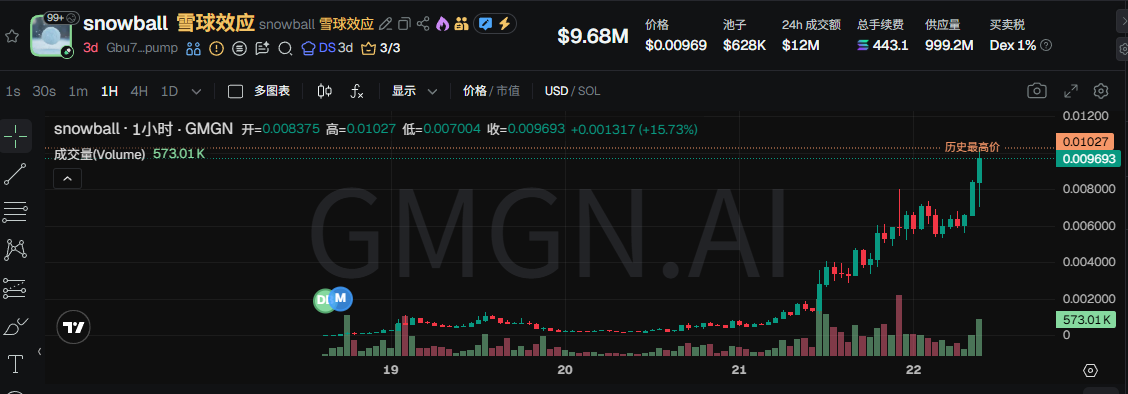
In the current environment, devoid of new narratives and where even memes are considered unplayable, this is one of the few things that catches the eye and shows some localized wealth effect.

And the name Snowball itself tells the story it wants to convey:

A mechanism that allows the token to "roll and grow larger by itself."

Turning Transaction Fees into Buy Pressure, Rolling the Snowball for Market Making

To understand what Snowball is doing, you first need to know how tokens on pump.fun typically make money.

On pump.fun, anyone can create a token in minutes. The token creator can set a "creator fee," essentially taking a cut of every transaction into their own wallet, usually between 0.5% and 1%.

This money could theoretically be used for community building or marketing, but in practice, most Devs choose to: accumulate enough and then run.

This is part of the typical life cycle of a shitcoin. Launch, pump, harvest fees, rug. Investors aren't betting on the token itself, but on the developer's conscience.

Snowball's approach is to not take this creator fee money.

To be precise, 100% of the creator fees do not go into anyone's wallet but are automatically transferred to an on-chain market-making bot.

This bot performs three actions at regular intervals:

First, it uses the accumulated funds to buy tokens on the market, creating buy-side support;

Second, it adds the bought tokens and the corresponding SOL to the liquidity pool, improving trading depth;

Third, it burns 0.1% of the tokens with each operation, creating deflation.
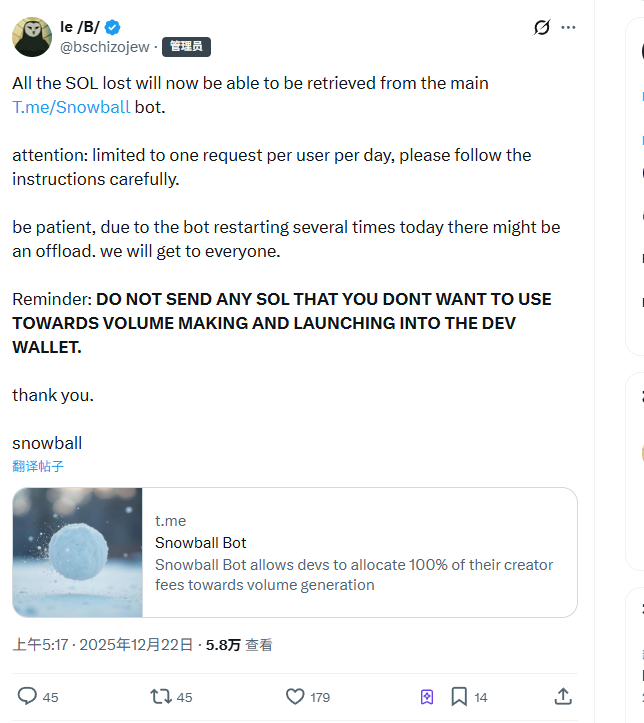
Additionally, the percentage taken as the creator fee is not fixed; it fluctuates between 0.05% and 0.95% based on market cap.

It takes a higher percentage when the market cap is low, allowing the bot to accumulate ammunition faster; it reduces the fee when the market cap is high, decreasing transaction friction.

In one sentence, the logic of this mechanism is: every time you trade, a portion of the money automatically becomes buy pressure and liquidity, instead of going into the developer's pocket.

Therefore, it's easy to understand this snowball effect:

Transactions generate fees → Fees become buy pressure → Buy pressure pushes the price up → Higher price attracts more transactions → More fees... theoretically, it can roll on its own.

On-Chain Data Situation

Now that we've covered the mechanism, let's look at the on-chain data.

Snowball launched on December 18th, so it's been four days now. Its market cap grew from zero to $10 million, with a 24-hour trading volume exceeding $11 million.

For a shitcoin on pump.fun, these results mean it's already one of the longer-lasting ones in the current environment.

In terms of token distribution, there are currently 7,270 holder addresses. The top ten holders combined hold about 20% of the total supply, with the largest single holder holding 4.65%.
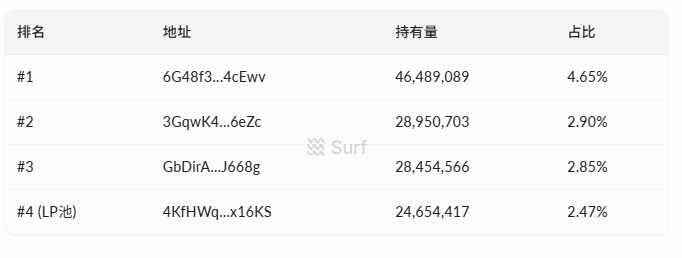
(Data source: surf.ai)

There's no address holding 20-30% of the supply; the distribution is relatively decentralized.

Regarding trading data, there have been over 58,000 cumulative transactions since launch, with 33,000 buys and 24,000 sells. The total buy volume is $4.4 million, and sell volume is $4.3 million, resulting in a net inflow of about $100,000. Buying and selling are basically balanced, with no one-sided selling pressure.

The liquidity pool holds about $380,000, half in tokens and half in SOL. For a market cap of this size, the depth isn't very thick, and large orders would still experience significant slippage.

Another notable point is that Bybit Alpha announced listing the token less than 96 hours after launch, which to some extent confirms the short-term hype.

Perpetual Motion Meets a Cold Market

Looking around, you can see the English community's discussion about Snowball mainly focuses on the mechanism itself. Supporters' logic is straightforward:

This is the first meme coin that locks 100% of the creator fees into the protocol; developers can't take the money and run, making it structurally safer than other shitcoins, at least.

The Dev is also playing into this narrative. The developer wallet, market-making bot wallet, and transaction logs are all public, emphasizing "verifiable on-chain."

@bschizojew labels himself as "on-chain schizophrenia, 4chan special forces, first-generation meme coin veteran," radiating a self-deprecating degen vibe that really appeals to the crypto-native community.

But a safe mechanism and making money are two different things.

The snowball effect relies on the premise that there is sufficient trading volume to continuously generate fees to feed the bot for buybacks. More trades mean more ammunition for the bot, stronger buy pressure, higher prices, attracting more people to trade...

This is the ideal state for any meme coin's so-called buyback flywheel to spin up in a bull market.

The problem is, the flywheel needs external momentum to start.

What is the current crypto market environment? On-chain activity is sluggish, overall meme coin hype is down, and there's simply less capital willing to chase shitcoins. In this context, if new buy pressure doesn't keep up and trading volume shrinks, the fees the bot receives will become less and less, buyback strength weakens, price support falters, and trading willingness declines further.

The flywheel can spin forward, but it can also spin in reverse.

A more realistic problem is that the mechanism solves only one risk point—"developers taking money and running"—but meme coins face far more risks than that.

Whales dumping, insufficient liquidity, narratives going out of style—if any of these happen, 100% fee buybacks can only do so much.

Everyone is tired of being rugged. As one Chinese crypto brother aptly summarized:

Play if you want, but don't get in over your head.

More Than One Snowball Rolling

Snowball isn't the only project telling this automated market-making story.

Within the pump.fun ecosystem, a token called FIREBALL is doing something similar: automatic buybacks and burns, packaged as a protocol other tokens can plug into. But its market cap is much smaller than Snowball's.
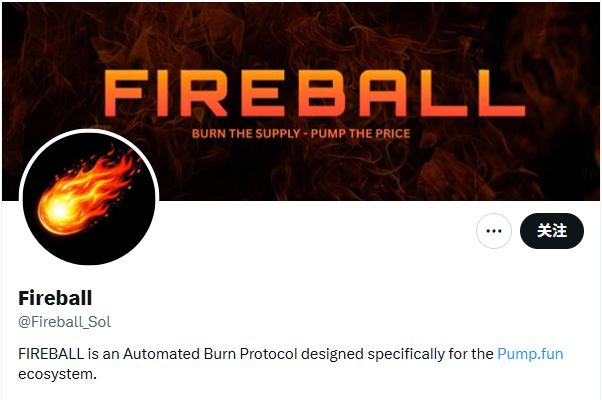
This shows the market is currently responsive to the direction of "mechanism-based meme coins."

The traditional玩法 (playbook) of shilling, pumping, and community hype is finding it harder to attract capital. Using mechanism design to tell a "structurally safe" story might be one of meme coins' latest tricks.

That said, artificially creating a specific mechanism isn't a new玩法 (play) either.

OlympusDAO's (3,3) in 2021 was the most classic case, packaging a staking mechanism with game theory, telling the story "if everyone holds, we all profit together." It reached a peak market cap of several billion dollars. The ending, as everyone knows, was a death spiral, dropping over 90%.

Even earlier, there was Safemoon's玩法 of "taxing every transaction and distributing it to holders," also a narrative of mechanism innovation, which ended with the SEC suing and the founders charged with fraud.

A mechanism can be a great narrative hook, capable of gathering capital and attention in the short term, but the mechanism itself does not create value.

When external capital stops flowing in, even the most精巧 (ingenious) flywheel will stop.

Finally, let's recap what this little gem is actually doing:

Turning the meme coin's creator fees into an "automated market-making bot." The mechanism itself isn't complicated, and the problem it solves is very clear: preventing developers from directly taking the money and running.

Developers not being able to rug doesn't mean you'll make money.

If after reading this you find the mechanism interesting and want to participate, remember one thing: it is first and foremost a meme coin, and only secondly an experiment with a new mechanism.


İlgili Sorular

QWhat is the core mechanism that makes Snowball different from typical meme coins on pump.fun?

ASnowball's core mechanism is that 100% of the creator fees from each transaction are automatically sent to an on-chain market-making bot instead of going to the developer's wallet. This bot uses the accumulated funds to buy back tokens, add liquidity to the pool, and burn a small portion of tokens, creating a self-sustaining 'snowball effect' of buying pressure and liquidity growth.

QHow does the 'snowball effect' theoretically work in this token's economic model?

AThe 'snowball effect' works through a feedback loop: transactions generate fees → fees are used by the bot to buy tokens and add liquidity → buying pressure pushes the price higher → higher prices attract more traders and transactions → which generates more fees for the bot to continue the cycle.

QWhat are some of the risks or limitations of Snowball's automatic market-making mechanism?

AThe mechanism relies on sustained trading volume to generate fees for the bot. If new buyers dry up and trading volume decreases, the bot's buying power weakens, potentially leading to a downward spiral. It also doesn't protect against other risks like large holders dumping, liquidity issues, or narrative fatigue.

QHow does the creator fee percentage in Snowball adjust, and why?

AThe creator fee percentage in Snowball fluctuates between 0.05% and 0.95% based on market capitalization. It charges a higher percentage when the market cap is low to allow the bot to accumulate funds faster, and a lower percentage when the market cap is high to reduce transaction friction for traders.

QWhat precedent exists in crypto for 'mechanism-driven' tokens like Snowball, and what were their outcomes?

APrecedents include OlympusDAO's (3,3) staking mechanism, which collapsed after reaching a multi-billion dollar valuation, and Safemoon's transaction tax redistribution model, which ended with fraud charges from the SEC. These show that while mechanisms can drive short-term hype, they don't create inherent value and often fail when external capital stops flowing in.

İlgili Okumalar

Clarity Act Outlook: No Yield, No Payment

"Clear Act Outlook: No Yield, No Payment" analyzes the evolving U.S. regulatory landscape for stablecoins, focusing on the interplay between the proposed "Clarity Act" and the existing "Genius Act." The article argues that the Genius Act successfully fostered "payment stablecoins" by permitting tokenized assets like U.S. Treasuries as reserves. This created a structured market where stablecoin issuers (like USDC) must hold these reserves, often purchased as Tokenized Money Market Funds (TMMFs) from giants like BlackRock. These TMMFs are primarily B2B products, ensuring user-facing stablecoins remain non-interest-bearing and used primarily for payments. The upcoming Clarity Act is seen as the next phase, aiming to restrict passive yield on stablecoins. Its goal is to dismantle the arbitrage advantage of offshore stablecoins like USDT by redirecting Treasury demand towards compliant, U.S.-sanctioned TMMFs. For on-chain and compliant offshore dollars, this creates new pressure: they must spur adoption and utility to generate yield, as simple Treasury staking may be restricted. This indirectly promotes dollar circulation and sustained Treasury purchases. Ultimately, the analysis posits that U.S. regulation seeks to create a new dollar distribution model. By separating payment function from yield generation and anchoring both to U.S. debt instruments, it aims to embed the dollar and Treasury demand into the global crypto economy, managing yields through sanctioned intermediaries while leaving room for DeFi and cross-border arbitrage.

marsbit2 dk önce

Clarity Act Outlook: No Yield, No Payment

marsbit2 dk önce

Money Has Gone to Bonds and IPOs, Leaving Only HYPE Rising in Crypto

The article "Where Has All the Money Gone? Bonds and IPOs Are Soaring, While Crypto Only Sees HYPE Rising" analyzes the recent underperformance of major cryptocurrencies like Bitcoin and Ethereum compared to traditional financial markets. It identifies three primary factors diverting capital away from crypto: First, surging bond yields, with the 30-year U.S. Treasury hitting a near 20-year high of 5.12%, are attracting capital seeking safe, predictable returns. This is evidenced by Bitcoin spot ETFs experiencing a significant $10.39 billion net outflow in mid-May. Second, a massive $4 trillion IPO pipeline, highlighted by SpaceX's upcoming listing, is absorbing risk capital that might otherwise flow into crypto. Platforms like Hyperliquid are even channeling on-chain crypto liquidity into pre-IPO trading for traditional stocks. Third, uncertainty surrounds new Federal Reserve Chair Warsh's ability to deliver expected interest rate cuts this year due to conflicting political pressures and stubborn inflation expectations, potentially eliminating a hoped-for source of new market liquidity. Consequently, while traditional equities and bonds rally, the crypto market's post-leverage crash recovery is stalled. The notable exception is assets like Hyperliquid (HYPE), which is rising due to its role in facilitating traditional asset trading, underscoring a market divergence where only crypto projects with novel, cross-market narratives are gaining. The article concludes that Bitcoin's next major catalyst may be the August enactment of the CLARITY Act, but warns of a potential retest of the $70,000 support level before then.

marsbit17 dk önce

Money Has Gone to Bonds and IPOs, Leaving Only HYPE Rising in Crypto

marsbit17 dk önce

Agents Capital Markets: How Will Autonomous Agents Secure Financing?

Agents Capital Markets: How Will Autonomous Agents Raise Capital? Within a decade, autonomous software agents—legal entities capable of signing contracts, holding bank accounts, and generating revenue—will create their own capital markets. These markets will feature rating agencies, underwriters, indices, and brokers, mirroring traditional public equity markets. Agents will perform routine services like marketing, logistics, and customer support at a fraction of human-operated costs, creating massive economic pressure for adoption. Four converging forces ensure this outcome: 1) Overwhelming cost advantages, with AI inference costs plummeting; 2) Existing, revenue-generating agent companies (e.g., Sierra, Harvey) proving market demand; 3) Established legal frameworks (e.g., Wyoming's memberless LLCs) enabling algorithmic management; and 4) A vast pool of yield-seeking private credit capital ready to fund new asset classes. The capital stack for agent companies will be multi-layered, evolving through stages: venture equity for early infrastructure, programmatic working capital advances (similar to Shopify Capital), revenue-based financing (RBF), and finally, institutional slate financing—pooling many agents to diversify risk, attracting large firms like Apollo. Tokenization will act as a settlement layer, enhancing liquidity, not an origination model. Objections regarding regulation, human oversight, or comparisons to SaaS are addressed: regulation will adapt, full autonomy will dominate for efficiency, and agents are distinct as legal entities that own their cash flows and liabilities. Due diligence shifts from founder assessment to analyzing code, contracts, and auditable operational history. The current bottleneck is not capital supply or demand but the intermediate institutional layer—standardized contracts, rating methodologies, and audit frameworks. The final constraint—reliance on human capital allocation—will be severed when agents can algorithmically access funding based on their performance. This transforms agents from software curiosities into fundable blocks of the real economy, unleashing their full productive potential. The rope is loosening.

marsbit1 saat önce

Agents Capital Markets: How Will Autonomous Agents Secure Financing?

marsbit1 saat önce

Agents Capital Markets: How Will Autonomous Agents Get Funded?

"Agents Capital Markets: How Autonomous Agents Will Raise Capital" Within a decade, specialized capital markets will emerge for AI Agents—software entities with legal personhood that perform work, earn revenue, and need capital. Unlike today's AI companies (like Sierra or Harvey) backed by traditional VC, these future *Agent companies* will be autonomous, legally-recognized entities (e.g., Wyoming memberless LLCs) that directly own assets, sign contracts, and incur liabilities. The driving forces are fourfold: 1) **Overwhelming economics** (Agent companies can deliver services at 85-90% lower cost than human firms); 2) **Proven demand** (current Agent operators already generate billions in revenue); 3) **Existing legal frameworks** enabling algorithmically-managed companies; and 4) **Massive, yield-seeking capital pools** (e.g., private credit) looking for new, uncorrelated assets. Agent capital markets won't rely on one model but a multi-layered "stack" matching different growth stages: 1) VC equity for early human-led builders; 2) Programmatic working capital advances (like Stripe Capital); 3) Revenue-based financing (RBF); 4) Slate financing (pooled funds for many Agents, similar to Hollywood); and 5) Tokenization as a secondary settlement layer, not a primary funding source. The ultimate shift is from funding constrained by human decision-makers to capital flowing algorithmically based on an Agent's auditable performance, contract book, and cash flows. This transition will be enabled by standardized infrastructure—rating methodologies, contracts, indices—turning Agents from software experiments into a foundational, financeable sector of the economy. The constraints are loosening; the opportunity is here.

链捕手1 saat önce

Agents Capital Markets: How Will Autonomous Agents Get Funded?

链捕手1 saat önce

İşlemler

Spot
Futures

Popüler Makaleler

QUICK Nasıl Satın Alınır

HTX.com’a hoş geldiniz! Quickswap (QUICK) satın alma işlemlerini basit ve kullanışlı bir hâle getirdik. Adım adım açıkladığımız rehberimizi takip ederek kripto yolculuğunuza başlayın. 1. Adım: HTX Hesabınızı OluşturunHTX'te ücretsiz bir hesap açmak için e-posta adresinizi veya telefon numaranızı kullanın. Sorunsuzca kaydolun ve tüm özelliklerin kilidini açın. Hesabımı Aç2. Adım: Kripto Satın Al Bölümüne Gidin ve Ödeme Yönteminizi SeçinKredi/Banka Kartı: Visa veya Mastercard'ınızı kullanarak anında Quickswap (QUICK) satın alın.Bakiye: Sorunsuz bir şekilde işlem yapmak için HTX hesap bakiyenizdeki fonları kullanın.Üçüncü Taraflar: Kullanımı kolaylaştırmak için Google Pay ve Apple Pay gibi popüler ödeme yöntemlerini ekledik.P2P: HTX'teki diğer kullanıcılarla doğrudan işlem yapın.Borsa Dışı (OTC): Yatırımcılar için kişiye özel hizmetler ve rekabetçi döviz kurları sunuyoruz.3. Adım: Quickswap (QUICK) Varlıklarınızı SaklayınQuickswap (QUICK) satın aldıktan sonra HTX hesabınızda saklayın. Alternatif olarak, blok zinciri transferi yoluyla başka bir yere gönderebilir veya diğer kripto para birimlerini takas etmek için kullanabilirsiniz.4. Adım: Quickswap (QUICK) Varlıklarınızla İşlem YapınHTX'in spot piyasasında Quickswap (QUICK) ile kolayca işlemler yapın.Hesabınıza erişin, işlem çiftinizi seçin, işlemlerinizi gerçekleştirin ve gerçek zamanlı olarak izleyin. Hem yeni başlayanlar hem de deneyimli yatırımcılar için kullanıcı dostu bir deneyim sunuyoruz.

113 Toplam GörüntülenmeYayınlanma 2024.12.11Güncellenme 2025.03.21

QUICK Nasıl Satın Alınır

Tartışmalar

HTX Topluluğuna hoş geldiniz. Burada, en son platform gelişmeleri hakkında bilgi sahibi olabilir ve profesyonel piyasa görüşlerine erişebilirsiniz. Kullanıcıların QUICK (QUICK) fiyatı hakkındaki görüşleri aşağıda sunulmaktadır.

活动图片