147 Trillion vs 70 Billion: The Rise of On-Chain 'Risk Managers' and the Potential Dawn of a New Era in DeFi Asset Management

marsbit2026-05-21 tarihinde yayınlandı2026-05-21 tarihinde güncellendi

Özet

"147 Trillion vs 70 Billion: The Rise of On-Chain 'Risk Managers' and the Potential Dawn of a New Era in DeFi Asset Management" Key Points: The role of professional asset managers is emerging in DeFi, ending the era where protocols and governance dictated everything. While early DeFi protocols like Aave and Compound bundled risk management within their code, innovations like Morpho have separated infrastructure from risk judgment. This allows specialized "Risk Managers" to operate independent lending vaults, acting as on-chain asset managers. The market, though early with ~$7B in assets under management (AUM), is rapidly consolidating around top performers like SteakhouseFi (RWA focus), SentoraHQ (AI-driven models), and Gauntlet (crisis management). This modular structure mirrors TradFi's division of labor: distributors (e.g., exchanges) source capital, Risk Managers design strategies and set standards, and underlying protocols handle custody and execution. For traditional asset managers, this familiar structure presents clear entry paths: 1) **Distribution**: Partnering with Risk Managers as a backend service. 2) **Supply**: Bringing real-world assets (RWA) on-chain as collateral. 3) **Operation**: Becoming a Risk Manager themselves (e.g., Bitwise). The core competency required is shifting from coding to traditional risk underwriting and financial expertise—areas where established institutions hold a natural advantage. While the current DeFi market (~$80B) is minuscule co...

Authored by: Tiger Research

Compiled by: AididiaoJP, Foresight News

The weight of DeFi lending is shifting from protocols to risk managers who possess the power of choice. Entering the market boils down to one decision: to borrow this judgment, to provide it, or to own it yourself.

Key Takeaways

  • The role of asset manager is emerging in DeFi. The era where protocols and governance decided everything is over.
  • The market is still early, but capital and distribution channels are starting to concentrate towards leading managers, whose track records are becoming institutional benchmarks.
  • There are three paths to entry: distribution (risk manager as backend), supply (bringing assets on-chain), and operation (becoming a risk manager).
  • The chosen path determines the level of control gained, the capabilities required, and the risks assumed.
  • The core question is not *whether* to enter DeFi, but *which* judgment calls to delegate and which to retain.

1. Risk Managers: On-Chain Asset Management Specialists
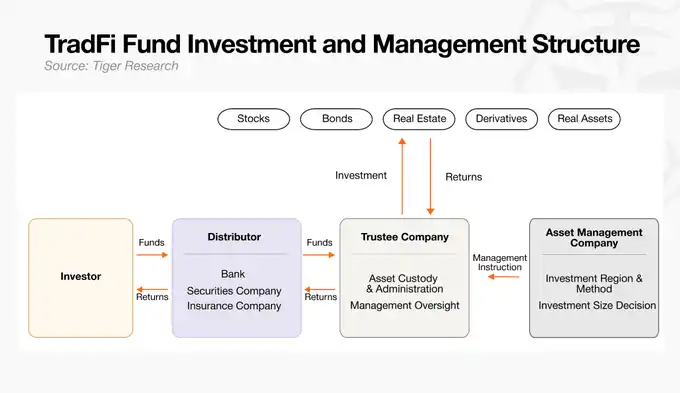
Just as traditional finance long ago separated judgment from execution, the crypto market has matured to a point where each function is handled by specialized players. The division of labor in TradFi is as follows:

  • Asset Manager: The "brain" of the fund, formulating strategies and issuing specific instructions to the custodian.
  • Custodian: Holds the assets, executes investments per the manager's instructions, and provides oversight.
  • Distributor: Distributes fund products to investors and raises capital.

The crypto market has corresponding roles. DeFi was initially designed to rely entirely on smart contract code, but over time it became clear that code alone cannot fully control on-chain risks.

To safely operate on-chain lending, a class of professionals specializing in assessing and coordinating complex risks emerged. They are called risk managers and have de facto taken on the role of asset managers within the on-chain ecosystem.

2. Early DeFi Had No Professionals
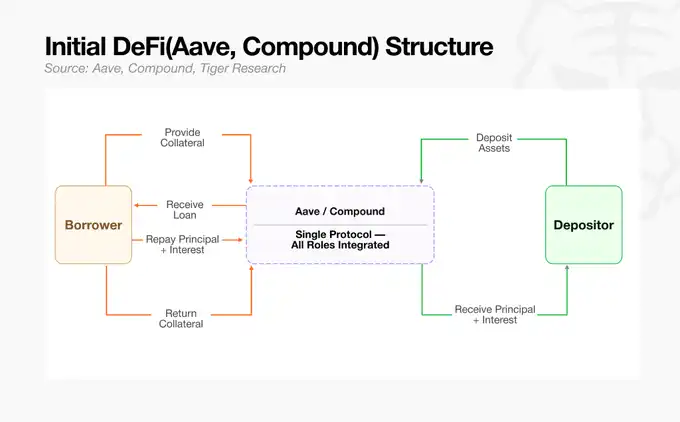
Early DeFi protocols like Aave and Compound bundled lending infrastructure and risk standards into a single structure. Risk managers existed back then, but because all assets were in one giant pool, their role was limited to being a "risk manager" at the system level, adjusting the protocol's overall risk parameters. As high-volatility assets flowed in, the single-pool design meant one bad asset could spread losses throughout the entire system. Someone had to manage this contagion risk.
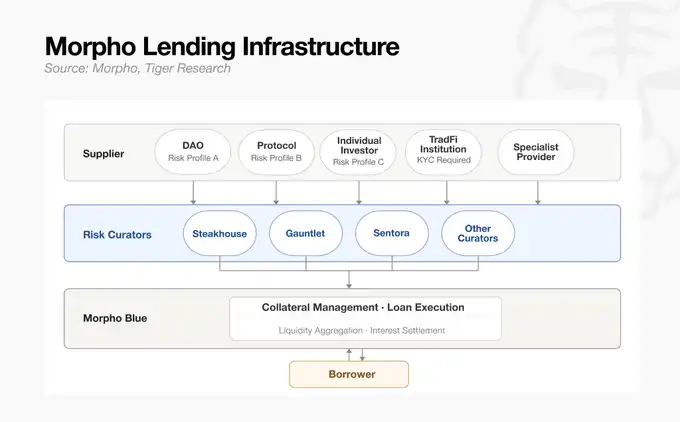
This changed with the advent of Morpho, which separated collateral assets and loan terms into independent markets. By replacing the single giant pool with a multi-vault structure, asset management strategies became modular, and the role of the risk manager transformed completely. They were no longer passive risk managers within a single protocol's fixed framework; they became external professionals able to design and operate independent lending vaults according to their own criteria.

With infrastructure and risk judgment fully separated, risk managers evolved from system-level risk managers into "asset managers" for the crypto market, actively operating multiple vaults.

3. Current Market Leaders
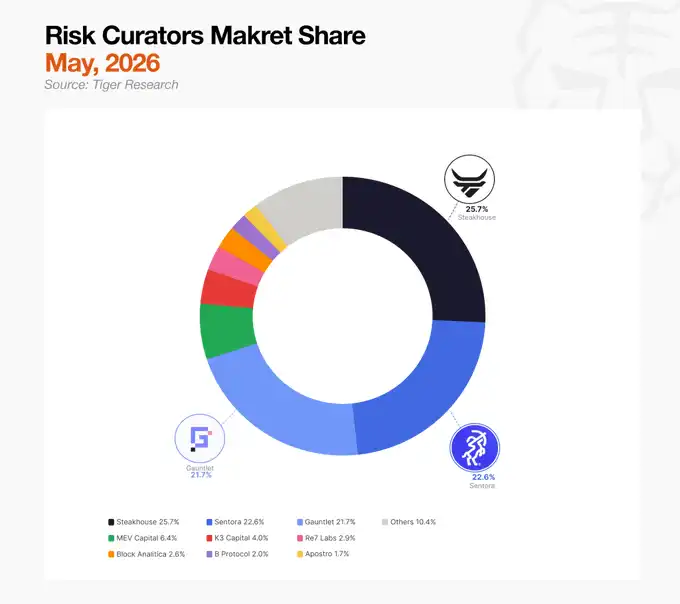
As of May 2026, the risk manager market manages roughly $70 billion in assets, with the top three teams accounting for 70% of that share. This market only truly entered the institutional arena in 2025, yet capital has quickly concentrated, indicating capital is chasing teams with reliable track records. The three leading teams reached the top via different paths:
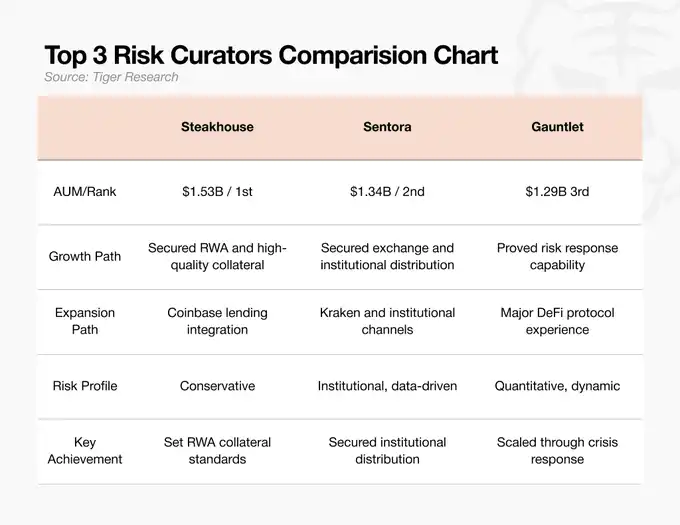
  • SteakhouseFi: A conservative risk manager leading the adoption of high-grade real-world assets (RWAs, like US Treasuries). As the backend for Coinbase's lending service, it unlocked distribution channels and currently ranks first in AUM ($15.3B as of Feb 2026). Beyond AUM, this team sets industry standards for which RWAs qualify as legitimate DeFi collateral.
  • SentoraHQ: A team built on AI risk models and institutional-grade data infrastructure. As Kraken's backend, it has secured institutional capital pipelines, ranking second in AUM ($13.4B). It won the channel connecting exchanges to institutional clients.
  • Gauntlet: Initially an on-chain quant analytics firm simulating risk parameters. In October 2025, when one of its vaults saw an influx of $775M, the team normalized collapsing APYs within 10 days, proving its capabilities. Ranking third in AUM ($12.9B), it is recognized as the strongest team in risk defense and crisis response to massive inflows.

At this stage, the risk manager market is no longer a simple TVL race but a competition to establish standards first: collateral standards, distribution channels, and risk response capabilities.

4. Traditional Asset Management vs. DeFi Risk Managers
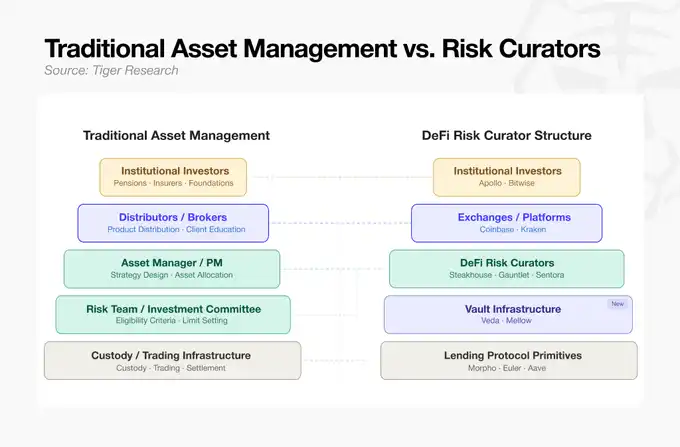
As Morpho fragmented the market, each collateral type required professional judgment. Specialist risk teams like Steakhouse entered as DeFi risk managers. Through this shift, DeFi began to approximate the traditional asset management process.

Reading the chart from top to bottom shows how today's DeFi infrastructure replicates the labor division of TradFi on-chain:

  • Capital Sourcing & Distribution (Top): Institutional investors are at the top as capital sources. Their large capital pools flow into the on-chain ecosystem via major CeFi exchanges and platforms, which assume the role of TradFi distributors (brokers).
  • Strategy Design & Risk Control (Middle): Below are the DeFi risk managers who decide how the incoming capital is managed. Analogous to TradFi asset managers' portfolio managers (PMs) and risk committees, they set asset eligibility criteria and limits and design the overall investment strategy.
  • Product Assembly & Custody (Bottom): The risk managers' strategies become investable on-chain products via the vault infrastructure below. At the very bottom are lending protocol primitives, which hold assets and execute settlements in code, replacing TradFi's custody and trading infrastructure.

From capital sourcing to management to custody, the entire workflow now mirrors the labor division of traditional finance. For traditional TradFi institutions, on-chain lending is no longer a foreign domain but a structured market with a familiar architecture, creating natural entry points.

5. A TradFi-Like Industry: Where Are the Opportunities?

As on-chain lending infrastructure adopts a labor division akin to TradFi asset management, the door is open for institutional entry. But not every layer has the same entry barriers.

  • Distribution Layer: The customer-facing, front-end market. Highly saturated, making it inefficient for TradFi institutions to compete head-on here.
  • Management Layer: An area driven entirely by financial expertise and human judgment. Assessing, controlling, and packaging asset risk is the core work of traditional asset managers. They can apply existing risk management capabilities to already-built, modular infrastructure without constructing complex systems, instantly gaining a business model.
  • Custody & Infrastructure Layer: Asset custody and transaction processing are technology-intensive, requiring deep blockchain engineering capabilities. It is unrealistic for TradFi institutions to build their own systems and compete here.

Unlike other layers requiring technical or platform-first advantages, the management layer presents the clearest window of opportunity where TradFi institutions can achieve market leadership using the very risk management capabilities they already possess.
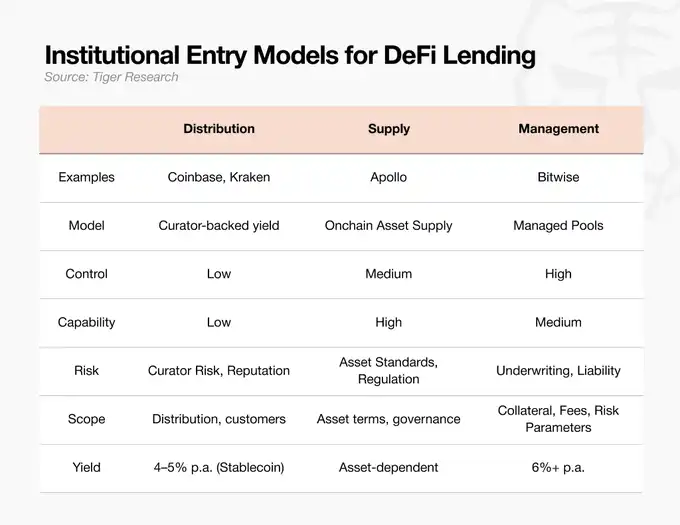
Institutions currently enter the DeFi market through three paths: distribution, supply, and operation. Regardless of the path chosen, the engine driving the market is the asset manager's "risk curation" ability.

Distribution: Risk Manager as Backend
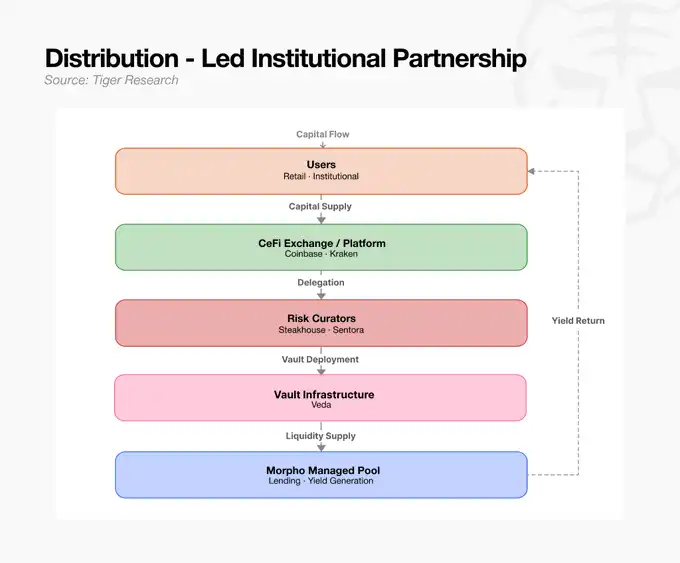
Connect with proven external risk managers as a backend for quick market entry. This suits exchanges and fintech companies with client channels but lacking internal management capabilities. Strategy is outsourced, but reputational risk and accountability for the chosen risk manager remain with the distributor.

This is the path chosen by centralized exchanges with strong client touchpoints but unwilling to directly manage the complexities of on-chain lending risk. They connect to proven external risk managers as backends and launch lending services. The exchange distributes large capital pools through its own platform, while collateral evaluation and risk management are entirely handed over to the partner risk manager.

Supply: Pushing Assets onto On-Chain Rails

Asset managers holding RWAs or credit assets directly supply these assets to the market. Like Apollo, they can acquire governance tokens of protocols like Morpho while supplying assets, thereby shaping infrastructure standards (e.g., collateral standards). The challenge lies in asset standardization and regulatory infrastructure development.

Large private equity funds or institutions holding real-world assets directly place their own capital on the on-chain rails. Apollo not only simply supplies assets but also acquired governance tokens of a major lending protocol. This move aims to push rules and standards so that its RWAs are recognized as superior, safer "official collateral" in the on-chain market.

But asset suppliers cannot arbitrarily register any asset as collateral. Someone must calmly assess whether the asset is truly safe and whether it can be liquidated immediately in an on-chain liquidation event. This requires the rigorous evaluation and endorsement capabilities of a risk manager. Ultimately, the supply path also must rely on the asset manager's risk validation capability to be viable.

Operation: Becoming a Risk Manager (Bitwise)
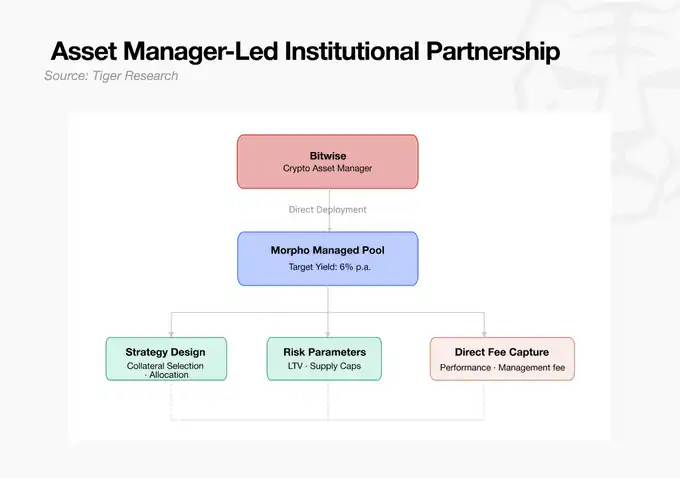
The asset manager designs its own strategy and operates its own vault. Bitwise defined on-chain vaults as "ETF 2.0" and entered directly. This path offers the strongest control over fees and collateral standards, but the manager bears full responsibility for operational failure. It suits asset managers with in-house risk teams.

This is the path where a traditional asset manager itself enters as a risk manager, without relying on external platforms. Bitwise defined the on-chain lending vault structure as "ETF 2.0" and entered the market directly. Leveraging its own portfolio construction capabilities and risk control systems, it designs and controls vaults itself, directly establishing a management fee model on-chain.

6. Before the Capital Arrives

Given the current trajectory, traditional asset managers are most likely to gain an advantageous position as on-chain lending matures. With the DeFi ecosystem's modularization and labor division, the capabilities truly needed by the market have shifted. Not the ability to write code, but the traditional financial expertise of underwriting collateral and setting risk limits. The competitive advantage of institutions with decades of experience can directly extend on-chain.

But today's DeFi market is still too small for global mega-managers. The global traditional asset management market is approximately $147 trillion, with BlackRock alone managing $14 trillion. In contrast, the entire DeFi market is around $80 billion, with the portion managed by risk managers at only $70 billion. This is merely 1/2000th of BlackRock's AUM.

Yet, it is precisely this massive scale gap that reveals the runway for growth. Institutional capital will not flow where risks are uncontrolled. Once risk managers lay secure on-chain rails for capital and regulatory frameworks take shape, the story changes. Even a tiny fraction flowing in from the $147 trillion could rapidly expand the $80 billion market.

Some opportunities exist only while the market is still small. Currently, the main players in the risk manager market can be counted on one hand. Institutions going on-chain need rails, and the teams that lay these rails first will set the standards.

Institutions entering later will find a safer, clearer market, but they will also become one of many players within already-established standards.


Trend Kriptolar

İlgili Sorular

QWhat fundamental shift is happening in DeFi lending according to the article?

AThe weight in DeFi lending is shifting from the protocols themselves to risk managers who possess decision-making power. The market is evolving from a model where protocols and governance decided everything to one where specialized asset manager roles are emerging.

QWhat are the three primary paths for traditional institutions to enter the DeFi market as described in the article?

AThe three primary entry paths are: 1. Distribution: Acting as a front-end and using proven external risk managers as the back-end. 2. Supply: Bringing real-world assets (RWA) on-chain as collateral. 3. Operation: Becoming a risk manager themselves by designing strategies and operating their own vaults.

QHow did the role of 'risk managers' in DeFi evolve, and what platform catalyzed this change?

AInitially, risk managers in protocols like Aave and Compound were limited to adjusting system-wide parameters within a single giant pool. Their role evolved fundamentally with the advent of Morpho, which introduced isolated markets and a multi-vault structure. This modularity allowed risk managers to become external professionals who design and operate independent lending vaults based on their own standards, effectively becoming crypto's 'asset managers'.

QAccording to the article, which layer of the DeFi lending stack represents the clearest opportunity window for traditional financial (TradFi) institutions and why?

AThe management layer represents the clearest opportunity. This layer is driven entirely by financial expertise and human judgment for assessing, controlling, and packaging asset risk—the core competency of traditional asset managers. Unlike the distribution or infrastructure layers, TradFi institutions can leverage their existing risk management capabilities on the already-built modular infrastructure without needing to develop complex technical systems.

QWhat key comparison does the article make to highlight the potential growth runway for DeFi asset management?

AThe article compares the massive scale of the traditional asset management industry (approximately $147 trillion) and a single giant like BlackRock ($14 trillion AUM) to the current size of the DeFi risk manager market (~$70 billion in AUM). This vast disparity shows the significant growth potential. Once risk managers establish safe on-chain 'rails' and regulatory frameworks mature, even a small fraction of the traditional capital flowing in could rapidly expand the DeFi market.

İlgili Okumalar

From Gold to Bitcoin: Fixed Supply + Institutional Frenzy, Might It Repeat the 'Explosive' Price Trend?

"From Gold to Bitcoin: Fixed Supply and Institutional Frenzy May Lead to 'Explosive' Price Rally Analysts suggest Bitcoin's price action could mirror gold's over the past two decades, following the launch of spot Bitcoin ETFs. Gold ETFs, introduced in 2004, drove gold's price surge to a current market cap near $28 trillion. Both gold and Bitcoin are non-yielding stores of value, with prices driven purely by investor sentiment rather than cash flows or credit. Gold ETFs experienced dramatic cycles: explosive growth, painful drawdowns, and slow recoveries, with each cycle reaching higher peaks. Bitcoin ETFs, approved in early 2024, saw rapid institutional adoption but are now facing similar volatility. Recent warnings highlight the risk of significant ETF outflows disrupting the current rebound. BlackRock's IBIT, a leading Bitcoin ETF, has sold nearly 100,000 BTC to meet redemptions while still holding over 733,000. The core parallel is fixed supply: when demand surges, prices explode, but demand is often volatile and wave-like, not steady. Institutional interest, through ETFs and corporate adoption, remains a key support pillar, helping to cushion sell-offs. If Bitcoin captures even a fraction of gold's role as a store of value, its upside potential is immense, though the path will be marked by high volatility. For investors, focusing on long-term trends and managing risk is crucial as this 'price explosion' narrative unfolds."

Foresight News32 dk önce

From Gold to Bitcoin: Fixed Supply + Institutional Frenzy, Might It Repeat the 'Explosive' Price Trend?

Foresight News32 dk önce

Why Is AI Agent Shopping Hard to Popularize?

The article argues that the popular narrative of "AI agent shopping" – equipping AI with a wallet to autonomously handle purchases – is fundamentally flawed and oversimplifies the complexity of shopping. It deconstructs shopping into two core actions: **information retrieval** (standardized, easily automated) and **value judgment** (deeply subjective and human-centric). The narrative mistakenly assumes AI can fully handle both. Value judgment itself has two layers: **evaluation** (assessing options against criteria) and **demand definition** (setting the criteria, weights, and values). The latter is inherently human and dynamic, as preferences are not fixed but constructed during the decision-making process ("constructive preferences"). The real dividing line for automation is not product standardization, but whether the **act of choosing** itself holds experiential value. For mundane purchases (e.g., printer paper), full AI delegation works. For experiential goods (e.g., wine, furniture), the joy of selection is core to consumption, so AI should act as an assistant that narrows options, leaving the final choice to humans. The "AI wallet" concept confuses three separate elements: decision-making, execution, and fund custody. Current payment industry solutions (e.g., from Stripe, Mastercard, Google, Visa) show that limited, scoped payment authorization tokens are sufficient for most consumer scenarios, not full fund custody. The true use case for autonomous AI wallets is in **B2B procurement** and **machine-to-machine (M2M) settlements** for standardized, high-frequency, low-value transactions. The real bottlenecks for AI shopping are not payment technology, but **1) the lack of trusted data sources** (e.g., fake reviews, counterfeit goods) and **2) the impossibility of automating human demand definition**. The conclusion is that the focus should be on safely automating the assessment and filtering process while reserving for humans the rights to define their criteria and enjoy the final act of choice. For experiential goods, the platform's competitive advantage shifts to providing a superior selection experience.

Foresight News1 saat önce

Why Is AI Agent Shopping Hard to Popularize?

Foresight News1 saat önce

After Nine Months of Shorting, a Full Turn to Long: Renowned Trader Opens Bitcoin Positions Around 64K, Crypto Market Long-Short Divergence Intensifies

After nine months of being short, prominent crypto trader Doctor Profit has closed all his bearish positions and started buying Bitcoin near $64,000, signaling a complete bullish reversal. He argues that structural market changes—such as impending U.S. regulation (CLARITY Act) and institutional adoption via securities tokenization—are rewriting the traditional four-year cycle script, potentially bringing the market bottom forward from the widely expected September/October timeframe. This view finds some technical support from on-chain analyst gumsays, who notes a bullish divergence on Bitcoin's weekly chart has persisted for 147 days, nearing the 161-day duration seen before the 2022 cycle low. However, cycle researcher Jake Pahor presents a counter-argument based on historical data. Analyzing patterns since 2014, he identifies three common features of past bear market bottoms: a ~12-month duration from peak to trough, a sustained period of extreme fear (with a proprietary risk score below 20), and the price falling below Bitcoin's realized price (~$53,000 currently). The current cycle, only nine months from its October 2025 peak, meets none of these conditions. The debate highlights a market torn between "front-running" a potential early bottom driven by new fundamentals and waiting for confirmation through traditional on-chain and sentiment metrics. While Doctor Profit opts for aggressive buying, Pahor maintains a disciplined, tiered accumulation strategy, continuing weekly buys at current risk levels but reserving larger orders for if more extreme fear emerges.

marsbit1 saat önce

After Nine Months of Shorting, a Full Turn to Long: Renowned Trader Opens Bitcoin Positions Around 64K, Crypto Market Long-Short Divergence Intensifies

marsbit1 saat önce

İşlemler

Spot

Popüler Makaleler

ERA Nasıl Satın Alınır

HTX.com’a hoş geldiniz! Caldera (ERA) satın alma işlemlerini basit ve kullanışlı bir hâle getirdik. Adım adım açıkladığımız rehberimizi takip ederek kripto yolculuğunuza başlayın. 1. Adım: HTX Hesabınızı OluşturunHTX'te ücretsiz bir hesap açmak için e-posta adresinizi veya telefon numaranızı kullanın. Sorunsuzca kaydolun ve tüm özelliklerin kilidini açın. Hesabımı Aç2. Adım: Kripto Satın Al Bölümüne Gidin ve Ödeme Yönteminizi SeçinKredi/Banka Kartı: Visa veya Mastercard'ınızı kullanarak anında Caldera (ERA) satın alın.Bakiye: Sorunsuz bir şekilde işlem yapmak için HTX hesap bakiyenizdeki fonları kullanın.Üçüncü Taraflar: Kullanımı kolaylaştırmak için Google Pay ve Apple Pay gibi popüler ödeme yöntemlerini ekledik.P2P: HTX'teki diğer kullanıcılarla doğrudan işlem yapın.Borsa Dışı (OTC): Yatırımcılar için kişiye özel hizmetler ve rekabetçi döviz kurları sunuyoruz.3. Adım: Caldera (ERA) Varlıklarınızı SaklayınCaldera (ERA) satın aldıktan sonra HTX hesabınızda saklayın. Alternatif olarak, blok zinciri transferi yoluyla başka bir yere gönderebilir veya diğer kripto para birimlerini takas etmek için kullanabilirsiniz.4. Adım: Caldera (ERA) Varlıklarınızla İşlem YapınHTX'in spot piyasasında Caldera (ERA) ile kolayca işlemler yapın.Hesabınıza erişin, işlem çiftinizi seçin, işlemlerinizi gerçekleştirin ve gerçek zamanlı olarak izleyin. Hem yeni başlayanlar hem de deneyimli yatırımcılar için kullanıcı dostu bir deneyim sunuyoruz.

579 Toplam GörüntülenmeYayınlanma 2025.07.17Güncellenme 2026.06.02

ERA Nasıl Satın Alınır

Tartışmalar

HTX Topluluğuna hoş geldiniz. Burada, en son platform gelişmeleri hakkında bilgi sahibi olabilir ve profesyonel piyasa görüşlerine erişebilirsiniz. Kullanıcıların ERA (ERA) fiyatı hakkındaki görüşleri aşağıda sunulmaktadır.

活动图片