September 1st, A Major Chip Price Hike

marsbitОпубликовано 2026-07-30Обновлено 2026-07-30

Введение

On July 29, 2026 (US time), Qualcomm reported its Q3 FY2026 (Q2 CY) results. Revenue reached $9.95 billion, up 4% and beating estimates, but net profit fell 25% YoY to $2 billion. The "revenue up, profit down" trend is attributed to rising costs across semiconductor manufacturing, testing, packaging, and materials. In response, CEO Cristiano Amon announced price increases for all chip products, effective September 1, to pass on costs and restore historical profit margins. The stock fell over 5% in after-hours trading due to weaker-than-expected Q4 profit guidance. Qualcomm's core chip business (QCT) revenue was $8.5 billion, down 5% YoY. Handset revenue dropped 20% to $5.09 billion, reflecting a weak global smartphone market with declining shipments. In contrast, Automotive revenue surged 61% to $1.59 billion, marking 23 consecutive quarters of double-digit growth, and IoT revenue grew 9% to $1.83 billion. The licensing division (QTL) revenue was $1.28 billion, down 3%. Facing smartphone headwinds and a reduced component share in future iPhones, Qualcomm is aggressively diversifying. It is betting heavily on the data center AI market, maintaining a target of $5 billion in data center revenue for FY2027. The company completed the acquisition of AI software firm Modular to build an open software platform for generative AI. For Q4 FY2026, Qualcomm forecasts revenue between $9.7B and $10.5B, roughly in line with expectations. However, non-GAAP EPS guidance of $2.05-$2.25 fell ...

On July 29th local time in the United States, chip giant Qualcomm announced its financial results for the third quarter of fiscal year 2026 (corresponding to the second quarter of the calendar year) ended June 28th.

The earnings report shows that Qualcomm's third-quarter revenue was $9.947 billion, a year-on-year increase of 4%, exceeding the analyst average expectation of $9.67 billion compiled by the London Stock Exchange Group (LSEG), and also reaching the upper limit of the company's previously provided performance guidance.

In the third quarter, Qualcomm's net profit was $2.002 billion, a significant 25% decrease compared to $2.666 billion in the same period last year. Diluted earnings per share were $1.87. On a Non-GAAP basis, net profit was $2.356 billion, a year-on-year decline of 23%, with corresponding earnings per share of $2.21.
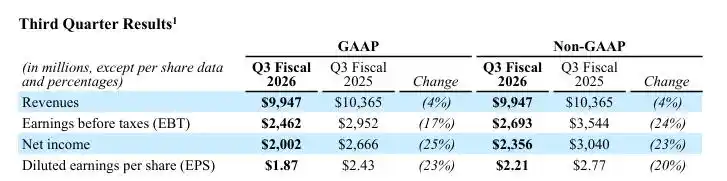
Qualcomm Q3 Revenue and Profit Data

The core reason for "increased revenue without increased profit" is the comprehensive rise in semiconductor industry input costs.

Qualcomm pointed out in its earnings report that costs in areas such as wafer fabrication, assembly, testing, advanced packaging, memory, and other materials are all increasing. These cost pressures directly impacted the company's profitability.

The report shows that the pre-tax profit margin of Qualcomm's QCT division, responsible for chip sales, was 26%, down 4 percentage points from 30% in the same period last year. The pre-tax profit margin of the technology licensing division QTL also decreased from 71% to 69%.

Facing continued pressure on the cost side, Cristiano Amon said bluntly in an interview: "Costs have gone up, and prices will follow. We are simply passing on the significant cost increases we are facing."

Previously, on July 24th, Qualcomm had already issued a notification letter to customers, announcing that it would implement double-digit percentage price increases across its entire chip series starting September 1st.

Amon emphasized that a temporary disconnect between costs and pricing has led to a slight temporary decline in gross margin, and the price increase is precisely to restore profitability to historical levels.

In terms of returning capital to shareholders, Qualcomm returned a total of $2.3 billion in the third quarter, including $973 million in cash dividends, equivalent to $0.92 per share, and $1.4 billion paid through the repurchase of 8 million ordinary shares.

As the company's profit guidance for the fourth quarter fell below market expectations, its stock price fell more than 5% in after-hours trading.

01 Smartphone Chips Bottom Out, Automotive Chips Surge

As Qualcomm's core revenue source, its semiconductor business (QCT) generated revenue of $8.504 billion for the quarter, a year-on-year decrease of 5%. This decline was primarily dragged down by its largest internal revenue segment, the handset business, while the automotive and IoT businesses showed strong growth resilience.
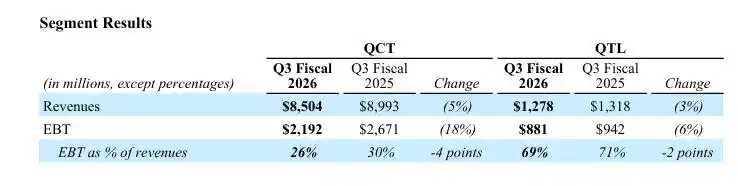
Qualcomm Q3 QCT and QTL Division Revenue Data

The earnings report shows that within the QCT division, handset revenue in the third quarter fell to $5.086 billion, a year-on-year decline of 20%. This performance reflects the complex difficulties currently facing the smartphone market.
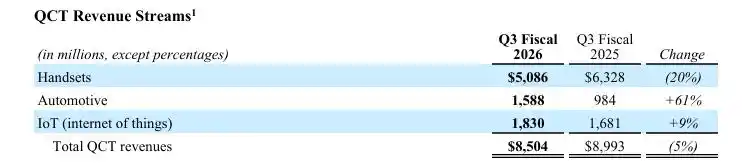
Qualcomm Q3 QCT Division Segment Financial Data

From a demand structure perspective, due to rising memory prices, consumer preferences within the high-end smartphone category are shifting towards lower-priced models within the same series and older models from the previous year, directly affecting Qualcomm's revenue and profit mix.

At the macro level, the entire smartphone industry is under significant pressure. According to Counterpoint Research data, global smartphone shipments in the second quarter of 2026 fell 11% year-on-year.

Bernstein analyst Stacy Rasgon commented, "The smartphone industry is not in good shape. Memory prices are rising, and AI is consuming a lot of supply. So, there isn't much supply left for smartphone makers. We've seen unit growth turn negative."

The Chinese market became a key focus this quarter. Qualcomm management's assessment is that revenue from Chinese smartphone manufacturers bottomed out in the second quarter as customers worked through excess inventory.

Amon mentioned that due to rising memory costs, smartphone manufacturers are forced to raise prices, which in turn suppresses demand and hurts Qualcomm's profit margins.

In stark contrast to the contraction in the phone business, the QCT automotive business was the biggest highlight of the quarter.

The QCT division's automotive business recorded revenue of $1.588 billion for the quarter, a 61% increase compared to $984 million in the same period last year. This marks the 23rd consecutive quarter of double-digit year-on-year revenue growth for this business. This performance also significantly exceeded Wall Street expectations of approximately $1.4 billion.

Alongside the earnings release, Qualcomm also announced a long-term agreement with BMW to supply digital cockpit and advanced driver-assistance systems (ADAS) chips for BMW's future vehicle platforms over the next decade.

The Internet of Things (IoT) business within the QCT division also performed steadily, with third-quarter revenue of $1.830 billion, a year-on-year increase of 9%. This business covers emerging areas such as low-power industrial uses, smart glasses, and robotics, showing good momentum for diversified development.

Turning to the parallel technology licensing division QTL, third-quarter revenue was $1.278 billion, a slight year-on-year decrease of 3%, slightly above the analyst average expectation of $1.26 billion surveyed by StreetAccount. The division's pre-tax profit margin was 69%, remaining a stable profit source for Qualcomm.

02 Betting Big on Data Centers

Facing structural challenges in the smartphone market and the potential decline in Apple's business share, Qualcomm is accelerating its diversification strategy, targeting the AI data center market and a broader ecosystem of intelligent devices.

Regarding the relationship with Apple, CEO Amon provided a key expectation. He stated that due to supply constraints, Qualcomm's component share in the upcoming iPhone would drop to well below the previously estimated 20%. He attributed this to supply availability issues and stated bluntly: "We are, to some extent, replacing Apple with the data center business."

In the data center field, Qualcomm is expanding rapidly. Amon said the goal of achieving $5 billion in data center revenue next year remains on track.

Previously, at the investor day in June, Qualcomm showcased a complete data center product line and servers, including AI accelerators, CPUs, memory, and rack-level servers. CFO Akash Palkhiwala predicted at that time that data center products would generate $5 billion in revenue in fiscal year 2027.

Amon further predicted in this earnings report that the year-on-year revenue growth of non-handset businesses, including data centers, would accelerate from 24% in fiscal 2026 to over 60% in fiscal 2027, calling this an important inflection point in the execution of the growth strategy.

To lay the software groundwork for this grand vision, Qualcomm completed the acquisition of AI programming technology company Modular in the third quarter. The company plans to officially announce its AI software platform at an event in August. Amon emphasized at the beginning of the earnings report that this acquisition aims to "create an open software foundation for generative AI and agents."

According to data from the previous investor day, Qualcomm aims to grow total revenue from non-handset businesses to $40 billion by fiscal year 2029, nearly double the target shared in November 2024.

03 Margin Pressure Continues

Looking ahead to the fourth quarter, Qualcomm's guidance indicates that the impacts of cost pressures and product mix changes will persist.

Qualcomm expects fourth-quarter fiscal 2026 revenue to be between $9.7 billion and $10.5 billion, with the midpoint roughly in line with the analyst average expectation of $10.02 billion. Within this, QCT chip business revenue is expected to be between $8.4 billion and $9.0 billion, and QTL technology licensing revenue is expected to be between $1.2 billion and $1.4 billion.
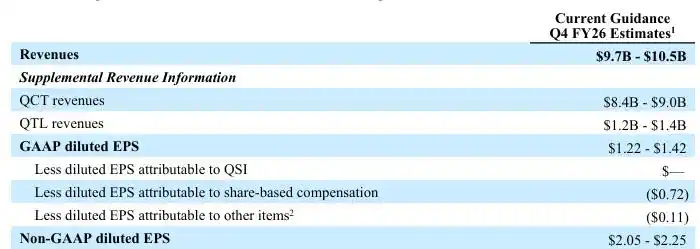
Qualcomm Q4 Financial Guidance

However, the profit guidance still fell short of expectations.

Qualcomm expects fourth-quarter Non-GAAP diluted earnings per share to be between $2.05 and $2.25, while the LSEG-compiled analyst average expectation was $2.36. On a GAAP basis, the earnings per share guidance range is $1.22 to $1.42. Qualcomm stated that this includes $0.72 in stock-based compensation costs and $0.11 in costs from other items.

From this perspective, Qualcomm's upcoming across-the-board chip price increase may not immediately offset the short-term pain caused by current cost increases and smartphone market weakness.

Management has factored these headwinds into its outlook for the fourth quarter and reiterated that the positive impact on gross margins from the pricing changes will materialize over time after they take effect on September 1st.

This article is from the WeChat public account "Tencent Technology", author: Worth Following

Трендовые криптовалюты

Связанные с этим вопросы

QAccording to the article, what is the main reason for Qualcomm's profit decline despite revenue growth?

AThe main reason is the comprehensive rise in semiconductor industry costs, including expenses for wafer manufacturing, assembly, testing, advanced packaging, memory, and other materials. These cost pressures directly impacted the company's profitability.

QWhen will Qualcomm implement a price increase for its chips, and what is the primary reason given for this action?

AQualcomm will implement a company-wide chip price increase starting September 1st. The primary reason is to pass on the significant cost increases the company is facing to its customers, aiming to restore profit margins to historical levels.

QWhich segment of Qualcomm's QCT business showed the most significant growth in the third fiscal quarter, and what was the percentage increase?

AThe Automotive business within the QCT segment showed the most significant growth. It recorded revenue of $1.588 billion, a 61% increase compared to $984 million in the same quarter last year.

QWhat is Qualcomm's financial target for its data center business revenue in the 2027 fiscal year?

AQualcomm's target is for its data center products to generate $5 billion in revenue in the 2027 fiscal year.

QHow did the market react to Qualcomm's fourth-quarter profit guidance, and what was the cause?

AQualcomm's stock price fell more than 5% in after-hours trading. The negative market reaction was caused by the company's fourth-quarter profit guidance falling below market expectations.

Похожее

Вице-президент Coinbase: Войны за регулирование криптовалют закончились

Новый вице-президент Coinbase Райан ВанГрак объявил о завершении периода ожесточённых регуляторных баталий в криптоиндустрии. Назначенный в июле 2026 года, он представляет новый подход компании, фокусирующийся на росте и инновациях вместо судебных разбирательств. Ключевым фактором стало продвижение Закона CLARITY, который устанавливает чёткую федеральную нормативную базу, разграничивая полномочия SEC и CFTC. Это позволяет отрасли развиваться, не борясь за право на существование. Смена главного юрисконсульта Пола Гревала, ведшего масштабный судебный процесс против SEC, на ВанГрака символизирует переход от «советника военного времени» к «дипломату мирного времени». Опыт ВанГрака в SEC и институциональных финансах соответствует новой стратегии Coinbase по трансформации в полноценного поставщика финансовых услуг с расширенным набором продуктов. Законодательство о криптовалютах, в частности двухпартийная поддержка Закона CLARITY, демонстрирует сдвиг в позиции регуляторов: от вопроса о целесообразности существования криптоактивов к вопросу о том, как их регулировать. Тем не менее, риски сохраняются, так как закон ещё не принят окончательно, и на пути к его реализации могут возникнуть препятствия.

cryptonews.ru45 мин. назад

Вице-президент Coinbase: Войны за регулирование криптовалют закончились

cryptonews.ru45 мин. назад

Глубокий анализ FWA: Интересный эксперимент по превращению NFT в «ончейн-гачапон»

**FWA (Fake World Assets): увлекательный эксперимент по превращению NFT в «онлайн-гэча»** FWA — это новая платформа на базе Ethereum, которая функционирует как полностью онлайн-автомат по продаже «гэча» (слепых коробок). Проект позволяет владельцам NFT участвовать в качестве «поставщиков ликвидности», а пользователям — случайно получать эти активы. **Как это работает?** * **Поставщик (Depositor):** блокирует свой NFT вместе с депозитом в ETH («Backing»), создавая позицию. Этот депозит определяет вероятность выпадения его NFT (меньше депозит = выше шанс) и служит гарантией выкупа. * **Покупатель/Игрок (Purchaser):** платит единую для всех цену, рассчитанную системой (среднее гармоническое всех депозитов + сбор), и гарантированно получает случайную позицию. При выигрыше можно либо забрать NFT, либо продать его обратно поставщику, получив 85% от его депозита (в ETH или в токенах $FWA). **Ключевые особенности:** * **Динамическое распределение:** часть сборов от покупок распределяется между поставщиками, стимулируя ликвидность. * **Система обратного веса:** низкие депозиты делают пул доступным, высокие создают редкие «джеко-поты». * **Токен $FWA:** используется для стимулирования и формирует постоянный спрос, поскольку часть депозитов при продаже NFT конвертируется в покупку $FWA на рынке. **Суть проекта:** FWA предлагает новый способ монетизации и торговли NFT, объединяя механизмы ликвидности, азарт слепых коробок и игровую экономику для двух типов участников.

marsbit58 мин. назад

Глубокий анализ FWA: Интересный эксперимент по превращению NFT в «ончейн-гачапон»

marsbit58 мин. назад

Подразделение Samsung изучает инфраструктуру стейблкоинов с оператором Upbit

Компания Samsung SDS, IT-подразделение Samsung Group, изучает возможность создания инфраструктуры для стейблкоинов, систем цифровых активов и платежных моделей на основе ИИ совместно с Dunamu, оператором одной из крупнейших южнокорейских криптобирж Upbit. Это сотрудничество может помочь Samsung SDS укрепить свои позиции на рынке инфраструктуры цифровых активов. Ранее Samsung Electronics анонсировала планы по добавлению поддержки стейблкоинов в Samsung Wallet. Также в мае 2026 года Samsung Securities, SDS и Samsung Card договорились о совместной покупке 4% доли в Dunamu, что углубляет вовлеченность аффилированных компаний Samsung в цифровой сектор Южной Кореи. Инициатива в области цифровых активов развивается на фоне расширения деятельности Samsung SDS в сфере ИИ и облачных сервисов, которые способствовали росту выручки во втором квартале. Компания планирует значительно нарастить мощности своей ИИ-инфраструктуры к 2031 году, совмещая это направление с развитием услуг в области цифровых финансов.

cointelegraph1 ч. назад

Подразделение Samsung изучает инфраструктуру стейблкоинов с оператором Upbit

cointelegraph1 ч. назад

10 тысяч ученых получают год бесплатного доступа: OpenAI переносит научный конвейер в ChatGPT

OpenAI запустила программу «ChatGPT для академических исследователей», предлагая 100 000 ученым бесплатный годовой доступ к своим передовым моделям, включая флагманскую GPT-5.6 Sol Pro. Цель — интегрировать весь научно-исследовательский рабочий процесс — от изучения литературы и генерации гипотез до написания кода, анализа данных и составления рукописей — в единую среду ChatGPT, дополненную инструментами вроде Codex и ChatGPT Work, а также специализированными навыками для наук о жизни и подключением к базам данных. Программа уже пользуется спросом: еженедельно около 1,3 миллиона человек используют ChatGPT для сложных научных и математических задач. OpenAI видит в этом возможность сформировать у исследователей привычку работать в своей экосистеме, повышая будущие затраты на переход после окончания бесплатного периода. Однако у предложения есть ограничения: доступ предоставляется только на использование моделей (без API и без раскрытия весов), предназначен для преподавателей и постдоков из утвержденных учреждений и имеет лимиты использования, аналогичные ChatGPT Pro. Эта стратегия отличается от подхода Anthropic, который предлагает ученым кредиты на API, но также не раскрывает веса моделей. Таким образом, OpenAI укрепляет свои позиции, предоставляя не просто инструмент, а целую рабочую среду, оставаясь при этом закрытой в отношении фундаментальных технологий.

marsbit1 ч. назад

10 тысяч ученых получают год бесплатного доступа: OpenAI переносит научный конвейер в ChatGPT

marsbit1 ч. назад

После вывода 4,4 млрд акционером на рекордные 20 млрд: Что за маневр у Gigadevice?

За месяц акции ведущей китайской компании по производству микросхем памяти GigaDevice (兆易创新) упали с исторического максимума в 846 юаней до около 350 юаней, потеряв в стоимости более 330 млрд юаней. Причиной резкого падения стал выход на IPO аффилированной компании Changxin Technologies, что разрушило логику инвестиций в GigaDevice как в "акцию-тень". Одновременно аналитики Morgan Stanley предупредили о возможном пике цикла роста рынка памяти. Ранее, в период с мая по июнь, крупнейший акционер и председатель правления Чжу Имин продал акций на сумму около 4,4 млрд юаней по цене от 339 до 538 юаней за акцию. После обвала котировок 29 июля он объявил о планах выкупить акций на сумму не менее 1 млрд юаней и предложил компании провести обратный выкуп акций на сумму до 2 млрд юаней, а также пообещал не продавать свои акции в течение года. Хотя операции по продаже были проведены в соответствии с правилами, такая последовательность действий — масштабная продажа на пике с последующими планами выкупа после обвала — подорвала доверие рынка. Полугодовой отчет компании показал впечатляющий рост выручки на 177% и чистой прибыли на 1099%, однако около трети прибыли носит разовый характер. Компания признает высокие циклические риски в своем секторе. Эксперты отмечают долгосрочный потенциал GigaDevice на волне импортозамещения в Китае, однако инвесторам следует четко разделять инвестиции в фундаментальный бизнес компании и риски, связанные с действиями инсайдеров.

marsbit1 ч. назад

После вывода 4,4 млрд акционером на рекордные 20 млрд: Что за маневр у Gigadevice?

marsbit1 ч. назад

Торговля

Спот

Популярные статьи

Как купить CHIP

Добро пожаловать на HTX.com! Мы сделали приобретение USD.AI (CHIP) простым и удобным. Следуйте нашему пошаговому руководству и отправляйтесь в свое крипто-путешествие.Шаг 1: Создайте аккаунт на HTXИспользуйте свой адрес электронной почты или номер телефона, чтобы зарегистрироваться и бесплатно создать аккаунт на HTX. Пройдите удобную регистрацию и откройте для себя весь функционал.Создать аккаунтШаг 2: Перейдите в Купить криптовалюту и выберите свой способ оплатыКредитная/Дебетовая Карта: Используйте свою карту Visa или Mastercard для мгновенной покупки USD.AI (CHIP).Баланс: Используйте средства с баланса вашего аккаунта HTX для простой торговли.Третьи Лица: Мы добавили популярные способы оплаты, такие как Google Pay и Apple Pay, для повышения удобства.P2P: Торгуйте напрямую с другими пользователями на HTX.Внебиржевая Торговля (OTC): Мы предлагаем индивидуальные услуги и конкурентоспособные обменные курсы для трейдеров.Шаг 3: Хранение USD.AI (CHIP)После приобретения вами USD.AI (CHIP) храните их в своем аккаунте на HTX. В качестве альтернативы вы можете отправить их куда-либо с помощью перевода в блокчейне или использовать для торговли с другими криптовалютами.Шаг 4: Торговля USD.AI (CHIP)С легкостью торгуйте USD.AI (CHIP) на спотовом рынке HTX. Просто зайдите в свой аккаунт, выберите торговую пару, совершайте сделки и следите за ними в режиме реального времени. Мы предлагаем удобный интерфейс как для начинающих, так и для опытных трейдеров.

789 просмотров всегоОпубликовано 2026.04.21Обновлено 2026.06.02

Как купить CHIP

Обсуждения

Добро пожаловать в Сообщество HTX. Здесь вы сможете быть в курсе последних новостей о развитии платформы и получить доступ к профессиональной аналитической информации о рынке. Мнения пользователей о цене на CHIP (CHIP) представлены ниже.

活动图片