Polygon burns hit 107M POL this year – So why is its price tanking?

ambcryptoPublished on 2026-07-01Last updated on 2026-07-01

Abstract

Polygon (POL) has burned over 107 million tokens in 2026, becoming net deflationary this year. Its network activity remains strong, achieving the highest stablecoin transaction volume among payment networks in May at 198 million. Major staking activity and whale confidence also support its fundamentals. However, POL's price has declined, recently trading around $0.06948. This price drop is attributed to a prolonged technical downtrend since late 2024, with the asset now in a consolidation pattern and facing significant selling pressure, as indicated by exchange offloads and negative market indicators.

Polygon [POL] is among the widely used chains for payment, with its volume matching or even surpassing that of established networks like Solana [SOL].

In the past 24 hours, POL price has declined by more than 1% after breaking below a support level at $0.07161. The altcoin’s price is currently trading at around $0.06948. Despite the price action declining, its network activity and fundamentals are growing.

A look into Polygon’s strong network activity and fundamentals!

As per Sandeep Nailwal, the founder and CEO of Polygon, the network has burned over 107 million POL tokens in 2026 alone. He celebrated the moment on X by marking,

Officially net deflationary this year.

All this was happening despite Polygon minting over 105 million POL tokens. The burned tokens were coming from the base fees collected, which resulted in a slightly reduced circulating supply.

In contrast, Ethereum [ETH], Solana, and Sui Network [SUI] added hundreds of millions of dollars worth of new tokens to the market.

The high fees were coming from the spike in transactions as a payment protocol. In fact, Polygon had the highest stablecoin volume in May among all payment networks, recording 198 million.

At the same time, whale activity and staking were heightening.

For instance, a whale migrated 17.512 million MATIC to 17.512 million POL worth $1.25 million. This indicated some whales were still confident with the Polygon project.

At the same time, a multisig wallet linked to Stader Labs and Polygon staked 11 million POL worth $839.41K. In total, the wallet has staked over 28 million POL tokens, which has helped reduce circulating supply in the market and improve network security.
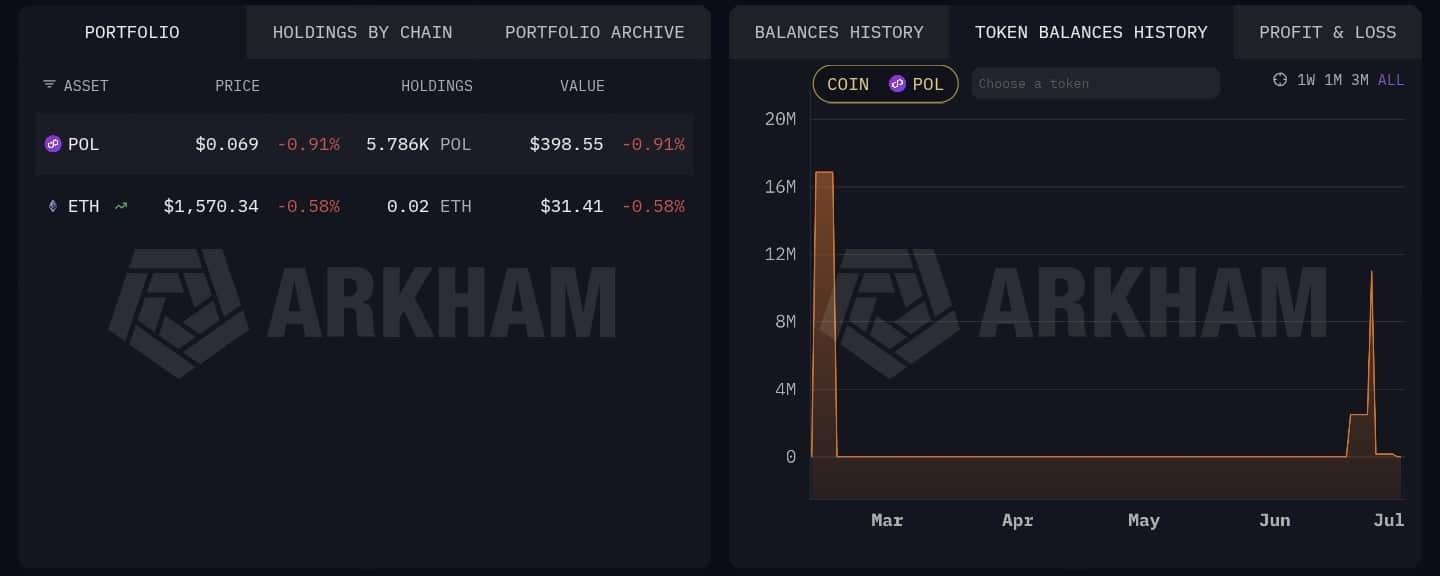
Source: Arkham

While the Polygon chain has continued to display strong fundamentals and network activity, its price action is tanking.

But why is POL price stalling?

Since towards the end of 2024, Polygon has been in a consistent descent. A keen look at its price action shows the altcoin entered a consolidation phase in the form of a triangle pattern, which is nearing a break point.

The weekly chart shows sellers have been highly dominant starting October 2025 as the Bull Bear Power indicator is red. The Cumulative Volume Delta [CVD] too shows selling, indicating 670K POL have been offloaded into exchanges.
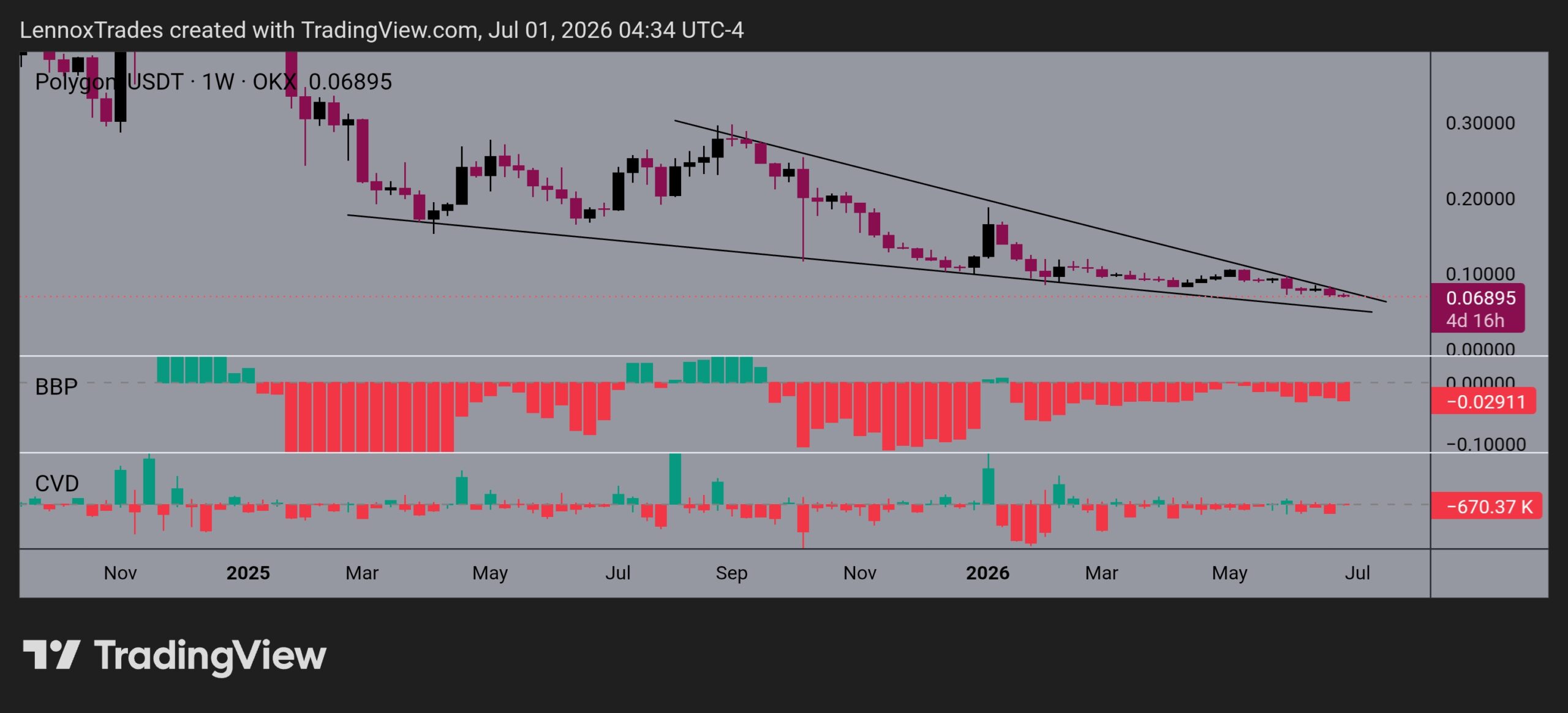
Source: POL/USDT on TradingView

Therefore, Polygon price is stalling because of the technical weakness even though its transaction count and burn rates were growing.


Final Summary

  • Polygon has burned over 107 million POL tokens in 2026 while its transaction volume reached 198 million in May.
  • POL price was trading in a triangle pattern as it has been falling since the end of 2024.

Trending Cryptos

Related Questions

QWhat key contradiction does the article highlight between Polygon's on-chain activity and its market performance?

AThe article highlights that despite Polygon exhibiting strong fundamentals in 2026—such as burning over 107 million POL tokens, recording a high stablecoin transaction volume of 198 million in May, and increased staking activity—its price has been declining, trading in a descending triangle pattern since late 2024.

QAccording to the article, why is Polygon considered 'officially net deflationary this year'?

APolygon is considered net deflationary because in 2026 alone, the network burned over 107 million POL tokens from base fees, which was more than the 105 million POL it minted, resulting in a net reduction in the circulating supply.

QWhat specific technical indicators suggest continued selling pressure on POL's price?

ATechnical indicators showing selling pressure include a red Bull Bear Power indicator starting October 2025 and a negative Cumulative Volume Delta (CVD), which indicates that approximately 670,000 POL tokens have been offloaded onto exchanges.

QHow did Polygon's stablecoin transaction volume in May compare to other payment networks, and what does it signify?

AIn May, Polygon had the highest stablecoin volume among all payment networks, recording 198 million transactions. This signifies its strong adoption and utility as a leading chain for payments, even surpassing established networks like Solana.

QWhat actions by whales and institutional stakers does the article mention as positive for Polygon's network?

AThe article mentions a whale converting 17.512 million MATIC to POL (worth $1.25 million), showing confidence, and a Stader Labs multisig wallet staking 11 million POL (worth ~$839k), bringing its total staked to over 28 million POL, which reduces circulating supply and improves network security.

Related Reads

The Verdict in Choi Tae-won's Divorce Case: Revealing the Inheritance Undercurrent Behind SK Hynix's Trillion-Won Empire

SK Group Chairman Chey Tae-won's high-profile divorce case, involving a record 1.38 trillion won settlement, has drawn attention to the succession plans for Korea's second-largest conglomerate, especially its crown jewel, SK hynix. Unlike traditional chaebol scripts centered on the eldest son, Chey's three children from his marriage to former President Roh Tae-woo's daughter, Roh Soh-yeong, are carving distinct, non-traditional paths. Eldest daughter Chey Yun-jung (b. 1989) is seen as the most evident successor. With a scientific and consulting background, she holds executive roles at SK bioscience and SK Inc.'s growth support department, focusing on future strategy and biopharma. Her marriage is to an AI infrastructure entrepreneur, not a traditional business alliance. Second daughter Chey Min-jung (b. 1991) took a unique route, voluntarily serving as a South Korean naval officer, including an anti-piracy deployment. She later worked on policy and strategy for SK hynix in Washington D.C. before co-founding an AI-driven healthcare startup. She married a former U.S. Marine Corps officer, connecting her to U.S. defense and policy circles—networks crucial for a global semiconductor giant. The only son, Chey In-geun (b. 1995), who studied physics like his father, worked briefly at SK E&S before joining McKinsey. Despite fitting the traditional "heir" profile as the eldest son, he remains silent and holds no public position or shares in SK, suggesting the old succession playbook is obsolete. As SK hynix's valuation soars, becoming a geopolitical asset in the AI era, the heirs' legitimacy is no longer automatic. They must prove themselves in fields like AI biotech, global policy, and strategic consulting. Their marriages also reflect new elite networks in tech and defense, not old political alliances. Their inheritance is the complex challenge of navigating a globalized, tech-driven world, not just a corporate throne.

marsbit22h ago

The Verdict in Choi Tae-won's Divorce Case: Revealing the Inheritance Undercurrent Behind SK Hynix's Trillion-Won Empire

marsbit22h ago

From OpenSea to OpenRouter: Is Alex Atallah Repeating His 'Exit at the Peak' Playbook?

From OpenSea to OpenRouter: Is Alex Atallah Repeating His "Exit at the Peak" Playbook? According to the Wall Street Journal, payments giant Stripe is in talks to acquire the AI model aggregation platform OpenRouter in a potential deal valuing the company near $100 billion. This would mark founder Alex Atallah's second creation of a company reaching a $100 billion valuation, following his co-founding of NFT marketplace OpenSea. OpenRouter, founded just over three years ago, has grown rapidly by acting as a unified gateway for developers to access over 400 AI models. It currently has about 10 million users and processes over 200 trillion tokens monthly. While the platform's annualized revenue is around $50 million, its valuation has skyrocketed from $1.3 billion in March 2026. The potential acquisition by Stripe, a company OpenRouter's founder once likened it to, represents a major expansion into AI infrastructure for the payments leader. This move echoes Atallah's previous timing with OpenSea, where he departed before the NFT market's significant downturn. For OpenRouter, selling now may be strategic. Despite its scale, its business model—charging a 5-5.5% fee on AI inference calls—faces pressure from competition, open-source models, and potential price wars among model providers, limiting its profitability narrative for an IPO. A key asset for potential acquirers like Stripe is OpenRouter's vast repository of real-world AI usage data, which offers unique insights into model performance and developer preferences that are difficult to replicate. Whether this potential deal signifies a new valuation benchmark for AI infrastructure or another market peak signal remains to be seen.

链捕手22h ago

From OpenSea to OpenRouter: Is Alex Atallah Repeating His 'Exit at the Peak' Playbook?

链捕手22h ago

Trading

Spot

Hot Articles

How to Buy POL

Welcome to HTX.com! We've made purchasing Polygon Ecosystem Token (POL) simple and convenient. Follow our step-by-step guide to embark on your crypto journey.Step 1: Create Your HTX AccountUse your email or phone number to sign up for a free account on HTX. Experience a hassle-free registration journey and unlock all features.Get My AccountStep 2: Go to Buy Crypto and Choose Your Payment MethodCredit/Debit Card: Use your Visa or Mastercard to buy Polygon Ecosystem Token (POL) instantly.Balance: Use funds from your HTX account balance to trade seamlessly.Third Parties: We've added popular payment methods such as Google Pay and Apple Pay to enhance convenience.P2P: Trade directly with other users on HTX.Over-the-Counter (OTC): We offer tailor-made services and competitive exchange rates for traders.Step 3: Store Your Polygon Ecosystem Token (POL)After purchasing your Polygon Ecosystem Token (POL), store it in your HTX account. Alternatively, you can send it elsewhere via blockchain transfer or use it to trade other cryptocurrencies.Step 4: Trade Polygon Ecosystem Token (POL)Easily trade Polygon Ecosystem Token (POL) on HTX's spot market. Simply access your account, select your trading pair, execute your trades, and monitor in real-time. We offer a user-friendly experience for both beginners and seasoned traders.

4.2k Total ViewsPublished 2024.09.12Updated 2026.06.02

How to Buy POL

Discussions

Welcome to the HTX Community. Here, you can stay informed about the latest platform developments and gain access to professional market insights. Users' opinions on the price of POL (POL) are presented below.

活动图片














