dogwifhat jumps 16% – but massive resistance stands in WIF’s path to more gains

ambcryptoPublished on 2026-06-28Last updated on 2026-06-28

Abstract

Dogwifhat (WIF) surged 16% in 24 hours, marking a potential rebound after a 38% year-to-date decline. However, the rally faces a major obstacle: a persistent descending resistance line that has rejected price advances three times previously. While key indicators like Accumulation/Distribution and the Money Flow Index signal strong buying pressure and capital inflow, WIF must achieve a confirmed breakout and close above this resistance to sustain its upward momentum. Additionally, liquidation data suggests limited near-term upside and room for further downside. The token's outlook hinges on decisively overcoming this key technical barrier.

dogwifhat [WIF] is staging a comeback after spending most of the year subdued, with the memecoin down 38% on a year-to-date basis yet up 16% over the past day.

Market analysis shows that a stronger rally could still take shape once the asset overcomes the key structural level that could keep its price from staging a surge.

A descending resistance line caps WIF’s rally

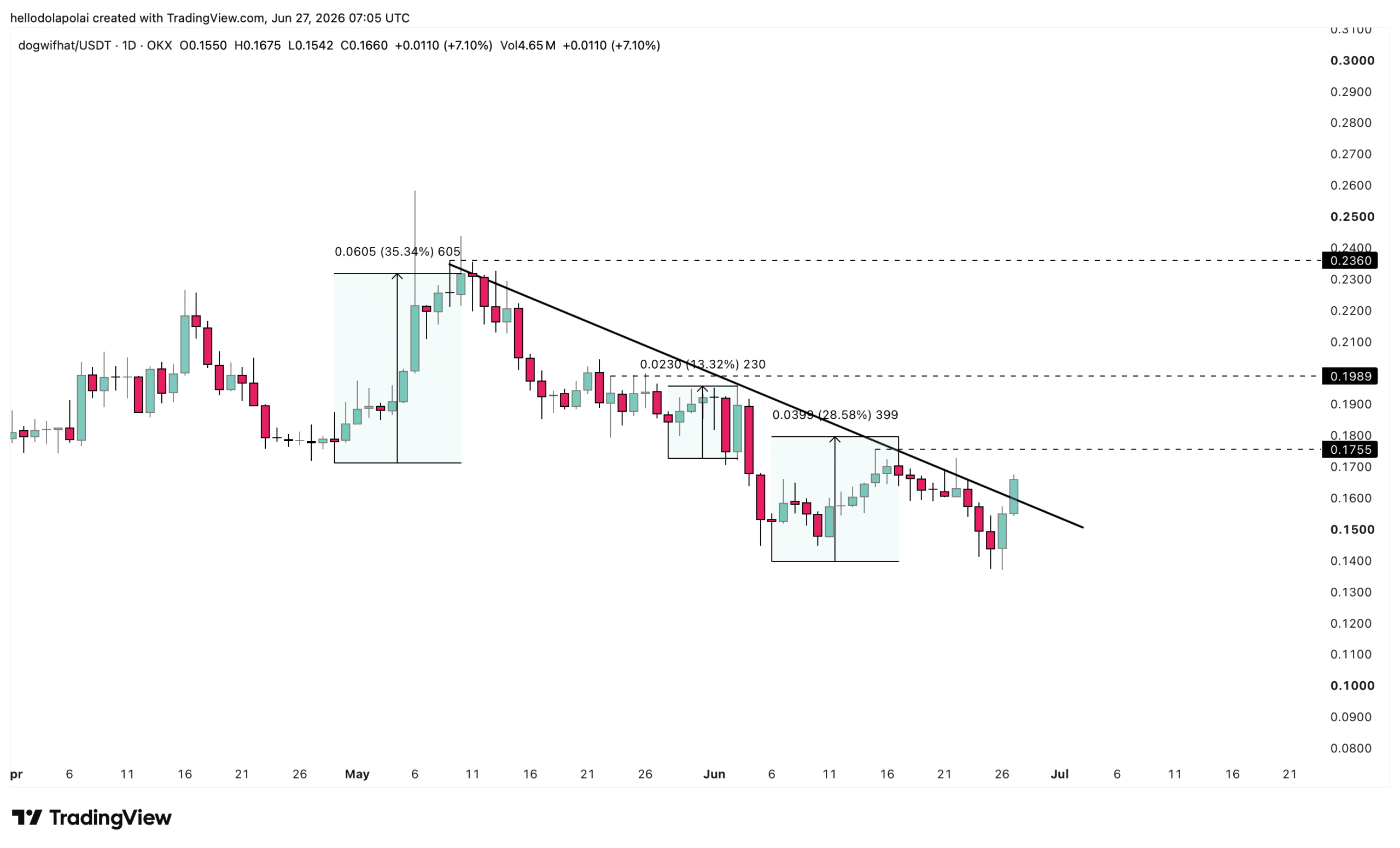
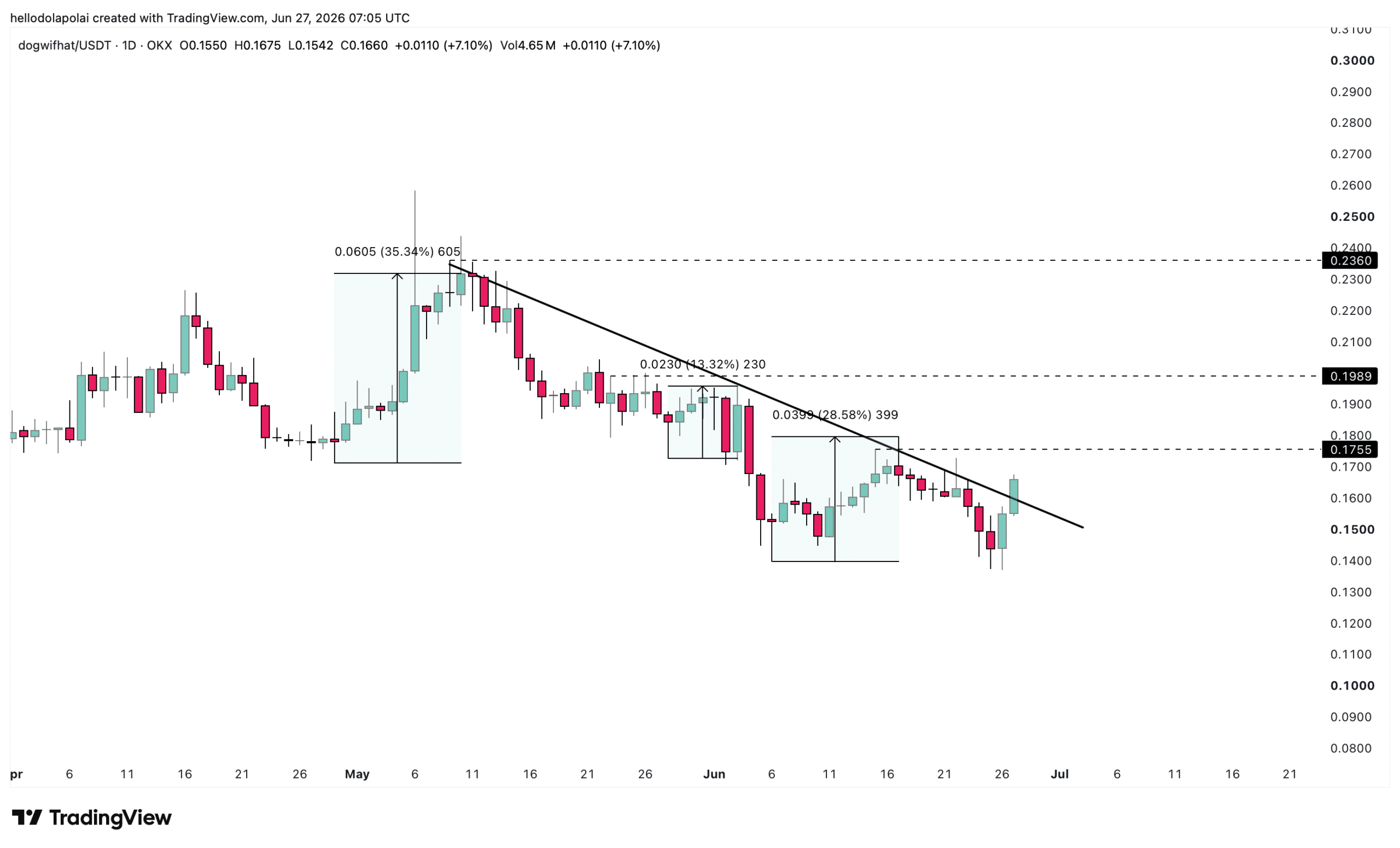
The major obstacle standing between WIF and a sizeable rally remains the descending resistance line that price has only marginally crossed.

The breakout cannot be confirmed as bullish yet. WIF’s price has not closed above the descending line, nor has it continued along the bullish path it began carving out days earlier.
Source: TradingView

For context, this same resistance has repeatedly capped WIF’s advances and forced the token to trade lower thrice in a row, even though each run leading into the level delivered double-digit gains.

A failure to push higher would leave WIF trudging beneath the resistance line for an extended period, adding to the 48 days it has already spent trading below this barrier.

Capital and buying indicators back WIF

WIF stands a strong chance of a major upswing, with the key indicators that track capital flow and buying activity all pointing in the same direction.

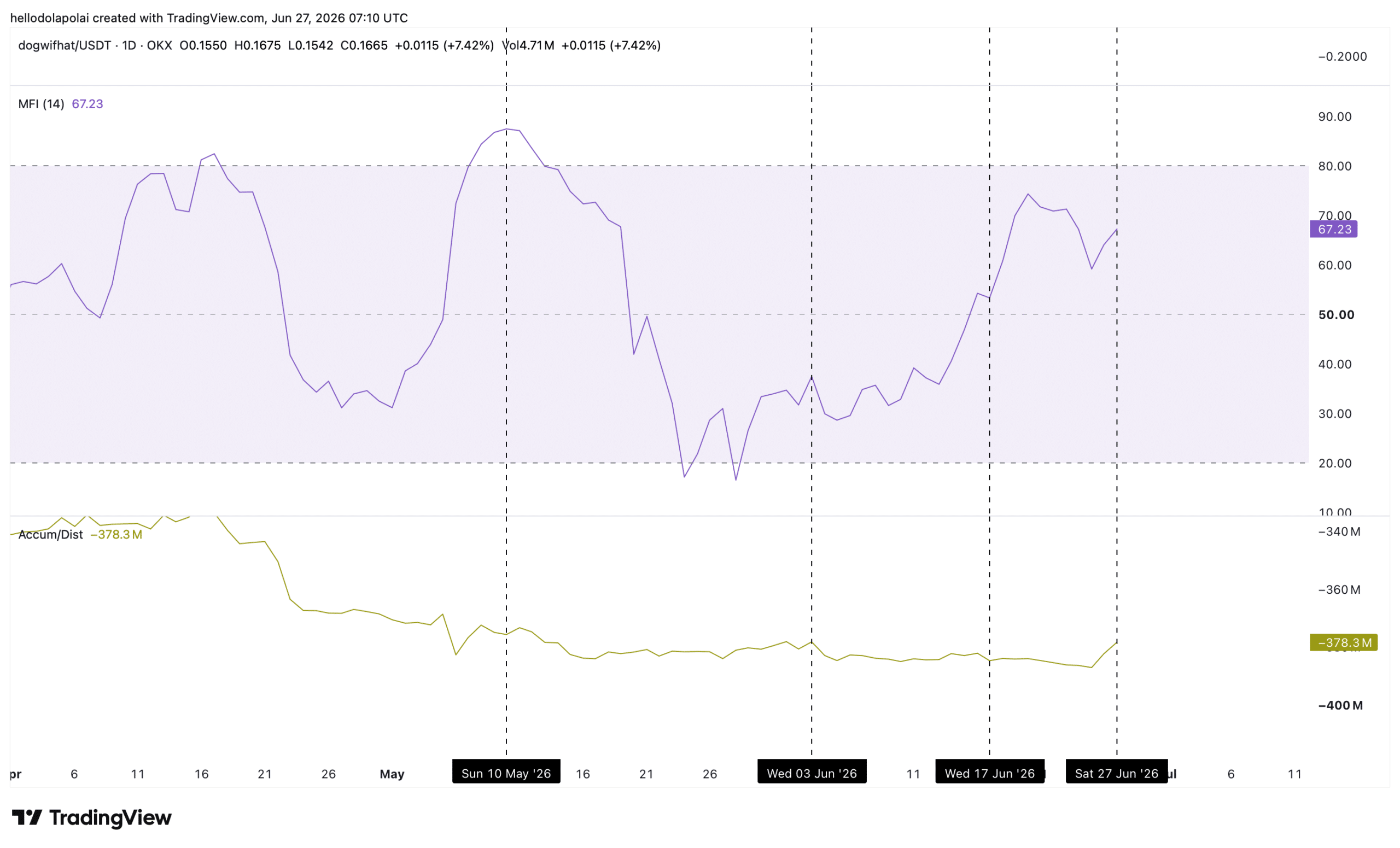
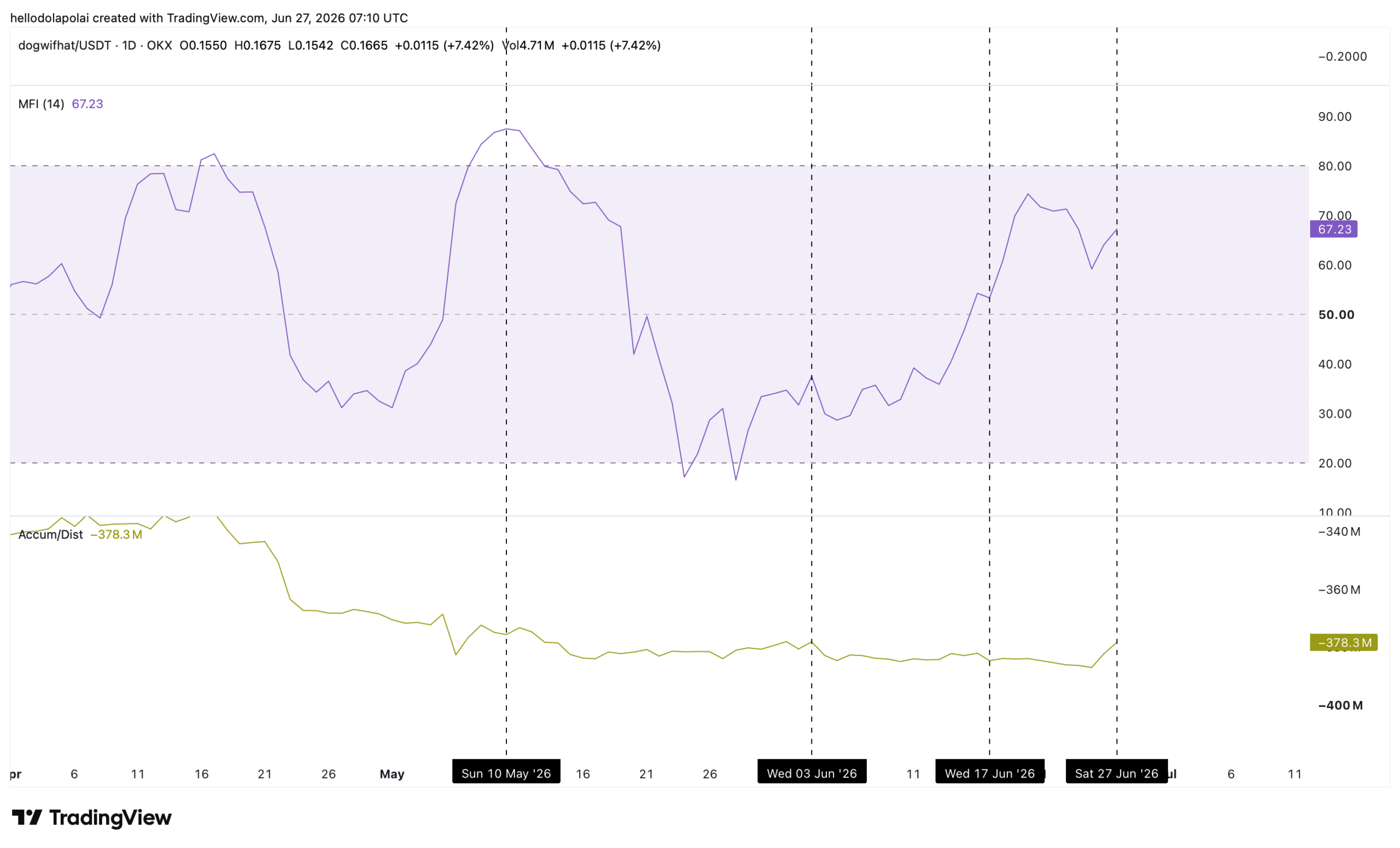
The accumulation/distribution indicator is showing a powerful upswing, which implies sustained buying, while total volume has settled at around 378 million WIF traded over the past 24-hour window.

Adding to this, the money flow index—which measures the movement of capital into and out of an asset—is surging upward at a reading of 67, signaling that more capital has flowed into WIF. More importantly, that reading sits in the bullish zone above 50, suggesting investors are actively buying.
Source: TradingView

The pattern worth noting appears at the vertical lines marking the points where price failed to breach the resistance mentioned earlier, where both indicators rallied into the level together—unlike previous instances in which one indicator rose while the other lagged, or one sat in overvalued territory.

A continued upward move would meaningfully reshape the outlook for WIF, since it would confirm a close above the resistance and establish a sustained bullish pattern.

Liquidation clusters limit WIF’s upside

The liquidation chart shows that WIF’s possible upside is limited, based on the arrangement of its clusters, which mark the levels where unfilled orders sit.

The downside below the current price level extends even further, suggesting WIF could still fall well beneath its present position despite the bullish momentum on display.

An important caveat applies here, as the liquidation heatmap offers only a glimpse rather than an extended view across a broader price spectrum. That leaves it unknown whether more buy orders sit beyond what the chart currently displays.


Final Summary

  • WIF has bounced 16% in a day after a rough year down 38%, and the signals that track buying activity suggest investors are stepping back in.
  • The rally isn’t safe yet, as WIF still needs to firmly clear a price ceiling that has rejected it three times before, and there’s room for it to slip lower first.


Related Questions

QWhat is the current short-term performance of the dogwifhat (WIF) token mentioned in the article?

AAccording to the article, dogwifhat (WIF) has jumped 16% over the past day.

QWhat is identified as the major obstacle preventing WIF from a stronger rally?

AA descending resistance line is identified as the major obstacle. The price has not confirmed a bullish breakout as it hasn't closed above this line, which has rejected price advances three times before.

QWhat do the Accumulation/Distribution indicator and Money Flow Index suggest about buying activity for WIF?

AThe Accumulation/Distribution indicator shows a powerful upswing, implying sustained buying. The Money Flow Index is surging at a reading of 67, which is above 50, signaling that more capital is flowing into WIF and investors are actively buying.

QAccording to the article, what does the liquidation heatmap suggest about WIF's potential price movement?

AThe liquidation heatmap suggests that WIF's possible upside is limited by the arrangement of liquidation clusters. It also indicates that the downside below the current price level extends further, meaning WIF could still fall well beneath its present position despite the current bullish momentum.

QWhat two key points are summarized at the end of the article regarding WIF's outlook?

AFirst, WIF has bounced 16% with buying indicators suggesting investor interest is returning. Second, the rally isn't safe yet as WIF needs to firmly clear a key price resistance level that has rejected it three times, and there is room for the price to slip lower first.

Related Reads

The Verdict in Choi Tae-won's Divorce Case: Revealing the Inheritance Undercurrent Behind SK Hynix's Trillion-Won Empire

SK Group Chairman Chey Tae-won's high-profile divorce case, involving a record 1.38 trillion won settlement, has drawn attention to the succession plans for Korea's second-largest conglomerate, especially its crown jewel, SK hynix. Unlike traditional chaebol scripts centered on the eldest son, Chey's three children from his marriage to former President Roh Tae-woo's daughter, Roh Soh-yeong, are carving distinct, non-traditional paths. Eldest daughter Chey Yun-jung (b. 1989) is seen as the most evident successor. With a scientific and consulting background, she holds executive roles at SK bioscience and SK Inc.'s growth support department, focusing on future strategy and biopharma. Her marriage is to an AI infrastructure entrepreneur, not a traditional business alliance. Second daughter Chey Min-jung (b. 1991) took a unique route, voluntarily serving as a South Korean naval officer, including an anti-piracy deployment. She later worked on policy and strategy for SK hynix in Washington D.C. before co-founding an AI-driven healthcare startup. She married a former U.S. Marine Corps officer, connecting her to U.S. defense and policy circles—networks crucial for a global semiconductor giant. The only son, Chey In-geun (b. 1995), who studied physics like his father, worked briefly at SK E&S before joining McKinsey. Despite fitting the traditional "heir" profile as the eldest son, he remains silent and holds no public position or shares in SK, suggesting the old succession playbook is obsolete. As SK hynix's valuation soars, becoming a geopolitical asset in the AI era, the heirs' legitimacy is no longer automatic. They must prove themselves in fields like AI biotech, global policy, and strategic consulting. Their marriages also reflect new elite networks in tech and defense, not old political alliances. Their inheritance is the complex challenge of navigating a globalized, tech-driven world, not just a corporate throne.

marsbitYesterday 09:06

The Verdict in Choi Tae-won's Divorce Case: Revealing the Inheritance Undercurrent Behind SK Hynix's Trillion-Won Empire

marsbitYesterday 09:06

From OpenSea to OpenRouter: Is Alex Atallah Repeating His 'Exit at the Peak' Playbook?

From OpenSea to OpenRouter: Is Alex Atallah Repeating His "Exit at the Peak" Playbook? According to the Wall Street Journal, payments giant Stripe is in talks to acquire the AI model aggregation platform OpenRouter in a potential deal valuing the company near $100 billion. This would mark founder Alex Atallah's second creation of a company reaching a $100 billion valuation, following his co-founding of NFT marketplace OpenSea. OpenRouter, founded just over three years ago, has grown rapidly by acting as a unified gateway for developers to access over 400 AI models. It currently has about 10 million users and processes over 200 trillion tokens monthly. While the platform's annualized revenue is around $50 million, its valuation has skyrocketed from $1.3 billion in March 2026. The potential acquisition by Stripe, a company OpenRouter's founder once likened it to, represents a major expansion into AI infrastructure for the payments leader. This move echoes Atallah's previous timing with OpenSea, where he departed before the NFT market's significant downturn. For OpenRouter, selling now may be strategic. Despite its scale, its business model—charging a 5-5.5% fee on AI inference calls—faces pressure from competition, open-source models, and potential price wars among model providers, limiting its profitability narrative for an IPO. A key asset for potential acquirers like Stripe is OpenRouter's vast repository of real-world AI usage data, which offers unique insights into model performance and developer preferences that are difficult to replicate. Whether this potential deal signifies a new valuation benchmark for AI infrastructure or another market peak signal remains to be seen.

链捕手Yesterday 08:42

From OpenSea to OpenRouter: Is Alex Atallah Repeating His 'Exit at the Peak' Playbook?

链捕手Yesterday 08:42

Trading

Spot
活动图片




