Super Spiral Mega-Boom, Micron's Earnings Report Rekindles the Semiconductor Bull Run

Odaily星球日报Xuất bản vào 2026-06-25Cập nhật gần nhất vào 2026-06-25

Tóm tắt

On June 25, 2026, Micron Technology released its blockbuster Q3 FY2026 results, significantly exceeding market expectations and reigniting confidence in the semiconductor bull market. Revenue soared to $41.456 billion (vs. ~$35.4B expected), up 346% year-over-year, while GAAP net profit surged nearly 15 times to $28.243 billion. Guidance for Q4 was even more striking, with projected revenue of approximately $50 billion, far surpassing prior estimates. The report highlighted that the AI boom is now fueling growth across Micron's entire product stack, not just HBM. Cloud memory, core data center, SSD, mobile, and automotive businesses all saw revenue growth exceeding 250-600%, with margins hovering around 80%. While HBM4 is already in volume shipment and 2026 capacity is sold out, AI-driven demand is also tightening supply for traditional DRAM and NAND, sustaining a strong pricing cycle. A pivotal development is Micron's shift toward a "demand-first" model. The company disclosed 16 long-term strategic customer agreements (SCAs), most spanning 5 years to 2030, covering about 20% of DRAM and one-third of NAND shipments. These are take-or-pay contracts, with 14 agreements already securing roughly $100 billion in guaranteed future revenue and $22 billion in customer performance assurances. To fulfill this locked-in demand, Micron plans substantial capacity expansion, with Q4 capital expenditure projected at ~$10 billion. This investment, backed by concrete long-term orders rathe...

Original | Odaily Planet Daily (@OdailyChina)

Author | Azuma (@azuma_eth)

At midnight Beijing time on June 25th, the highly anticipated Micron Q3 FY2026 earnings report was officially released.

Prior to this quarter's report, Micron found itself in a somewhat awkward position. On one hand, everyone knew it would deliver an outstanding report. On the other hand, everyone also knew that the market had already priced in such "outstanding" performance.

Over the past few weeks, various market participants have been speculating around the same question — for a memory giant already at the heart of the AI wave, just how strong do its results need to be to continue driving its stock price higher and inject further confidence into the already frenzied semiconductor bull market?

The answer is — more exaggerated than anyone expected!

The Market Was Aggressive Enough, But Still Conservative

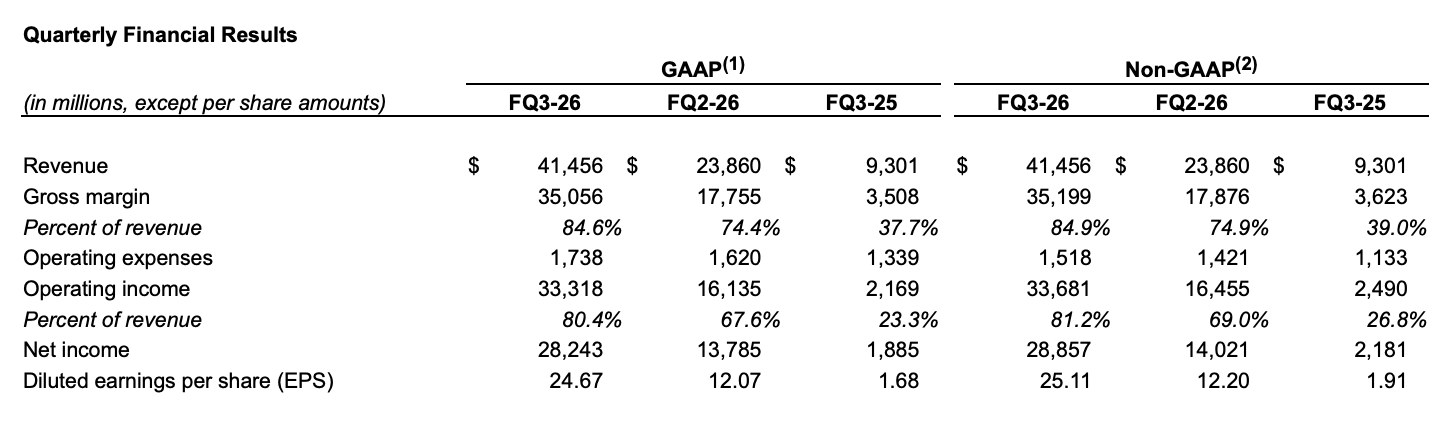
The Q3 report released this morning shows that Micron's third-quarter revenue reached $41.456 billion (consensus estimates were around $35.4 billion), a staggering year-over-year increase of 346%; GAAP net profit was $28.243 billion, up nearly 15 times year-over-year; adjusted earnings per share were $25.11.
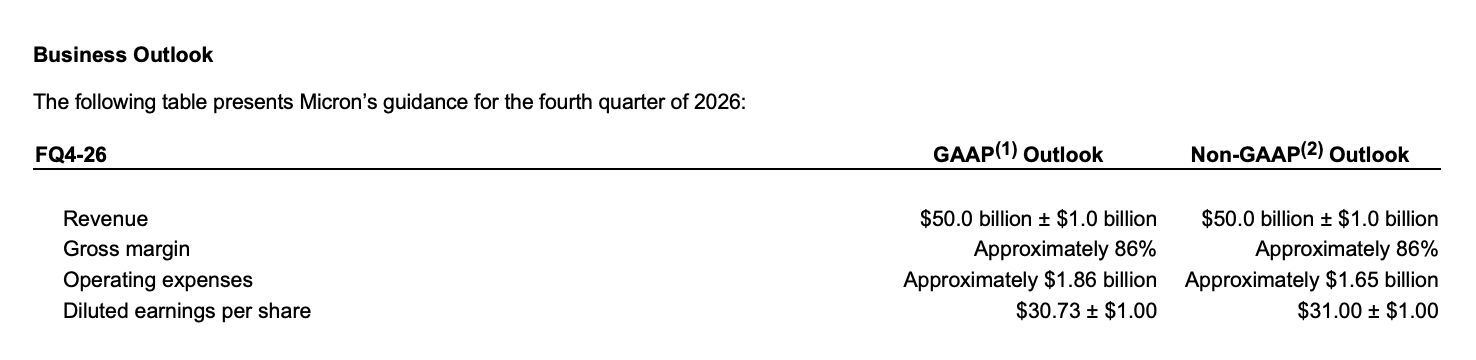
Even more exaggerated is the next quarter's guidance. Micron expects its Q4 revenue to reach $50 billion (plus or minus $1 billion), far exceeding the market's previous expectation of about $42.9 billion and even Goldman Sachs's aggressive forecast of $48.8 billion (widely seen as the most optimistic scenario); Q4 gross margin is expected to be about 86%, with EPS expected to reach around $31.
This is why many investors exclaimed the same sentiment immediately after the report's release: this is what you call a super, invincible, spiral, explosive, sky-rocketing earnings report!

From HBM to SSD, the Entire Memory Stack is Sprinting

If one were to identify a core driver for this round of growth, the answer remains, of course, AI. However, compared to the HBM that the market has repeatedly discussed over the past year, a more noteworthy point in this report is — AI's influence has begun to spread throughout the entire memory supply chain.

From a business structure perspective, almost all of Micron's core businesses are growing simultaneously, including:

  • Cloud memory business revenue reached $13.77 billion, up over 300% year-over-year;
  • Core data center business revenue reached $11.52 billion, up over 600% year-over-year;
  • Data center SSD revenue exceeded $5 billion;
  • Mobile and client business grew over 250% year-over-year;
  • Automotive and embedded business also achieved over 300% growth;
  • Gross margins across business lines generally remained around 80% or higher.

This signifies that the current AI wave is benefiting not just a single product, but the entire memory industry chain comprehensively.

On one hand, HBM remains the most direct beneficiary. Micron stated that HBM4 has begun volume shipments to core customers, with samples already delivered to multiple end customers; HBM4E is progressing as planned and is expected to enter mass production in 2027. Simultaneously, the company reiterated that its 2026 HBM capacity is completely sold out.

On the other hand, the continued expansion of AI training and inference demand is also driving concurrent growth in high-end DRAM, enterprise SSD, and NAND product demand. As more advanced capacity is prioritized for HBM, supply in the traditional DRAM and NAND markets tightens further, propelling the entire memory market into its strongest pricing cycle in recent years.

This is also why Micron remains extremely optimistic about the industry's outlook. Management expects the tight supply-demand situation in the DRAM and NAND markets to persist beyond 2027. In other words, in Micron's view, the industry is not nearing a cycle peak, but rather resembles the early stages of the AI infrastructure construction cycle.

Long-Term Agreements Locked In as Far Out as 2030

If we merely interpret this earnings report as a victory for HBM, we might still be underestimating its true significance. Because compared to the $50 billion revenue guidance, perhaps the most noteworthy numbers in this report are another set — $100 billion.

On the earnings call, Micron disclosed that to date, the company has signed 16 long-term strategic customer agreements (SCAs) covering data center, consumer electronics, and automotive customers. Most of these agreements have terms of up to 5 years, with some automotive client agreements lasting 3 years, extending as far out as the end of 2030.

These agreements already cover approximately 20% of DRAM shipments and about one-third of NAND shipments. As more agreements are finalized, over half of future revenue is expected to fall under the long-term agreement framework.

It is important to emphasize that these agreements are not traditional supply contracts. Management confirmed that the agreements utilize a strongly binding Take-or-Pay model. Even if customers do not fully take delivery in the future, they are still obligated to fulfill the agreed purchase commitments. Some major agreements even incorporate price ceiling and floor mechanisms, with the ceiling anchored to Q2 FY2026 market prices. Even at the agreement's price floor, the corresponding gross margin level remains significantly higher than Micron's historical cycle peaks.

Based on data disclosed by Micron management, 14 of these agreements currently correspond to guaranteed revenue of approximately $100 billion; concurrently, customers will also provide a total of about $22 billion in performance guarantees, with roughly $18 billion in cash form, which can be directly used to support future capacity construction and R&D investment.

For the memory industry, this is almost a historic change. For decades, the industry's operating logic has been "expand capacity first, then wait for demand to catch up"; now, Micron is gradually shifting to another model — lock in orders first, then expand capacity.

This is also what excites the capital market the most. Because it means Micron's current profitability is no longer based solely on expectations for a cyclical upturn, but is underpinned by long-term contracts.

Capacity Expansion, Expansion, and More Expansion, $10 Billion to be Spent in Q4

If long-term agreements answer "where is the demand coming from?", then capital expenditure answers another question — how does Micron plan to meet this demand?

The report shows that Micron expects Q4 capital expenditure to reach approximately $10 billion (higher than Wall Street's previous expectation of about $8.9 billion). Full-year FY2026 capital expenditure is projected to be around $27 billion, and quarterly capital expenditure in FY2027 will be higher than the Q4 FY2026 level. New investments will primarily be used for HBM, advanced DRAM, and advanced packaging capacity construction.

In the past, such capital expenditure figures might have raised market concerns. After all, for the memory industry, "large-scale capacity expansion" is hardly an unfamiliar phrase. Historically, whether it's Samsung, SK Hynix, or Micron itself, companies have ramped up investment at industry peaks, ultimately leading to oversupply, price collapses, and亲手 ending the previous bull market.

But this time, things seem to be changing. The reason is simple — this new capacity is not based on optimistic forecasts of future demand, but on long-term orders already signed.

On one side is $100 billion in guaranteed revenue, $22 billion in performance guarantees, and long-term agreements extending to 2030; on the other side is continuously expanding HBM, advanced DRAM, and advanced packaging capacity. Comparing these data points, the current capacity expansion appears more like executing already locked-in orders, rather than the traditional cycle-betting expansion based on demand forecasts.

Micron's Earnings Report Rekindles the Semiconductor Bull Market

Prior to the release of Micron's quarterly report, market sentiment surrounding the ongoing semiconductor bull run had shown signs of wavering.

Earlier this week, the South Korean semiconductor sector experienced a noticeable pullback, with leading companies like SK Hynix and Samsung Electronics collectively under pressure. Some investors began to worry whether the AI trade had become too crowded after over a year of frenzied gains.

And Micron's answer was quite direct — demand hasn't peaked; the market is still underestimating demand.

From the far-exceeding-expectations Q3 performance and the high $50 billion Q4 revenue guidance; from the sold-out HBM capacity to the long-term strategic agreements extending to 2030 — all convey the same signal: AI infrastructure construction is accelerating, not slowing down.

Following the report's release, Micron's stock surged 16% in after-hours trading, driving collective gains for other U.S. semiconductor companies like Intel, ASML, Marvell, and Qualcomm. Japanese and South Korean markets also opened higher and rose today, with the South Korean market experiencing another trading halt, and Samsung and Hynix both rebounding significantly. After the A-share market opened, the semiconductor industry chain also strengthened, led by memory and advanced packaging sectors.

In a sense, this is no longer just an earnings report belonging to Micron, but another confidence booster for the entire semiconductor industry. Because the market has reconfirmed one thing — the AI story is far from over, and memory is becoming an increasingly important protagonist in this story.

Tiền kỹ thuật số thịnh hành

Câu hỏi Liên quan

QWhat were the key financial highlights of Micron's Q3 2026 earnings report?

AMicron's Q3 2026 revenue reached $41.456 billion, a 346% year-over-year increase, significantly exceeding the expected ~$35.4 billion. GAAP net profit was $28.243 billion, up nearly 1500% year-over-year. Adjusted earnings per share were $25.11. The company's Q4 guidance forecasts revenue of approximately $50 billion, far surpassing prior market expectations.

QWhat is driving the explosive growth across Micron's business segments, and which product is specifically mentioned as a direct beneficiary?

AThe explosive growth is primarily driven by the AI wave. While the impact has expanded across the entire memory stack, the High Bandwidth Memory (HBM) remains the most direct beneficiary. Micron confirmed that HBM4 is in volume production for core customers, HBM4E is on schedule, and all HBM capacity for 2026 is sold out.

QWhat significant change in business model does Micron's 16 Long-term Strategic Customer Agreements (SCAs) represent for the memory industry?

AThe 16 'take-or-pay' SCAs, some extending to 2030, represent a historic shift. Instead of the traditional industry model of 'expand capacity first, then wait for demand to catch up,' Micron is moving towards a model of 'lock in orders first, then expand capacity.' This provides guaranteed future revenue and reduces cycle volatility.

QHow is Micron's massive capital expenditure plan for Q4 2026, estimated at ~$10 billion, different from historical expansion cycles?

AThis massive capital expenditure is fundamentally different. It is not based on speculative future demand forecasts, but is primarily driven by the need to fulfill the firm, long-term 'take-or-pay' customer agreements already secured. This makes the expansion more akin to executing on locked-in orders rather than a traditional gamble on the cycle.

QHow did Micron's earnings report impact broader market sentiment towards the semiconductor sector?

AMicron's report, with its hugely exceeded expectations and strong long-term visibility, re-ignited confidence in the semiconductor bull market. It countered recent concerns about AI trade saturation by signaling that AI infrastructure build-out is accelerating. This led to a surge in Micron's stock and sparked rallies across U.S., South Korean, and A-share semiconductor stocks.

Nội dung Liên quan

Phần Lan 'cắt bỏ' cáp: Các nhà mạng Nga phải tìm kiếm tuyến đường mới cho internet

Công ty năng lượng Phần Lan Fingrid đã thông báo cho các nhà mạng Nga rằng từ năm 2027 sẽ ngừng bảo trì các cột đường dây điện, nơi lắp đặt cáp quang kết nối giữa Nga và Phần Lan. Kế hoạch là cắt bỏ cáp và tháo dỡ các cột này. Lý do chính thức là việc ngừng cung cấp điện từ Nga sang Phần Lan từ năm 2022, khiến việc bảo trì cột chỉ phục vụ mục đích viễn thông trở nên không kinh tế. Phía Nga cho biết đường dây 400 kV này hiện chỉ hoạt động hạn chế và sẽ được tận dụng cho mục đích trong nước. Kênh kết nối này rất quan trọng, ước tính sau năm 2022, khoảng 60-70% lưu lượng Internet quốc tế của Nga đi qua Phần Lan, trong đó riêng đường dây trên cột điện chiếm tới 30% tổng liên kết với nước này. Các nhà mạng Nga đang đàm phán tìm tuyến đường thay thế qua Belarus, các nước Baltic và hệ thống cáp ngầm dưới Biển Baltic. Dự kiến không ảnh hưởng lớn đến người dùng, nhưng có thể xảy ra việc định tuyến lại, giảm mức độ dự phòng mạng và tăng độ trễ khi truy cập tài nguyên nước ngoài, đặc biệt ở khu vực Tây Bắc và phần châu Âu của Nga. Phân tích dữ liệu chỉ ra rằng việc chuyển hướng sang cáp ngầm Baltic cũng tiềm ẩn rủi ro kỹ thuật do dễ bị hư hại. Bối cảnh này trùng hợp với xu hướng tự chủ kỹ thuật số trong nước, đặt ra câu hỏi về tương lai của các kênh kết nối quốc tế đối với Nga.

cryptonews.ru1 giờ trước

Phần Lan 'cắt bỏ' cáp: Các nhà mạng Nga phải tìm kiếm tuyến đường mới cho internet

cryptonews.ru1 giờ trước

Sau quyết định về lãi suất của Fed và tuyên bố từ Kevin Walsh, các chuyên gia tập hợp lại và chia sẻ nhận định mới nhất!

Sau quyết định giữ nguyên lãi suất của Fed và các phát biểu từ Chủ tịch Kevin Warsh, các chuyên gia đã đưa ra nhận định mới nhất. Việc ba thành viên FOMC bỏ phiếu chống lại quyết định này củng cố dự báo về một giai đoạn chính sách độc lập và phân hóa hơn trong nội bộ Ủy ban. Mặc dù lợi tức trái phiếu giảm nhẹ và đồng USD suy yếu sau thông báo, khả năng tăng lãi suất vào tháng 9 vẫn chưa bị loại trừ. Chuyên gia Mark Hackett nhận định ba phiếu chống có thể báo hiệu một xu hướng mới tại Fed, với các thành viên hành động độc lập hơn. Ông lưu ý thị trường vẫn cần chờ đợi họp báo của Chủ tịch Warsh để có cái nhìn rõ ràng hơn. Chiến lược gia Audrey Child-Freeman cho rằng Fed vẫn giữ lập trường diều hâu, và kịch bản lợi tức trái phiếu cao hỗ trợ đồng USD vẫn có hiệu lực trong mùa hè. Phân tích Chris Anstey nhấn mạnh thị trường sẽ theo dõi sát sao biến động lợi tức trái phiếu Kho bạc kỳ hạn 10 năm xung quanh họp báo. Việc lợi tức dài hạn tiếp tục tăng có thể phản ánh lo ngại nhà đầu tư về nỗ lực kiểm soát lạm phát chưa đủ của Fed. Nhà kinh tế trưởng Diane Swonk tại KPMG bày tỏ quan điểm rằng Fed nên tăng lãi suất ngay từ cuộc họp này và dự báo một đợt tăng vào tháng 9, cảnh báo lạm phát cao kéo dài có nguy cơ trở thành vấn đề cố hữu.

cryptonews.ru2 giờ trước

Sau quyết định về lãi suất của Fed và tuyên bố từ Kevin Walsh, các chuyên gia tập hợp lại và chia sẻ nhận định mới nhất!

cryptonews.ru2 giờ trước

Đã công bố các altcoin có số lượng người dùng hoạt động lớn nhất trong tuần qua!

Các blockchain và ứng dụng phi tập trung (DApps) với số lượng người dùng hoạt động hàng tuần lớn nhất trên thị trường tiền điện tử vừa được công bố. Dữ liệu mới nhất cho thấy $BNB Chain dẫn đầu danh sách với 13,8 triệu người dùng hoạt động hàng tuần. Số liệu này thường đo lường số lượng địa chỉ ví duy nhất thực hiện ít nhất một giao dịch trong mạng hoặc giao thức trong 7 ngày qua. Ngoại trừ Bitcoin, các dự án tiền điện tử có số người dùng hoạt động hàng tuần cao nhất được xếp hạng như sau: 1. Mạng $BNB ($BNB) – 13,8 triệu (tăng 2,6%) 2. Solana (SOL) – 9,9 triệu (tăng 0,6%) 3. Tron (TRX) – 8,7 triệu (tăng 3,3%) 4. opBNB – 5 triệu (giảm 3,1%) 5. World Mobile Chain (WMTX) – 3,2 triệu (không đổi) 6. Ethereum (ETH) – 2,6 triệu (tăng 3%) 7. Polygon (POL) – 1,6 triệu (giảm 14%) 8. Uniswap (UNI) – 1,4 triệu (tăng 62,8%) – mức tăng trưởng mạnh nhất. 9. Avalanche (AVAX) – 1,3 triệu (giảm 0,3%) 10. PancakeSwap (CAKE) – 1,2 triệu (giảm 3,8%) 11. Litecoin (LTC) – 1,1 triệu (giảm 2,7%) 12. Base – 952.400 (giảm 36,8%) 13. Robinhood Chain – 948.800 (tăng 37.625%) – mức tăng trưởng phi mã. 14. Celo (CELO) – 810.900 (tăng 8,5%) *Đây không phải là lời khuyên đầu tư.

cryptonews.ru2 giờ trước

Đã công bố các altcoin có số lượng người dùng hoạt động lớn nhất trong tuần qua!

cryptonews.ru2 giờ trước

“Tôi không có thời gian cố thuyết phục anh” – cụm từ nổi tiếng của Satoshi tròn 16 tuổi

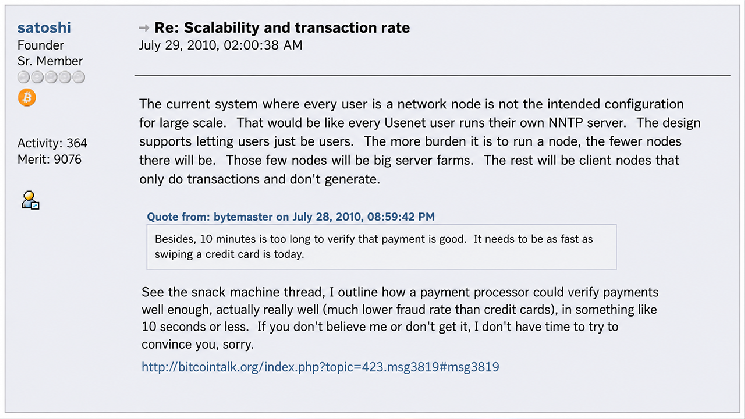
Ngày 29 tháng 7 năm 2010, Satoshi Nakamoto đã đăng một bài trả lời trên Bitcointalk mang tên "Re: Khả năng mở rộng và tốc độ giao dịch". Một người dùng có tên bytemaster chỉ trích rằng cửa sổ xác nhận 10 phút của Bitcoin là quá chậm. Satoshi giải thích rằng một bộ xử lý thanh toán có thể xác nhận giao dịch một cách an toàn chỉ trong "khoảng 10 giây hoặc ít hơn". Sau đó, ông nói thêm một câu đã trở nên nổi tiếng: "Nếu bạn không tin tôi hoặc không hiểu, tôi không có thời gian để cố gắng thuyết phục bạn, xin lỗi." Câu nói này nổi bật vì nó trái ngược với phong cách thường thấy trong phần lớn thư từ và bài đăng của Satoshi, vốn được đặc trưng bởi sự kiên nhẫn và sẵn sàng giải thích các khái niệm kỹ thuật một cách tỉ mỉ. Tuy nhiên, vào thời điểm tháng 7/2010, ông đã phải trả lời cùng một lời chỉ trích về khả năng mở rộng nhiều lần. Trong các cuộc thảo luận này, ông luôn trình bày một triết lý thiết kế nhất quán: Bitcoin không bao giờ dự định để mọi người dùng đều vận hành một node đầy đủ. Ông so sánh điều này với việc yêu cầu mọi người dùng Usenet chạy máy chủ NNTP, và hình dung rằng phần lớn người dùng sẽ là các client nhẹ, trong khi một số ít server chuyên dụng đảm nhận công việc nặng hơn. Phong cách của Satoshi là sự tự tin dựa trên số liệu và lập luận kỹ thuật, không phải sự khoa trương. Ông thảo luận về quy luật Moore, cơ chế phí giao dịch, và giới hạn 21 triệu đồng coin như những quyết định thiết kế có cân nhắc. Trong thư từ riêng với các cộng tác viên đầu tiên như Martti "Sirius" Malmi, ông thể hiện sự hợp tác và khiêm tốn, thậm chí nhờ Malmi giúp viết FAQ vì "tôi không viết tốt lắm". Ngược lại, trong các bài đăng công khai, ông đóng vai trò một người hướng dẫn, giải thích các khái niệm như chữ ký số và vấn đề double-spending cho đối tượng rộng rãi. Ngay cả khi bày tỏ sự không đồng tình, Satoshi tránh các cuộc tấn công cá nhân. Ông thẳng thắn thừa nhận những thiếu sót của chính mình, chẳng hạn như việc đặt tên file mã nguồn không tối ưu. Trong email cuối cùng được biết đến gửi cho Gavin Andresen, ông yêu cầu không miêu tả mình như một "nhân vật bí ẩn trong bóng tối" mà nên ghi nhận đóng góp của cả nhóm phát triển rộng lớn hơn. Cuộc tranh luận về khả năng mở rộng đã khơi nguồn cho câu nói nổi tiếng của Satoshi vẫn tiếp diễn cho đến ngày nay, trong các cuộc thảo luận về kích thước block, phí giao dịch và thu nhập từ khai thác. Việc xem lại thư từ gốc cho thấy mô hình thiết kế "node đầy đủ cho một số ít, client nhẹ cho số đông" là một phần của kế hoạch ban đầu. Câu trả lời với bytemaster vẫn là một lời nhắc nhở: ngay cả một người kiên nhẫn và tận tâm giải thích như Satoshi cũng có giới hạn khi phải lặp lại cùng một câu trả lời nhiều lần.

cryptonews.ru2 giờ trước

“Tôi không có thời gian cố thuyết phục anh” – cụm từ nổi tiếng của Satoshi tròn 16 tuổi

cryptonews.ru2 giờ trước

Người sáng tạo DOGE chia sẻ trải nghiệm sử dụng memecoin đáng nhớ nhất của mình

Người sáng tạo Dogecoin, Billy Marcus (biệt danh Shibetoshi Nakamoto), đã chia sẻ trải nghiệm đáng nhớ nhất khi sử dụng đồng tiền meme DOGE. Ông kể lại việc vào tháng 7/2022, đã dùng DOGE để thanh toán cho một chuyến đi trên hệ thống tàu điện ngầm Las Vegas Loop của công ty The Boring Company thuộc sở hữu của Elon Musk. Marcus nhấn mạnh rằng việc này chứng minh giá trị thực tế của Dogecoin, vượt ra ngoài phạm vi giao dịch thuần túy. Ông cho biết kỷ niệm này còn quan trọng hơn tất cả các giao dịch tiền mã hóa khác mà ông từng thực hiện. Câu chuyện được ông chia sẻ để trả lời một bài đăng trên mạng xã hội hỏi về những trải nghiệm tiền mã hóa khác thường. Bài viết cũng đề cập đến quan điểm gần đây của Marcus về thị trường, khi ông mô tả xu hướng giảm giá kéo dài là "nhàm chán". Về tình hình thị trường, đồng DOGE đã giảm 3% trong tháng, với giá trị vốn hóa thị trường hiện tại khoảng 12,07 tỷ USD. Marcus nổi tiếng với những phát ngôn thẳng thắn, từng chỉ trích nhiều đồng tiền mã hóa là "rác" và có những bình luận gây tranh cãi nhắm vào các nhân vật nổi bật trong ngành.

cryptonews.ru2 giờ trước

Người sáng tạo DOGE chia sẻ trải nghiệm sử dụng memecoin đáng nhớ nhất của mình

cryptonews.ru2 giờ trước

Giao dịch

Giao ngay

Bài viết Nổi bật

Làm thế nào để Mua MEGA

Chào mừng bạn đến với HTX.com! Chúng tôi đã làm cho mua MegaETH (MEGA) trở nên đơn giản và thuận tiện. Làm theo hướng dẫn từng bước của chúng tôi để bắt đầu hành trình tiền kỹ thuật số của bạn.Bước 1: Tạo Tài khoản HTX của BạnSử dụng email hoặc số điện thoại của bạn để đăng ký tài khoản miễn phí trên HTX. Trải nghiệm hành trình đăng ký không rắc rối và mở khóa tất cả tính năng. Nhận Tài khoản của tôiBước 2: Truy cập Mua Crypto và Chọn Phương thức Thanh toán của BạnThẻ Tín dụng/Ghi nợ: Sử dụng Visa hoặc Mastercard của bạn để mua MegaETH (MEGA) ngay lập tức.Số dư: Sử dụng tiền từ số dư tài khoản HTX của bạn để giao dịch liền mạch.Bên thứ ba: Chúng tôi đã thêm những phương thức thanh toán phổ biến như Google Pay và Apple Pay để nâng cao sự tiện lợi.P2P: Giao dịch trực tiếp với người dùng khác trên HTX.Thị trường mua bán phi tập trung (OTC): Chúng tôi cung cấp những dịch vụ được thiết kế riêng và tỷ giá hối đoái cạnh tranh cho nhà giao dịch.Bước 3: Lưu trữ MegaETH (MEGA) của BạnSau khi mua MegaETH (MEGA), lưu trữ trong tài khoản HTX của bạn. Ngoài ra, bạn có thể gửi đi nơi khác qua chuyển khoản blockchain hoặc sử dụng để giao dịch những tiền kỹ thuật số khác.Bước 4: Giao dịch MegaETH (MEGA)Giao dịch MegaETH (MEGA) dễ dàng trên thị trường giao ngay của HTX. Chỉ cần truy cập vào tài khoản của bạn, chọn cặp giao dịch, thực hiện giao dịch và theo dõi trong thời gian thực. Chúng tôi cung cấp trải nghiệm thân thiện với người dùng cho cả người mới bắt đầu và người giao dịch dày dạn kinh nghiệm.

Tổng lượt xem 576Xuất bản vào 2026.04.30Cập nhật vào 2026.06.02

Làm thế nào để Mua MEGA

Thảo luận

Chào mừng đến với Cộng đồng HTX. Tại đây, bạn có thể được thông báo về những phát triển nền tảng mới nhất và có quyền truy cập vào thông tin chuyên sâu về thị trường. Ý kiến ​​của người dùng về giá của MEGA (MEGA) được trình bày dưới đây.

活动图片