Crypto GPs' Midlife Crisis: No PMF, No LP's Next Check

链捕手Publié le 2026-06-01Dernière mise à jour le 2026-06-01

Résumé

The article "The Midlife Crisis of Crypto GPs: No PMF, No LP's Next Check" analyzes the shifting crypto fundraising landscape. It argues that the era of LPs funding vague "vision" is over; GPs must now offer products with clear Product-Market Fit (PMF) to secure capital. The market has matured. LPs, disillusioned by the last cycle's failures and wary of long lock-up periods, now demand tangible, near-term returns rather than speculative narratives. The proliferation of accessible crypto ETFs and other liquid products has reduced the need for VC blind pools as an entry point. The author categorizes crypto fundraising products into three types: Primary (VC funds, with blind pools or clear pipelines), Liquid (alpha/beta, directional/market-neutral strategies), and CeFi/DeFi Native Yield (crypto-specific mechanisms like staking, farming). Focusing on the Primary market, the piece details why traditional LP rationales for investing in crypto VCs have weakened: easier beta access via ETFs, diminished "access" and "judgement" premiums as LPs build internal teams, and a widespread lack of proven superior returns from GPs. Ultimately, only specific players are likely to remain at the primary VC table: large funds with access to patient endowment capital, family offices/HNWIs investing proprietary capital, the few funds with demonstrable excess returns from the last cycle, and those with clear "deal-making" or ecosystem resource advantages. For others, the path forward is to rebuil...

Author: Yi.Pineapple

LPs no longer buy dreams; GPs must sell products. This article will attempt to categorize current crypto fundraising products into three types: Primary, Liquid, and CeFi / DeFi Native Yield. The first part will focus on Primary: After VC blind pools lose their appeal, who remains at this table, and who must prove themselves anew? The answer is at the end; feel free to scroll down.

Note: This article aims to provide a landscape description of the entire crypto fundraising market. The first part mainly categorizes and explains the market status from a product perspective, while the next part will analyze it more from the LP's perspective. As the author is primarily in the Asian market, this article may have a regional bias.

Market Status

After losing the grand vision, most Crypto GPs who failed to earn excess returns this cycle must now ground themselves and launch a product with PMF (Product-Market Fit). They must either re-prove their ability to generate excess returns for LPs in niche markets or demonstrate their capacity to solve specific problems for LPs/partners to survive.

  • For most GPs, the market has long transitioned from a phase of "buying a future vision" to one of "buying a specific product."
  • LPs have lost patience and no longer want to gaze at the stars and the ocean; they want to see immediate, tangible, and relatively certain opportunities to make money.
  • Crypto LPs have lost trust in the market and are no longer willing to easily believe the "next cycle" narrative (this has been discussed too much and won't be elaborated here). Moreover, many haven't made easy money this cycle; when money becomes harder to earn, investment actions tend to become more cautious and conservative.
  • Most traditional LPs have also completed a round of learning, moving past the storytelling phase. The 2020/2021 bull market was the peak of market FOMO. Dollar funds were cheap (Treasury yield near 0), LPs were making relatively easy money (on the eve of the economic downturn), and Crypto was in an explosive growth phase (with numerous rags-to-riches stories and dreams to sell). Back then, many were willing to impulse buy into the dream even if they didn't fully understand crypto, or they entered strategically to learn.
  • AI and declining labor costs have also changed GPs' niche. The cost for LPs to learn, hire, analyze data, trade, and make small direct investments is decreasing. The trend of LPs transforming into GPs is significant. GPs who only offer vague capabilities like "I understand crypto" will find their value increasingly precarious.
  • In terms of storytelling, unless it's a strong US-based fund with a proven track record pitching visions in specific niches (like a16z leveraging its AI advantage to pitch crypto * AI, or Dragonfly pitching internet capital markets based on its investments in Ethena/Polymarket), opportunities remain. In Asia, this niche is already difficult, as both crypto projects and funds, to some extent, only get the chance to tell stories if they are "White Papers."

Product Landscape

This article divides crypto fundraising products into three main categories for discussion: Primary, Liquid, and CeFi / DeFi Native Yield (Note: This classification is not entirely precise, with some blurry areas between the three). (*This part covers Primary first)

Primary VC:

In terms of transparency, they can roughly be divided into blind pools and those with clear pipelines.

In terms of liquidity, they can roughly be divided into primary and primary-secondary markets.
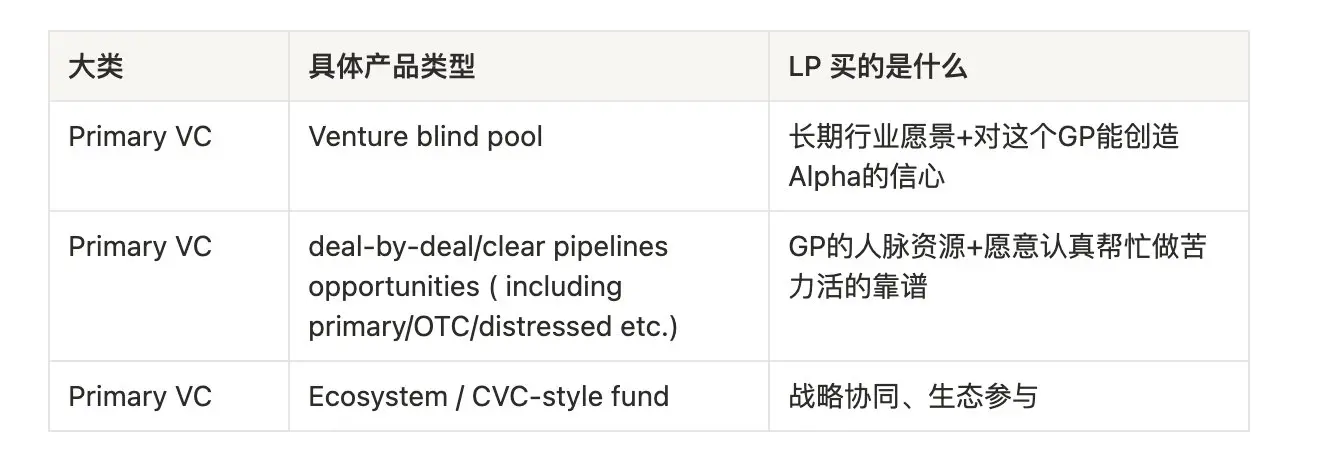
Liquid:

Divided by source of returns, roughly into alpha-focused (buying the GP's personal skill) and beta-focused (buying industry trends).

Divided by directionality, roughly into directional (buying cycle timing) and market neutral (buying market inefficiencies in immature markets).
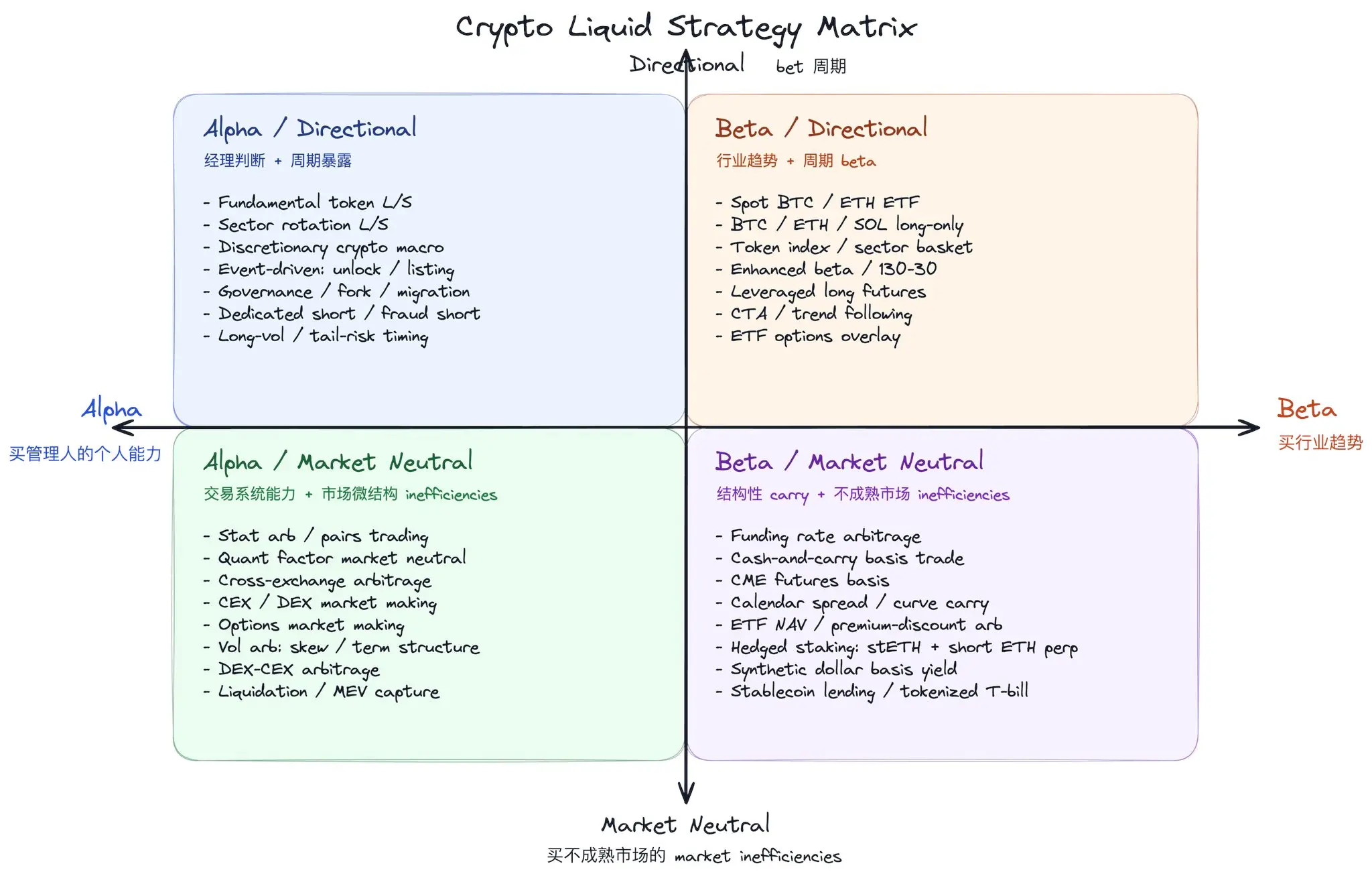
There are many ways to categorize; this is just one idea.

CeFi/DeFi Native Yield:

Theoretically, CeFi/DeFi Native Yield could be seen as a source of returns within or spanning both the crypto primary and liquid markets. The main reason for separating it is that from a TradFi investor's perspective, they usually use traditional financial frameworks to understand crypto: for example, crypto VC can be seen as a sub-sector of VC, and staking/lending yield can be analogous to fixed income or cash management products.

However, crypto does have some mechanisms and playbooks not fully mirrored in traditional finance, such as farm-and-dump, points/airdrop farming, protocol incentives, and on-chain liquidity mining. These are more like crypto-native distribution, customer acquisition, and incentive mechanisms, warranting separate discussion.

Secondly, for many Crypto Native Investors, their initial entry point to understanding financial markets was not the traditional equity/bond market, but crypto-native scenarios like exchange wealth management products, staking, DeFi lending, providing liquidity, points/airdrop farming, and basis trades. Therefore, they might not first translate this yield into TradFi terms like fixed income, cash management, or alternative yield. Instead, they more naturally understand it from angles like protocol incentives, liquidity provision, token emission, on-chain risks, counterparty risk, and capital efficiency.

For Crypto Native LPs, accessing this yield doesn't require a GP, maybe just a reliable key account manager.

For TradFi LPs, some institutions are now packaging this yield into fund products to sell to them.

Primary Market

From the perspective of the entire primary market, crypto VC is just a sub-sector under the broad VC category. 2021 was a crazy year; whether crypto or non-crypto, the real returns from that vintage are poor. As a cruel fact, LPs have learnt their lessons and are tired of any product with ultra-long lock-ups (traditional VC often 10 years, crypto VC often 5-10 years). Because without hard locks, they at least have a chance to withdraw some money if circumstances change.

In some sense, crypto is worse off than traditional VC because the grand vision has collapsed. It is not a new industrial revolution, at most a revolution in financial infrastructure. This judgment is not to disparage crypto; financial infrastructure revolution is still important, but it's not as grand as many imagined in the last bull run. Worse, the market was too immature back then; many projects were funded without sufficient due diligence and legal protection. Many failures are a combination of investment failure and founder exit. Too many articles in the industry describe the current misery, so we won't elaborate here.

Investing in VC is like VC investing in startups: it's a power-law business, a lottery-like business. As long as someone is willing to buy lottery tickets, this table won't disappear.

Why LPs invested in crypto VC back then, and why these reasons have weakened now:

1. Invest to capture the beta of the industry

This reason was particularly true for TradFi LPs. It held early on because market choices were few. For outsiders, onboarding, buying tokens, going on-chain, using CEXs, and managing wallets were difficult. They feared losing private keys and CEXs running away. Investing in VC seemed like a more reliable access point.

But today, a traditional LP entering crypto has a full suite of choices: BTC ETF, ETH ETF, crypto ETPs, DATs, custody accounts, SMAs, structured products. More importantly, these products don't require learning on-chain operations; they trade like stocks.

According to CoinShares, global digital asset investment products AUM (ETF/ETP/trust/closed-end funds, etc.) reached about $156.9B in mid-May 2026. This number isn't total industry AUM, just a tally of listed or quotable products, but it shows: gaining crypto exposure no longer requires investing in a VC blind pool.

However, for long-term capital with clear mandates (e.g., endowments, etc.), this reason still applies. For them, positioning in an industry often involves a basket of assets, so there's still likely a 1~2% allocation to Crypto VC.

2. Invest for deal accessibility

This typically applied to crypto LPs and some TradFi LPs with strategic layout visions. Many such LPs didn't have the resources/time/capability to build their own investment teams, so they gave money to GPs hoping for good deal access.

But they later found this reason unstable. When the market was good, GPs themselves had insufficient allocation, and LPs struggled to get real access. When the market was bad, competition wasn't fierce; if you were willing to reach out, getting allocation wasn't that hard.

For traditional LPs, access had another meaning: they knew nothing initially but hoped to enter the ecosystem and gain insider information by investing in crypto-native GPs. It was a form of strategic investment when there was no clear strategic target. Now the situation has changed. Many traditional LPs have either left for hotter fields like AI, or have developed their own internal teams. AI and cheap analysts have narrowed the knowledge gap. New learners still exist, but they learn faster and have more paths. Investing in the primary market with ultra-long lock-ups is not necessarily the optimal choice for them anymore.

3. Invest for superior judgment

This is the trickiest part. In a rapidly evolving market, unless a GP can continuously self-iterate, the judgment premium disappears quickly. The rules change every cycle, but people don't change easily (is this another form of "old habits die hard").

We must face a harsh reality: Most GPs did not prove to LPs they had superior judgment in the last cycle.

For traditional LPs, part of the reason for investing in crypto-native GPs was to educate themselves and learn the industry through the GP's judgment. This typically applied to two types: companies wanting to strategically enter Web3 (like internet giants, etc.), and sophisticated TradFi investors (like traditional GPs or family offices) who wanted to later do their own direct Web3 investments. The learning phase is over. Only a few GPs who have truly proven superior judgment remain on their investment lists.
For crypto LPs, they found it better to lose money themselves than to bet on a GP's judgment. Losing money yourself at least has emotional value, and you don't pay management fees.

4. Invest for deal-making ability

From an investment return perspective, deal-making ability primarily manifests as whether it can achieve good final exits for projects. Ideally, it's best to help projects achieve healthy growth for good secondary market returns. Failing that, the ability to organize the next round of financing is also important (essentially, the difference between relying on retail or large investors to take over).

However, as a form of financial innovation, Crypto sometimes resembles a large-scale capital game. Sometimes, investment is just a form of interest exchange, ensuring aligned interests to make money together relatively safely.

5. Invest for reputation

For some large LPs, money invested in a single VC might only be 1% of their overall portfolio, insignificant. Sometimes they invest in a GP just to be cool (like investing in A16Z). But most GPs aren't in this category.

Who can still stay at the primary table

From a pure capital source perspective, the players most likely to remain at the primary table are:

Funds large enough to enter the mandate of endowments/other similar long-term patient capital. These institutions buy crypto VC as lottery tickets without short-term funding pressure.

FOs, companies, and HNW individuals investing proprietary capital in primary crypto investments. FOs/HNWs are more likely to run accelerator-like, very early-stage funds; companies are more likely to make direct strategic investments/acquisitions.

The few funds that struck gold/bought BTC this cycle and genuinely delivered excess returns to LPs. LPs believe they can win next time.

Funds with clear deal-making ability, possessing ecosystem resources to exchange interests with LPs.

For other players, if trust is lost, it might be better to restart mentally and rebuild trust. Re-prove the ability to generate excess returns for investors in a niche, or provide some specific service/value, then scale based on that.


Cryptos en tendance

Questions liées

QAccording to the article, why must crypto GPs shift from selling visions to selling products with PMF?

ABecause LPs have lost patience and trust. They no longer want to buy distant 'future visions' or 'next cycle' stories, especially after many failed to achieve outsized returns in the last cycle. LPs now demand immediate, relatively certain opportunities to make money. Therefore, GPs must offer concrete products with Product-Market Fit (PMF) to survive.

QWhat are the three broad categories of crypto fundraising products mentioned in the article?

AThe three broad categories are: 1) Primary (e.g., VC blind pools, funds with clear pipelines, primary and secondary deals), 2) Liquid (e.g., funds focused on alpha/beta, directional/market-neutral strategies), and 3) CeFi / DeFi Native Yield (e.g., staking, lending, airdrop farming, protocol incentives).

QWhy is the 'CeFi/DeFi Native Yield' category discussed separately from Primary and Liquid markets?

AIt's discussed separately for two main reasons. First, from a TradFi perspective, these yields (like staking) are often analogized to fixed income, but crypto has unique mechanics (like airdrop farming) not fully present in traditional finance. Second, for Crypto Native investors, these were their first entry points into finance, so they view them through a crypto-native lens of protocol incentives and on-chain risks, not just as traditional yield products.

QWhat are two reasons mentioned for why LPs' original motivations for investing in crypto VC funds have weakened?

ATwo key reasons are: 1) **Invest to Capture Industry Beta**: This is less valid now as traditional LPs have many easier alternatives for crypto exposure (like BTC/ETH ETFs, ETPs, SMA) without the long lock-ups of VC funds. 2) **Invest for Accessibility/Judgement**: LPs found that during bull markets, good deal access wasn't guaranteed, and during bear markets, it's easier to get. Furthermore, most GPs failed to demonstrate superior investment judgement in the last cycle, and LPs can now build internal teams or learn faster using AI, reducing their reliance on GPs for access and insight.

QBased on the article, which types of players are most likely to remain active in the crypto primary (VC) market?

AThe players most likely to remain are: 1) Large funds that can secure mandates from endowments or other long-term patient capital, treating crypto VC as a lottery ticket. 2) Family offices (FOs), high-net-worth individuals (HNWIs), or companies investing their own capital, often in very early-stage or strategic investments. 3) The few funds that delivered outsized returns in this cycle (e.g., by betting on successful projects like Bitcoin), thus maintaining LP trust. 4) Funds with clear ecosystem resources and deal-making ('攒局') capabilities that can offer value exchange to LPs.

Lectures associées

Soudain, Google Earth retire en urgence la fonctionnalité de génération d'images Nano Banana 2 !

**Google Earth retire d'urgence la fonctionnalité de génération d'image Nano Banana 2** Google a brièvement intégré son dernier modèle de génération d'image, Nano Banana 2, à Google Earth, permettant aux utilisateurs de transformer, via de simples invites textuelles, des vues satellites ou aériennes en scènes historiques, visualisations architecturales ou créations futuristes, le tout ancré dans les contraintes géospatiales réelles (topographie, perspectives 3D). Cette technologie, baptisée « ancrage géospatial » (Geospatial Grounding), s'appuie sur les données cartographiques et les capacités de recherche de Google pour générer des images crédibles intégrées au paysage. Cependant, cette fonctionnalité a été rapidement retirée après son lancement. Bien que Google ait présenté des cas d'usage potentiels en éducation, tourisme ou urbanisme, les utilisateurs s'en sont rapidement emparés pour créer des contenus fantaisistes, comme transformer le Independence Hall de Philadelphie en ruine post-apocalyptique peuplée de zombies et de clowns maléfiques. Cette expérience, qualifiée par certains de « bouillie d'IA » (AI Slop) pour son manque de rigueur géométrique, a révélé des problèmes de modération. Google a indiqué retirer temporairement l'outil pour « renforcer les mesures de protection » avant un éventuel nouveau déploiement. Cette initiative place Google sur un terrain unique face à des concurrents comme Midjourney ou DALL-E : plutôt que de simplement « bien dessiner », il s'agit de « remodeler la Terre » de manière crédible en s'appuyant sur son immense base de données géographiques, créant ainsi un nouveau champ : la visualisation IA géo-an crée.

marsbitIl y a 1 h

Soudain, Google Earth retire en urgence la fonctionnalité de génération d'images Nano Banana 2 !

marsbitIl y a 1 h

Une transformation majeure de la Fed ? Rapport : Walsh envisage de réduire la fréquence des réunions sur les taux, rompant avec une tradition de 40 ans

Le président de la Fed, Walsh, envisage de réduire la fréquence des réunions du Comité fédéral de l'open market (FOMC), ce qui constituerait un changement majeur dans son fonctionnement, en rupture avec la routine établie depuis 1981 de huit réunions par an. Selon des informations du New York Times, Walsh a évoqué cette idée lors de la réunion cette semaine. Un nouvel horaire pourrait être arrêté avant la prochaine réunion de septembre, bien que les changements concrets interviendraient plus tard. Réduire le nombre de réunions diminuerait les opportunités de voter sur les taux et pourrait affaiblir la capacité de réaction de la Fed face à l'évolution de l'économie, tout en réduisant la transparence de sa politique, inversant une tendance de plusieurs décennies. La loi bancaire de 1935 n'exige qu'un minimum de quatre réunions par an. Walsh avait précédemment déclaré au Congrès que quatre réunions étaient insuffisantes, ce qui contraste avec la direction actuelle des discussions. Le système actuel de huit réunions, instauré sous Paul Volcker, fournit un cadre prévisible. Moins de réunions signifierait moins d'occasions pour le marché de comprendre la trajectoire des taux. Cette initiative s'inscrit dans la volonté plus large de Walsh de réformer l'institution depuis sa prise de fonction en mai, notamment en réduisant la longueur des communiqués et en repensant les conférences de presse. Historiquement, la fréquence des réunions a varié, avec jusqu'à 19 réunions en 1956. Une évaluation interne de 1988 avait conclu que le rythme de huit réunions restait approprié. Le projet de Walsh irait à l'encontre de cette conclusion, et son impact potentiel sur la communication de la Fed et la flexibilité de sa politique sera surveillé de près.

marsbitIl y a 1 h

Une transformation majeure de la Fed ? Rapport : Walsh envisage de réduire la fréquence des réunions sur les taux, rompant avec une tradition de 40 ans

marsbitIl y a 1 h

Sélections hebdomadaires de la rédaction (25-31 juillet)

**Résumé éditorial hebdomadaire (25-31 juillet)** Face au flux incessant d'informations, cette sélection met en avant des analyses de fond pour filtrer le bruit et offrir des insights. **Marchés & Investissement :** La Réserve Fédérale américaine a maintenu ses taux lors d'une réunion jugée très incertaine, tiraillée entre des données inflationnistes en baisse et des positions d'hawks. Dans la cryptosphère, Real Vision réfléchit à la valeur à long terme des crypto-monnaies, soulignant l'importance de la conviction face à la volatilité. Une tendance se dessine : les marchés actions globaux, notamment technologiques, adoptent des dynamiques narratives similaires à celles des cryptos. Par ailleurs, la divergence entre la croissance des revenus des protocoles DeFi et la performance de leurs tokens est analysée. **AI & Stockage :** Les marchés s'interrogent sur les risques de crédit liés à l'expansion de l'infrastructure cloud IA, dont Nvidia est un acteur clé. Le secteur du stockage mémoire a connu une forte volatilité, les investisseurs anticipant dès maintenant un risque de surcapacité pour 2027. Le trimestre record de SK Hynix a été jugé « inférieur aux attentes », reflétant la pression sur les valorisations des leaders du secteur. **Politique & Règlementation :** Le Clarity Act, loi crypto américaine cruciale, est dans la dernière ligne droite mais bute sur des désaccords politiques, notamment sur les clauses d'éthique. Son adoption avant la fin de l'année apparaît incertaine. **CeFi, DeFi & Ethereum :** La plateforme TradeXYZ a démontré une précision remarquable pour le prix d'introduction de la société chinoise Changxin Technology. Du côté d'Ethereum, le protocole Lido a entamé une migration massive de plus de 8 millions d'ETH vers une nouvelle architecture de validateurs, un changement structurel pour le staking. **Points chauds de la semaine :** La Fed maintient ses taux ; le règlement MiCA entre en vigueur en Europe ; Sam Altman promet qu'OpenAI va « étonner le monde » dans l'année ; SpaceX a perdu 1 200 milliards de dollars de valorisation depuis son pic ; Apple rejoint le club des 5 000 milliards de dollars de capitalisation.

marsbitIl y a 2 h

Sélections hebdomadaires de la rédaction (25-31 juillet)

marsbitIl y a 2 h

Ne pas investir n'est pas un laissez-passer pour Apple

Face aux géants technologiques comme Meta et Google qui font face à des critiques pour leurs dépenses d'investissement massives dans l'IA, Apple, bien qu'en retard dans ce domaine, se distingue par sa retenue budgétaire. Cette approche lui a même permis de retrouver brièvement la première place mondiale en termes de valorisation boursière. Le rapport trimestriel (T3 2026) d'Apple affiche des performances solides, avec un chiffre d'affaires en hausse de 16,4% et un bénéfice net en progression de 27,1%. L'iPhone et le Mac sont les principaux moteurs de cette croissance, compensant les résultats plus modestes de l'iPad (en baisse) et des services (ralentissement de la croissance). Cependant, le marché réagit négativement après la publication des résultats, en raison des perspectives prudentes pour le trimestre suivant. Apple anticipe des contraintes d'approvisionnement majeures, notamment pour les puces et la mémoire, entraînant des hausses de prix sur ses produits. Contrairement à ses concurrents qui investissent des milliards dans l'infrastructure IA, Apple maintient des dépenses d'investissement (capex) faibles, privilégiant les dépenses de R&D. Malgré cela, l'entreprise n'échappe pas aux répercussions de la frénésie de l'IA, qui exacerbe les tensions sur sa chaîne d'approvisionnement. Ce rapport marque la dernière conférence téléphonique de Tim Cook en tant que PDG, avant son départ prévu en septembre. Il exprime sa confiance dans l'avenir de l'entreprise.

marsbitIl y a 3 h

Ne pas investir n'est pas un laissez-passer pour Apple

marsbitIl y a 3 h

Trading

Spot

Articles tendance

Comment acheter CHECK

Bienvenue sur HTX.com ! Nous vous permettons d'acheter Checkmate (CHECK) de manière simple et pratique. Suivez notre guide étape par étape pour commencer votre parcours crypto.Étape 1 : Création de votre compte HTXUtilisez votre adresse e-mail ou votre numéro de téléphone pour ouvrir un compte sur HTX gratuitement. L'inscription se fait en toute simplicité et débloque toutes les fonctionnalités.Créer mon compteÉtape 2 : Choix du mode de paiement (rubrique Acheter des cryptosCarte de crédit/débit : utilisez votre carte Visa ou Mastercard pour acheter instantanément Checkmate (CHECK).Solde :utilisez les fonds du solde de votre compte HTX pour trader en toute simplicité.Prestataire tiers :pour accroître la commodité d'utilisation, nous avons ajouté des modes de paiement populaires tels que Google Pay et Apple Pay.P2P :tradez directement avec d'autres utilisateurs sur HTX.OTC (de gré à gré) : nous offrons des services personnalisés et des taux de change compétitifs aux traders.Étape 3 : stockage de vos Checkmate (CHECK)Après avoir acheté vos Checkmate (CHECK), stockez-les sur votre compte HTX. Vous pouvez également les envoyer ailleurs via un transfert sur la blockchain ou les utiliser pour trader d'autres cryptos.Étape 4 : tradez des Checkmate (CHECK)Tradez facilement Checkmate (CHECK) sur le marché Spot de HTX. Il vous suffit d'accéder à votre compte, de sélectionner la paire de trading, d'exécuter vos trades et de les suivre en temps réel. Nous offrons une expérience conviviale aux débutants comme aux traders chevronnés.

700 vues totalesPublié le 2026.01.19Mis à jour le 2026.06.02

Comment acheter CHECK

Discussions

Bienvenue dans la Communauté HTX. Ici, vous pouvez vous tenir informé(e) des derniers développements de la plateforme et accéder à des analyses de marché professionnelles. Les opinions des utilisateurs sur le prix de CHECK (CHECK) sont présentées ci-dessous.

活动图片












