Pendle Dismantles the 'Walls': From 'Locking' to 'Retaining' Users

比推Published on 2026-01-22Last updated on 2026-01-22

Abstract

Pendle, a leading DeFi protocol in the interest rate derivatives sector, has announced a major shift away from its long-standing veTokenomics model, transitioning to a more liquid sPENDLE system. This move sparked debate, with critics like Curve’s Michael Egorov calling it a mistake, while the token price rose 11% following the news. The vePENDLE model, which required long-term locking for governance and rewards, was deemed inefficient—concentrating power and yields among a small group of sophisticated users and creating imbalanced incentives across liquidity pools. Over 60% of pools were unprofitable, relying on a few high-performing ones like Ethena for subsidies. The new sPENDLE model introduces a 14-day unstaking period (with a 5% fee for instant exit), replacing indefinite locks. It also adopts algorithmic reward distribution—cutting emissions by ~30%—and directs 80% of protocol revenue to buy back and distribute PENDLE to stakers. Existing vePENDLE holders will receive up to 4x sPENDLE bonuses based on remaining lock-up time at the snapshot on January 29. This shift reflects a broader DeFi trend away from forced loyalty via locking and toward attracting users through real yields and flexibility, as seen in updates by PancakeSwap, Balancer, and Ethena. The industry is increasingly prioritizing product appeal and capital efficiency over locked value.

Recently, Pendle, the "long-distance runner" in the DeFi space, announced a major update: abolishing its long-standing veTokenomics (vote-escrowed economic model) and shifting to the more liquid sPENDLE.
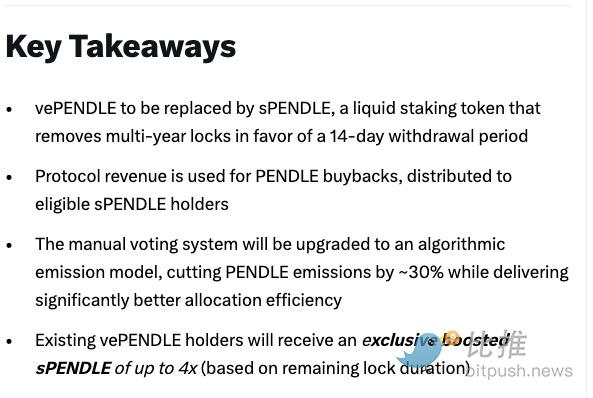
The news quickly sparked heated discussions in the community. Curve founder Michael Egorov promptly voiced his doubts, stating bluntly that 'abolishing the ve model is a mistake.' However, on the other side, the market voted with real money—the price of PENDLE rose by 11%.

As the absolute dominator in the interest rate derivatives track, Pendle's 'self-dismantling' reform not only concerns the growth of its $3.5 billion TVL but also seems like a public trial of DeFi's core narrative over the past three years: the model of exchanging 'lock-up periods' for 'loyalty' appears to be losing its effectiveness.

The Shackles of Locking: 20% 'Minority' Governance

Although Pendle's revenue growth has been significant over the past two years, the performance of its core governance asset, vePENDLE, has not fully kept pace with the protocol's explosive growth.
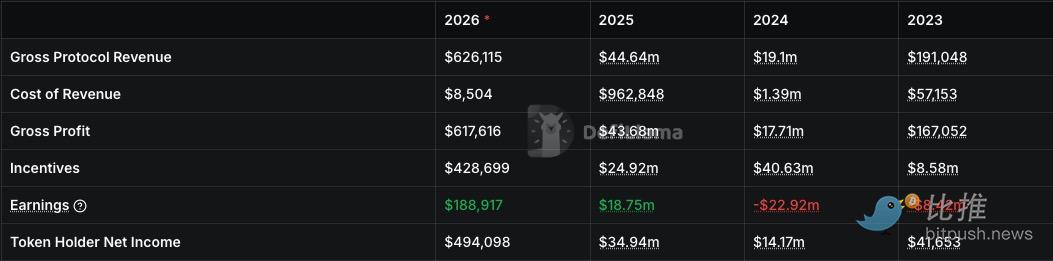
The harsher truth is:

  • Reward 'Wealth Gap': The complex weekly manual voting system is extremely unfriendly to ordinary users, causing rewards to be concentrated in the hands of a few professional players.

  • False Efficiency Boom: Although Pendle's annualized fee efficiency ratio is excellent—with annualized fees of approximately $13.99 million and annualized revenue of about $13.83 million—if broken down by specific pools, over 60% of the pools are actually operating at a loss. The protocol has long relied on profits from a few core high-quality pools (such as Ethena) to subsidize inefficient pools.

This non-transferability of 'lock-up equals disconnection' completely insulates holders from DeFi's most powerful feature: composability.

Algorithms and Buybacks: Shifting from 'Manual' to 'Autopilot'

Pendle's new solution, sPENDLE, essentially transforms the protocol from a 'power game' to an 'efficiency tool.'

The most significant change is the release of liquidity: users no longer face lock-ups of several years; instead, there is a 14-day exit period. If funds are urgently needed, paying a 5% fee allows instant redemption. This 'current account' style treatment provides higher flexibility for the approximately $127 million (35.51% of the market cap) of currently staked funds.

At the governance level, Pendle introduces two 'game-changers':

  1. Algorithm-Driven Emissions: Reward distribution, once determined by manual voting, is now handled by an algorithm. This model will automatically configure rewards based on the actual contribution of each pool, expected to reduce overall emissions by about 30%.

  2. Substantive Buybacks: Up to 80% of protocol revenue will be directly used to buy back PENDLE and distribute it to stakers. Current annualized holder revenue has reached $11.06 million, and cumulative total fees have exceeded $64.56 million. The buyback mechanism will make these earnings directly impact the token's value.

Change inevitably comes with interest restructuring. To appease those 'old contributors' who had locked for years, Pendle set a snapshot date for January 29th.

According to the plan, existing vePENDLE holders can receive up to a 4x sPENDLE multiplier upon conversion. This multiplier will linearly decay based on the original remaining lock-up period, ensuring that those who truly supported the protocol retain the strongest voice and profit rights in the early stages of the transition. This design cleverly alleviates old users' concerns about a 'collapse of long-term consistency.'

This change instantly made PENDLE more 'liquid.' The market clearly prefers liquid assets that allow easy exit while still sharing in buyback dividends, rather than a distant 'long-term meal ticket.'

III. Controversy: Consistency or Liquidity?

However, many industry insiders are not optimistic about this approach.
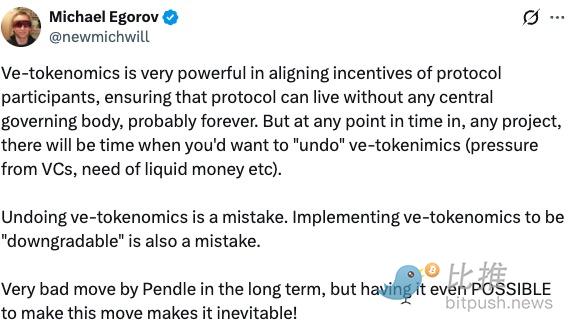
'Opposing' view from Curve founder Michael Egorov:

"Abolishing the vote-escrowed token economics is a mistake. Designing it as 'downgradable' from the start was also a mistake. In the long run, Pendle's move is very bad—but more critically, when such an operation becomes mechanically 'possible,' its occurrence was inevitable."

Maple co-founder and CEO Sid Powell believes that long-term lock-ups essentially 'forcibly retain capital,' which often masks the protocol's true risks and leads to excessive concentration of power. Pendle's approach is 'no longer forcing loyalty through locking, but attracting stay through yields.'

The essence of this debate is: should the moat of a mature DeFi protocol be 'lock-up scale' or 'the appeal of the product itself'?

In fact, Pendle is not alone.

Amid the bull and bear cycles of DeFi in recent years, a group of established protocols have率先 realized that loyalty bought with 'lock-up periods' essentially mortgages the protocol's future.

PancakeSwap was one of the pioneers of this change. As early as the end of 2023, it began reforming its old system that required users to lock CAKE for up to four years. By introducing a flexible Revenue Share mechanism for veCAKE, PancakeSwap directly distributed 5% of protocol fees to stakers, no longer mandating years of immobility. By the end of 2025, despite multi-chain competition, its TVL steadily recovered and remained around $2.3 billion, successfully attracting many retail users unwilling to be locked in long-term.

Balancer's trajectory is also highly illustrative. Its veBAL model long faced difficulties, with nearly 80% of tokens in a 'non-active governance state,' meaning the vast majority of holders only locked and did not vote. In 2025, the team彻底 adjusted the incentive structure in the v3 upgrade: introducing short lock-up options and automated fee adjustments, turning governance from a 'chore' into a flexible tool. Within half a year, the protocol's governance participation rate increased by about 40%.

A more radical experiment came from the stablecoin protocol Ethena. In September last year, it activated a 'fee switch,' directly distributing protocol revenue to holders of the liquidity token sENA, completely bypassing the complex vote-escrow model.

These cases point to a new consensus: DeFi protocols are shifting from 'forcing user binding' to 'retaining users with tangible benefits.' Locking was once a shortcut to maintain data stability but also led ecosystems into false prosperity. Now, protocols prefer to gain real activity by lowering participation barriers and improving capital efficiency.

The effectiveness of Pendle's reform will be tested after the official end of vePENDLE lock-ups on January 29th. But regardless of the outcome, it has sent a clear signal to the industry: in the future DeFi world, excellent products should not make users 'staking prisoners.'

Author: Bootly


Twitter:https://twitter.com/BitpushNewsCN

Bitpush TG Discussion Group:https://t.me/BitPushCommunity

Bitpush TG Subscription: https://t.me/bitpush

Original link:https://www.bitpush.news/articles/7604977

Trending Cryptos

Related Questions

QWhat major update did Pendle recently announce regarding its tokenomics model?

APendle announced the abolition of its veTokenomics (vote-escrowed tokenomics) model and transitioned to a more liquid sPENDLE model.

QWhat are the two key features introduced in Pendle's new sPENDLE model?

AThe two key features are algorithm-driven emissions for reward distribution and a substantial buyback mechanism where 80% of protocol revenue is used to repurchase PENDLE for stakers.

QHow did the market initially react to Pendle's announcement of abandoning veTokenomics?

AThe market reacted positively, with the price of PENDLE increasing by 11% following the announcement.

QWhat criticism did Curve founder Michael Egorov raise about Pendle's decision?

AMichael Egorov criticized the move, stating that撤销投票托管代币经济模型是一个错误 (revoking the vote-escrowed tokenomics model is a mistake) and that designing it as 'degradable' was also an error, predicting negative long-term consequences.

QWhat is the exit period for users in the new sPENDLE model, and what option is available for immediate withdrawal?

AThe exit period is 14 days, but users can withdraw immediately by paying a 5% fee for instant redemption.

Related Reads

Shing-Tung Yau Invites Wang Hong and Deng Yu to Teach Back Home, After 20 Years of Rivalry, Tsinghua and Peking University Realize the Opponent Isn't Each Other

On July 23, the Fields Medal, the highest global mathematics award, was awarded to two Chinese mathematicians, Wang Hong and Deng Yu, both undergraduate classmates from Peking University's class of 2007. This marks the first time mathematicians who completed their undergraduate studies in mainland China have won the prize, with two laureates in the same year. Following the announcement, renowned mathematician Shing-Tung Yau publicly invited Wang and Deng to return to China to teach at Tsinghua University's Qiuzhen College. This invitation is the latest episode in a decades-long rivalry between Tsinghua and Peking University (PKU) for supremacy in Chinese mathematics. The competition traces back to a 1952 national university restructuring that transferred Tsinghua's entire mathematics department to PKU, leaving Tsinghua without a math program for nearly 30 years until its reinstatement in 1979. The rivalry intensified in 2005 with a public falling-out between Yau and his former student, PKU professor Gang Tian. Subsequently, Yau shifted his efforts to building Tsinghua's mathematics program from the ground up. He established the Yau Mathematical Sciences Center in 2009 and founded the Qiuzhen College in 2021, implementing an elite, accelerated "Math Leadership Program" to recruit prodigies as young as middle school students. The competition spans multiple fronts: recruiting top junior high and high school students from math olympiads, luring renowned scholars from overseas, and securing research funding. A new and fierce battleground has emerged in AI and mathematical reasoning. Both universities are heavily investing in AI research to enhance large language models' mathematical capabilities, with Tsinghua collaborating on projects like the STARE algorithm and PKU developing specialized models for geometry. Despite the intense competition, this rivalry has arguably elevated China's overall standing in mathematics. Chinese mathematicians now frequently publish in top journals and win major international awards. At the recent 17th Yau College Students Mathematics Contests, PKU students swept the top individual awards. Yau, presenting the awards, emphasized the need for inter-university collaboration to advance Chinese mathematics. The landscape is now shifting with the rise of AI in mathematical research. As AI begins to generate proofs at an unprecedented rate, the traditional metrics of competition between institutions may become less relevant. The future for mathematicians, as noted by Terence Tao, is navigating an era of "proof surplus" driven by AI, presenting a new common challenge that transcends university rivalries.

marsbit5m ago

Shing-Tung Yau Invites Wang Hong and Deng Yu to Teach Back Home, After 20 Years of Rivalry, Tsinghua and Peking University Realize the Opponent Isn't Each Other

marsbit5m ago

UBS Interpretation: Public Funds' Tech Holdings Hit Record High, Electronics Becomes Core Increase in Q2

According to UBS's latest China equity strategy report, in Q2 2026, mutual funds' allocations to A-share "hard tech" reached a historical high. The electronics and telecommunications sectors, along with the STAR and ChiNext boards, were the primary focus of increased holdings. The standout figure is the mutual fund allocation to the major technology sector (encompassing electronics, telecom, computers, and defense), which rose to 57.3%, with an overweight position of 18.5%—both setting new records. UBS calculations show the electronics sector alone saw a 20.2 percentage point increase in allocation for the quarter, making it the strongest area of buying. Telecom and machinery allocations also rose. This trend was reinforced by foreign capital inflows. Estimates from major securities firms indicate northbound capital turned to a net inflow of over 2.1 trillion yuan in Q2, a sharp reversal from Q1 outflows. According to UBS's sector classification, industrials and IT were the main destinations for these inflows. The shift wasn't broad-based but concentrated in specific tech areas. Concurrently, holdings in traditional sectors like consumer staples and certain cyclicals declined. The allocation to the STAR and ChiNext boards also hit record highs, indicating a broader exposure to high-growth tech assets beyond just leading industries. Furthermore, the expansion of actively managed technology-themed funds—now constituting 27.5% of total active mutual fund AUM—suggests this is a structural shift in fund focus, not merely short-term portfolio rotation. While this concentration of institutional capital can provide valuation support and liquidity for the hard tech sector, the report cautions that historically high positioning also increases susceptibility to short-term volatility, profit-taking, and external market shocks. The sustainability of the trend will depend on the concurrent realization of upward earnings revisions, stabilization of leverage, and continued foreign capital inflows, all against a backdrop of supportive policies for AI, semiconductors, and advanced manufacturing.

marsbit13m ago

UBS Interpretation: Public Funds' Tech Holdings Hit Record High, Electronics Becomes Core Increase in Q2

marsbit13m ago

Trading

Spot

Hot Articles

How to Buy PENDLE

Welcome to HTX.com! We've made purchasing Pendle (PENDLE) simple and convenient. Follow our step-by-step guide to embark on your crypto journey.Step 1: Create Your HTX AccountUse your email or phone number to sign up for a free account on HTX. Experience a hassle-free registration journey and unlock all features.Get My AccountStep 2: Go to Buy Crypto and Choose Your Payment MethodCredit/Debit Card: Use your Visa or Mastercard to buy Pendle (PENDLE) instantly.Balance: Use funds from your HTX account balance to trade seamlessly.Third Parties: We've added popular payment methods such as Google Pay and Apple Pay to enhance convenience.P2P: Trade directly with other users on HTX.Over-the-Counter (OTC): We offer tailor-made services and competitive exchange rates for traders.Step 3: Store Your Pendle (PENDLE)After purchasing your Pendle (PENDLE), store it in your HTX account. Alternatively, you can send it elsewhere via blockchain transfer or use it to trade other cryptocurrencies.Step 4: Trade Pendle (PENDLE)Easily trade Pendle (PENDLE) on HTX's spot market. Simply access your account, select your trading pair, execute your trades, and monitor in real-time. We offer a user-friendly experience for both beginners and seasoned traders.

5.8k Total ViewsPublished 2024.03.29Updated 2026.06.02

How to Buy PENDLE

Discussions

Welcome to the HTX Community. Here, you can stay informed about the latest platform developments and gain access to professional market insights. Users' opinions on the price of PENDLE (PENDLE) are presented below.

活动图片