According to the latest China equity strategy report from UBS, in Q2 2026, public funds' allocation to A-share hard tech reached a historical high, with electronics, telecommunications, and the STAR Market and ChiNext board becoming the most concentrated areas for increasing positions.
The most striking figures are that the proportion of major tech sectors, including electronics, telecommunications, computers, and defense, in public fund holdings rose to 57.3%, with an over-allocation ratio reaching 18.5%, both setting new historical highs. As measured by UBS, holdings in the electronics sector increased by 20.2 percentage points in a single quarter, making it the strongest sector for increased positions in Q2; holdings in telecommunications and machinery rose by 4.4 percentage points and 0.8 percentage points, respectively.
Foreign capital inflows are also reinforcing this trend. Public reports indicate that CMB Securities estimated net inflows of northbound capital at approximately 223 billion yuan in Q2, while Guosen Securities estimated about 219.3 billion yuan, both pointing to a shift from net outflows in Q1 to significant inflows. According to UBS's own industry classification, industrials and IT were the main directions of inflows.
Electronics Single-Quarter Increase of 20.2 Percentage Points, Hard Tech Holdings Exceed Half
The changes in public funds in Q2 were not a uniform rise across all sectors but a concentrated influx of funds into electronics and telecommunications.
UBS estimates that holdings in the electronics sector increased by 20.2 percentage points compared to Q1, telecommunications by 4.4 percentage points, and machinery by 0.8 percentage points. Holdings in sectors such as electrical equipment, food and beverage, non-ferrous metals, chemicals, defense, and banks declined or continued to fall. Traditional consumer and some cyclical sectors were no longer the main focus for public fund increases.
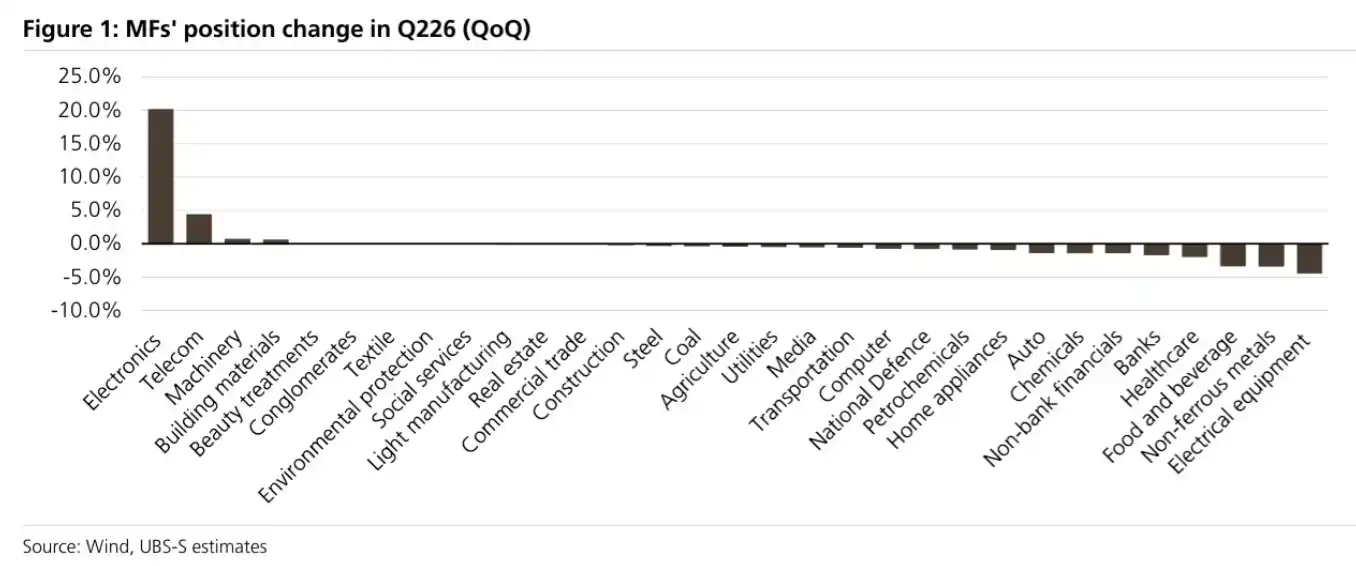
Changes in public fund industry holdings in Q2: Electronics increased by 20.2 percentage points, telecommunications by 4.4 percentage points.
Major tech sector holdings at 57.3% and an over-allocation of 18.5% not only set historical records but have also clearly surpassed the peak allocation levels during the hottest periods for consumer sectors. For ordinary investors, the preference of A-share institutional funds in Q2 is clear: it is not broad tech or all growth stocks, but assets closer to the AI computing power, semiconductors, equipment, and advanced manufacturing supply chains.
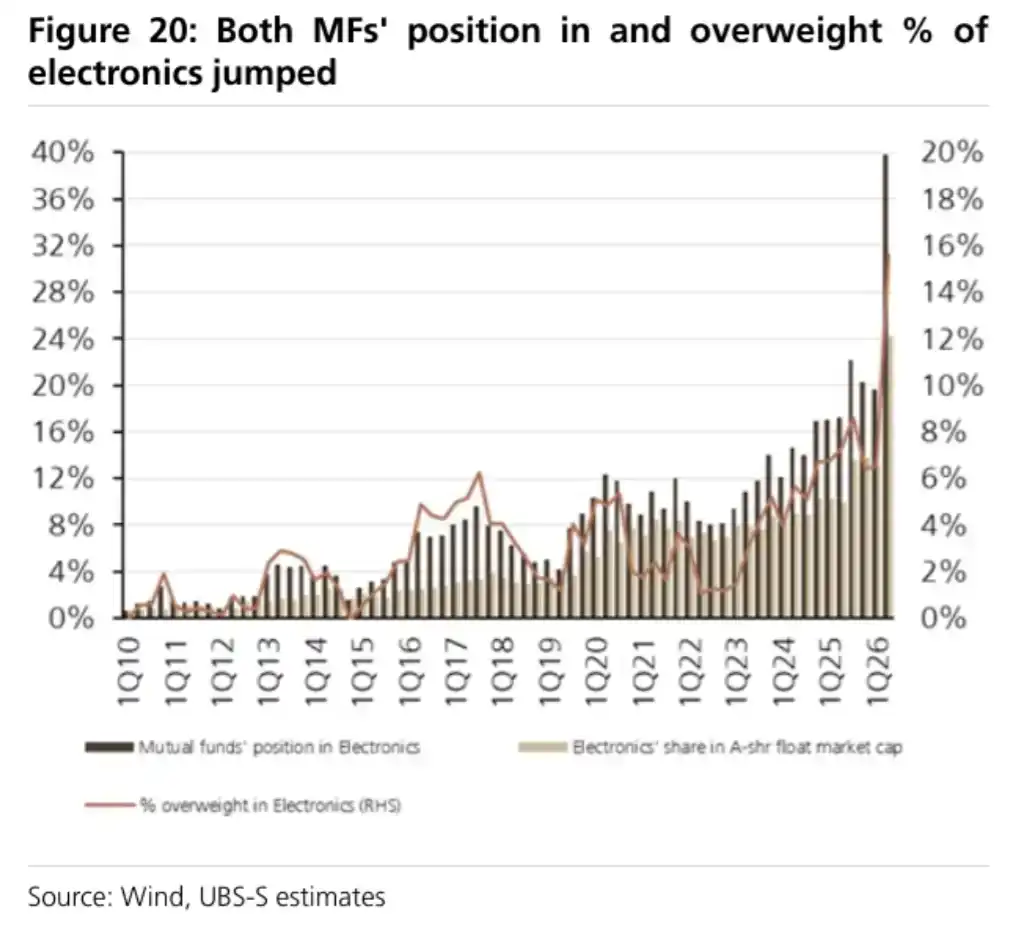
Public funds' major tech sector holdings rose to 57.3%, and the over-allocation ratio increased to 18.5%, both reaching historical highs.
Changes in the STAR Market and ChiNext board also reinforce this point. In Q2, public fund holdings in the STAR Market increased by 9.9 percentage points, and in the ChiNext board by 3.5 percentage points, both setting new records. The rise in holdings for these two emerging sectors indicates that funds are not only buying a few leading industries but are also increasing overall exposure to high-volatility tech assets.
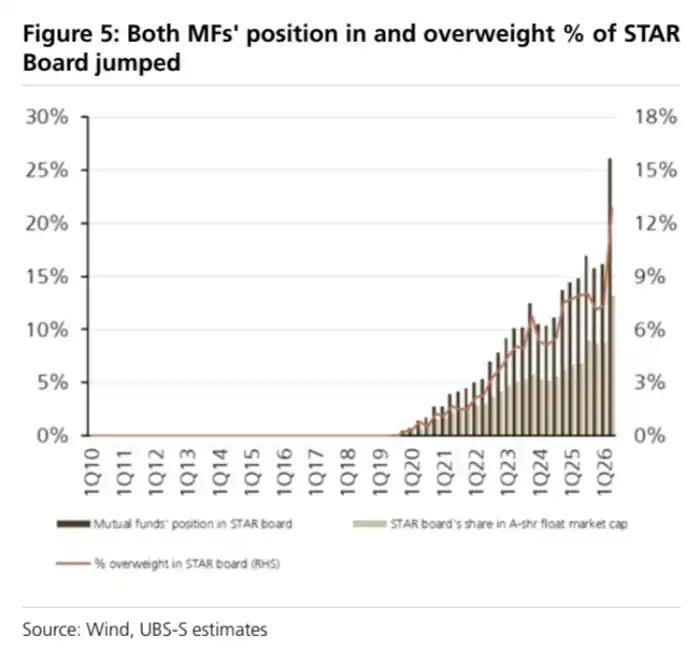
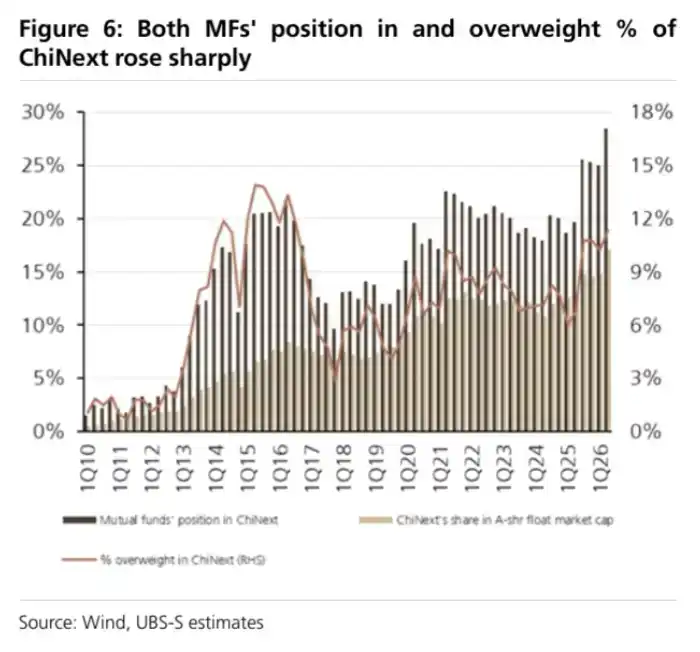
Public fund holdings and over-allocation ratios for the STAR Market and ChiNext board both increased significantly in Q2, reaching historical highs.
Expansion of Tech-Themed Funds: Institutions Not Just Making Short-Term Switches
If it were only a single-quarter change in sector holdings, it would not be sufficient to indicate a fund trend. The expansion of actively managed tech-themed funds shows that this round of changes has already been reflected in product structures.
UBS defines actively managed tech-themed funds as: actively managed public funds where at least 7 of the top ten holdings are from the tech sector, and their combined weight exceeds 50%. Under this definition, the proportion of such funds to the total AUM of actively managed public funds has risen to 27.5%, a historical high.
This proportion is significantly higher than the share of actively managed funds tracking tech indices and also exceeds the relative popularity of other themes like consumer and new energy at their peaks. An increasing number of actively managed funds are not making small allocations to tech stocks in their portfolios but are treating tech as their main direction.
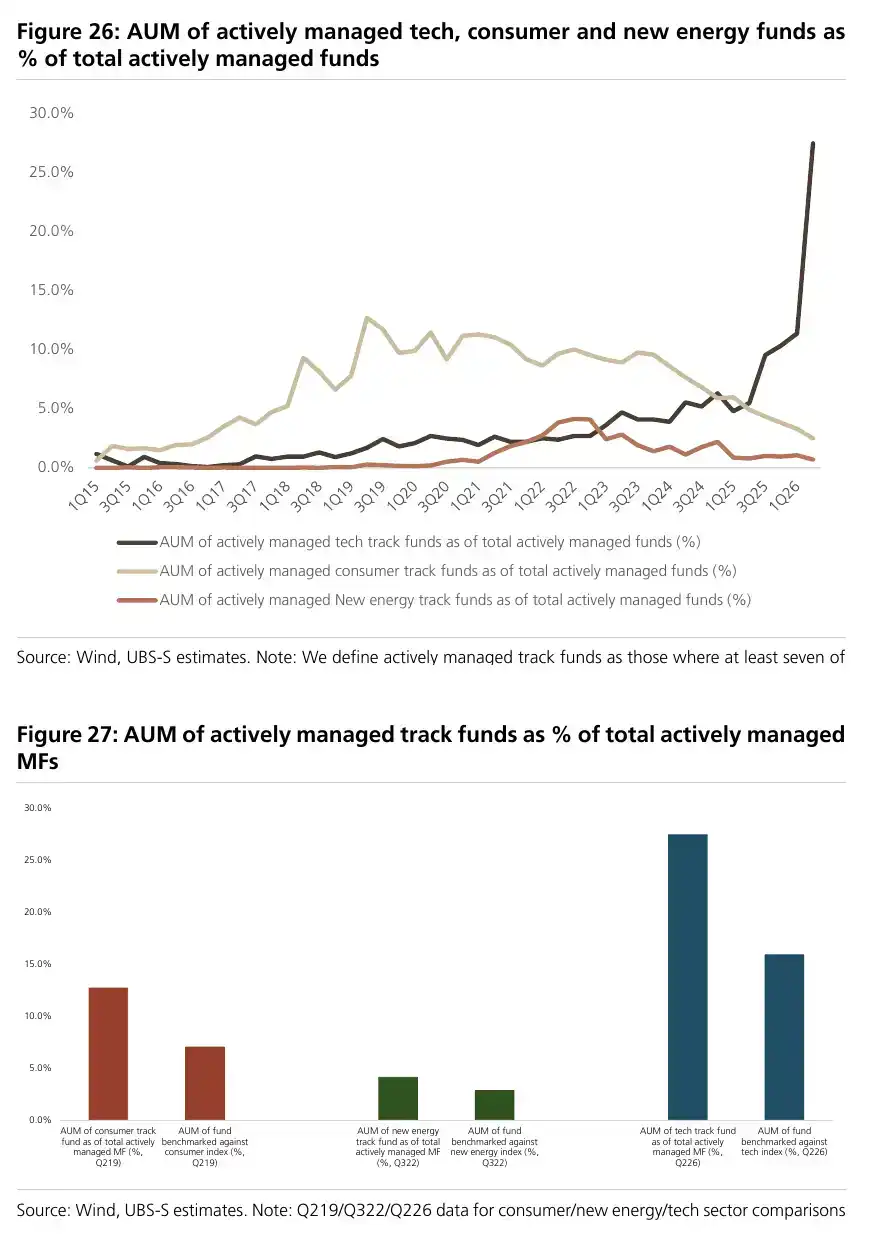
The proportion of AUM for actively managed tech-themed funds rose to 27.5%, exceeding levels seen during peak periods for consumer and new energy themes.
This has a dual impact on the market.
On one hand, the warming of tech allocations will strengthen sector liquidity. Sectors like electronics, communications, AI infrastructure, semiconductor equipment, and industrial tech supply chains may gain stronger valuation elasticity due to concentrated institutional funds.
On the other hand, with holdings and over-allocation at historical highs, crowded trades can more easily become a source of short-term volatility. Recent volatility in global tech stocks and corrections in the A-share tech sector may be related to profit-taking, cooling trading sentiment, and a contraction in leveraged funds, and do not necessarily indicate a sudden deterioration in fundamentals.
This is also why the report does not equate the Q2 increase directly with "a hard tech bull market is already established." Funds have clearly shifted towards hard tech, but high holdings themselves also increase sensitivity to short-term pullbacks.
Northbound Capital Inflows: Public Data and UBS Classification Point in the Same Direction
Foreign capital flows provide another layer of evidence for this round of hard tech allocations.
Public reports show that CMB Securities estimated net inflows of northbound capital at approximately 223 billion yuan in Q2, while Guosen Securities estimated 219.3 billion yuan. The South China Morning Post, citing Choice data, reported that as of the end of June 2026, the northbound holdings of the Shanghai-Hong Kong Stock Connect reached 3.13 trillion yuan, a record high since its launch.
Industry flows need to be distinguished by classification. In public reports, industry classifications like Shenwan or CITIC are more common, with sectors like power equipment, electronics, and machinery equipment receiving significant inflows. Under UBS's industry classification, industrials saw net purchases of 128.5 billion yuan, and IT saw net purchases of 67.2 billion yuan, representing the main inflow directions.
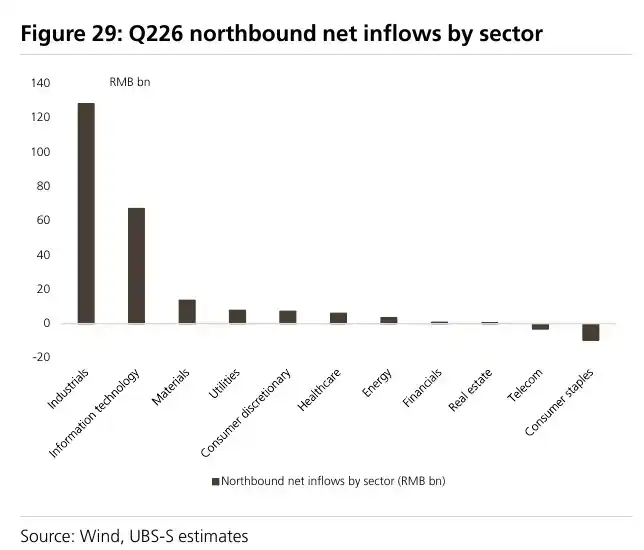
According to UBS industry classification, northbound capital saw net inflows of approximately 223 billion yuan in Q2, with industrials and IT as the main inflow directions.
Regardless of which industry classification is used, the Q2 foreign capital inflow was more biased towards industrial tech, IT, and advanced manufacturing supply chains. Compared to the directions of public fund increases in electronics, telecommunications, and machinery, the overlap between domestic and foreign capital in hard tech has clearly increased.
Such fund changes will affect market judgments about A-share structural trends. Over the past period, A-share investors have been concerned about tech stock gains being too rapid, leveraged trading overheating, and insufficient profit realization. If both domestic and foreign capital are simultaneously increasing positions in hard tech while profit expectations are being revised upward, market debate will shift from "whether there is a fundamental basis" to "whether the gains are too fast."
UBS expects that the year-on-year profit growth rate for all A-shares will recover from 3.9% in 2025 to 11% in 2026. This provides a stronger explanatory basis for institutions to increase their holdings in tech and growth assets. Funds are buying hard tech not only because of the hot AI theme but also because profit expectations, industry profitability, and policy direction are forming supportive alignment.
Deleveraging May Be Nearing an End, High Holdings Will Still Amplify Volatility
During the Q2 tech stock correction, one of the market's biggest concerns was the withdrawal of leveraged funds.
UBS believes that A-share margin financing balances have declined rapidly from their highs, and the leverage ratio in the tech sector is roughly equivalent to the overall market. Meanwhile, the trading volume of ETFs tracking the CSI 300, ChiNext, and STAR 50 indices surged, and significant net inflows occurred, indicating that the deleveraging phase may be nearing its end.
However, qualifications remain. Whether deleveraging has truly ended depends on whether margin financing balances can stabilize further and whether ETF fund inflows can continue. If leveraged funds contract again or global tech stocks experience sharp volatility, A-share hard tech may still face dual pressure from valuation and sentiment.
Policy support is another long-term clue. AI, advanced manufacturing, import substitution, and industrial upgrading remain important supports for China's tech assets, making the hard tech sector more likely to attract medium- to long-term capital. However, a clear policy direction does not equate to linear short-term stock price increases.
In Q2, funds have clearly sided with hard tech, with public funds, tech-themed funds, and northbound capital giving the same signal. The problem is that holdings and over-allocation are at historical highs, and the sector will also be more sensitive to external volatility, profit-taking, and changes in leveraged funds. Whether the hard tech trend can continue ultimately depends on whether profit revisions, deleveraging progress, and foreign capital inflows materialize simultaneously.






