Behind the Rejection of the $17M CRV Grant: Founder's Proposal Power Weakened, Convex and Yearn Become Key Players

marsbitPublished on 2025-12-25Last updated on 2025-12-25

Abstract

A proposal to grant 17 million CRV tokens (worth approximately $1.7 million) to Swiss Stake AG, a long-time core development team, was rejected in a Curve Finance governance vote. Major veCRV holders, including Convex and Yearn, voted against it, wielding enough voting power to determine the outcome. The rejection reflects two key shifts in DAO governance: First, communities are demanding greater accountability, transparency, and measurable results for treasury grants, moving beyond unconditional funding. Second, large veCRV holders, motivated by self-interest, are resistant to proposals that dilute their token value without clear, foreseeable benefits to them. The incident highlights the evolving power dynamics within Curve's governance. The veToken model, which ties voting rights to long-term locked capital, inherently concentrates power among large, capital-rich entities like Convex and Yearn. As users delegate their tokens to these protocols for yield and liquidity, governance is increasingly shifting from founders and communities to a form of "governance capitalism" dominated by major stakeholders.

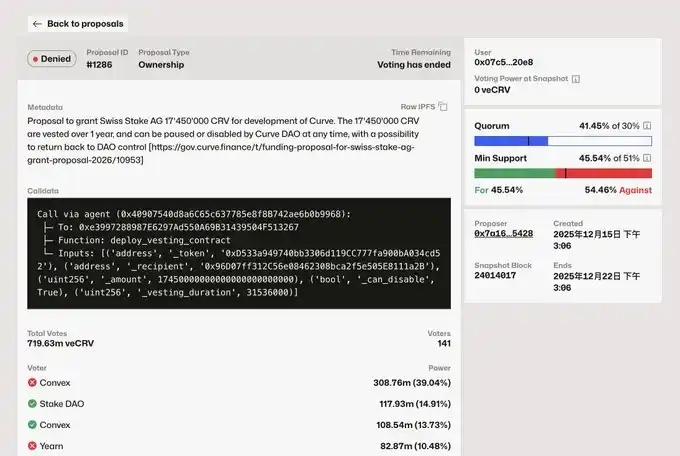
A few days ago, a funding proposal on Curve was rejected, which involved allocating 17M $CRV to the development team (Swiss Stake AG) for development expenses. Both Convex and Yearn voted against it, and their voting power was sufficient to influence the final outcome.

Since the Aave governance issue began to gain attention, governance has started to be scrutinized by the market, and the habit of approving funding requests without question is being broken. This Curve proposal highlights two key points:

1. Some voices in the community are not opposed to funding AG, but they want clarity on how previous funds were used, how future funds will be utilized, whether the approach is sustainable, and whether it has generated returns for the project. At the same time, this overly simplistic grant model lacks accountability once funds are disbursed. In the future, the DAO needs to establish a Treasury, ensure transparency in income and expenditures, or add governance constraints.

2. The major veCRV holders do not want to dilute their value. This is a clear conflict of interest. If the projects supported by CRV grants cannot foreseeably benefit veCRV holders, they are unlikely to gain support. Of course, Convex and Yearn also have their own agendas and influence, but that’s a separate issue.

This proposal was initiated by Curve founder Mich. AG is one of the teams that has been maintaining the core codebase since 2020. The roadmap presented by AG for this funding includes advancing llamalend, supporting PT and LP, as well as expanding the on-chain foreign exchange market and crvUSD. These seem like worthwhile initiatives, but whether they justify a 17M $CRV grant is another calculation. Particularly, Curve’s governance differs significantly from Aave’s, with power distributed among several teams with distinct stances.

Comparing ve with conventional governance models:

First, the conclusion: most conventional governance models, by design, have little to no advantage. Of course, if a DAO is mature enough, traditional structures can function well, but unfortunately, no crypto project has reached that level of maturity yet, as even market-consensus leaders like Aave have encountered issues.

If we focus solely on model design, ve has some advanced aspects. Firstly, it generates cash flow and is backed by liquidity control rights. When there is external demand for liquidity, this power is subject to bribes. So even if you don’t want to lock your tokens long-term, you can delegate them to proxy projects like Convex/Yearn to earn yields.

Thus, ve is a model where voting rights are tied to cash flow. Its future evolution will likely follow the path of “governance capitalism.” Vetoken binds voting rights with “long-term locking,” essentially筛选 those with large capital, ability to bear liquidity loss, and capacity for long-term博弈. Over time, this means governance will shift from ordinary users to “capital groups.”

At the same time, due to the presence of proxy layers like Convex/Yearn, many ordinary users, even loyal ones, who want to retain liquidity and flexibility while earning yields, will gradually choose to delegate their governance to these projects.

This vote also offers some insight: in the future, Mich may not be the key player in Curve’s governance; instead, power lies with these major token holders. When Aave faced governance issues, some proposed the idea of “delegated governance/elite governance,” which is quite similar to Curve’s current structure. As for whether this is good or bad, only time will tell.
Trending Cryptos

Related Questions

QWhy was the proposal to grant 17M $CRV to the development team Swiss Stake AG rejected by the Curve community?

AThe proposal was rejected primarily because major veCRV holders, such as Convex and Yearn, voted against it. They were concerned about the dilution of their token value and the lack of transparency and accountability regarding the use of funds. The community also demanded clearer details on past fund usage, future plans, and measurable benefits to the project before approving such a grant.

QWhat are the key concerns raised by the Curve community regarding grant proposals like this one?

AThe community emphasized the need for transparency in treasury management, including clear reporting on how funds are used and how they generate value for the project. They also called for sustainable and constrained grant models rather than unconditional funding, ensuring that grants align with the long-term interests of veCRV holders and the ecosystem.

QHow does Curve's ve token model differ from traditional governance models in crypto?

ACurve's ve (vote-escrowed) model binds voting rights to long-term token lockups, creating a system where governance power is coupled with financial incentives like yield and bribes. This contrasts with traditional governance models, which often lack built-in economic alignment. The ve model tends to concentrate governance influence among large, long-term capital providers rather than ordinary users.

QWhat role do Convex and Yearn play in Curve's governance structure?

AConvex and Yearn act as major vote aggregators in Curve's governance by accumulating veCRV tokens from users who delegate to them. They wield significant voting power, often enough to sway governance outcomes, as seen in the rejection of the 17M $CRV grant proposal. Their influence highlights the shift toward 'governance capitalism,' where large capital entities dominate decision-making.

QWhat does the rejection of this proposal indicate about the future of Curve's governance?

AThe rejection signals that Curve's governance is increasingly dominated by large veCRV holders and proxy platforms like Convex and Yearn, rather than individual founders or small stakeholders. This reflects a broader trend toward capital-driven governance, where decisions are made based on economic incentives and long-term value preservation for major stakeholders.

Related Reads

The Verdict in Choi Tae-won's Divorce Case: Revealing the Inheritance Undercurrent Behind SK Hynix's Trillion-Won Empire

SK Group Chairman Chey Tae-won's high-profile divorce case, involving a record 1.38 trillion won settlement, has drawn attention to the succession plans for Korea's second-largest conglomerate, especially its crown jewel, SK hynix. Unlike traditional chaebol scripts centered on the eldest son, Chey's three children from his marriage to former President Roh Tae-woo's daughter, Roh Soh-yeong, are carving distinct, non-traditional paths. Eldest daughter Chey Yun-jung (b. 1989) is seen as the most evident successor. With a scientific and consulting background, she holds executive roles at SK bioscience and SK Inc.'s growth support department, focusing on future strategy and biopharma. Her marriage is to an AI infrastructure entrepreneur, not a traditional business alliance. Second daughter Chey Min-jung (b. 1991) took a unique route, voluntarily serving as a South Korean naval officer, including an anti-piracy deployment. She later worked on policy and strategy for SK hynix in Washington D.C. before co-founding an AI-driven healthcare startup. She married a former U.S. Marine Corps officer, connecting her to U.S. defense and policy circles—networks crucial for a global semiconductor giant. The only son, Chey In-geun (b. 1995), who studied physics like his father, worked briefly at SK E&S before joining McKinsey. Despite fitting the traditional "heir" profile as the eldest son, he remains silent and holds no public position or shares in SK, suggesting the old succession playbook is obsolete. As SK hynix's valuation soars, becoming a geopolitical asset in the AI era, the heirs' legitimacy is no longer automatic. They must prove themselves in fields like AI biotech, global policy, and strategic consulting. Their marriages also reflect new elite networks in tech and defense, not old political alliances. Their inheritance is the complex challenge of navigating a globalized, tech-driven world, not just a corporate throne.

marsbit7h ago

The Verdict in Choi Tae-won's Divorce Case: Revealing the Inheritance Undercurrent Behind SK Hynix's Trillion-Won Empire

marsbit7h ago

From OpenSea to OpenRouter: Is Alex Atallah Repeating His 'Exit at the Peak' Playbook?

From OpenSea to OpenRouter: Is Alex Atallah Repeating His "Exit at the Peak" Playbook? According to the Wall Street Journal, payments giant Stripe is in talks to acquire the AI model aggregation platform OpenRouter in a potential deal valuing the company near $100 billion. This would mark founder Alex Atallah's second creation of a company reaching a $100 billion valuation, following his co-founding of NFT marketplace OpenSea. OpenRouter, founded just over three years ago, has grown rapidly by acting as a unified gateway for developers to access over 400 AI models. It currently has about 10 million users and processes over 200 trillion tokens monthly. While the platform's annualized revenue is around $50 million, its valuation has skyrocketed from $1.3 billion in March 2026. The potential acquisition by Stripe, a company OpenRouter's founder once likened it to, represents a major expansion into AI infrastructure for the payments leader. This move echoes Atallah's previous timing with OpenSea, where he departed before the NFT market's significant downturn. For OpenRouter, selling now may be strategic. Despite its scale, its business model—charging a 5-5.5% fee on AI inference calls—faces pressure from competition, open-source models, and potential price wars among model providers, limiting its profitability narrative for an IPO. A key asset for potential acquirers like Stripe is OpenRouter's vast repository of real-world AI usage data, which offers unique insights into model performance and developer preferences that are difficult to replicate. Whether this potential deal signifies a new valuation benchmark for AI infrastructure or another market peak signal remains to be seen.

链捕手7h ago

From OpenSea to OpenRouter: Is Alex Atallah Repeating His 'Exit at the Peak' Playbook?

链捕手7h ago

Trading

Spot

Hot Articles

Discussions

Welcome to the HTX Community. Here, you can stay informed about the latest platform developments and gain access to professional market insights. Users' opinions on the price of S (S) are presented below.

活动图片