Hageman video fuels Senate chatter as Lummis leaves Wyoming seat open

cointelegraphPublished on 2025-12-23Last updated on 2025-12-23

Abstract

Wyoming Representative Harriet Hageman has sparked speculation about a 2026 Senate run by posting a cryptic "Soon" video after Senator Cynthia Lummis announced she will not seek reelection. Lummis, a key crypto industry ally and co-sponsor of major digital asset legislation, is retiring, leaving a significant void for crypto advocacy in the Senate. Hageman, while aligned with broader conservative priorities, is now being encouraged by Wyoming's crypto community, including Custodia Bank founder Caitlin Long, to embrace this legacy. The race will test whether Wyoming continues its role as a central hub for crypto policy or shifts focus to other agenda items.

Wyoming Representative Harriet Hageman intensified chatter about a 2026 Senate run by posting a video days after Senator Cynthia Lummis announced she will not seek reelection.

​The five-second clip shows the congresswoman alongside a single-word caption: “Soon.” It breaks a months‐long lull on her account and bolsters speculation that she is eyeing Lummis’ open seat.

Wyoming’s Senate seat has been a reliable voice in advancing regulatory clarity for the crypto industry, from market structure bills and stablecoin regulation to banking access. Whoever replaces Lummis will help decide whether crypto keeps a dedicated champion in the Senate.

Hageman’s tweet has fueled speculation that she may target Wyoming’s open crypto-focused Senate seat. Source: Harriet Hageman

A crypto ally steps down

Lummis is expected to retire at the end of her term, removing one of the digital‐asset industry’s most outspoken allies from the Senate just as lawmakers edge toward potential votes on landmark market‐structure legislation.

​Lummis has built a national profile as a reliable pro‐crypto voice, embracing Bitcoin early and co‐sponsoring legislative efforts widely viewed to advance the blockchain industry, including the Responsible Financial Innovation Act and the ongoing US Clarity Act.

Her pending exit leaves the industry without a guaranteed champion in a chamber that has become increasingly central to decisions on trading‐platform oversight, stablecoin rules and banking access for crypto firms.

Related: Crypto community ‘very sorry’ over Senator Lummis’ reelection decision

​Hageman’s record and crypto’s hopes

As Wyoming’s at‐large House member, she has so far focused on broader conservative themes like parental rights in education, opposition to federal overreach and backing pro‐fossil fuel energy policies, while aligning herself with President Donald Trump. A Senate campaign would test how much she is willing to lean into Lummis’ crypto legacy alongside those priorities.

Wyoming’s crypto community is already nudging her in that direction. Caitlin Long, founder of Custodia Bank and a key architect of the state’s blockchain‐friendly laws, praised Hageman as “salt of the earth.” Long was reacting to news of Hageman’s expected entry in the race.
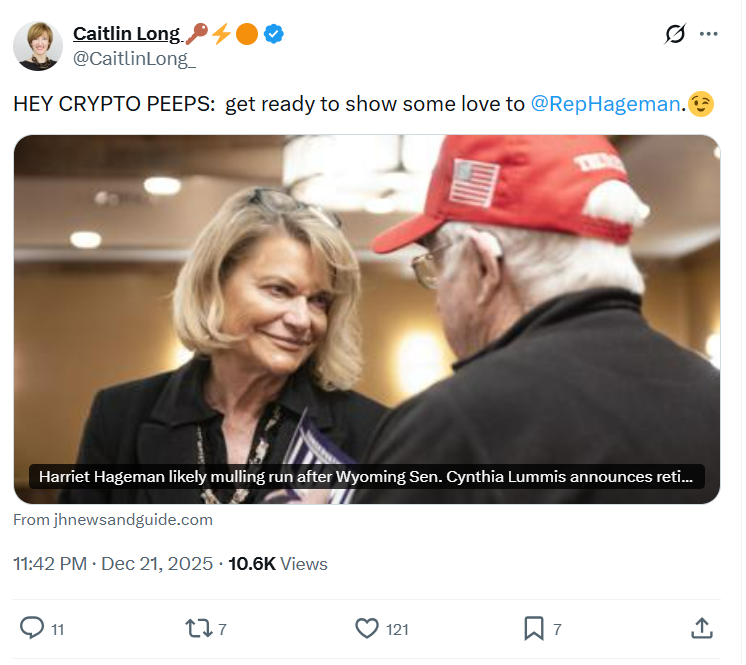
Introducing Harriet Hageman | Source: Caitlin Long

Related: Crypto among sectors ‘debanked’ by 9 major banks: US regulator

Long’s backing effectively introduces Hageman to crypto audiences as the preferred successor, even though the House member has not yet made digital assets a signature focus.

Wyoming’s 2026 Senate race is now poised to double as a test of whether the state wants to preserve its identity as home to the Senate’s most visible crypto advocate, or fold digital asset policy into a broader Trump‐era Republican agenda.

Trending Cryptos

Related Questions

QWhat action did Representative Harriet Hageman take that fueled speculation about a Senate run?

AShe posted a video with the caption 'Soon' on her social media account, breaking a months-long silence.

QWhy is Senator Cynthia Lummis's decision not to seek reelection significant for the crypto industry?

AShe is one of the digital asset industry's most outspoken allies, and her exit removes a guaranteed champion for crypto in the Senate.

QWhat major crypto legislation has Senator Lummis been involved in?

AShe co-sponsored the Responsible Financial Innovation Act and the ongoing US Clarity Act, which are widely viewed as advancing the blockchain industry.

QWho is Caitlin Long and what was her reaction to Hageman's potential Senate run?

ACaitlin Long is the founder of Custodia Bank and a key architect of Wyoming's blockchain-friendly laws. She praised Hageman as 'salt of the earth' and endorsed her as the preferred successor.

QWhat will the 2026 Wyoming Senate race test, according to the article?

AIt will test whether the state wants to preserve its identity as home to the Senate's most visible crypto advocate or fold digital asset policy into a broader Trump-era Republican agenda.

Related Reads

The $4 Quadrillion Switch Has Been Flipped: DTCC Moves Wall Street On-Chain, an Infrastructure Shift, Not a Crypto Bet

The Depository Trust & Clearing Corporation (DTCC), which custodies $115 trillion in assets and settles quadrillion-dollar securities annually, has executed its first real settlement of tokenized stocks, ETFs, and treasury securities. This marks a fundamental infrastructure shift in global finance, not merely a cryptocurrency experiment. Key insights from a discussion with DTCC's digital asset lead and BCG partners frame this transition. First, this is a multi-decade rebuild of financial rails, akin to telecom's shift to packet-switching, potentially exposing 15-30% of bank profits by 2035. Second, atomic settlement is a misnomer for scale; DTCC's netting eliminates 98% of gross obligations, a liquidity necessity. The first major application will be in collateral and repo markets, enabling near real-time, 24/7 movement and valuation of trillions in assets, reducing capital costs. BCG's projection of $8.8 trillion in tokenized real-world assets by 2035 assumes a 16% penetration rate, but momentum matters more than the precise figure. Winners will be structural orchestrators that abstract blockchain complexity for clients, not proponents of any single chain. Crucially, risk management is becoming code, with compliance logic embedded in smart contracts, though the role of human discretion in crises remains an open question. The core debate is settled: the system's deepest node has moved. The remaining variable is the adoption timeline.

marsbit4m ago

The $4 Quadrillion Switch Has Been Flipped: DTCC Moves Wall Street On-Chain, an Infrastructure Shift, Not a Crypto Bet

marsbit4m ago

The Perfect Founder-Market Fit: Bear Markets Are the Ultimate Test

"Founder-Market Fit in a Bear Market: The Ultimate Test" While AI captures the vast majority of venture capital and attention, the current crypto bear market is revealing the strongest cohort of founders in four cycles. These operators, hailing from institutions like Goldman Sachs, Citadel, and Stripe, are not chasing narratives. They are converging on the now-compelling "hard problem" of institutional-grade financial infrastructure. Founder-market fit—the alignment between a specific founder's unique capabilities and a specific market's needs—is the most durable signal in venture. Products, markets, and regulations change, but this fit compounds even when prices don't. The bear market is the best environment to identify it. Talent is now concentrated on two serious verticals: AI and fintech. The quality of founders choosing blockchain for finance is unprecedented. Evidence is in who's building: founders from elite traditional finance backgrounds are tackling on-chain institutional infrastructure (e.g., Ondo's Nathan Allman, Offchain Labs' Ed Felten). Market data supports this shift, with tokenized real-world assets and stablecoins growing significantly and major banks launching products. The author evaluates founders on four traits: 1) Deep domain expertise (lived experience, not just theory), 2) High agency (ability to sell a vision based on deep market understanding), 3) Unfair network advantage (relationships that accelerate execution), and 4) Obsession (long-term commitment rooted in belief, not hype). In a bull market, momentum does the work. A bear market strips that away, leaving only belief—the observable output of true founder-market fit—as fuel. This period filters out tourists, leaving builders who see the long-term opportunity. For serious operators considering the space, the bear market is not a risk but a proving ground and the cleanest environment to build compounding advantage. The commitment is to back such founders at the intersection of market and conviction, as in every prior cycle.

marsbit10m ago

The Perfect Founder-Market Fit: Bear Markets Are the Ultimate Test

marsbit10m ago

Trading

Spot

Hot Articles

Upland: Rebuilding the World in the Open Metaverse

The innovative gameplay of corresponding virtual properties in the Upland game to physical addresses of the real world has attracted many players.

28.7k Total ViewsPublished 2024.08.09Updated 2024.08.09

Upland: Rebuilding the World in the Open Metaverse

Discussions

Welcome to the HTX Community. Here, you can stay informed about the latest platform developments and gain access to professional market insights. Users' opinions on the price of OPEN (OPEN) are presented below.

活动图片