Pyth Network’s TradFi push gains steam as PYTH nears $0.05

ambcryptoPublished on 2026-07-17Last updated on 2026-07-17

Abstract

Pyth Network is expanding beyond crypto into traditional finance, with its native token PYTH approaching $0.05. The network has integrated institutional bond-market data from providers like Fenics Market Data, OpenYield, and Tradeweb, covering areas such as U.S. Treasuries and corporate bonds. This move aims to create a unified market data standard alongside its existing equities and futures data. Concurrently, Pyth is growing its presence in Asia, adding coverage for major Hong Kong stocks and a dedicated Seoul price feed. This expansion addresses regional demand for timely market data, as highlighted by recent volatility in South Korean markets, and can be packaged into paid products. The market has responded positively. The PYTH token has risen from its June lows, trading near $0.049 with its RSI at 67, indicating strong buying interest but nearing overbought conditions. A break above $0.05 could target $0.055, while rejection might pull the price back toward $0.045.

Pyth Network [PYTH] is moving beyond crypto and into traditional finance; its bond data and Asia expansion could bring more paid data services.

The native token too, is responding positively.

Institutional bond pricing into one data network

Pyth Network is adding institutional bond-market data to its platform.

Fenics Market Data, OpenYield and Tradeweb will now provide pricing through Pyth Pro and the Pyth Data Marketplace. Together, they cover dealer quotes, U.S. Treasuries, corporate bonds, municipal bonds and benchmark prices used by large financial institutions.

About the same, Mike Cahill, CEO of Douro Labs and Contributor to Pyth Network, said,

Fixed income pricing underpins global financial markets.

He added,

Making it available through the same infrastructure that already distributes equities, futures... is a structural step toward a unified, modern market data standard.

The effect can be immense. Bond pricing is often spread across dealers, private transactions, and separate trading venues. By bringing these sources into one network, Pyth is making fixed-income data easier for developers and financial applications to access alongside other major asset classes.

The Asia push for high-demand market data

That same strategy is also playing out in Asia. A recent South Korean market sell-off reportedly pushed more than 1.2 million leveraged accounts toward margin calls. The recent South Korean market sell-off highlights the value of timely regional market data, an area where Pyth has continued expanding its coverage.
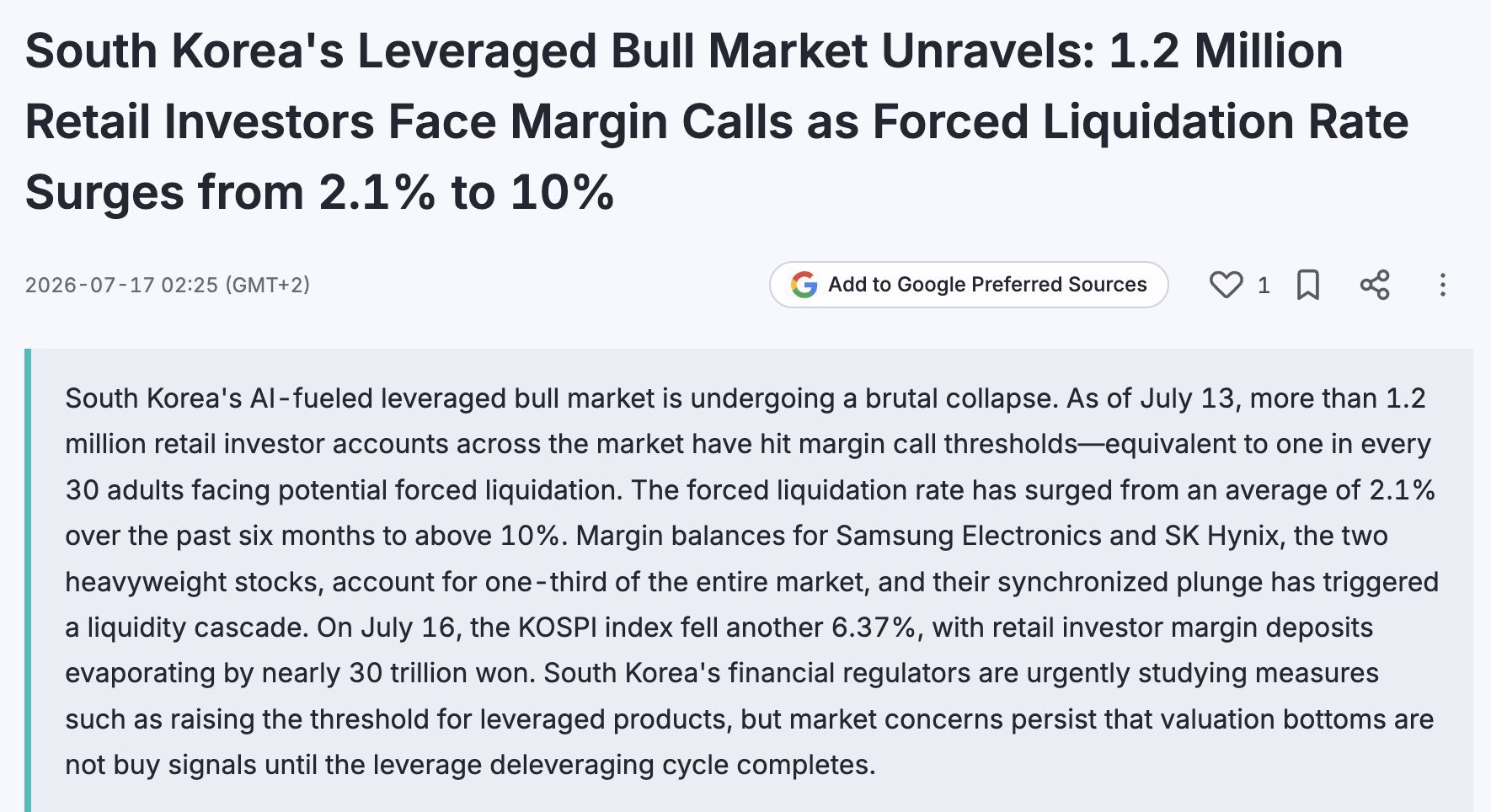
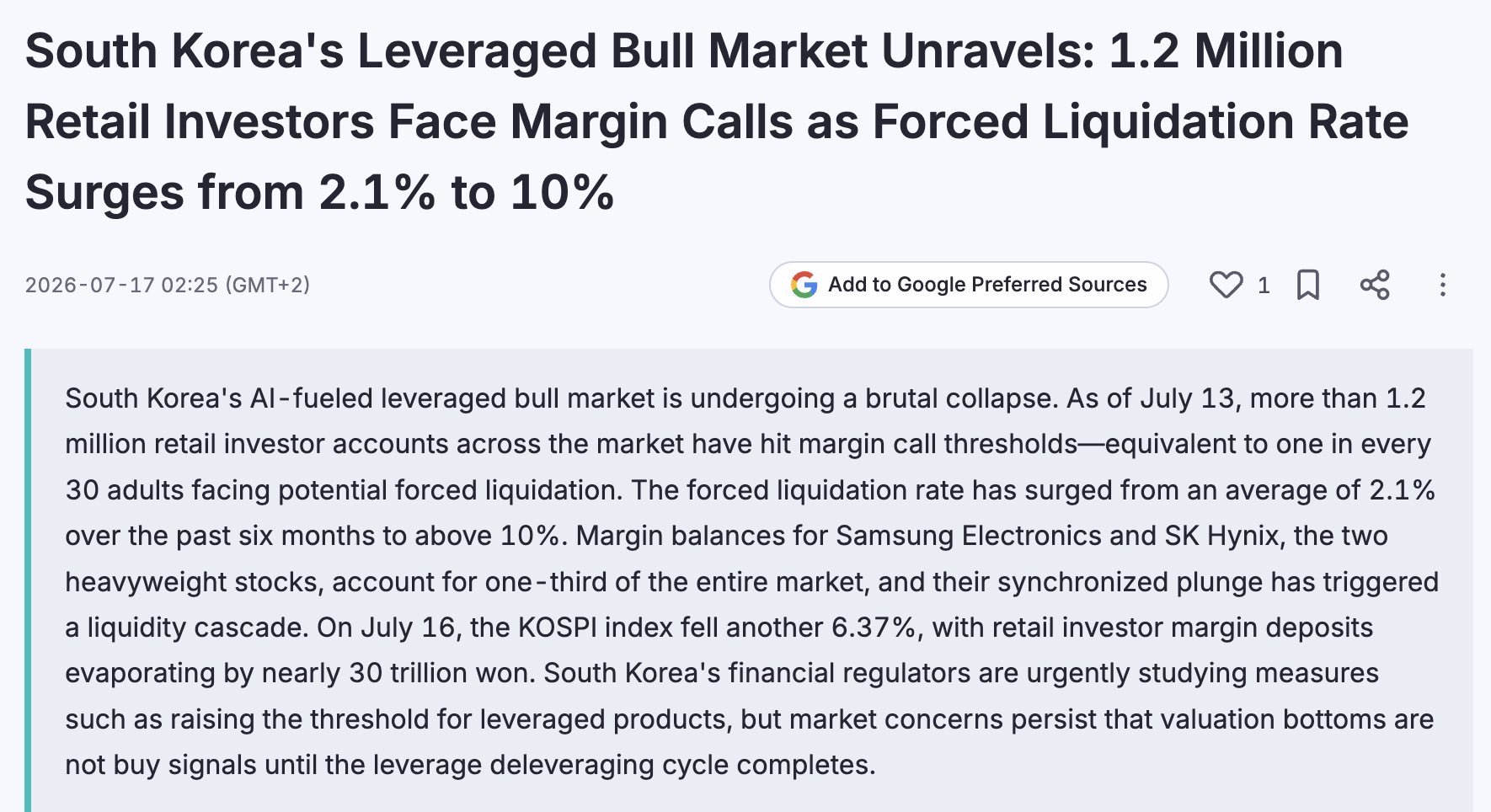
Source: X

Interestingly, Pyth has already expanded its coverage across Asia, including major Hong Kong stocks and a dedicated Seoul price feed for SK Hynix. Through Pyth Pro and its Data Marketplace, this coverage can be packaged into paid products for trading firms and financial apps.

Broader regional coverage could increase demand for Pyth’s data products and support network revenue over time.

Market responds to Pyth’s data push

Native token PYTH has gone up from its June lows. At the time of writing, it traded near $0.049. That puts the $0.05 level in focus.
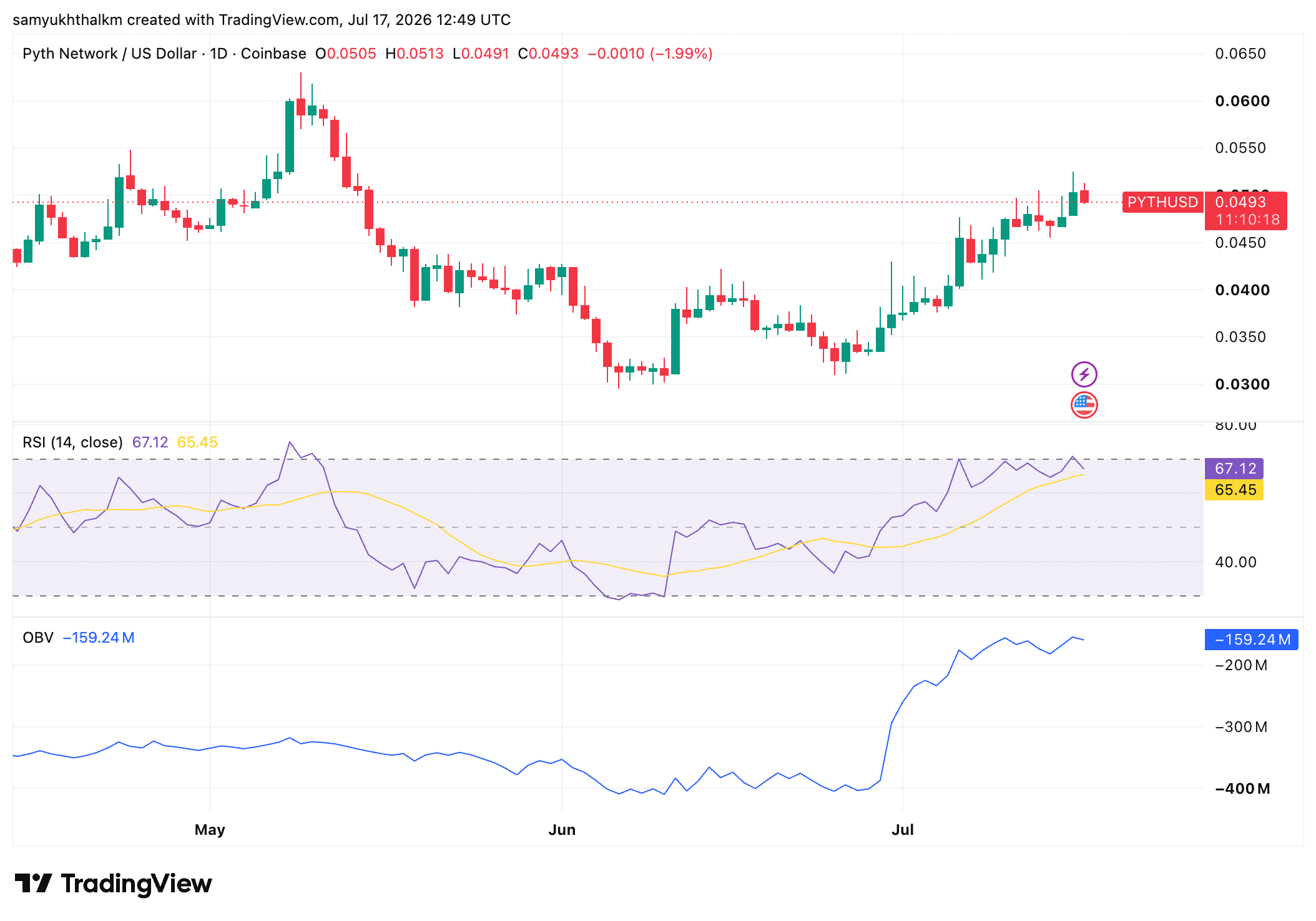
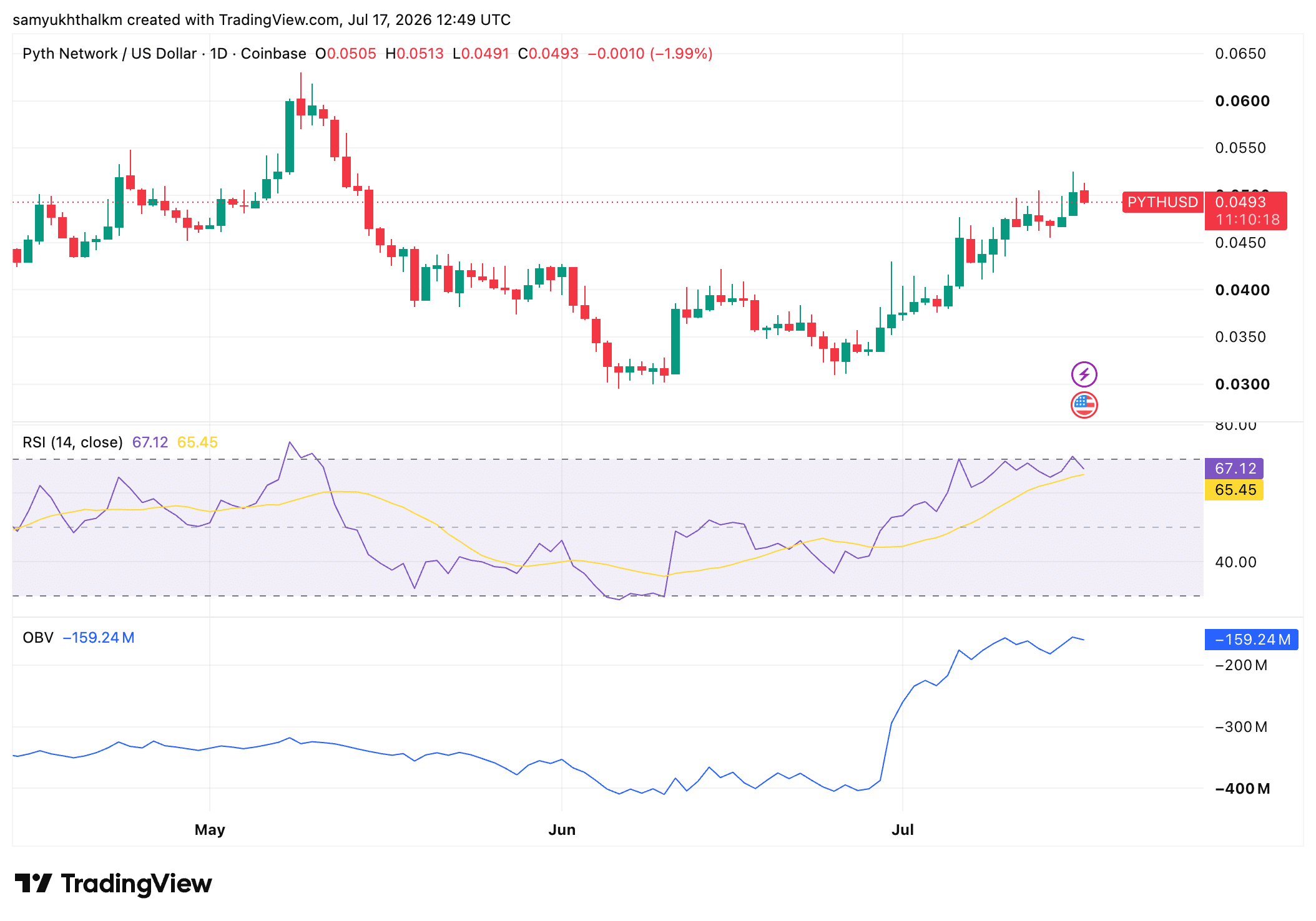
Source: TradingView

RSI was at 67, so the token is getting close to overbought territory. At the same time, OBV has also improved since late June, so there’s good buying interest.

A good move above $0.05 could open the door toward $0.055. However, rejection at this level may pull PYTH back toward $0.045.


Final Summary

  • Pyth Network expanded its institutional market data offering with new bond-market pricing partnerships and continued growing its presence across Asia.
    PYTH has recovered toward the key $0.05 resistance level as improving momentum accompanies the network’s latest expansion.


Trending Cryptos

Related Questions

QWhat is the main focus of Pyth Network's recent expansion according to the article?

AThe main focus is expanding beyond the crypto space into traditional finance (TradFi) by adding institutional bond-market data to its platform and expanding its data coverage in Asia.

QWhich specific new data providers are mentioned as joining the Pyth Network?

AFenics Market Data, OpenYield, and Tradeweb are the new providers joining to supply bond pricing data through Pyth Pro and the Pyth Data Marketplace.

QWhat is the significance of Pyth adding bond-market data, as highlighted by Mike Cahill?

AMike Cahill stated that making fixed income pricing available through the same infrastructure that distributes other assets is a structural step toward a unified, modern market data standard, as this data underpins global financial markets.

QWhat potential effect does the article suggest Pyth's Asian expansion could have?

AThe article suggests that broader regional coverage in Asia, including dedicated price feeds for major stocks, could increase demand for Pyth's paid data products and support network revenue over time.

QWhat is the key price level for the PYTH token mentioned in the article, and what are the potential price targets discussed?

AThe key resistance level is $0.05. A move above it could open the door toward $0.055, while a rejection at this level may pull the price back toward $0.045.

Related Reads

The Verdict in Choi Tae-won's Divorce Case: Revealing the Inheritance Undercurrent Behind SK Hynix's Trillion-Won Empire

SK Group Chairman Chey Tae-won's high-profile divorce case, involving a record 1.38 trillion won settlement, has drawn attention to the succession plans for Korea's second-largest conglomerate, especially its crown jewel, SK hynix. Unlike traditional chaebol scripts centered on the eldest son, Chey's three children from his marriage to former President Roh Tae-woo's daughter, Roh Soh-yeong, are carving distinct, non-traditional paths. Eldest daughter Chey Yun-jung (b. 1989) is seen as the most evident successor. With a scientific and consulting background, she holds executive roles at SK bioscience and SK Inc.'s growth support department, focusing on future strategy and biopharma. Her marriage is to an AI infrastructure entrepreneur, not a traditional business alliance. Second daughter Chey Min-jung (b. 1991) took a unique route, voluntarily serving as a South Korean naval officer, including an anti-piracy deployment. She later worked on policy and strategy for SK hynix in Washington D.C. before co-founding an AI-driven healthcare startup. She married a former U.S. Marine Corps officer, connecting her to U.S. defense and policy circles—networks crucial for a global semiconductor giant. The only son, Chey In-geun (b. 1995), who studied physics like his father, worked briefly at SK E&S before joining McKinsey. Despite fitting the traditional "heir" profile as the eldest son, he remains silent and holds no public position or shares in SK, suggesting the old succession playbook is obsolete. As SK hynix's valuation soars, becoming a geopolitical asset in the AI era, the heirs' legitimacy is no longer automatic. They must prove themselves in fields like AI biotech, global policy, and strategic consulting. Their marriages also reflect new elite networks in tech and defense, not old political alliances. Their inheritance is the complex challenge of navigating a globalized, tech-driven world, not just a corporate throne.

marsbitYesterday 09:06

The Verdict in Choi Tae-won's Divorce Case: Revealing the Inheritance Undercurrent Behind SK Hynix's Trillion-Won Empire

marsbitYesterday 09:06

From OpenSea to OpenRouter: Is Alex Atallah Repeating His 'Exit at the Peak' Playbook?

From OpenSea to OpenRouter: Is Alex Atallah Repeating His "Exit at the Peak" Playbook? According to the Wall Street Journal, payments giant Stripe is in talks to acquire the AI model aggregation platform OpenRouter in a potential deal valuing the company near $100 billion. This would mark founder Alex Atallah's second creation of a company reaching a $100 billion valuation, following his co-founding of NFT marketplace OpenSea. OpenRouter, founded just over three years ago, has grown rapidly by acting as a unified gateway for developers to access over 400 AI models. It currently has about 10 million users and processes over 200 trillion tokens monthly. While the platform's annualized revenue is around $50 million, its valuation has skyrocketed from $1.3 billion in March 2026. The potential acquisition by Stripe, a company OpenRouter's founder once likened it to, represents a major expansion into AI infrastructure for the payments leader. This move echoes Atallah's previous timing with OpenSea, where he departed before the NFT market's significant downturn. For OpenRouter, selling now may be strategic. Despite its scale, its business model—charging a 5-5.5% fee on AI inference calls—faces pressure from competition, open-source models, and potential price wars among model providers, limiting its profitability narrative for an IPO. A key asset for potential acquirers like Stripe is OpenRouter's vast repository of real-world AI usage data, which offers unique insights into model performance and developer preferences that are difficult to replicate. Whether this potential deal signifies a new valuation benchmark for AI infrastructure or another market peak signal remains to be seen.

链捕手Yesterday 08:42

From OpenSea to OpenRouter: Is Alex Atallah Repeating His 'Exit at the Peak' Playbook?

链捕手Yesterday 08:42

Trading

Spot

Hot Articles

Discussions

Welcome to the HTX Community. Here, you can stay informed about the latest platform developments and gain access to professional market insights. Users' opinions on the price of S (S) are presented below.

活动图片