JPMorgan backs crypto bill as Donald Trump vows to ‘not sign other bills’ – What now?

ambcryptoPublicado a 2026-07-11Actualizado a 2026-07-11

Resumen

The House-passed Digital Asset Market Clarity Act of 2025 faces an uncertain future despite gaining significant backing from JPMorgan, a major shift for the traditionally crypto-skeptical bank. According to BitGo CEO Mike Belshe, this support is crucial as regulatory uncertainty has been the largest obstacle to institutional adoption. Should the bill pass, it could simplify market entry for institutional investors, potentially leading to wider cryptocurrency uptake. However, approval odds on Polymarket have dropped to 45%. Supporters, including Rep. French Hill and former CFTC Chairman Michael Selig, are pushing for a Senate vote before the August recess to force a compromise. Ethereum co-founder Joseph Lubin also supports the legislation. Yet, Democratic Senator Elizabeth Warren criticizes the current draft as enabling sanctions evasion. A further complication is former President Donald Trump's vow not to sign other bills until the SAVE America Act is passed, pushing the CLARITY Act's next deadline to August 7th.

The House passed its version of the Digital Asset Market Clarity Act of 2025 nearly a year ago, but the bill is still in a tight spot. However, Mike Belshe, CEO of BitGo, recently pointed out that JPMorgan has shown full support for the CLARITY Act.

He said,

Let that sink in. The world’s largest bank — long crypto-skeptical — is now publicly supporting crypto market structure legislation. This is a different ballgame.

AD

What does this mean for the market?

Belshe emphasized that JPMorgan’s backing of the CLARITY Act is important because regulatory uncertainty has long been the largest obstacle. So banks, asset managers, pension funds, and investment advisers are likely to be encouraged to get ready for increased crypto participation.

Should the bill pass, it might make it simpler for institutional investors to confidently join the market, which could lead to a wider uptake of cryptocurrencies.

This occurs as the approval odds on Polymarket have dropped to 45%, a 20% decrease from 74% two months ago.
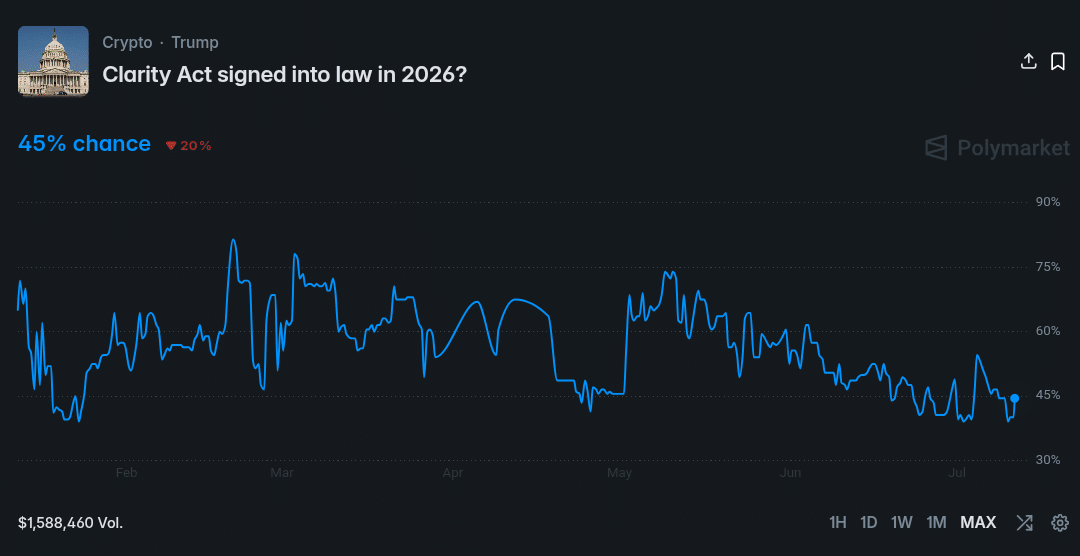
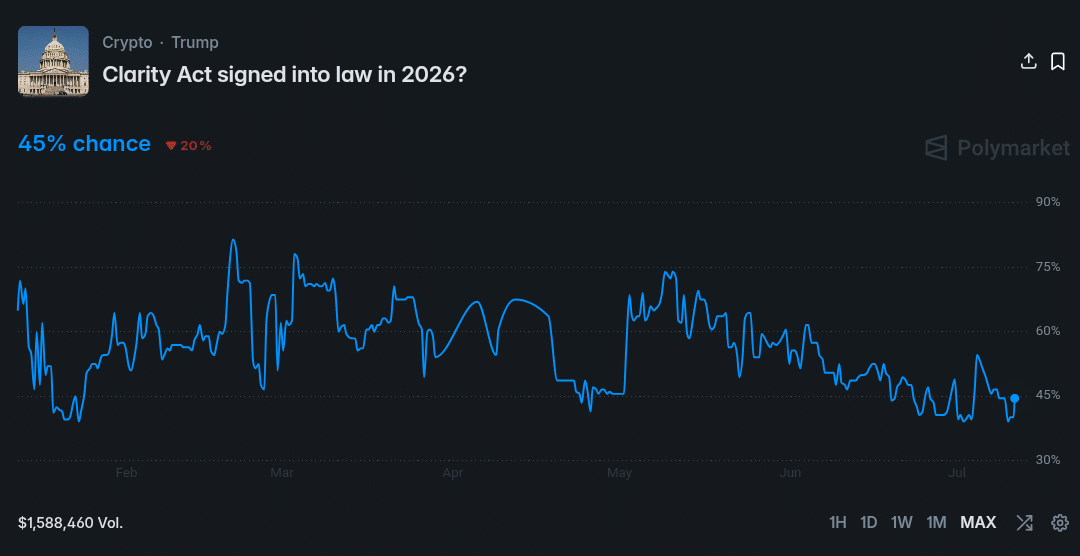
Source: Polymarket

Others supporting the passage of the CLARITY Act

However, regarding the approval, the community still appears to be in favor.

For instance, Rep. French Hill is arguing that the best way to force lawmakers to reach a compromise is to give them a clear deadline to vote on the CLARITY Act before Congress starts its August recess.

Rather than leaving these activities in a regulatory gray area, Hill believes the CLARITY Act would subject them to defined standards and said,

I’ve encouraged Senate leadership to put it on the floor. I think if you schedule a floor date here in the month of July, that will cause these final meetings, these final discussions to take place. You’ve got to have a deadline in Congress to get people to move and find consensus.

Supporters net increases

Not only this, the bill is also supported by Michael S. Selig, the 16th Chairman of CFTC, who said,

The Clarity Act, talking to this future proof notion of making sure that crypto is here to stay.

Echoing similar sentiments, Joseph Lubin, Ethereum’s co-founder, added,

Source: Joseph Lubin/X

In fact, Democratic Senator Elizabeth Warren, who has been a stern supporter of the bill, recently put it best when she said,

As currently drafted, the CLARITY Act is a ticket to sanctions evasion.

However, Trump has stated that he will “not sign other bills” until Republicans in Congress have passed the SAVE America Act. As a result, the CLARITY Act is now awaiting a new deadline of the 7th of August to advance.


Final Summary

  • JP Morgan, supporting the bill, has ignited fresh optimism for the approval of the CLARITY Act.
  • Though the Polymarket odds have fallen to the 45% Senators, CFTC chairman, Ethereum co-founder, and many others are demanding the bill’s approval.


Criptos en tendencia

Preguntas relacionadas

QAccording to the article, what is the significance of JPMorgan's public support for the CLARITY Act?

AAccording to Mike Belshe, CEO of BitGo, JPMorgan's support is highly significant because it signals a major shift from a long-time crypto-skeptical stance. It indicates that regulatory uncertainty, a major obstacle, might be addressed, which could encourage banks, asset managers, and institutional investors to prepare for greater participation in the crypto market.

QWhat is the current approval probability for the CLARITY Act on Polymarket, and how has it changed?

AThe current approval odds on Polymarket have dropped to 45%. This represents a 20% decrease from a probability of 74% recorded two months ago.

QWhat strategy did Representative French Hill propose to advance the CLARITY Act?

ARep. French Hill argued that setting a clear deadline for a vote on the CLARITY Act before Congress's August recess is the best way to force lawmakers to reach a compromise and find consensus.

QWho are some of the notable figures mentioned as supporting the passage of the CLARITY Act?

ASupporters mentioned include Michael S. Selig, the 16th Chairman of the CFTC; Joseph Lubin, co-founder of Ethereum; and Democratic Senator Elizabeth Warren, who has been a stern supporter, though she has also voiced specific concerns about the bill's current draft.

QWhat is the main political obstacle currently facing the CLARITY Act, as stated in the article?

AThe main political obstacle is that former President Donald Trump has stated he will "not sign other bills" until Republicans in Congress have passed the SAVE America Act. This has put the CLARITY Act in a tight spot, with its next advancement deadline set for August 7th.

Lecturas Relacionadas

Tras tres trimestres consecutivos de caída, ¿puede el mercado cripto encontrar una ventana de estabilización en el tercer trimestre?

El mercado cripto sufrió su peor trimestre desde 2022, con una caída del 12.6% en la capitalización total (ahora en $2.1 billones). El volumen de operaciones y el valor de las stablecoins también disminuyeron, señalando una salida generalizada de capitales. Bitcoin y Ethereum cayeron un 14.2% y 25.4% respectivamente, rompiendo su correlación con los mercados de riesgo tradicionales. Los ETFs de Bitcoin en EE.UU. registraron importantes salidas netas ($4.67 mil millones en Q2), aunque datos sugieren que el ciclo de ventas podría estar cerca de su fin. La atención del mercado se centra ahora en la reunión de la FED a finales de julio, cuya postura (halcón o paloma) podría definir el rango de trading de Bitcoin para el trimestre. El avance de la ley CLARITY en el Senado estadounidense se ha estancado, reduciendo la probabilidad de aprobación en 2026 y manteniendo una prima de riesgo regulatorio alta. Solo dos sectores mostraron crecimiento: los mercados de predicción (volumen +48.7%) y los coleccionables tokenizados (volumen +143% vs. Q1). El sentimiento general es de cautela. La lógica del mercado ha cambiado, priorizando fundamentos como la política monetaria y la regulación frente a los simples impulsos narrativos. Aunque las bases para una caída extrema parecen limitadas, la recuperación sostenida en Q3 depende críticamente de la FED y de un posible progreso regulatorio.

marsbitAyer 08:41

Tras tres trimestres consecutivos de caída, ¿puede el mercado cripto encontrar una ventana de estabilización en el tercer trimestre?

marsbitAyer 08:41

BIT Trading Moments: BTC aún presionado por la EMA 200 semanal, tras el rechazo podría reiniciar la caída, los valores de almacenamiento y semiconductores que subieron fuertemente anoche comenzaron a caer en la sesión nocturna

**BIT Trading Moments: BTC aún presionado por la EMA 200 semanal; almacenamiento y semiconductores caen en el after-hours** El mercado de cripto continúa su recuperación, con **Bitcoin** manteniéndose cerca de los $66,000. Enfrenta una fuerte resistencia en la zona de los $68,000, nivel que coincide con el costo promedio de los inversores en los últimos cinco meses y un punto de fallo anterior. Los analistas señalan que se encuentra atrapado entre la media móvil simple (MA) de 200 semanas (~$63,333) y la media exponencial (EMA) de 200 semanas (~$68,328). Se necesitaría un cierre semanal por debajo de $55,000 o por encima de $70,000 para confirmar una dirección de mayor alcance. Los ETF de Bitcoin registran entradas netas por sexto día consecutivo. En Wall Street, los **futuros de los principales índices** caen. Después de fuertes ganancias el martes, las acciones de **semiconductores y almacenamiento** retroceden en el after-hours: el ETF de semiconductores cae un 2.22%, Micron un 2.29% y SK Hynix casi un 5%. Sin embargo, **Super Micro Computer (SMCI)** se dispara más de un 20% tras el cierre, impulsada por sólidos pedidos. Otras noticias positivas incluyen un contrato de $266M de la Fuerza Aérea para **Rocket Lab**. A pesar del repunte bursátil, factores como el **crudo Brent por encima de $91** y el **rendimiento del bono estadounidense a 10 años subiendo a ~4.64%** generan preocupaciones inflacionarias y enfrían el optimismo. Las acciones relacionadas con cripto, como Coinbase y Robinhood, tuvieron un buen desempeño apoyadas por avances regulatorios. En Asia, los mercados siguieron la recuperación tecnológica. El **índice KOSPI de Corea del Sur** subió un 0.74%, con acciones de semiconductores mostrando volatilidad. El principal riesgo es el **yen japonés**, que tocó su nivel más bajo desde 1986, lo que genera temores a una intervención del gobierno. **Próximos eventos clave:** Este miércoles 22 de julio, el enfoque está en los eventos de **AMD AI** y los resultados financieros de **Alphabet (Google), Tesla e IBM** después del cierre. El jueves 23, la **decisión de tasas del BCE** y los resultados de **Intel** serán cruciales para el sentimiento del mercado.

marsbitAyer 08:33

BIT Trading Moments: BTC aún presionado por la EMA 200 semanal, tras el rechazo podría reiniciar la caída, los valores de almacenamiento y semiconductores que subieron fuertemente anoche comenzaron a caer en la sesión nocturna

marsbitAyer 08:33

Trading

Spot

Artículos destacados

Cómo comprar BILL

¡Bienvenido a HTX.com! Hemos hecho que comprar Billions Network (BILL) sea simple y conveniente. Sigue nuestra guía paso a paso para iniciar tu viaje de criptos.Paso 1: crea tu cuenta HTXUtiliza tu correo electrónico o número de teléfono para registrarte y obtener una cuenta gratuita en HTX. Experimenta un proceso de registro sin complicaciones y desbloquea todas las funciones.Obtener mi cuentaPaso 2: ve a Comprar cripto y elige tu método de pagoTarjeta de crédito/débito: usa tu Visa o Mastercard para comprar Billions Network (BILL) al instante.Saldo: utiliza fondos del saldo de tu cuenta HTX para tradear sin problemas.Terceros: hemos agregado métodos de pago populares como Google Pay y Apple Pay para mejorar la comodidad.P2P: tradear directamente con otros usuarios en HTX.Over-the-Counter (OTC): ofrecemos servicios personalizados y tipos de cambio competitivos para los traders.Paso 3: guarda tu Billions Network (BILL)Después de comprar tu Billions Network (BILL), guárdalo en tu cuenta HTX. Alternativamente, puedes enviarlo a otro lugar mediante transferencia blockchain o utilizarlo para tradear otras criptomonedas.Paso 4: tradear Billions Network (BILL)Tradear fácilmente con Billions Network (BILL) en HTX's mercado spot. Simplemente accede a tu cuenta, selecciona tu par de trading, ejecuta tus trades y monitorea en tiempo real. Ofrecemos una experiencia fácil de usar tanto para principiantes como para traders experimentados.

493 Vistas totalesPublicado en 2026.05.07Actualizado en 2026.06.02

Cómo comprar BILL

Discusiones

Bienvenido a la comunidad de HTX. Aquí puedes mantenerte informado sobre los últimos desarrollos de la plataforma y acceder a análisis profesionales del mercado. A continuación se presentan las opiniones de los usuarios sobre el precio de BILL (BILL).

活动图片