Why do people like Luke still want to fork Bitcoin despite having no support? BIP-100 has already been declared a failure!

marsbitPublished on 2026-08-11Last updated on 2026-08-11

Abstract

On August 8th, the Bitcoin network experienced a contentious fork triggered by BIP-110, despite the proposal having only 2.53% miner signaling support in the prior period. Led primarily by developer Luke Dashjr and based on his Bitcoin Knots implementation (not merged into Bitcoin Core), this User-Activated Soft Fork (UASF) aimed to impose strict new limits on non-financial data (like Ordinals inscriptions) within blocks to reduce long-term node costs. The fork activated at block height 961632, with BIP-110 nodes rejecting blocks without the required signaling. This created two chains: the dominant original chain continuing normally, and a low-hashrate BIP-110 chain which quickly fell behind. The core conflict is between those viewing block space as a fee market open to all data and those prioritizing Bitcoin as a monetary network, seeking to ban what they see as blockchain "spam." BIP-110's strategy relied on economic nodes (exchanges, wallets) adopting the new rules first, hoping to force miners to follow. However, this has not materialized. The BIP-110 chain now faces severe challenges: extremely slow block times potentially stretching over 1.9 years before its rules would even activate, a lack of broad economic support, and no automatic replay protection. For most users, Bitcoin's main chain operates unchanged. The immediate technical impact is limited to services running BIP-110 software, which now see a different blockchain. The event highlights ongoing ideological d...

Author:Bitcoin Orange Trader

With only 2.53% support, BIP-110 still forked Bitcoin: Can it succeed?
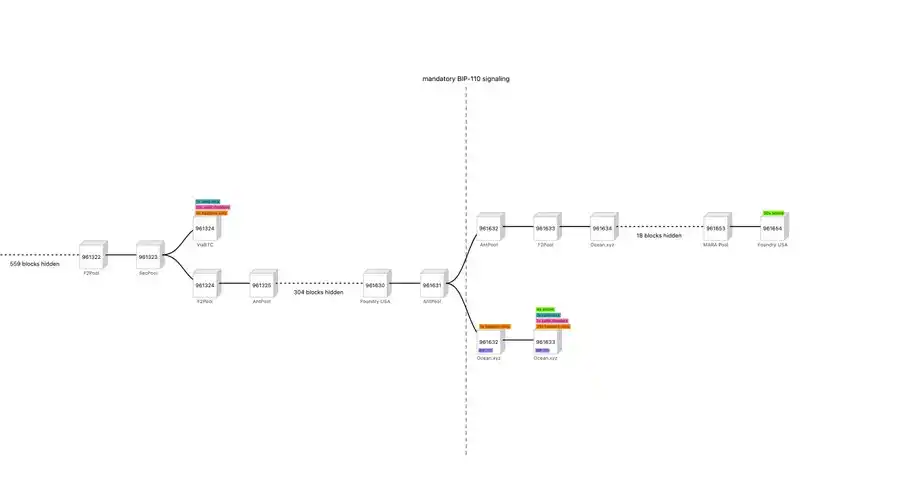
On August 8, the Bitcoin network split into two mutually incompatible chains.

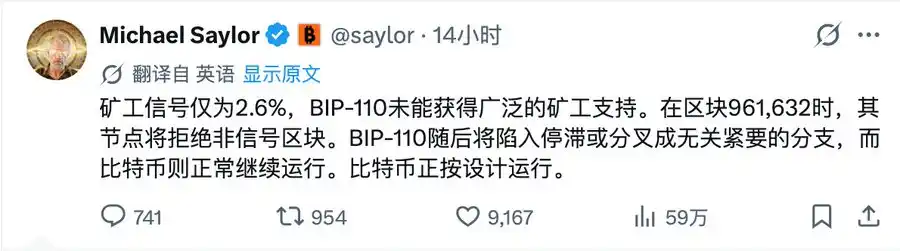
What was even more unusual was that BIP-110, which drove this fork, had only received signaling support from 51 blocks in the previous 2016-block cycle, representing a mere 2.53% support rate. However, after block height 961632, nodes running BIP-110 followed the predetermined rules and began rejecting all blocks that did not signal bit 4.

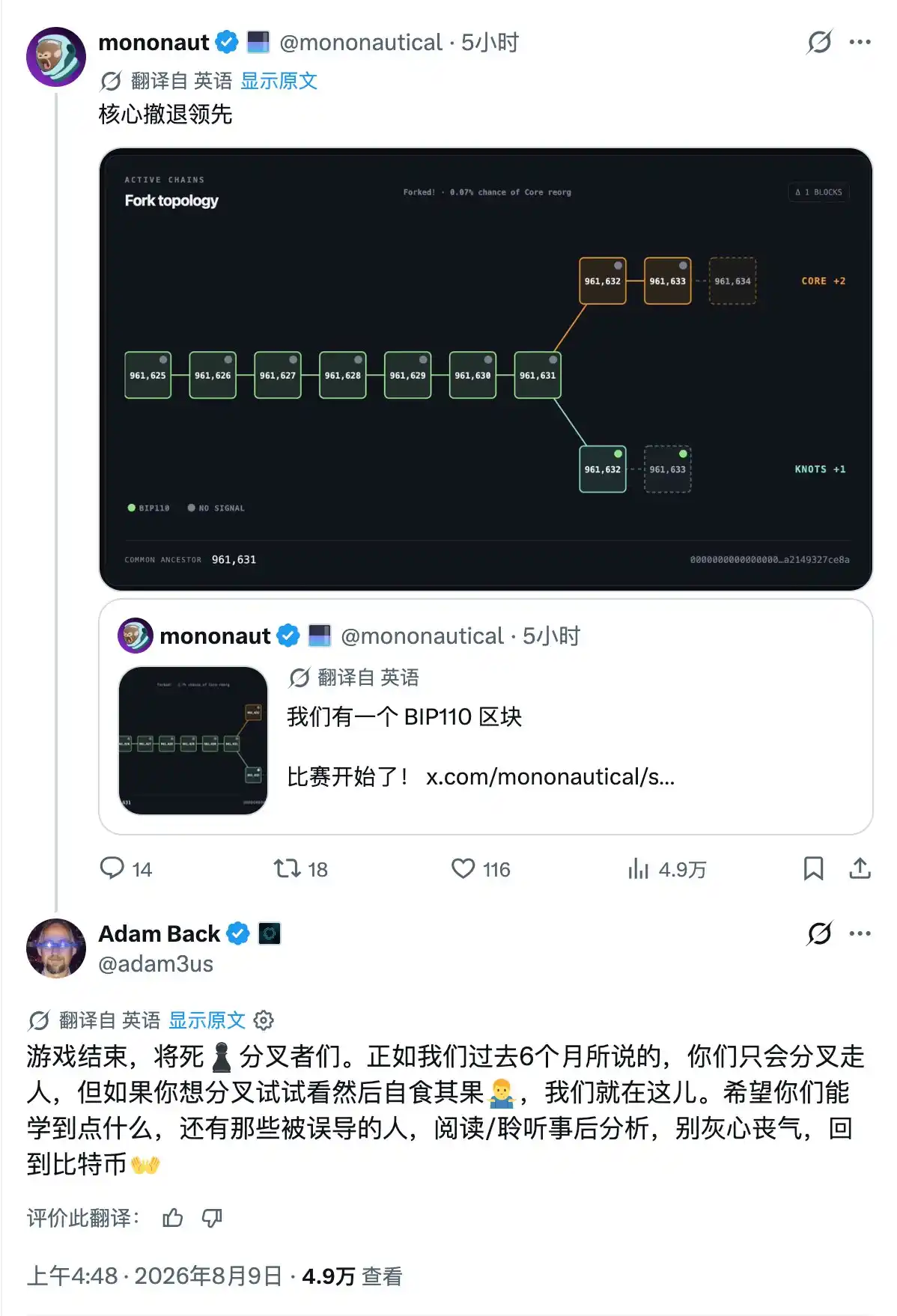
The majority of miners did not support it and continued to mine blocks under the original rules. The minority of nodes and miners executing BIP-110 remained on the other chain. As of 9:00 AM Beijing Time on August 9, the main chain with higher cumulative proof-of-work had reached block 961654, while the BIP-110 execution chain was stuck at 961633, lagging by 21 blocks. In the first 23 blocks of the new cycle, not a single one signaled support for BIP-110 on the main chain.

This is not an evenly matched hash power battle. The main chain is progressing normally, while the BIP-110 chain, due to its low hash power, is significantly lagging in block production speed.

Who is driving this fork?

BIP-110 was proposed by pseudonymous developer Dathon Ohm, with Luke Dashjr participating in early drafts and technical advice. Its reference implementation is based on Bitcoin Knots maintained by Luke, and it was not merged into Bitcoin Core, nor did it gain support from a majority of miners.
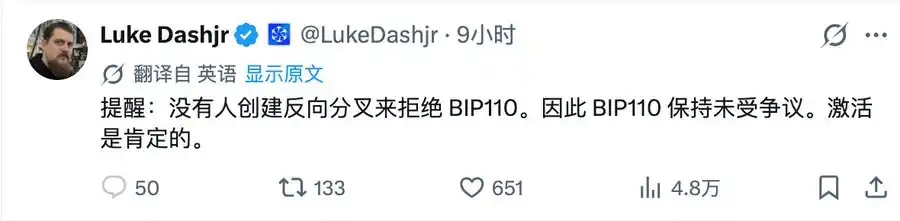
It is not part of Bitcoin Core's mainnet upgrade roadmap. The actual drivers are some Knots node operators and a minority of miners. This is a UASF attempt: even if miners do not achieve sufficient signaling support, nodes can still proactively tighten the rules for the blocks they accept, forcing the network to make a choice.

Why are these people insisting on pushing BIP-110?

The background remains the ongoing controversy over inscriptions spanning several years.

Ordinals, BRC-20, and Runes write image, text, and token data into Bitcoin blocks. Supporters of these use cases believe that block space is essentially a fee market; miners can include whatever people are willing to pay for. Supporters of BIP-110, on the other hand, believe that Bitcoin should primarily be a monetary and payment network, and that large amounts of arbitrary data increase blockchain size, imposing long-term storage, bandwidth, verification, and propagation costs on all full nodes.

Data publishers pay a fee only once, but once the data enters a block, nodes worldwide must store it permanently. The publisher and miner complete a transaction, but the subsequent costs are left to the entire network. BIP-110 aims to turn this conflict from a policy issue of "whether nodes are willing to relay, whether mining pools are willing to include" into a consensus rule.

It plans to be temporarily enforced for about one year upon activation. Most new output scripts cannot exceed 34 bytes, the OP_RETURN limit becomes 83 bytes, data pushes and some witness elements cannot exceed 256 bytes, and certain Taproot constructions that could be used to carry data are disabled. Old UTXOs are exempt, and regular payment transactions are mostly unaffected.

Opponents are concerned about more than just whether inscriptions can still be created. BIP-110 turns some transaction uses from a fee market issue into a consensus judgment of valid or invalid, which could affect Miniscript, BitVM, and future protocols using Taproot. It also cannot completely eliminate on-chain data; users can still split data and change encodings, albeit at higher costs and with more complex operations.
Why push so hard despite such low support?

Because BIP-110 supporters do not believe miner signaling equals a final vote. In the logic of a UASF, nodes have the right to decide what blocks are valid; if enough users, wallets, exchanges, and payment services adopt the new rules, miners will ultimately follow to avoid mining blocks that no one accepts.

BIP-110 sets the miner lock-in threshold at 55%, lower than the traditional BIP9 common 95%. The more radical part comes later: even if the threshold is not met in the long term leading up to it, the period from block 961632 to 963647 will still enter a mandatory signaling period. BIP-110 nodes will consider blocks not signaling bit 4 as invalid. Their chain will lock in after block 963648, go through another 2016-block cycle, and plan to formally enforce data restrictions at block 965664.

It bets that nodes and economic actors will take sides first, forcing hash power to follow. Current on-chain results show this bet has not paid off yet. The majority of miners continue to extend the original chain, while nodes running BIP-110 can only wait for their blocks on a low-hash-power branch.

What is currently happening is only a signaling rule fork. The data limits of 34, 83, and 256 bytes have not taken effect on the Bitcoin mainnet; the BIP-110 chain hasn't even reached the formal lock-in and enforcement stage yet.

Is success still possible?

We need to look at two separate things.

As long as there are miners willing to produce blocks, the BIP-110 chain can continue to exist and will eventually activate its rules at its own chain height. However, for it to become the Bitcoin main chain in economic terms, it requires sustained hash power and collective recognition from exchanges, wallets, custody platforms, Lightning services, and coin holders. Nodes can reject main chain blocks, but rejection alone cannot make others recognize their chain.

Time is also a significant hard barrier. When the BIP-110 chain forked, it inherited the mainnet's mining difficulty. Bitcoin adjusts difficulty only every 2016 blocks, with a maximum downward adjustment of 4x per period. Roughly estimating the execution chain's hash power using the previous 2.53% signaling rate, completing its first cycle might take about 553 days; after difficulty adjustment, reaching the formal activation would take another approximately 138 days, totaling nearly 690 days, or about 1.9 years.
This is not a fixed date. The timeframe can be significantly shortened with the addition of new hash power. However, it illustrates that BIP-110, even if it can activate on its own chain, might first experience a very long period of slow progress. The wait before activation could even be longer than the rule's originally planned one-year enforcement period.

Ordinary coin holders currently do not need to interpret this as "Bitcoin's rules have already changed."

The main chain with the highest cumulative proof-of-work still operates under the original rules. The 21 million coin cap, existing balances, and daily payments remain unchanged. The risks are primarily concentrated on nodes, wallets, and service providers using the BIP-110 backend: the two chains see different confirmation states, and this fork lacks dedicated replay protection, meaning a single regular transaction might be valid on both sides.

The current outcome: BIP-110 has not activated on the Bitcoin mainnet; it first created a low-hash-power execution chain.


Trending Cryptos

Related Questions

QWhat is the BIP-110 fork described in the article, and what was its goal?

AThe BIP-110 fork was a recent attempt to split the Bitcoin network, initiated on August 8th. Its primary goal was to impose new consensus rules limiting the size of non-financial data, such as inscriptions (Ordinals, BRC-20, Runes), within Bitcoin blocks. Proponents argued this data imposes long-term storage and bandwidth costs on all nodes. The change aimed to enforce stricter limits on script sizes and certain Taproot constructs to curb these uses.

QWhy did BIP-110 proceed with the fork despite having very low miner support (2.53%)?

ABIP-110 proceeded based on a UASF (User-Activated Soft Fork) philosophy. Its supporters believe that nodes (users, exchanges, wallets) ultimately decide which blocks are valid, not just miners. They enforced new signaling rules starting at block 961632, rejecting blocks that did not signal support for BIP-110. The strategy was to force a network choice, hoping economic actors would adopt the new rules and miners would eventually follow to avoid having their blocks rejected.

QWhat is the current state of the BIP-110 chain compared to the main Bitcoin chain?

AAs of the article's reporting, the BIP-110 chain has effectively split off but is struggling. It lags significantly behind the main chain in block height (21 blocks behind at one point) due to having very low hashrate support. The main chain continues normally with overwhelming miner support, while the BIP-110 chain experiences slow block production. The new data-limiting rules have not yet activated on either chain; currently, only the signaling rules differ.

QAccording to the article, what are the main arguments for and against BIP-110's proposed rules?

A**For BIP-110:** Supporters argue Bitcoin should prioritize being a currency and payment network. Inscriptions and similar data create a negative externality where data publishers pay a one-time fee, but the cost of storing and propagating that data indefinitely is borne by all network nodes. The rules aim to protect the network from bloating with non-monetary data. **Against BIP-110:** Opponents argue that block space is a fee market, and miners should be free to include any paying transaction. They also worry the rules could negatively impact other legitimate uses of Bitcoin's scripting capabilities, such as Miniscript, BitVM, and future Taproot-based protocols. Furthermore, they believe such rules cannot eliminate on-chain data entirely but only make it more cumbersome to publish.

QWhat challenges does the BIP-110 chain face in becoming the economically dominant Bitcoin chain?

AThe BIP-110 chain faces significant challenges: 1) **Extremely low hashrate**, leading to very slow block times until the next difficulty adjustment (which could take over 1.5 years at current levels). 2) **Lack of broad economic adoption** from exchanges, wallets, payment processors, and holders, who continue to recognize the original chain. 3) **No automatic replay protection**, creating risks for users. 4) **Time constraint**: The chain's planned ~1-year activation period for data rules may be shorter than the time it takes to even activate them on its own low-hashrate chain.

Related Reads

720 Attacks, 0 Successes: Claude Code Defaults to Auto-Approval, AI Clicks 'Agree' for You

The era of manually approving every action for Claude Code is ending. Starting August 14th, Claude Code will default to an "Auto Mode" for Pro, Max, and Team plans, where AI automatically approves actions instead of prompting users for permission each time. This change is driven by a security report from Trajectory Labs commissioned by Anthropic, which tested 720 attack scenarios across Claude's latest models with zero successful breaches. The defense relies on a three-layer system: the aligned model itself, an input-side probe to detect hijacking attempts, and an output-side classifier to vet actions before execution. Anthropic claims this stack has made prompt injection attacks undemonstrable even internally. Tests showed the Auto Mode blocked 89% of dangerous commands, far surpassing the 13.6% interception rate by human users, who often develop "approval fatigue." However, experts like Simon Willison express caution, warning of potential blind spots. Independent research suggests vulnerabilities may persist, particularly with indirect attacks like malicious commands in third-party packages. While Auto Mode improves efficiency and reduces human error from repetitive prompts, it shifts approval authority from the user to AI. The article concludes that while the system is more reliable than fatigued users, it does not eliminate risk, and ultimate responsibility remains with the human user.

marsbit7m ago

720 Attacks, 0 Successes: Claude Code Defaults to Auto-Approval, AI Clicks 'Agree' for You

marsbit7m ago

Interview with Kalshi's Founders: Sports Trading Accounts for 95%; Disagreement on Philosophy with Polymarket

Interview with Kalshi Founders: Sports Trading at 95%, Disagreement with Polymarket on Philosophy Kalshi, a US-based prediction market platform founded in 2018 by MIT graduates Tarek Mansour and Luana Lopes Lara, has reached a $220 billion valuation. Operating under CFTC regulation, the platform allows users to trade on event outcomes, from sports to politics. Currently, sports-related trading dominates, accounting for about two-thirds of volume, down from 95% last year. Mansour argues this liquidity boosts other categories like crypto and politics, where major events can see $50-100 million in volume. He defends the concept of "financializing everything," stating markets transform partisan debates into objective, incentive-aligned systems for truth-seeking. A key point of contention is the regulatory approach. Mansour emphasizes Kalshi's commitment to a compliant path, contrasting it with rival Polymarket, which he accuses of operating without proper safeguards. He views established financial platforms like Robinhood and CME as his real competition. The industry faces legal challenges, including a lawsuit from New York's Attorney General alleging illegal gambling, and scrutiny over potential insider trading. Kalshi cites identity verification, surveillance systems, and full transparency as its defenses. On management, Mansour describes a flat, non-hierarchical structure adapted from his upbringing in Lebanon, focusing on agility. He credits his success to consistent, extreme effort. In rapid-fire questions, Mansour highlighted a trade on computing power prices, uses ChatGPT to analyze Kalshi's own election data, and advises young entrepreneurs to experiment boldly and avoid most outside advice.

marsbit26m ago

Interview with Kalshi's Founders: Sports Trading Accounts for 95%; Disagreement on Philosophy with Polymarket

marsbit26m ago

Vitalik Updates Ethereum Roadmap: From Merge to 'Lean Refactoring', with STARK, AI, and Privacy Reshaping the Technical Foundation

Vitalik Buterin has updated Ethereum's long-term roadmap, outlining a major shift from the post-Merge evolution toward a "Lean Ethereum" vision. The update builds on the 2023 framework but reorders priorities and introduces new concepts. Key continuations include improving consensus (single-slot finality), scaling data availability (larger blobs), simplifying light client verification with SNARKs/STARKs, and protocol simplification. Major adjustments involve significantly prioritizing quantum resistance due to heightened perceived threats, while deprioritizing items like VDFs and some EVM improvements. Technical replacements are planned, such as moving from Verkle trees to a unified Binary Tree and eventually PBTs, and rethinking state management with "New State Types." Notable new additions are: 1. Making **privacy a top-tier priority**, aiming to build it natively into the protocol. 2. **Radical scaling under post-quantum conditions**, using techniques like leanSPHINCS signatures and zkzk frames. 3. **Protocol "Lean-ification" and formal verification**, leveraging modern AI tools to make full formal verification feasible. 4. Exploring **Blob and Gas futures** for future capacity. 5. Developing **Native Rollups**, deeply integrating rollup capabilities into the protocol. 6. **Reimagining the EVM's future**, potentially exposing a simpler, modern instruction set (e.g., leanISA or RISC-V), with EVM becoming a compatibility layer. The core philosophy shifts toward specializing mechanisms for high-load activities (transfers, swaps, privacy) to gain scalability, rather than attempting to infinitely scale all activities. It also elevates **recursive STARKs and AI-assisted formal verification** as foundational infrastructure. In summary, Ethereum is embarking on a systemic "third-generation" redesign—Lean Ethereum—involving replacements or rewrites of major components. The goal is to achieve a quantum-safe, privacy-first, secure, decentralized, and highly scalable network while maintaining a lean and verifiable protocol.

marsbit52m ago

Vitalik Updates Ethereum Roadmap: From Merge to 'Lean Refactoring', with STARK, AI, and Privacy Reshaping the Technical Foundation

marsbit52m ago

Trading

Spot

Hot Articles

How to Buy PEOPLE

Welcome to HTX.com! We've made purchasing ConstitutionDAO (PEOPLE) simple and convenient. Follow our step-by-step guide to embark on your crypto journey.Step 1: Create Your HTX AccountUse your email or phone number to sign up for a free account on HTX. Experience a hassle-free registration journey and unlock all features.Get My AccountStep 2: Go to Buy Crypto and Choose Your Payment MethodCredit/Debit Card: Use your Visa or Mastercard to buy ConstitutionDAO (PEOPLE) instantly.Balance: Use funds from your HTX account balance to trade seamlessly.Third Parties: We've added popular payment methods such as Google Pay and Apple Pay to enhance convenience.P2P: Trade directly with other users on HTX.Over-the-Counter (OTC): We offer tailor-made services and competitive exchange rates for traders.Step 3: Store Your ConstitutionDAO (PEOPLE)After purchasing your ConstitutionDAO (PEOPLE), store it in your HTX account. Alternatively, you can send it elsewhere via blockchain transfer or use it to trade other cryptocurrencies.Step 4: Trade ConstitutionDAO (PEOPLE)Easily trade ConstitutionDAO (PEOPLE) on HTX's spot market. Simply access your account, select your trading pair, execute your trades, and monitor in real-time. We offer a user-friendly experience for both beginners and seasoned traders.

8.0k Total ViewsPublished 2024.03.29Updated 2026.06.02

How to Buy PEOPLE

Discussions

Welcome to the HTX Community. Here, you can stay informed about the latest platform developments and gain access to professional market insights. Users' opinions on the price of PEOPLE (PEOPLE) are presented below.

活动图片