Zcash Developer Rift: Entire ECC Team Walks Out Of Bootstrap

bitcoinistОпубликовано 2026-01-09Обновлено 2026-01-09

Введение

The entire Electric Coin Company (ECC) team behind Zcash has left the nonprofit Bootstrap, citing a governance breakdown. ECC CEO Josh Swihart stated the team was constructively discharged by a majority faction of the board (Zaki Manian, Christina Garman, Alan Fairless, and Michelle Lai), making their work untenable. The ECC team will form a new company but will continue building on Zcash, stressing the protocol itself is unaffected. Zcash founder Zooko Wilcox reassured users the network remains secure and operational. Bootstrap's board responded that the dispute was not about Zcash's mission but about legal and fiduciary obligations as a nonprofit. They were negotiating a deal involving Zashi and argued the proposed structure introduced legal and political risks to the ecosystem. The conflict caused ZEC's price to drop by 13%.

The entire Electric Coin Company (ECC) team behind privacy coin Zcash has left Bootstrap, a nonprofit created to support the token, after what ECC CEO Josh Swihart described as a governance breakdown that made the team’s work untenable. Swihart said the team will form a new company and continue building on Zcash, while stressing that the protocol itself is unaffected.

A Zcash Civil War In The Making?

In a statement posted to X, Swihart said that “over the past few weeks, it’s become clear that the majority of Bootstrap board members ... have moved into clear misalignment with the mission of Zcash,” naming Zaki Manian, Christina Garman, Alan Fairless, and Michelle Lai, which he referred to collectively as “ZCAM.”

Swihart framed the departure as a response to employment changes imposed by the board majority. “Yesterday, the entire ECC team left after being constructively discharged* by ZCAM,” he wrote. “In short, the terms of our employment were changed in ways that made it impossible for us to perform our duties effectively and with integrity.”

The exit represents a sharp escalation in tensions inside one of the support structures surrounding Zcash, a network that has historically relied on a small number of specialist organizations to fund and coordinate development. Swihart did not provide specific details on the governance actions or employment terms at issue, but portrayed the split as a defensive move to protect Electric Coin Company’s ability to execute its mandate.

“We’re founding a new company, but we’re still the same team with the same mission: building unstoppable private money,” Swihart said. He emphasized that “the Zcash protocol is unaffected,” adding that the decision was “simply about protecting our team’s work from malicious governance actions that have made it impossible to honor ECC’s original mission.”

Zooko Wilcox, the founder of Zcash said the conflict does not involve him or Shielded Labs, also sought to separate the organizational dispute from the operational status of the network. “Big drama in one (or two now?) of the many Zcash support orgs,” he wrote on X, before offering reassurance to users.

“The Zcash network is open source, permissionless, secure, and private, and nothing that happens in this conflict can change that,” Zooko said. “You can safely continue to use Zcash.”

In a second point, Zooko offered a character reference for the board members named by Swihart, highlighting how personal trust and long-running working relationships can factor into ecosystem governance disputes. “I’ve worked closely with Alan Fairless, Zaki Manian, and Christina Garman for more than 10 years, through many intense and difficult situations, and with Michelle Lai for about 5 years,” he wrote. “Based on my experiences, I believe them all to be people of exceptionally high integrity.”

Bootstrap Board Responds

[UPDATE:] After Swihart’s post, Bootstrap’s board issued its own statement tying the dispute to governance and legal constraints around a proposed transaction involving Zashi, describing the fallout as a disagreement over structure rather than over Zcash’s underlying mission. “We are saddened by this outcome and respect the contributions of those who have chosen to depart,” the board wrote, before adding that “it’s important to clarify the nature of the disagreement.”

Bootstrap said it was formed as a 501(c)(3) public-benefit nonprofit with “specific legal and fiduciary obligations” governing how assets, intellectual property, and transactions can be structured. According to the board, it had been discussing “external investment and alternative structures to privatize Zashi,” while working with legal counsel to ensure any path forward complied with US nonprofit law and preserved the long-term Zcash mission.

“There is nothing wrong with for-profits,” the statement said, adding that a well-executed effort could bring “a large amount of outside capital into making Zcash and privacy great and user-friendly,” but emphasizing that “Bootstrap/ECC’s nonprofit constraints are real.”

The board warned that the most recent version of the proposed deal could create legal and political risk for the broader ecosystem, arguing it “introduces new vulnerabilities for politically-motivated attacks on Zcash.” It cited the possibility of donor lawsuits and even an unwinding scenario in which “Zashi would have to be transferred back to ECC,” framing those tail risks as a threat not just to the parties involved but to “the entire Zcash ecosystem.”

In that context, the statement cast the standoff as a compliance issue: “This is not a disagreement about Zcash’s mission, which remains unchanged,” the board wrote. “It is about compliance with the legal and fiduciary obligations of a 501(c)(3), and about the moral imperative of ensuring Bootstrap’s assets remain dedicated to the mission they were meant to serve.”

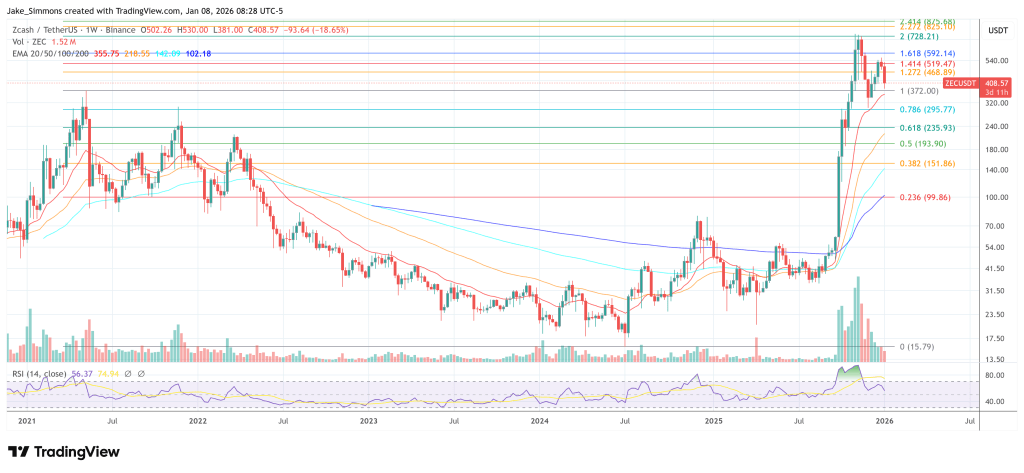
At press time, the ZEC price was strongly affected by the drama, trading at $408.57.

ZEC price crashes by 13%, 1-week chart | Source: ZECUSDT on TradingView.com

Похожее

$9.4 Billion: The Largest Robotics Funding This Year Has Emerged

Munich-based humanoid robotics company Neura has completed a $1.4 billion (approximately RMB 94.9 billion) Series C funding round, valuing the company at around $7 billion and positioning it among the global leaders in the sector. The investment round is notable not just for its size—reportedly the largest in robotics this year—but also for its strategic backers, which include tech giants like NVIDIA and Amazon, alongside established industrial players such as German engineering firms Bosch and Schaeffler. This mix of investors signals a significant shift in the industry's focus from technological demonstrations and general-purpose narratives toward practical, industrial deployment and commercialization. Neura's approach centers on developing humanoid robots for defined, high-value industrial tasks rather than pursuing a general-purpose model. Its early validation comes from a partnership with BMW, where its robots are being tested on actual production lines. The involvement of Bosch and Schaeffler, companies deeply embedded in global manufacturing, underscores a growing belief that humanoid robots are transitioning from labs to viable factory-floor solutions. The article highlights two converging trends driving investment: advancements in AI and large language models, which enhance robots' perception and decision-making in unstructured environments, and mounting pressure from labor shortages and rising costs in major manufacturing regions. The funding landscape is now bifurcating between companies like Figure AI, focusing on versatile general-purpose robots, and firms like Neura, targeting specific vertical industrial applications with clearer, shorter paths to ROI. While technical hurdles remain, the core challenges for widespread adoption are increasingly seen as engineering and commercial in nature: managing the high integration and customization costs for different factory environments and establishing robust, localized maintenance and service networks. The record investment in Neura, particularly from industrial capital, indicates the industry's growing confidence in moving from proving feasibility to solving the practical problems of scalability, reliability, and building sustainable business models around humanoid robots in real-world settings like automotive manufacturing and hazardous labor environments.

marsbit5 ч. назад

$9.4 Billion: The Largest Robotics Funding This Year Has Emerged

marsbit5 ч. назад

"119 to 176 Dollars": Behind SpaceX's Listing, MSX Once Again Successfully Executes the Pre-IPO Closed Loop

Following May's 300% gain on Cerebras, MSX delivered another outstanding performance during SpaceX's listing night. On June 12, SpaceX (SPCX) launched on Nasdaq, reaching a high of $176. This marked the successful culmination of MSX's Pre-IPO project launched in March, where users subscribed at $119, achieving gains of approximately 40-48%. This event validated MSX's complete Pre-IPO mechanism, a crucial advantage in a market where access to top-tier private company equity is typically limited to institutions. MSX's model provides a full cycle for users: subscription (at $119 for SpaceX), real-time on-chain portfolio tracking, optional early redemption, seamless conversion to tradable spot assets (SPCX.M) upon IPO, and final settlement in stablecoins. This end-to-end process distinguishes MSX from platforms that faced settlement issues during the SpaceX IPO, highlighting that the core challenge of Pre-IPO is not just access, but a clear exit and conversion path post-listing. This success with SpaceX is MSX's second major Pre-IPO verification, following the Cerebras listing in May, which yielded ~300% returns for early participants. These back-to-back achievements demonstrate MSX's capability to source, structure, and deliver real assets through a replicable on-chain model. The true barrier for Pre-IPO products lies not in providing an entry point, but in ensuring reliable fulfillment from subscription through to post-IPO liquidity. MSX's proven闭环 (closed-loop) process addresses this, offering Web3 users a structured way to access high-growth, pre-public companies in sectors like AI and frontier tech. MSX plans to continue expanding its Pre-IPO portfolio with this focus on authenticity, transparency, and post-listing execution.

Odaily星球日报17 ч. назад

"119 to 176 Dollars": Behind SpaceX's Listing, MSX Once Again Successfully Executes the Pre-IPO Closed Loop

Odaily星球日报17 ч. назад

Торговля

Спот
Фьючерсы
活动图片