Without Storytelling Power, Web3 Cannot Reach Vast Territories

marsbitОпубликовано 2025-12-30Обновлено 2025-12-30

Введение

Web3's failure stems not from a lack of ideas, but from its inability to resonate emotionally. Current Web3 narratives are dominated by abstract concepts—blockchains, infrastructure, protocols—which, while technically sound, lack humanity and fail to connect with ordinary people. Storytelling is crucial in Web3, more than in any other industry. Unlike topics like food or travel that evoke immediate sensory associations, Web3 feels distant and cold without emotional hooks. Projects often lead with technical explanations of how things work, neglecting the feelings they evoke—confusion, joy, relief—which are universal and relatable. Instead of listing features, effective communication starts with relatable user experiences. For example, rather than saying “this improves scalability,” describe the moment a user realizes a transaction completed instantly without waiting. Stories don’t dilute technical value; they prepare the audience to engage with complex ideas. By grounding concepts in human moments—struggles, breakthroughs, small victories—Web3 can become tangible and compelling. Practical experience shows that story-driven content, focusing on authentic user journeys, outperforms technical explanations in engagement and comprehension. The key is making Web3 feel human, not just functional.

Written by: Noir

Compiled by: Chopper, Foresight News

The failure of Web3 has never been due to a lack of creativity. In fact, its problem lies in its inability to resonate with people.

Most of the current Web3 narratives are filled with abstract concepts: public chains, infrastructure, protocols, layers... These terms are not wrong! But they lack any "human touch," making it impossible for ordinary people to feel a connection.

This is precisely where the value of storytelling comes in. In the Web3 field, the importance of storytelling far exceeds that of any other industry.

Web3 Is Built on Logic but Lacks Emotional Resonance

In other fields, people already come with a cognitive context. For example: talking about food can stimulate your appetite; discussing fitness can make you visualize progress; mentioning travel will immediately bring to mind the scenery of the destination.

But Web3 simply cannot do this. Creators and project teams are always painstakingly explaining how amazing those invisible systems and intangible processes are.

Without stories as a foundation, all of this seems distant and cold.

In short: utterly boring. Clearly, no one will pay for something boring.

Stories Are the Gateway for Ordinary People to Enter Web3

Most creators and project teams are eager to explain upfront how something works. But they forget that a good story always begins by describing how it feels.

Confusion, laughter, relief, vulnerability... these emotions are completely absent in Web3 narratives.

Friend, if this trend continues, the outcome is self-evident. Even if people don’t understand the technology, these emotions are universal. The key is that when someone recognizes familiar feelings in a story, they will instinctively follow you to hear your subsequent professional explanations.

Stop Listing Features; Talk More About User Experience Moments

Compare two ways of expression, and the difference is clear.

Feature-first version: This feature improves the system’s scalability by optimizing throughput.

There’s nothing wrong with this statement, but it’s forgettable, and... what does it even mean?😂

Story-first version: I kept refreshing the page, mentally prepared to wait again... only to find that the transaction had already been completed.

The same core information, but the latter has more warmth and is easier to understand.

Storytelling isn’t about downplaying technology; it’s about preparing the listener’s brain to receive complex information.

Got it? I hope you understand. Let’s continue...

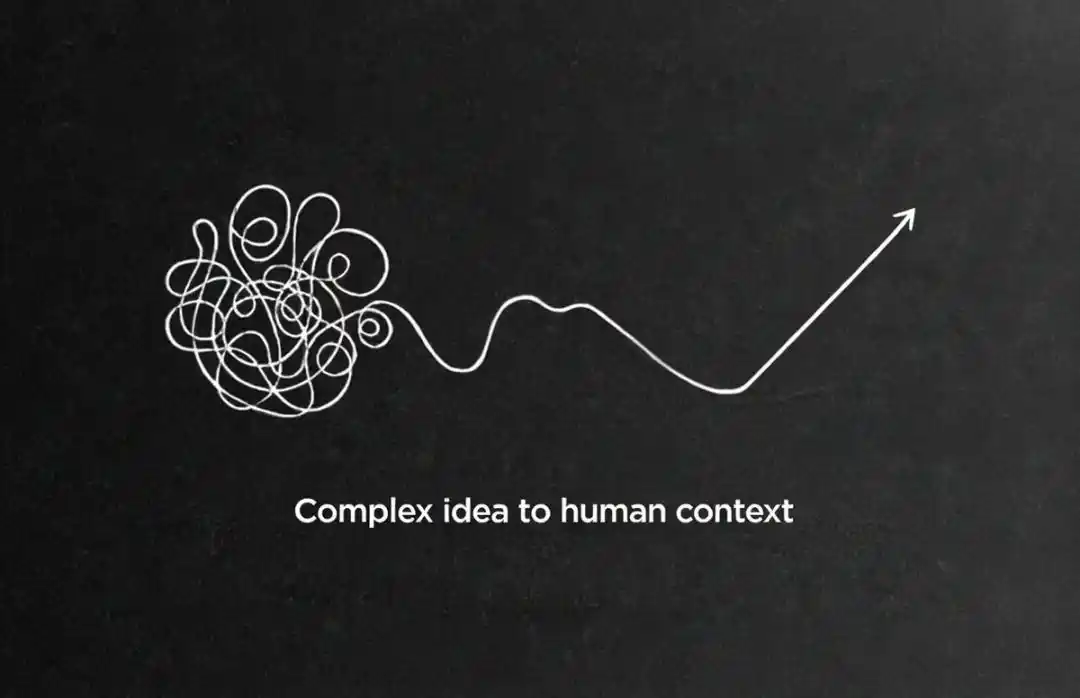
Complex Concepts Need Real-Life Scenarios to Land

When faced with complex problems, people ask themselves: "What does this have to do with me?"

And stories can subtly provide the answer. All it takes is a simple real-life scenario to make the connection.

You don’t actually need to explain every detail. You just need to showcase a key moment: a frustrating bottleneck, a moment of relief, a small victory.

That’s enough to make a complex concept feel real and tangible.

Practical Validation: This Methodology Really Works

The core of my work is creating story-centric video content for Web3 bounty campaigns and sponsors.

Over time, I’ve noticed a pattern: the videos that win are never the ones with the most hardcore technical explanations, but those that begin with moments full of human touch.

I don’t start by listing features or explaining principles. Instead, I focus on these scenes: the initial awkwardness of using a product for the first time; the stumbling before understanding a function; the sudden clarity when everything finally connects.

This narrative approach always keeps viewers engaged longer and helps them understand faster. This is also why my videos stand out in bounty competitions.

It’s not because I explain more technology, but because I make complex concepts feel human and emotionally warm.

Связанные с этим вопросы

QWhat is the main reason for Web3's failure according to the article?

AWeb3's failure is not due to a lack of creativity, but rather its inability to resonate with people emotionally. Its narratives are filled with abstract concepts that lack a human touch, making it difficult for ordinary people to connect.

QHow does the article suggest making Web3 concepts more relatable?

AThe article suggests using storytelling to make Web3 concepts more relatable. Instead of listing technical features, creators should focus on describing the user's experience and emotional moments, such as confusion, joy, or relief, to create a connection.

QWhat is the difference between 'function-first' and 'story-first' approaches as described in the article?

AThe 'function-first' approach focuses on explaining technical details, like 'optimizing throughput to improve system scalability,' which can be boring and hard to understand. The 'story-first' approach describes a relatable user experience, such as 'I kept refreshing the page, expecting to wait... only to find the transaction was already complete,' making it more engaging and understandable.

QWhy are emotions like confusion or joy important in Web3 storytelling?

AEmotions like confusion or joy are important because they are universal and relatable. When they recognize familiar feelings in a story, people are more likely to engage and be open to understanding the subsequent technical explanations.

QWhat practical evidence does the author provide to support the effectiveness of storytelling in Web3?

AThe author, who creates story-focused video content for Web3 bounty campaigns and sponsors, found that winning videos are not the most technically detailed but those that begin with human, emotional moments. These videos, which focus on user experiences like initial struggles or moments of clarity, keep viewers engaged longer and help them understand complex concepts faster, leading to success in bounty competitions.

Похожее

Apple Also Has to Pay Rent Now

Apple Pays Rent Too: The Two-Way Flow of "Traffic Tax" and "AI Capability Rent" Between Tech Giants For over two decades, Google has paid Apple an estimated $20 billion annually to remain the default search engine on Safari, a "traffic tax" for a critical user entry point. However, in 2026, the direction of this cash flow partially reversed. Apple agreed to pay Google roughly $1 billion per year to license its Gemini AI models, as Apple's own models reportedly struggled with complex tasks. This creates a unique dynamic: Apple acts as the "landlord" in the established search ecosystem, collecting rent from Google for access. Simultaneously, in the emerging AI arena, Apple becomes the "tenant," paying Google for access to cutting-edge AI capabilities it cannot currently match internally. While Apple claims its new models are "distilled" from Gemini outputs and contain "not a drop" of Google's original code, core dependencies remain. Its knowledge base is refined using Gemini's outputs, and its most powerful cloud model runs on Google's infrastructure. Apple has structured the deal as non-exclusive, allowing it to theoretically switch AI suppliers—a hedge against over-reliance. The future hinges on whether advanced AI models become a commodity (cheap and abundant) or remain a concentrated, scarce resource (expensive and controlled by few). Apple is betting on the former, leveraging its massive device ecosystem to be a powerful, choosy customer. If the latter proves true, its bargaining power could erode. This power dynamic is extending to developers. Apple, Google, and WeChat are all pushing for apps to expose their core functions as standardized "actions" or "intents" that their respective AI assistants (Siri, Gemini, WeChat AI) can directly call. The new scarce resource is no longer just app store visibility, but "being selected by the AI." The currency of "rent" has changed from a 30% revenue share to ceding control over how users interact with an app's functions.

marsbit2 мин. назад

Apple Also Has to Pay Rent Now

marsbit2 мин. назад

Missed the SpaceX IPO? WEEX's "First Trade Protection" Lets You Experience US Stock Trading Risk-Free.

With the excitement around SpaceX's recent public listing reigniting interest in the US stock market, Chinese investors face significant challenges accessing compliant and convenient trading channels following regulatory actions against major online brokers. This article explores the available options, highlighting their risks and limitations. Traditional paths for US stock investments remain problematic. Qualified Domestic Institutional Investor (QDII) and Listed Open-Ended Fund (LOF) products, while compliant, suffer from high fees, significant purchase premiums, and a very limited selection of assets. Small, unregulated offshore brokers pose substantial risks, including potential insolvency. While secure, VIP accounts at banks in Hong Kong or Singapore require high minimum deposits (often 1-2 million RMB) and in-person visits, placing them out of reach for most retail investors. The article positions cryptocurrency exchanges, specifically their TradFi (traditional finance on-chain) offerings, as a compelling alternative. Platforms like WEEX are noted for providing access to a wide range of US stocks and ETFs, including SpaceX (SPCXON), through tokenized assets. This method offers advantages such as a single account for both crypto and traditional assets, USDT-based settlement avoiding fiat complexities, flexible leverage, and robust risk management. To attract users, WEEX is promoting a "First Trade Guarantee" campaign. Running from June 15 to July 8 (UTC+8), it features a $30,000 prize pool. Users who trade $500 worth of US stock contracts can qualify for a guarantee on their first eligible trade: 100% loss coverage up to $30 or a 20% bonus on profits up to $30. The campaign is presented as a low-risk opportunity for both crypto natives and traditional investors to experience US stock trading.

marsbit4 мин. назад

Missed the SpaceX IPO? WEEX's "First Trade Protection" Lets You Experience US Stock Trading Risk-Free.

marsbit4 мин. назад

How Difficult is Chip Making? A Division Error Costs 475 Million Dollars

How Hard Is It to Make a Chip? A Division Error Cost $475 Million Chip expert Shi Kan, a researcher at the Chinese Academy of Sciences and a popular tech creator, explains the immense challenges of chip development. Chips are foundational to modern technology, but their creation is extraordinarily difficult. The journey from sand to a functional chip involves complex design and manufacturing, but a critical bottleneck is verification—ensuring the design works flawlessly before costly production. A single, undetected bug can have catastrophic consequences, as illustrated by the infamous 1994 Intel Pentium FDIV bug. A flaw in the floating-point division unit forced a recall costing $475 million. Unlike software, chips cannot be easily patched after manufacture, making "first-time success" paramount. However, industry surveys show only 24% of chip projects achieve this; over three-quarters require at least one costly re-spin due to design flaws. Verification has thus become the dominant phase, consuming up to 70% of the design cycle. The core challenge is a "verification impossible triangle" between high performance, good debuggability, and low cost. Exhaustively verifying a modern CPU core could take 15,000 years with software simulation, or 30 years with advanced hardware emulation—timeframes utterly impractical for development. Despite being essential, verification is often seen as unglamorous "dirty work," receiving less academic attention than fields like AI. Shi and his team are tackling this by developing an agile verification research framework called ENCORE, based on FPGA technology, to improve verification efficiency and debug capability. Beyond research, Shi engages in public science communication through long-form video content, aiming to demystify chip technology, AI, and computer science. He argues for the value of pursuing "hard and long-term" endeavors, whether in the meticulous world of chip verification or in creating substantive educational content, believing such sustained effort is likely the right path forward.

marsbit13 мин. назад

How Difficult is Chip Making? A Division Error Costs 475 Million Dollars

marsbit13 мин. назад

Claude to Mandate "Face-Scan ID Verification", No ID No Service Starting July?

Anthropic, the creator of Claude AI, has sent privacy policy update emails to users, signaling a significant shift. The key change, effective July 8, is the potential requirement for consumer-level users (Free, Pro, Max plans) to verify their age or identity. This verification would be conducted through the third-party service Persona, involving uploading a government-issued photo ID and taking a live selfie for comparison. Anthropic states this data is for security purposes only, will not be used for model training, and is processed by Persona, not stored on its own servers. The update also clarifies data handling for Claude's new capabilities: when performing multi-step tasks or connecting to third-party apps, user data may flow between Anthropic and those external services. Additionally, more information may be collected from users who participate in Anthropic research. This move is seen as a major step towards establishing accountability as AI agents become more powerful and autonomous, capable of executing complex, real-world tasks. It follows previous enforcement actions, like the banning of the "Fable 5" account, and indicates a broader industry trend toward stricter user identification and safety measures. The verification is expected to apply in specific scenarios, particularly as users engage Claude in more complex agentic workflows.

链捕手26 мин. назад

Claude to Mandate "Face-Scan ID Verification", No ID No Service Starting July?

链捕手26 мин. назад

Blockchain Has Finally Started to Sail into the Mainstream After 18 Years

Blockchain Finds Its True Path After 18 Years: Becoming the Financial Backbone for AI Agents and Autonomy This analysis explores a pivotal shift in the blockchain and crypto investment landscape, driven by the dominance of AI. Major venture capital firms, including Variant, Paradigm, Haun Ventures, and YZi Labs, are moving beyond pure "crypto" investment theses. They are expanding their focus to AI, robotics, and frontier tech, signaling that blockchain is no longer seen as a standalone sector but as an underlying infrastructure layer. The core argument is that blockchain's killer application may not be user-facing apps, but rather providing the economic rails for the coming wave of AI agents, autonomous robots, and automated systems. Key capabilities like self-custody wallets, programmable stablecoins for micropayments, on-chain identity, and verifiable smart contracts are positioned as essential for a future where machines conduct economic activity. The recent $1.4 billion investment by Tether (via its venture arm) in German robotics company NEURA Robotics exemplifies this, aiming to embed Tether's wallet tools directly into robots for autonomous transactions. While many "AI + Crypto" projects remain superficial, the article concludes that true value lies where crypto is a necessary component—enabling machine-to-machine payments, agent autonomy, verifiable data provenance, and open financial settlement for the AI era. For crypto venture capital, this convergence with AI represents both an adaptation to shifting capital flows and a potential path to unlocking the large-scale, non-speculative utility the industry has long sought.

marsbit34 мин. назад

Blockchain Has Finally Started to Sail into the Mainstream After 18 Years

marsbit34 мин. назад

Торговля

Спот
Фьючерсы
活动图片