With 300 Million Financing to Accumulate ETH, the Hidden Concerns Behind BitMine's High-Yield Preferred Shares

Foresight NewsОпубликовано 2026-06-05Обновлено 2026-06-05

Введение

BitMine, led by Thomas Lee, plans to raise up to $300 million through an initial public offering of 3 million shares of perpetual Series A preferred stock on the NYSE (ticker: BMNP). The stock offers a fixed 9.5% annual dividend. The funds are intended to further the company's accumulation of Ethereum, expand its staking node operations, and for general corporate purposes. This move comes as BitMine faces significant challenges. Its massive Ethereum holdings, over 5.3 million ETH (roughly 4.5% of circulating supply), are currently at an unrealized loss exceeding $8.5 billion due to the crypto market downturn. The company's core business model relies on staking these ETH holdings to generate yield, which it presents as the primary means to cover the new, substantial annual dividend obligation of approximately $28.5 million if the offering is fully subscribed. While the model is similar to MicroStrategy's bitcoin-focused strategy of using capital markets to fund crypto acquisitions, BitMine's product differs with its fixed, non-adjustable dividend rate. The company acknowledges risks, stating dividend payments could also come from cash reserves, asset sales, or future financing, and warns that staking yields may underperform or be illiquid during market stress. The 9.5% fixed rate reflects the higher risk premium demanded from investors for a company heavily exposed to Ethereum's volatility.


Written by: Oluwapelumi Adejumo

Compiled by: Saoirse, Foresight News


Key Points at a Glance


  • BitMine plans to issue 3 million perpetual Class A preferred shares to raise up to $300 million for Ethereum position deployment.
  • The 9.5% annualized dividend will provide the company with new funds for token purchases and staking node expansion, but will also incur approximately $28.5 million in annual new dividend costs.
  • The company's unrealized loss on its Ethereum holdings exceeds $8.5 billion; if staking yields fall short of expectations, dividend payments may rely on internal cash, asset sales, or subsequent refinancing.


Led by Thomas Lee, BitMine intends to raise funds through the preferred stock market, leveraging a fixed 9.5% annualized dividend to attract capital for increasing its Ethereum exposure. The company disclosed the plan on June 3rd: issuing 3 million Class A perpetual preferred shares with a face value of $100 and a fixed annual dividend of 9.5%, aiming to raise up to $300 million. Once approved, the securities will be listed on the New York Stock Exchange under the ticker BMNP, with Moelis & Company and Cantor acting as joint book-running managers.


If all shares are sold, the company's annual dividend obligation will increase by $28.5 million, payable weekly following board approval. This fundraising comes at a time when this heavily Ethereum-weighted company faces a severe test for its business model: dragged down by persistently low token prices, Ethereum's market price is far below the company's average cost basis, with BitMine's unrealized losses on related holdings exceeding $8.5 billion.
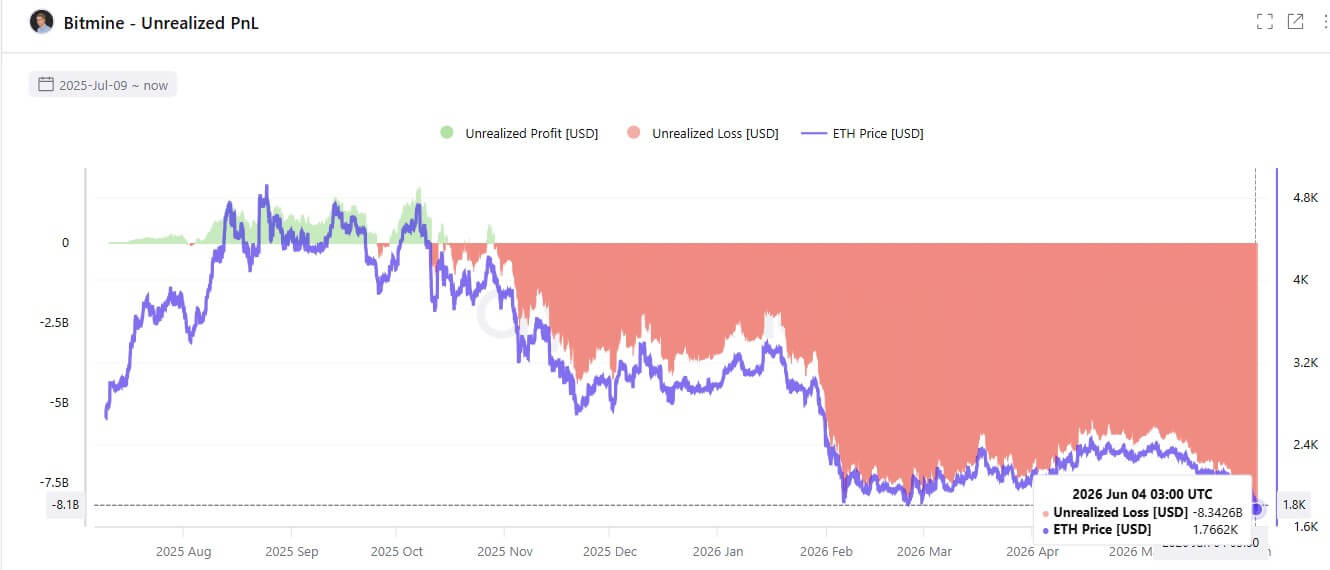

Unrealized Loss on Ethereum Assets Held by BitMine (Data Source: CryptoQuant)


This financing will further tie the company's balance sheet, staking operations, and public market investors, helping the company continue accumulating Ethereum at low prices.


Relying on Ethereum Staking Yields to Support the Dividend Logic


BitMine stated that the proceeds can be used for general corporate purposes: increasing holdings of Ethereum and other digital assets, expanding staking validator nodes, supplementing operational working capital, making strategic investments in the Ethereum ecosystem, and repurchasing its own common stock. This fundraising is not only for patching up book losses but also aids the company in continuously accumulating tokens during the bear market, solidifying its position as a leading publicly listed Ethereum treasury company globally.


Over the past year, the company has consistently made large-scale purchases of Ethereum, currently holding over 5.3 million tokens, accounting for approximately 4.5% of Ethereum's circulating supply; the vast majority of these holdings are in a staked state, continuously earning on-chain block rewards.
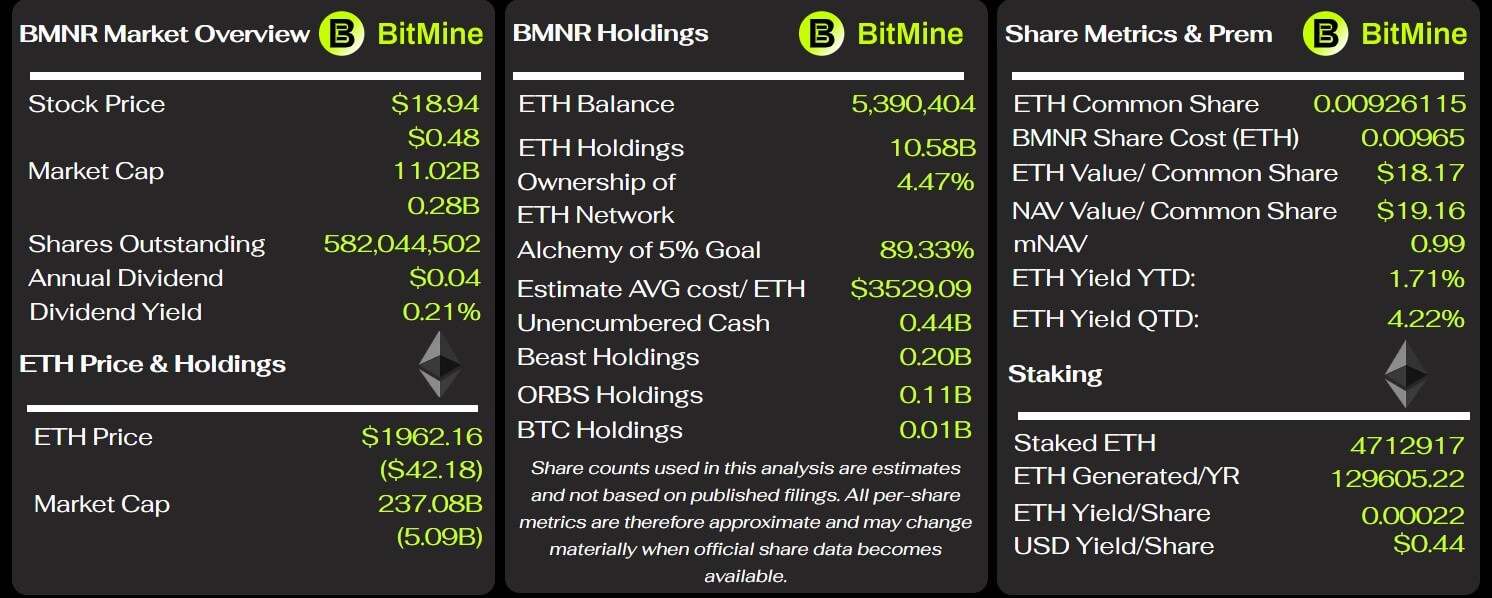

BitMine Key Metrics (Data Source: BitMineTracker)


Chairman Thomas Lee posited that yield generation through staking is the core advantage of Ethereum treasury companies compared to Bitcoin-heavy counterparts. Bitcoin cannot generate passive income, but Ethereum can continuously profit through staking, allowing holders to obtain cash flow without selling the principal. This income logic forms the fundamental support for this preferred share issuance: with the full $300 million raised, weekly dividend expenses amount to approximately $548,000. BitMine disclosed its annualized staking yield reaches hundreds of millions of dollars; under normal market conditions, the dividend cost is far lower than the income generated from staking.


Research by staking service provider Everstake shows: in 2025, among all publicly listed Ethereum treasury companies in the industry, staking income accounted for 60% of total disclosed revenue, indicating that monetizing staking has become the mainstream profit model in the sector. Industry data corroborates that BitMine's business model of using Ethereum-generated yield to cover fixed dividends shares common industry characteristics.


The company is not merely hoarding and locking tokens but is transforming its massive Ethereum reserves into sustainable cash flow to access capital market financing. However, as seen in the offering documents, this model is not without risks.


BitMine has not established a dedicated staking yield fund pool for preferred share dividends. The document states that dividend payments may be sourced from the company's internal cash, staking profits, sales of held securities, subsequent refinancing, or other channels. The company also warns of extreme market risks: staked Ethereum cannot be instantly redeemed and liquidated during market stress periods, and staking yields may fall short of expectations. Essentially, the preferred share issuance converts BitMine's Ethereum investment position into a rigid, regular cash payment obligation.


Benchmarked Against the Strategy Model, but Product Terms Show Significant Differences


BitMine's financing approach is benchmarked against Michael Saylor's Bitcoin-heavy Strategy: both companies rely on issuing listed preferred shares to raise funds, using public market capital to continuously accumulate tokens and optimize capital structure; by creating income-generating securities, they allow ordinary investors to gain exposure to the crypto treasury sector without directly holding the tokens. Both face the market risk of severe underlying asset price volatility and the rigid payment obligation of fixed dividends.


However, the rules of the two preferred share products differ markedly: Strategy's issued STRC preferred shares are floating-rate products, with dividends adjusted monthly to stabilize the share price close to the $100 face value; BitMine's Class A preferred shares feature a fixed 9.5% annualized rate, payable weekly upon resolution, lacking a floating rate adjustment mechanism to stabilize the share price. If BitMine fails to pay dividends on time, unpaid interest accrues weekly on a compound basis, with a penalty interest cap of 15% per annum.
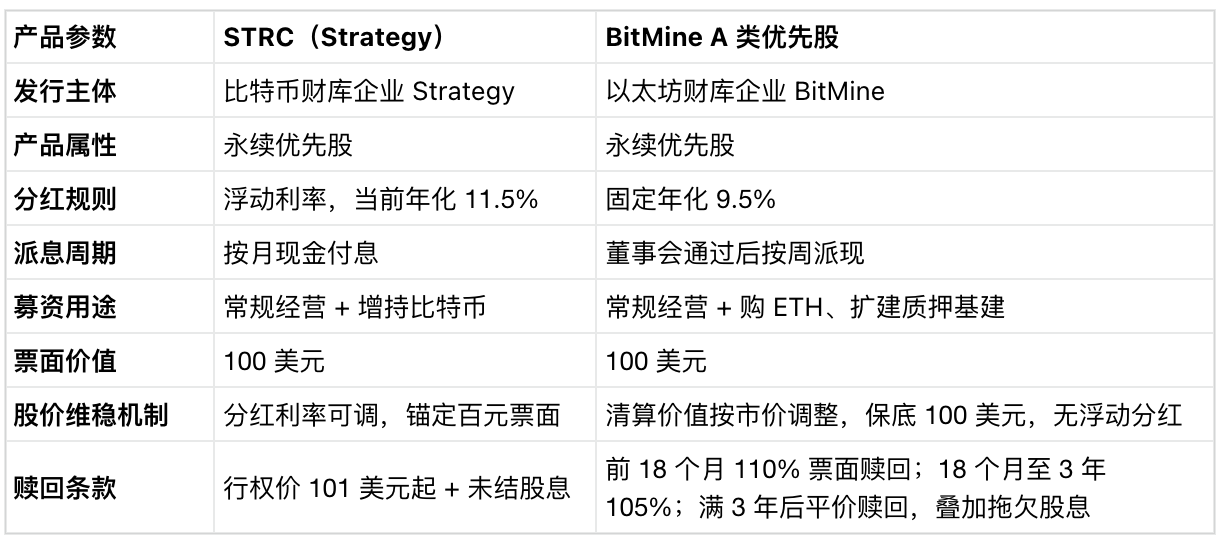


The liquidation reference price for these preferred shares is initially $100, dynamically adjusted according to a market price formula, with a floor not lower than the face value; redemption includes investor put rights triggered by change of control events.


The fixed 9.5% annualized dividend payout can attract fixed-income investors but also reflects the higher risk premium required for financing by companies heavily exposed to Ethereum assets in a bear market environment.


Связанные с этим вопросы

QWhat is BitMine's main purpose in issuing up to $300 million in perpetual preferred stock?

ABitMine aims to raise capital to further expand its Ethereum holdings, scale its staking node operations, and reinforce its position as a leading public Ethereum treasury company.

QWhat is the key risk associated with BitMine's preferred stock offering according to the article?

AThe key risk is the company's obligation to make fixed 9.5% annual dividend payments. If staking yields are insufficient, BitMine may need to cover the payments using its own cash, selling assets, or seeking further financing, creating a rigid cash outflow burden.

QHow does BitMine's business model for the preferred stock differ from MicroStrategy's approach with Bitcoin?

AWhile both use preferred stock to fund crypto acquisitions, MicroStrategy's STRC stock has a floating dividend rate adjusted monthly to stabilize its price. BitMine's offering has a fixed 9.5% annual dividend paid weekly, without a similar price-stabilizing mechanism.

QWhat is the current financial challenge BitMine faces with its Ethereum holdings mentioned in the article?

ABitMine is facing significant unrealized losses on its Ethereum holdings, exceeding $8.5 billion, as the current market price is substantially below its average purchase cost.

QWhat is the primary source of revenue that BitMine plans to use to support the dividend payments for the preferred stock?

AThe primary planned source is the staking rewards generated from its massive Ethereum holdings, which it states generates hundreds of millions in annual yield. However, dividends can also be paid from other sources like cash, asset sales, or future financing.

Похожее

U.S. Government Bans Foreign Nationals from Using Fable 5, Anthropic Issues Rebuttal

U.S. Government Bans Foreign Access to Fable 5, Anthropic Issues Rebuttal On June 12th, the U.S. government ordered AI company Anthropic to immediately suspend all foreign access—including foreign nationals within the U.S. and Anthropic's own foreign employees—to its newly released Fable 5 and Mythos 5 AI models, citing national security concerns. This forced Anthropic to temporarily disable access to both models for all users globally, as it cannot technically differentiate user nationality at scale. The models, released just three days prior, represent Anthropic's highest public capability tier. Fable 5 is the first publicly available model from the advanced "Mythos" family, while Mythos 5 is a less-restricted version for approved cybersecurity and critical infrastructure partners. The government's directive was reportedly triggered by claims from another company that it could "jailbreak" Mythos 5, raising alarm within the Trump administration. Anthropic, in a detailed public statement, strongly challenged this rationale. The company argues the demonstrated "jailbreak" is a narrow, non-generalized technique that merely involves identifying minor, known software vulnerabilities—a capability common to other publicly available models like OpenAI's GPT-5.5 and routinely used by cybersecurity defenders. Anthropic stated it has complied with the order but disagrees with the government's standard, warning that applying it industry-wide would halt all new frontier model deployments. The company criticized the lack of a transparent, fact-based legal process and expressed confidence the situation stems from a misunderstanding. It is working to restore access and will release more technical details within 24 hours. Other Anthropic models remain unaffected.

链捕手17 мин. назад

U.S. Government Bans Foreign Nationals from Using Fable 5, Anthropic Issues Rebuttal

链捕手17 мин. назад

The Revelation from the Raydium Theft Incident: New DeFi Vulnerabilities Lurking in Forgotten Old Contracts

**Raydium Exploit Reveals DeFi's Hidden Risk: Forgotten "Zombie" Contracts** A recent attack on Raydium's deprecated V3 AMM pools resulted in a loss of approximately $1.34 million. The hacker exploited pools that were no longer supported by Raydium's current UI or SDK but remained fully functional and accessible on-chain. This incident highlights a critical, often overlooked category of risk in DeFi: inactive or legacy smart contracts that projects fail to properly decommission. Since March 2025, there have been at least 8 publicly reported attacks targeting such abandoned contracts, with total losses around $10.8 million. Including older pools and deprecated features, the count rises to 10 incidents with roughly $22.5 million in losses. These "zombie contracts" represent a lifecycle management failure rather than a code vulnerability, yet they are typically misclassified under general "code bug" categories in security reports, masking the true scale of the problem. The root cause is that projects often merely document a contract as "deprecated" without taking essential technical steps to secure it: withdrawing remaining assets, disabling external call functions, and implementing ongoing monitoring. These forgotten, under-monitored components become prime targets for attackers. To address this, the industry needs to recognize "zombie contracts" as a distinct risk category and establish standardized decommissioning protocols. Essential steps should include: 1) a formal retirement announcement, 2) removal of all front-end integrations, 3) withdrawal of locked assets, 4) disabling key contract functions, 5) ongoing security monitoring, 6) clear user communication, and 7) a post-mortem analysis. The value of a DeFi project lies not only in its current TVL but also in the security of its historical codebase, which has now become a new attack surface.

Foresight News2 ч. назад

The Revelation from the Raydium Theft Incident: New DeFi Vulnerabilities Lurking in Forgotten Old Contracts

Foresight News2 ч. назад

Robots Begin to 'Consume Data': The Hidden Production Chain from Indian Data Factories to Billion-Dollar Humanoid Robots

Robots have started to 'consume data,' driving the formation of a new industrial supply chain focused on producing training data for embodied AI. Unlike large language models, which are trained on vast internet text corpora, embodied AI models face a 'data desert' in the physical world. This has created a massive demand for first-person perspective video data (Ego Data), captured by workers wearing cameras in places like Indian garment factories. Companies like Neocambrian AI are establishing 'data factories' where workers perform standardized tasks (e.g., sorting clothes, kitchen organization) to generate thousands of hours of video. Research, such as NVIDIA's EgoScale, demonstrates that scaling this human demonstration data predictably improves robot performance, particularly for dexterous manipulation. This has validated a training path combining large-scale human data for pre-training with smaller amounts of robot-specific data for fine-tuning. The value of different data types varies significantly, forming a 'data pyramid.' The base consists of low-cost, large-scale internet and Ego Data. Higher layers include more expensive motion-capture data (e.g., from data gloves), simulation/synthetic data, and the most costly and scarce layer: real robot teleoperation data. This demand has spawned a layered ecosystem of data suppliers: low-cost data factories, motion capture and alignment specialists, robot-native teleoperation service providers, simulation data companies, and platforms aiming for data standardization. Robot companies themselves are adopting a 'layered procurement' strategy: outsourcing generic Ego Data while building in-house capabilities for robot-specific adaptation data and the critical deployment/failure data generated in real-world applications. The industry is shifting focus from hardware and basic mobility to the data pipelines required for general-purpose capability. While parallels exist to data labeling companies like Scale AI in the LLM boom, the physical complexity of robot data—involving action success ambiguity and sim-to-real gaps—requires more integrated solutions for data collection, annotation, and a continuous feedback loop. The race is on to build the data engines that will teach robots to operate reliably in the unstructured real world.

marsbit4 ч. назад

Robots Begin to 'Consume Data': The Hidden Production Chain from Indian Data Factories to Billion-Dollar Humanoid Robots

marsbit4 ч. назад

Торговля

Спот
Фьючерсы

Популярные статьи

Как купить S

Добро пожаловать на HTX.com! Мы сделали приобретение Sonic (S) простым и удобным. Следуйте нашему пошаговому руководству и отправляйтесь в свое крипто-путешествие.Шаг 1: Создайте аккаунт на HTXИспользуйте свой адрес электронной почты или номер телефона, чтобы зарегистрироваться и бесплатно создать аккаунт на HTX. Пройдите удобную регистрацию и откройте для себя весь функционал.Создать аккаунтШаг 2: Перейдите в Купить криптовалюту и выберите свой способ оплатыКредитная/Дебетовая Карта: Используйте свою карту Visa или Mastercard для мгновенной покупки Sonic (S).Баланс: Используйте средства с баланса вашего аккаунта HTX для простой торговли.Третьи Лица: Мы добавили популярные способы оплаты, такие как Google Pay и Apple Pay, для повышения удобства.P2P: Торгуйте напрямую с другими пользователями на HTX.Внебиржевая Торговля (OTC): Мы предлагаем индивидуальные услуги и конкурентоспособные обменные курсы для трейдеров.Шаг 3: Хранение Sonic (S)После приобретения вами Sonic (S) храните их в своем аккаунте на HTX. В качестве альтернативы вы можете отправить их куда-либо с помощью перевода в блокчейне или использовать для торговли с другими криптовалютами.Шаг 4: Торговля Sonic (S)С легкостью торгуйте Sonic (S) на спотовом рынке HTX. Просто зайдите в свой аккаунт, выберите торговую пару, совершайте сделки и следите за ними в режиме реального времени. Мы предлагаем удобный интерфейс как для начинающих, так и для опытных трейдеров.

1.5k просмотров всегоОпубликовано 2025.01.15Обновлено 2026.06.02

Как купить S

Sonic: Обновления под руководством Андре Кронье – новая звезда Layer-1 на фоне спада рынка

Он решает проблемы масштабируемости, совместимости между блокчейнами и стимулов для разработчиков с помощью технологических инноваций.

2.3k просмотров всегоОпубликовано 2025.04.09Обновлено 2025.04.09

Sonic: Обновления под руководством Андре Кронье – новая звезда Layer-1 на фоне спада рынка

HTX Learn: Пройдите обучение по "Sonic" и разделите 1000 USDT

HTX Learn — ваш проводник в мир перспективных проектов, и мы запускаем специальное мероприятие "Учитесь и Зарабатывайте", посвящённое этим проектам. Наше новое направление .

1.8k просмотров всегоОпубликовано 2025.04.10Обновлено 2025.04.10

HTX Learn: Пройдите обучение по "Sonic" и разделите 1000 USDT

Обсуждения

Добро пожаловать в Сообщество HTX. Здесь вы сможете быть в курсе последних новостей о развитии платформы и получить доступ к профессиональной аналитической информации о рынке. Мнения пользователей о цене на S (S) представлены ниже.

活动图片