When Top Crypto VCs Are Shrinking Across the Board, Why Has This Firm Grown by 150%?

marsbitОпубликовано 2026-04-20Обновлено 2026-04-20

Введение

In a declining crypto market where top venture capital firms like Paradigm, Pantera, a16z crypto, and Multicoin saw significant reductions in assets under management (AUM), Haun Ventures stood out with a 150% growth, increasing its AUM from $1 billion to $2.5 billion by 2025. Founded by Katie Haun, a former federal prosecutor and a16z crypto veteran, the firm combines regulatory insight with investment discipline. Initially investing heavily in NFTs during the 2022 hype, Haun Ventures quickly pivoted as the bubble burst, adopting a cautious approach with only six investments over the following 18 months. The firm balanced its portfolio between digital tokens and traditional equity, allocating about 30% to liquid tokens like Bitcoin and Ethereum, which contributed significantly to returns as Bitcoin’s price surged. By 2024, Haun Ventures shifted focus to B2B solutions in payments and developer infrastructure, leading over 56% of its investment rounds—the highest rate among top VCs. This strategy paid off with several high-multiple exits via acquisitions, such as Bridge (acquired at $1.1 billion from a $200 million valuation) and BVNK (acquired at $1.8 billion from a $750 million valuation). The firm’s success is attributed to its regulatory foresight, adaptive strategy, high-conviction lead investments, and emphasis on real-world utility and exit efficiency—making it a standout performer during the crypto downturn.

Author: Gu Yu, ChainCatcher

As the crypto market overall declines, the assets under management (AUM) of almost all crypto VC firms are shrinking with it, and the industry is entering a brutal clearing cycle. But against this backdrop, a crypto venture capital fund established less than five years ago has become a clear exception, charting an independent growth trajectory amidst widespread contraction.

According to a batch of undisclosed financial disclosure documents from U.S. SEC obtained by a Fortune reporter last week, data shows that the AUM of leading firms like Paradigm, Pantera, a16z crypto, and Multicoin shrank across the board in 2025, with Multicoin's AUM shrinking by more than half.

The only one that grew against the trend was Haun Ventures, a venture capital fund established just four years ago. Its AUM grew from an initial $1 billion逐年 (year by year) to $2.5 billion in 2025.
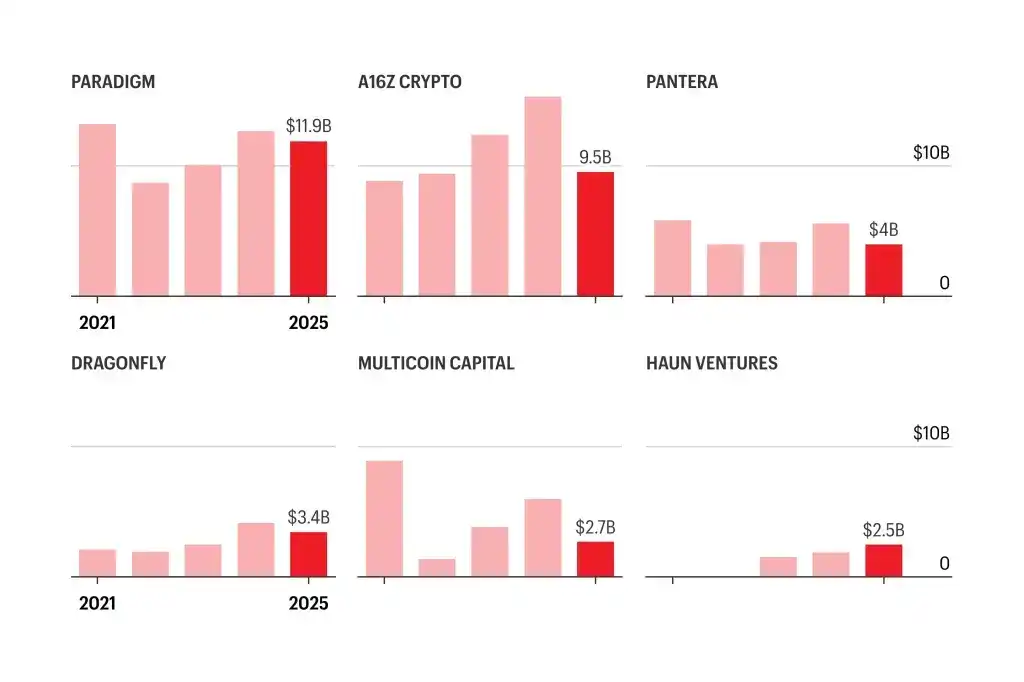
In the bleak crypto market, this is by no means just luck. Last year, market news indicated that Haun Ventures was close to completing a new round of fundraising for a $1 billion fund. All of this reflects that Haun Ventures and its founder Katie Haun's unique investment strategy has passed the test of the market and LPs, propelling them into the ranks of top VCs.

Distinct Founder Style and Background

The difference of Haun Ventures was foreshadowed from the very start.

Founder Katie Haun is not a typical crypto investor. She was a long-serving federal prosecutor in the U.S., working on financial crime investigations for over a decade, and created the U.S. government's first cryptocurrency task force. In 2018, she became a16z's first female general partner and co-led the firm's cryptocurrency fund. She also joined the Coinbase board, thus combining policy vision, institutional resources, and practical experience.

This experience means her understanding of the crypto industry does not stem purely from "technological potential" or "market size," but rather from compliance boundaries, systemic risks, and institutional embedding capabilities. The influence of this background is not obvious, but it is profound enough.

It is worth noting that Haun Ventures is one of only two crypto funds named after their founder, reflecting the fund's distinct founder-driven style. The other VC named after its founder is a16z.

In its early days, Haun Ventures was not flawless and also stepped into pitfalls during market frenzies. Looking back at its investment record, Haun Ventures once focused heavily on NFT as a key investment area, investing in at least 4 NFT projects including Opensea, Autograph, ZORA, and Highlight in the first half of 2022 alone.

However, as the bubble for NFTs and similar concepts burst quickly, Haun Ventures demonstrated a strong ability to correct mistakes and iterate. From the second half of 2022 onwards, it rapidly contracted its efforts, significantly decreasing its investment frequency, responding to the market downturn with extreme prudence.

According to RootData, in the 18 months spanning the second half of 2022 and the entirety of 2023, Haun Ventures publicly disclosed participation in only 6 funding rounds, averaging one investment every three months.

As of June 2023, Haun Ventures partner Rosenblum stated in an interview that the firm's investments were almost evenly split between digital tokens and traditional equity, and that it had already deployed about 30% of its capital into roughly twenty-plus projects, including publicly traded, liquid tokens. These tokens included well-known cryptocurrencies like Bitcoin and Ethereum, as well as smaller market cap tokens related to projects.

At that time, Bitcoin's price hovered for a long time in the $15,000-$30,000 range, before subsequently rising to a high of $126,000 in 2025. This also brought Haun Ventures very substantial investment returns, largely offsetting the investment losses in areas like NFTs and becoming a crucial foundation for its growth in scale.

Key Shift

Starting in 2024, Haun Ventures' investment strategy began to show a clear shift, with its focus turning towards B2B solution companies in areas like payments and developer platforms.

At the time, these directions were not particularly 'sexy.' They lacked explosive growth narratives and were difficult to generate market hype in a short time, yet they恰好 (exactly) hit the key node of the industry's transition from speculation to utility.

In that year, Haun Ventures invested in nearly ten B2B companies, including the stablecoin payment platform Bridge, crypto-native infrastructure platform Conduit, crypto protocol economic security solution Chaos Labs, Solana development platform Helius, and crypto payment platform BVNK.

In terms of investment style, Haun Ventures particularly favors leading investment rounds. According to RootData statistics, among its publicly disclosed participation in 39 funding rounds, it led the round 22 times, with a lead investment rate exceeding 56%, ranking first among top-tier VCs. This demonstrates that Haun Ventures has an unusual level of conviction in its portfolio, willing to support high-potential early-stage projects with substantial capital.

Looking back now, payments have become the sector with the highest valuation premiums and the clearest exit paths in the crypto space. Haun Ventures' early布局 (layout/positioning), combined with its consistent lead investment style, has yielded very considerable exit returns.
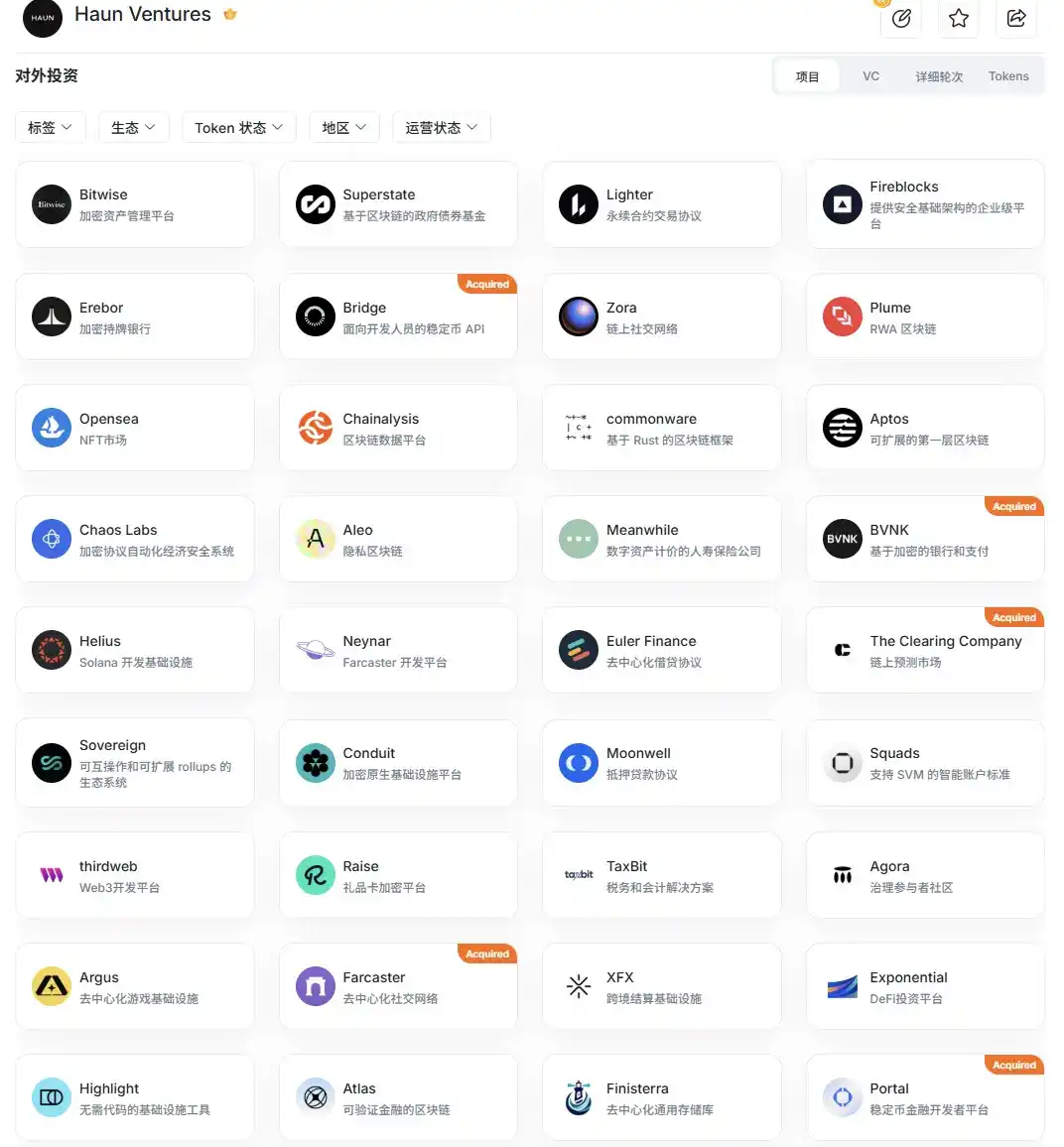
Since October 2024, over 5 of Haun Ventures' portfolio companies have been acquired, with several payment companies achieving high-multiple returns. For example, Haun Ventures once led an investment in the stablecoin development platform Bridge at a $200 million valuation, and it was eventually acquired for a valuation exceeding $1.1 billion. Haun Ventures also led an investment in the crypto payment platform BVNK at a $750 million valuation, which was eventually acquired for a valuation exceeding $1.8 billion.

In an environment where crypto asset exit channels are increasingly narrow and secondary market liquidity is highly concentrated towards the top, Haun Ventures has proven the viability of another path: investing via equity in companies that solve real payment pain points and possess compatibility with traditional finance, achieving high-multiple exits through acquisitions, which is more capital-efficient than holding a pile of highly illiquid tokens.

From chasing the hot trend of NFTs, to a balanced allocation of tokens and equity, and then to focusing on B2B payments and infrastructure, the evolution path of Haun Ventures is precisely an epitome of crypto VCs shifting from speculation-oriented to value-oriented. Katie Haun's compliance experience, the fund's rapid error-correction ability, prudent investment pace, high lead-investment ratio heavy allocation strategy, combined with precise grasp of real-world applications and exit paths, together build a moat for weathering cycles.

As industry泡沫 (bubbles) recede, institutions that expanded依靠 (relying on) narratives and leverage are shrinking one after another. Haun Ventures, with compliance and stability as its foundation, has become the most certain winner in the crypto winter, also pointing out the survival and growth logic for the next phase of the entire VC industry.


Связанные с этим вопросы

QAccording to the article, which crypto VC firm was the only one to experience growth in AUM during the market downturn, and what was its growth?

AHaun Ventures was the only crypto VC firm to experience growth. Its assets under management (AUM) grew from an initial $1 billion to $2.5 billion in 2025, representing a 150% increase.

QWhat unique background does Katie Haun, the founder of Haun Ventures, have that differentiates her from typical crypto investors?

AKatie Haun is a former U.S. federal prosecutor who worked on financial crime investigations for over a decade and created the U.S. government's first cryptocurrency task force. She later became a16z's first female general partner, co-leading their crypto fund, and served on the board of Coinbase.

QHow did Haun Ventures' investment strategy change after the NFT market bubble burst in 2022?

AAfter the NFT bubble burst, Haun Ventures significantly reduced its investment frequency, becoming extremely cautious. It shifted its focus from consumer-facing NFTs to a more balanced portfolio, splitting investments almost evenly between digital tokens and traditional equity, and later pivoting to B2B solutions like payment and developer platforms.

QWhat is a key characteristic of Haun Ventures' investment style in terms of its participation in funding rounds?

AA key characteristic is its high lead-investment rate. Haun Ventures led over 56% of the funding rounds it participated in, which is the highest rate among top-tier VCs, demonstrating strong conviction and a willingness to commit significant capital to early-stage projects.

QWhat type of companies did Haun Ventures focus on starting in 2024, and how did this strategy lead to successful exits?

AStarting in 2024, Haun Ventures focused on B2B solutions, particularly payment and developer infrastructure companies. This strategy led to successful high-multiple exits through acquisitions. For example, its portfolio company Bridge was acquired for over $1.1 billion after a lead investment at a $200 million valuation, and BVNK was acquired for over $1.8 billion after a lead investment at a $750 million valuation.

Похожее

US Stocks Suffer Worst Plunge Since 2025: Three Triggers Ignite Tech Stock Valuation Reset

The US stock market experienced its most severe sell-off since the 2025 tariff crisis on June 5th, 2025. The Nasdaq Composite plummeted 4.18%, the S&P 500 fell 2.64%, and the Dow Jones dropped 695 points. The panic stemmed from three converging factors. First, Broadcom's earnings report ignited fears of a slowdown in AI growth. While its AI chip revenue surged 143% YoY to $10.8B, its Q3 AI revenue guidance of $16B fell short of the $17.2B consensus. This triggered a massive sector-wide sell-off, with the Philadelphia Semiconductor Index crashing 10.26% and semiconductor stocks losing roughly $1.3 trillion in market value in a single day. Second, a shockingly strong May jobs report crushed hopes for Federal Reserve rate cuts. Non-farm payrolls added 172,000 jobs, doubling expectations. This robust data, combined with persistently high oil prices above $92/barrel due to the ongoing Iran war and blockade of the Strait of Hormuz, drastically increased market expectations for a potential Fed rate hike instead of a cut. Higher interest rates compress the valuations of growth-heavy tech stocks. Third, the prolonged Iran conflict continues to fuel inflationary pressures, complicating the Fed's policy decisions and undermining the "inflation is tamed" narrative. Together, these events challenged the twin pillars of the market rally: the "limitless AI growth" story and expectations for imminent monetary easing. The sell-off spread globally, impacting Asian and European markets and cryptocurrencies. The article posits this is likely a severe "valuation repricing" rather than the end of the AI story. The underlying demand for AI remains strong, but investor expectations for growth speed and the prices they are willing to pay are being recalibrated. Key upcoming factors include the June FOMC meeting, future AI company earnings, and developments in the Iran conflict.

marsbit1 ч. назад

US Stocks Suffer Worst Plunge Since 2025: Three Triggers Ignite Tech Stock Valuation Reset

marsbit1 ч. назад

From Madison Square Garden to Kalshi: Prediction Markets Break into the NBA Finals

From Madison Square Garden to Kalshi: Prediction Markets Break into the NBA Finals Prediction markets are playing a significant role in the 2026 NBA Finals, particularly around the New York Knicks' unexpected 2-0 series lead. Platforms like Kalshi and Polymarket have seen massive trading volumes, exceeding hundreds of millions of dollars on championship and related markets. Their influence extends beyond online trading. Kalshi's official partnership with Madison Square Garden has given it prominent physical branding at the arena. Furthermore, local businesses like The Jeffrey bar are using prediction market contracts to hedge the risk of game-result-based promotions, turning potential losses into manageable costs—a concept similar to the famous "Mattress Mack" strategy from traditional sports betting. These markets differentiate themselves by offering a wider, more entertainment-focused range of "event contracts" beyond typical game outcomes, such as predicting celebrity attendance. They also have broader accessibility across the U.S. compared to age- and location-restricted traditional sportsbooks. However, their rapid integration into sports raises regulatory and ethical questions. The NBA is cautiously engaging, discussing integrity frameworks with regulators like the CFTC. While the league permits minor investments like Giannis Antetokounmpo's stake in Kalshi, it advocates for strict rules to prevent insider trading. Many fans express concern on platforms like Reddit, fearing that the close ties between prediction markets, the league, and players could compromise the game's integrity. The NBA Finals has thus become a high-stakes testing ground, showcasing prediction markets' commercial potential while challenging traditional boundaries between financial trading, entertainment, and gambling.

marsbit3 ч. назад

From Madison Square Garden to Kalshi: Prediction Markets Break into the NBA Finals

marsbit3 ч. назад

Recursive Self-Improvement AI Gains Traction, Google Pours Cold Water, While DeepSeek and Others Approach the Fringes

The term "recursive self-improvement" (RSI), where AI improves itself autonomously, is gaining momentum in the AI industry. Startups like Recursive Superintelligence and projects such as Andrej Karpathy's Auto-Research aim to create systems where AI designs, implements, and validates its own research, moving toward superintelligence. While Google CEO Sundar Pichai cautions that such exponential acceleration is not yet a reality, progress is evident. For instance, Anthropic reported its Claude Code writes nearly 100% of the team's code, though it still lacks true self-direction. Analysts frame RSI development in stages: "adequacy" (systems functioning without humans), "parity" (matching human research quality), and "supremacy" (exceeding human-AI collaboration). Reaching parity could trigger rapid, unpredictable advancement due to AI's continuous operation. In China, companies like DeepSeek and Baidu incorporate self-optimization techniques without explicitly branding them as RSI, focusing on algorithmic efficiency and reinforcement learning. However, challenges remain, including "model collapse" from training on AI-generated data and the immense computational and open-collaboration requirements. Ultimately, RSI represents a trend of increasing automation in AI development, potentially reducing human oversight in the creation process itself.

marsbit3 ч. назад

Recursive Self-Improvement AI Gains Traction, Google Pours Cold Water, While DeepSeek and Others Approach the Fringes

marsbit3 ч. назад

Торговля

Спот
Фьючерсы
活动图片




