When Infringement Becomes a Narrative: Hyperliquid's 'Precision Breakthrough'

比推Опубликовано 2026-02-04Обновлено 2026-02-04

Введение

Hyperliquid, a high-performance Layer 1 blockchain, faces patent infringement allegations from Cypherium founder Sky Guo. The dispute centers on US Patent 11,411,721 B2, which covers optimized HotStuff consensus mechanisms involving dynamic validator committee selection and signature aggregation. Guo claims Hyperliquid’s HyperCore engine uses this patented technology without authorization, enabling its high throughput and sub-second finality. The accusation coincides with Hyperliquid’s strong market performance—its HYPE token surged over 40% amid a broader market downturn—and the launch of its HIP-4 proposal for prediction markets. Critics question the timing, noting promotional content for Cypherium’s new project “G-Exchange” appeared alongside the allegations, suggesting possible “clickbait marketing.” Hyperliquid has not yet responded to the legal claims, and its closed-source code complicates independent verification. The situation highlights tensions between intellectual property protection and open innovation in blockchain.

Author: Sanqing, Foresight News

Original Title: Hyperliquid Infringement Dispute: Technological Rights Protection or Opportunistic Marketing?


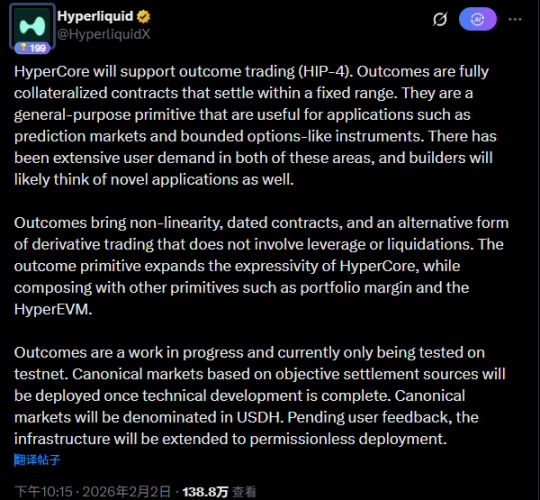
On February 2, Hyperliquid announced that the HIP-4 proposal had gone live on the testnet on February 2. This proposal aims to build prediction market infrastructure by introducing "Outcome Trading." Additionally, from late January to early February 2026, the cryptocurrency market trended weaker, with Bitcoin's price falling below the $75,000 mark, and the broader market experiencing a general pullback. However, Hyperliquid's native token HYPE bucked the trend, rising over 40% in the past week.

Image Source: Hyperliquid Tweet

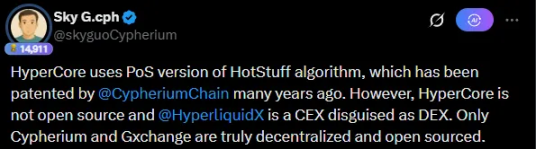
However, as it expands its business footprint, Hyperliquid has faced allegations of technological infringement from a peer. On February 2, Sky Guo, the founder of the RWA public chain project Cypherium, publicly accused Hyperliquid on social media of infringing on its patented technology. Sky Guo claimed that Hyperliquid's underlying consensus engine, HyperCore, uses a patented optimized version of the PoS-based HotStuff algorithm and demanded that Hyperliquid cease the infringement.

Image Source: Sky Guo Tweet

Core Dispute: The Technical Boundaries of Patent US 11,411,721 B2

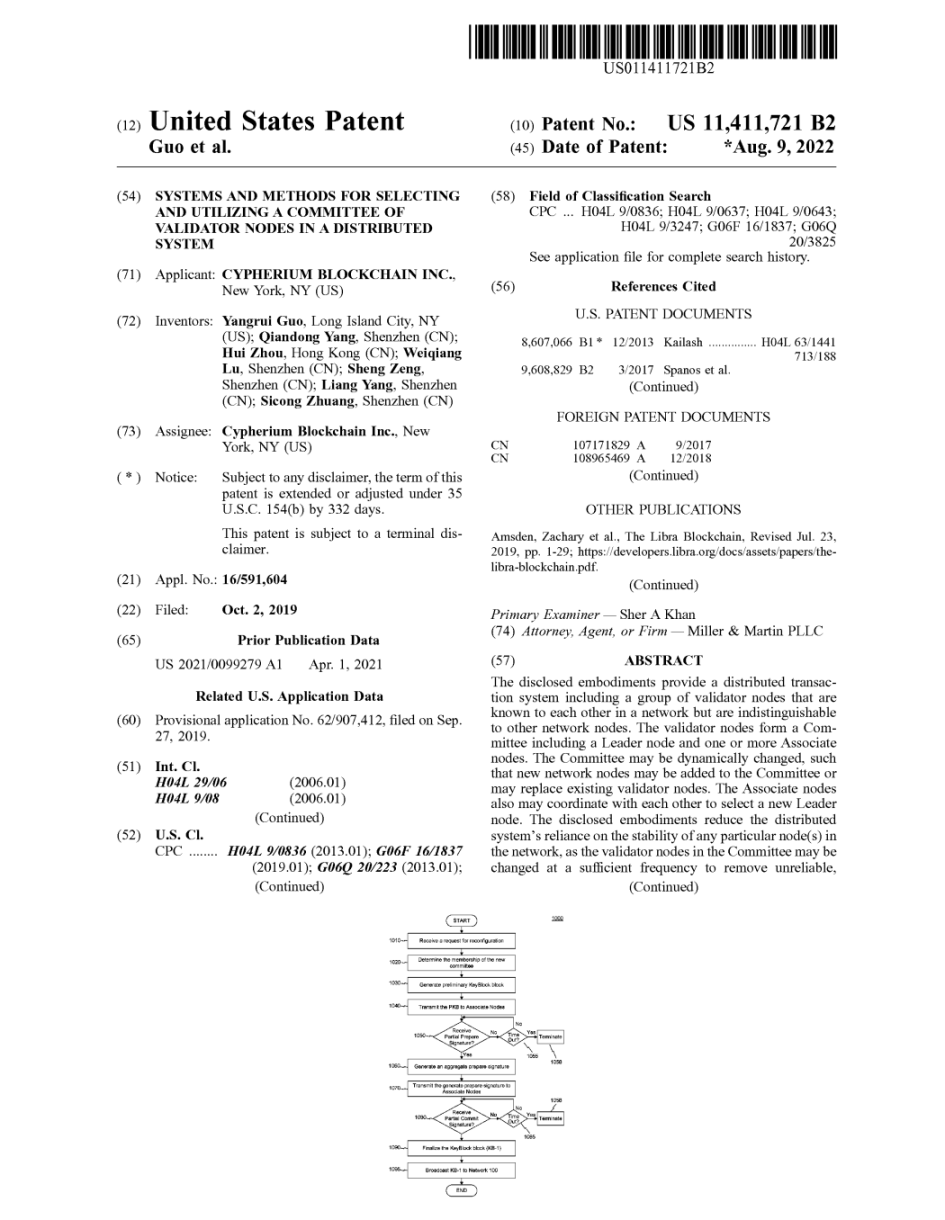
The core of this dispute revolves around a formal patent issued by the United States Patent and Trademark Office (USPTO) on August 9, 2022, with the number US 11,411,721 B2. The assignee of this patent is Cypherium Blockchain Inc., and its title is "Systems and methods for selecting and utilizing a committee of validator nodes in a distributed system."

The patent details a mechanism for dynamically selecting and reconfiguring a validator committee, supporting node election through PoW, PoS, or PoA, and emphasizes the use of Aggregate Signatures to enhance consensus efficiency and fault tolerance. The patent also proposes specific implementation paths such as Two-phase Reconfiguration and Tree-structured Hierarchy.

Cypherium believes that these technologies are key to the implementation of HotStuff in large-scale, high-performance networks (such as Hyperliquid's 200,000 TPS), and this constitutes the core barrier of the patent rights.

First page of Cypherium's patent US 11,411,721 B2 | Image Source: Google Patents

The technical controversy lies in the improvements and application of the consensus algorithm HotStuff by both parties. However, HotStuff itself is an open-source consensus protocol published in academia between 2018 and 2019.

Cypherium's CypherBFT combines HotStuff with PoW to achieve permissionless operation, while Hyperliquid's HyperBFT is a custom variant optimized for low-latency transactions.

But Cypherium claims that its patent covers specific enhancement logic of HotStuff in a PoS environment. Hyperliquid has not yet responded regarding whether HyperBFT uses the unique claims covered by the patent.

Escalation of Accusations: From Questioning Transparency to Denouncing Infringement

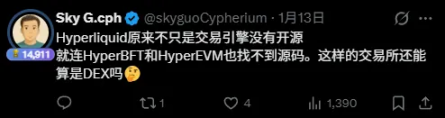
Prior to this infringement accusation, Sky Guo's criticism of Hyperliquid primarily focused on code transparency.

Image Source: Sky Guo Tweet

This lack of transparency, on one hand, protects Hyperliquid's commercial advantage in high-concurrency processing; on the other hand, it makes it difficult for the project to prove its innocence through public audits when facing external technical质疑 (questioning/doubts).

Sky Guo believes that it is precisely because HyperCore borrowed the dynamic committee selection logic described in its patent that it achieved its sub-second finality.

Sky Guo claimed to have sent a legal letter to the Hyperliquid team and relevant responsible persons, accusing them of using the patented technology without permission. He stated that the Hyperliquid side is currently avoiding the issue and has not responded to the legal correspondence.

Solid Evidence or Ambush Marketing?

From a superficial legal and technical logic perspective, the US patent US 11,411,721 B2 held by Cypherium is indeed a formally issued legal document. Its scope of protection确实 (indeed) covers key aspects of consensus mechanisms such as dynamic committee selection, signature aggregation, and two-phase reconfiguration.

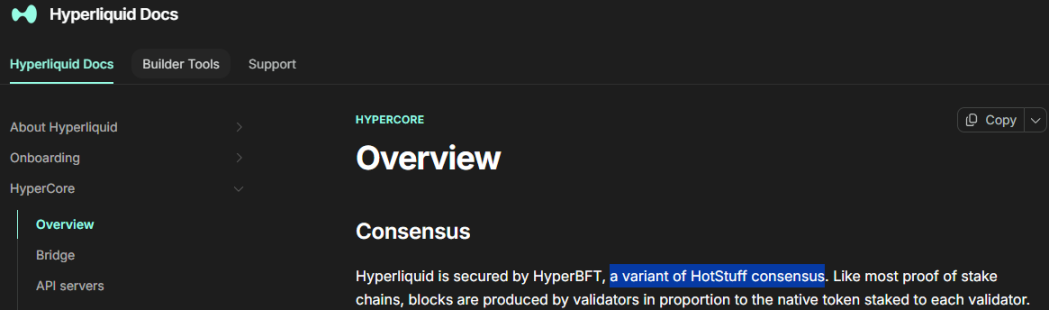
According to Hyperliquid's publicly available technical documentation, the underlying HyperCore engine确实 runs on a custom variant of the HotStuff algorithm called HyperBFT. HotStuff is precisely the technology改良 (improvement/modification) that is a key subject of the patent claims.

Image Source: Hyperliquid Docs

Furthermore, since Hyperliquid's core codebase is currently closed-source, this black-box属性 (attribute) makes it difficult for the outside world to determine whether its specific implementation path avoids the relevant patent through public code audits.

However, in fact, HotStuff and its variants are早已不是新鲜事 (long been nothing new) in the high-performance Layer 1 track. From Meta's (formerly Facebook) aborted Libra/Diem, to the currently booming Aptos (AptosBFT), Monad (MonadBFT), and even early research iterations of Sui's core consensus, all are deeply influenced by HotStuff's linear communication complexity and responsive design.

Additionally, the timing and context of the accusation are thought-provoking. The time Sky Guo issued the infringement accusation (12:00 on February 3) coincided with the strong market performance of the HYPE token and the heat brought by the HIP-4 proposal for prediction markets.

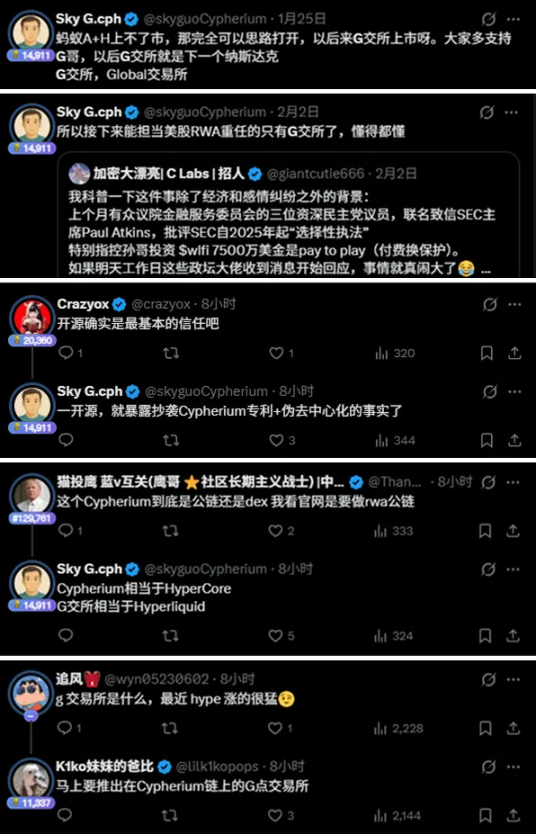
On social platforms, some KOLs expressed support for this rights protection action, but the comment sections of related posts featured疑似 (suspected) promotional content about "G-Exchange". "G-Exchange" is an upcoming new project within the Cypherium ecosystem. The coincidence in the timeline between this technical accusation and the预热 (pre-launch warm-up) of the new project makes this series of维权动作 (rights protection actions)疑似 (suspected) ambush marketing to generate buzz for the new business.

Image Source: Tweets from Sky Guo and other X accounts

Whether the accusation is a "real hammer" (solid evidence) or "ambush marketing," Hyperliquid seems to have reached a crossroads. As its business expands, community calls for increased transparency are growing. Faced with infringement质疑 (doubts/questions), will Hyperliquid insist on its black-box advantage, or will it prove its innocence through partial open-sourcing or third-party audits? This concerns the trust foundation of its decentralization narrative.

Note: HYPE tokens will unlock 9.92 million tokens on February 6, accounting for 2.79% of the circulating supply, worth approximately $357 million (calculated at $36 per token).


Twitter:https://twitter.com/BitpushNewsCN

Bitpush TG Discussion Group:https://t.me/BitPushCommunity

Bitpush TG Subscription: https://t.me/bitpush

Original link:https://www.bitpush.news/articles/7608566

Связанные с этим вопросы

QWhat is the core patent at the heart of the technical infringement dispute between Cypherium and Hyperliquid?

AThe core patent is US 11,411,721 B2, titled 'Systems and methods for selecting and utilizing a committee of validator nodes in a distributed system,' which was issued by the USPTO on August 9, 2022, and assigned to Cypherium Blockchain Inc.

QWhat specific technology does the patent US 11,411,721 B2 describe and protect?

AThe patent describes and protects a mechanism for dynamically selecting and reconfiguring a validator committee, supporting node election via PoW, PoS, or PoA. It emphasizes the use of Aggregate Signatures to improve consensus efficiency and fault tolerance, and proposes specific implementation paths like Two-phase Reconfiguration and Tree-structured Hierarchy.

QWhat is the key technical reason Sky Guo accuses Hyperliquid of infringement?

ASky Guo accuses Hyperliquid's underlying consensus engine, HyperCore, of using a patented PoS-optimized version of the HotStuff algorithm, specifically the dynamic committee selection logic described in his patent, which he claims is key to achieving Hyperliquid's sub-second finality and high TPS.

QWhat suspicious timing and context has led some to view the infringement accusation as a potential 'potshot marketing' stunt?

AThe accusation was made on February 3rd, coinciding with a period of strong performance for the HYPE token (which had risen over 40% in a week) and the launch of the HIP-4 testnet. Furthermore, promotional content for Cypherium's new project 'G-Exchange' appeared in the comment sections of related posts, suggesting the technical claim might be a coordinated effort to generate publicity for a new business launch.

QHow has Hyperliquid responded to the infringement allegations according to the article?

AThe article states that Hyperliquid has taken an evasive attitude and has not responded to the legal letters sent by Sky Guo. The core codebase of Hyperliquid remains closed-source, making it difficult to conduct a public audit to prove its innocence.

Похожее

Should You Buy SpaceX Stock at $1.7 Trillion? Here's What the Market Is Worried About

SpaceX is preparing for a massive IPO aiming to raise around $75 billion at a valuation of approximately $1.75 trillion. While its achievements in reusable rockets and the profitable Starlink satellite internet service are clear, the market is concerned about the aggressive valuation. Key issues include: the current $1.75 trillion valuation, which is about 94 times 2025 revenue, seems to price in not just existing businesses but also unproven future ventures like AI infrastructure and orbital data centers. Financially, while Starlink is profitable, the AI division, bolstered by the acquisition of xAI, is incurring massive losses and consuming the majority of capital expenditures. This acquisition also introduced complex related-party financing arrangements and debt onto SpaceX's balance sheet. Furthermore, corporate governance poses a challenge. SpaceX's dual-class share structure ensures founder Elon Musk retains absolute control, limiting ordinary shareholders' influence over high-risk, long-term strategic decisions. The future success of ambitious projects like the Starship rocket—critical for lowering costs and enabling new services—remains a significant variable for the valuation. In summary, the market's apprehension (FUD) centers not on doubting SpaceX's past technological triumphs but on questioning how much premium public investors should pay for a future that combines proven profits with highly speculative and capital-intensive new ventures, all under a governance structure that offers limited shareholder oversight.

marsbit54 мин. назад

Should You Buy SpaceX Stock at $1.7 Trillion? Here's What the Market Is Worried About

marsbit54 мин. назад

Breaking the DeFi Cascading Liquidation Curse: Vitalik Proposes a New Solution

Vitalik Buterin has proposed a new DeFi design to eliminate the automatic liquidation mechanism that causes market instability during sharp downturns. The current system, used by protocols like Aave, triggers forced sales when collateral value falls below a threshold, often exacerbating price drops and creating systemic selling pressure. Buterin's alternative model is based on splitting an asset like ETH into two synthetic option-like tokens, P and N, pegged to a price index. Their combined value always equals one ETH. Instead of sudden liquidation, a position's value gradually drifts from its target peg if the market moves. Users must proactively rebalance their holdings to maintain their desired exposure, transferring the management burden from the protocol to the user or automated tools. A key advantage is the reduced reliance on real-time oracles. Pricing decisions are deferred until contract expiry, allowing for more robust, fault-tolerant oracle designs. This removes a clear liquidation threshold that speculators can target for manipulation or MEV extraction. However, significant challenges remain. Frequent rebalancing could incur high slippage and transaction costs, necessitating new liquidity provider models. The design is better suited for hedging instruments than for stablecoins requiring a rigid 1:1 peg. While not an immediate replacement for existing systems, the proposal challenges the foundational assumption that instantaneous forced liquidation is an unavoidable necessity in DeFi, opening the door for fundamentally different risk management architectures.

marsbit59 мин. назад

Breaking the DeFi Cascading Liquidation Curse: Vitalik Proposes a New Solution

marsbit59 мин. назад

The End of Single-Factor Cryptography

The article "The End of Single-Factor Crypto" posits a fundamental shift in the cryptocurrency ecosystem. It argues the era where crypto asset valuations were predominantly driven by, and correlated with, Bitcoin's price is ending. The space is bifurcating into two distinct economies: endogenous and exogenous. The endogenous economy represents traditional crypto, where token and project values are directly tied to crypto market prices. The emerging exogenous economy comprises projects and businesses that may utilize blockchain technology or tokens but derive their fundamental value from external, non-crypto factors like consumer demand, subscription revenue, or real-world utility. Examples include AI inference platforms like Venice, fintech lenders using blockchain for efficiency, and stablecoin/payment infrastructure companies acquired by giants like Mastercard and Stripe. This shift means investment analysis must change. For exogenous assets, evaluating traditional business fundamentals—such as revenue streams, unit economics, and competitive moats—becomes more critical than tracking Bitcoin charts. While endogenous assets like Bitcoin remain relevant, the growth of the exogenous category is driven by measurable demand independent of crypto price cycles, paving the way for a new, more diversified market phase. Consequently, crypto is evolving from a single-factor, reflexive asset class into a multifaceted ecosystem with varied drivers and investment theses.

marsbit59 мин. назад

The End of Single-Factor Cryptography

marsbit59 мин. назад

Morning Post | Bitmine Plans to Raise $300 Million Through Preferred Stock Issuance; Polymarket Accuses Kalshi of Commercial Espionage

ChainCatcher's Daily Crypto Brief: Key developments from the past 24 hours include significant funding moves, regulatory actions, and market predictions. Bitmine announced a $300 million preferred stock fundraising. Polymarket accused rival prediction platform Kalshi of corporate espionage, citing numerous suspicious coincidences in product launches, a claim Kalshi strongly denied. The U.S. Department of Justice, in a joint "Disruption Week" anti-fraud operation with companies like Coinbase and Meta, froze over $3.8 million in cryptocurrency linked to scams. In infrastructure news, Macau completed its integration with the multi-central bank digital currency bridge, mBridge, aiming to build efficient cross-border payment channels. Cosmos Labs acquired the block explorer Mintscan. Market-wise, Geoffrey Kendrick, Standard Chartered's Head of Digital Assets Research, stated Bitcoin is nearing a bottom around $63,000, maintaining a year-end target of $100,000. He noted stability in U.S. spot Bitcoin ETF holdings. Ahead of SpaceX's anticipated IPO, internal insiders at Rocket Lab (RKLB) sold over $18.41 million in stock. In tokenization, Goldman Sachs partnered with Apex and Archax to launch a tokenized real estate fund. The meme token tracker GMGN reported the top trending tokens: on Ethereum, HEX, SHIB, LINK, PEPE, mUSD; on Solana, TROLL, swarms, WORLDCUP, neet, Buttcoin; and on Base, PEPE, toby, ODDS, ELSA, SKI.

链捕手1 ч. назад

Morning Post | Bitmine Plans to Raise $300 Million Through Preferred Stock Issuance; Polymarket Accuses Kalshi of Commercial Espionage

链捕手1 ч. назад

Торговля

Спот
Фьючерсы

Популярные статьи

Как купить S

Добро пожаловать на HTX.com! Мы сделали приобретение Sonic (S) простым и удобным. Следуйте нашему пошаговому руководству и отправляйтесь в свое крипто-путешествие.Шаг 1: Создайте аккаунт на HTXИспользуйте свой адрес электронной почты или номер телефона, чтобы зарегистрироваться и бесплатно создать аккаунт на HTX. Пройдите удобную регистрацию и откройте для себя весь функционал.Создать аккаунтШаг 2: Перейдите в Купить криптовалюту и выберите свой способ оплатыКредитная/Дебетовая Карта: Используйте свою карту Visa или Mastercard для мгновенной покупки Sonic (S).Баланс: Используйте средства с баланса вашего аккаунта HTX для простой торговли.Третьи Лица: Мы добавили популярные способы оплаты, такие как Google Pay и Apple Pay, для повышения удобства.P2P: Торгуйте напрямую с другими пользователями на HTX.Внебиржевая Торговля (OTC): Мы предлагаем индивидуальные услуги и конкурентоспособные обменные курсы для трейдеров.Шаг 3: Хранение Sonic (S)После приобретения вами Sonic (S) храните их в своем аккаунте на HTX. В качестве альтернативы вы можете отправить их куда-либо с помощью перевода в блокчейне или использовать для торговли с другими криптовалютами.Шаг 4: Торговля Sonic (S)С легкостью торгуйте Sonic (S) на спотовом рынке HTX. Просто зайдите в свой аккаунт, выберите торговую пару, совершайте сделки и следите за ними в режиме реального времени. Мы предлагаем удобный интерфейс как для начинающих, так и для опытных трейдеров.

1.4k просмотров всегоОпубликовано 2025.01.15Обновлено 2026.06.02

Как купить S

Sonic: Обновления под руководством Андре Кронье – новая звезда Layer-1 на фоне спада рынка

Он решает проблемы масштабируемости, совместимости между блокчейнами и стимулов для разработчиков с помощью технологических инноваций.

2.3k просмотров всегоОпубликовано 2025.04.09Обновлено 2025.04.09

Sonic: Обновления под руководством Андре Кронье – новая звезда Layer-1 на фоне спада рынка

HTX Learn: Пройдите обучение по "Sonic" и разделите 1000 USDT

HTX Learn — ваш проводник в мир перспективных проектов, и мы запускаем специальное мероприятие "Учитесь и Зарабатывайте", посвящённое этим проектам. Наше новое направление .

1.8k просмотров всегоОпубликовано 2025.04.10Обновлено 2025.04.10

HTX Learn: Пройдите обучение по "Sonic" и разделите 1000 USDT

Обсуждения

Добро пожаловать в Сообщество HTX. Здесь вы сможете быть в курсе последних новостей о развитии платформы и получить доступ к профессиональной аналитической информации о рынке. Мнения пользователей о цене на S (S) представлены ниже.

活动图片