Web3 Teams, Stop Wasting Your Marketing Budget on Platform X

marsbitОпубликовано 2026-03-12Обновлено 2026-03-12

Введение

Web3 marketing teams are wasting budgets on ineffective X platform campaigns, as traditional promotion strategies have become obsolete. The classic model—announcement, followed by coordinated KOL posts, and then community discussion—no longer works due to X's new partnership disclosure rules, which make paid promotions obvious to users. This triggers ad avoidance instead of organic engagement. X rewards drama, memes, and debates, not formal announcements. Using Starknet's recent strkBTC campaign as a case study, the author notes that their promotional efforts resulted in low organic mentions and engagement. The solution is to flip the strategy: start by creating narrative tension through debates and comparisons (e.g., "Ethereum L2 vs. Bitcoin L2"), encourage community-generated content, and only then release the official announcement. The goal is to dominate conversations, not just broadcast messages. For developer outreach, building ecosystem prestige and showcasing success stories is more effective than announcement-led campaigns. The key takeaway: marketing must prioritize sparking discussion rather than controlling the message.

Original Author / Stacy Muur

Compiled by / Odaily Planet Daily Golem(@web 3_golem)

Every month, Green Dots conducts research on KOL promotional campaigns on Platform X to understand the strategies of other Web3 marketing teams and track which strategies and post styles are truly effective. However, due to the new paid partnership policy introduced by X, which has changed the marketing landscape on Platform X(Related reading: Musk casually overturns the rice bowl of crypto KOLs), most Web3 projects' promotional strategies are no longer suitable. Stacy Muur reveals in this article the common problems in many recent Web3 promotional activities, using Starknet as the case study for this analysis.

Author's statement: This is not targeting Starknet; their technical strength remains strong. Despite the many doubts and suspicions from the outside world after the airdrop and TGE, the team continues to release and develop products, which deserves respect. But this article focuses only on one aspect: marketing strategy. Starknet's recent new product promotion is just a typical example.

How did Starknet conduct its advertising promotion?

Starknet recently launched strkBTC [₿] and invited some content creators on Platform X to promote this event. They adopted a very classic promotion model:

  1. First, release an announcement with a promotional video;
  2. Within 12-48 hours of the announcement, KOLs will post collaborative promotional posts;
  3. Subsequently, publish articles to specifically explain the advantages of the product.

Even though this promotion was conducted in late February, to comply with Platform X's paid partnership policy, some creators included the paid partnership label when posting related content. But the focus of this article is not on the disclosure of payments, but on the effectiveness of this promotion strategy itself.

On February 10th, around another announcement released by Starknet, their marketing team conducted another KOL promotion. Exactly the same routine: first release a video announcement, then promote it through KOLs.
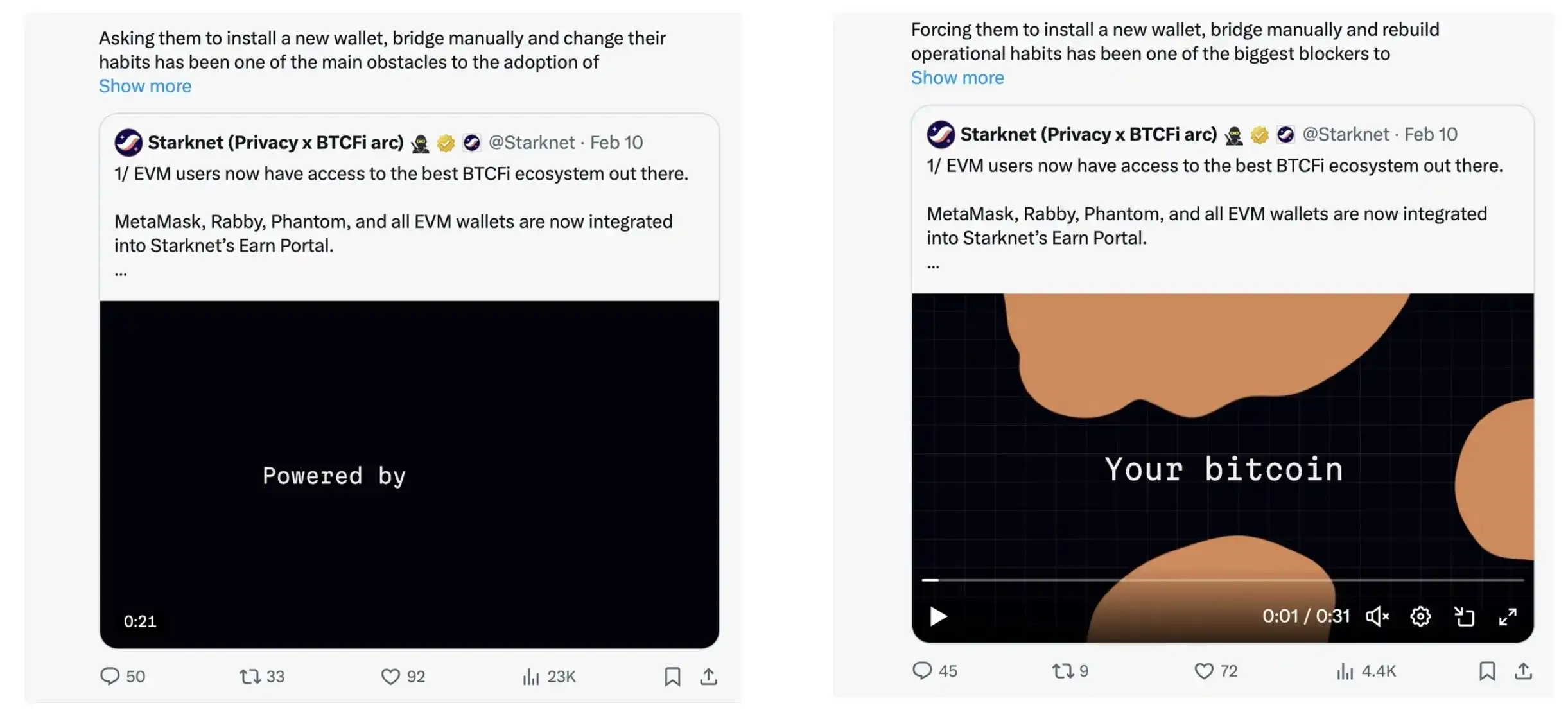
Of course, Starknet also has other promotional methods, such as publishing several long articles and conducting some promotional activities in the Korean language region.
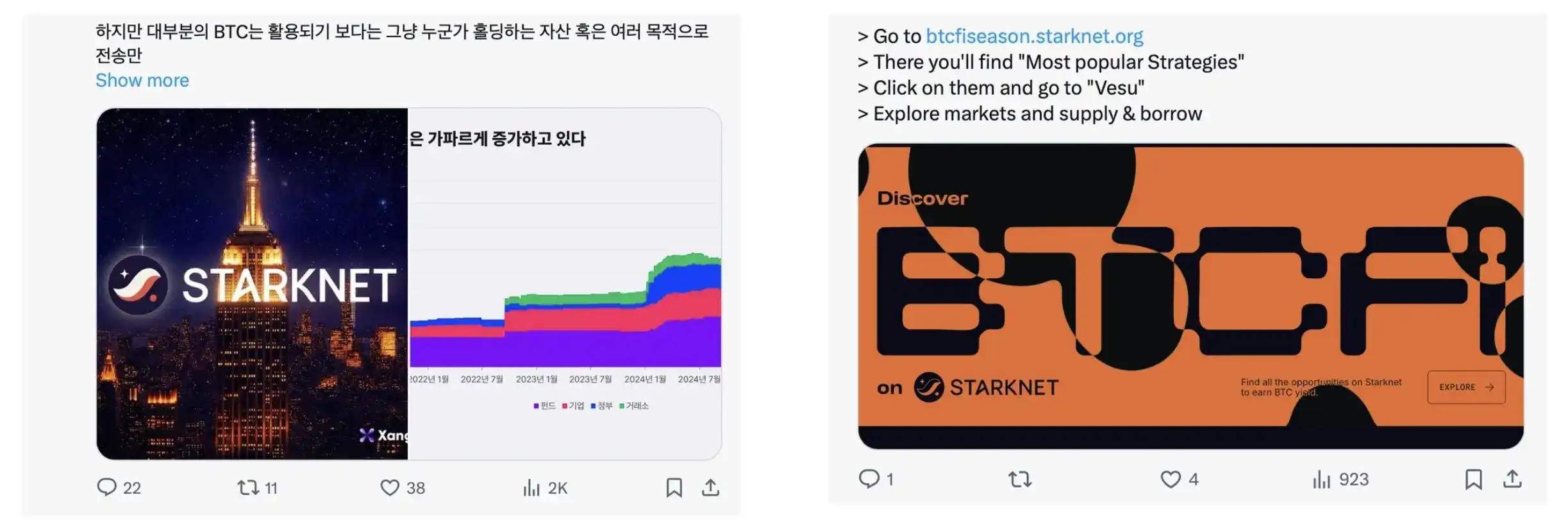
For the record, I don't know who was responsible for managing this campaign, nor whether any agency was involved. I am merely providing some thoughts from an outsider's perspective, from a marketer's point of view.

One problem is obvious throughout the promotion: the screening of creators participating in the promotion is weak.

X is essentially a perception layer. Ideally, creator promotions on X should bring:

  • More discussion about the brand
  • Trigger more voluntary posts from independent creators
  • Drive the production of more community content
  • Stronger ecosystem activation

But is that what we see? Not really.

If you use simple filtering conditions on X to view popular posts mentioning Starknet in February, the results are obvious.
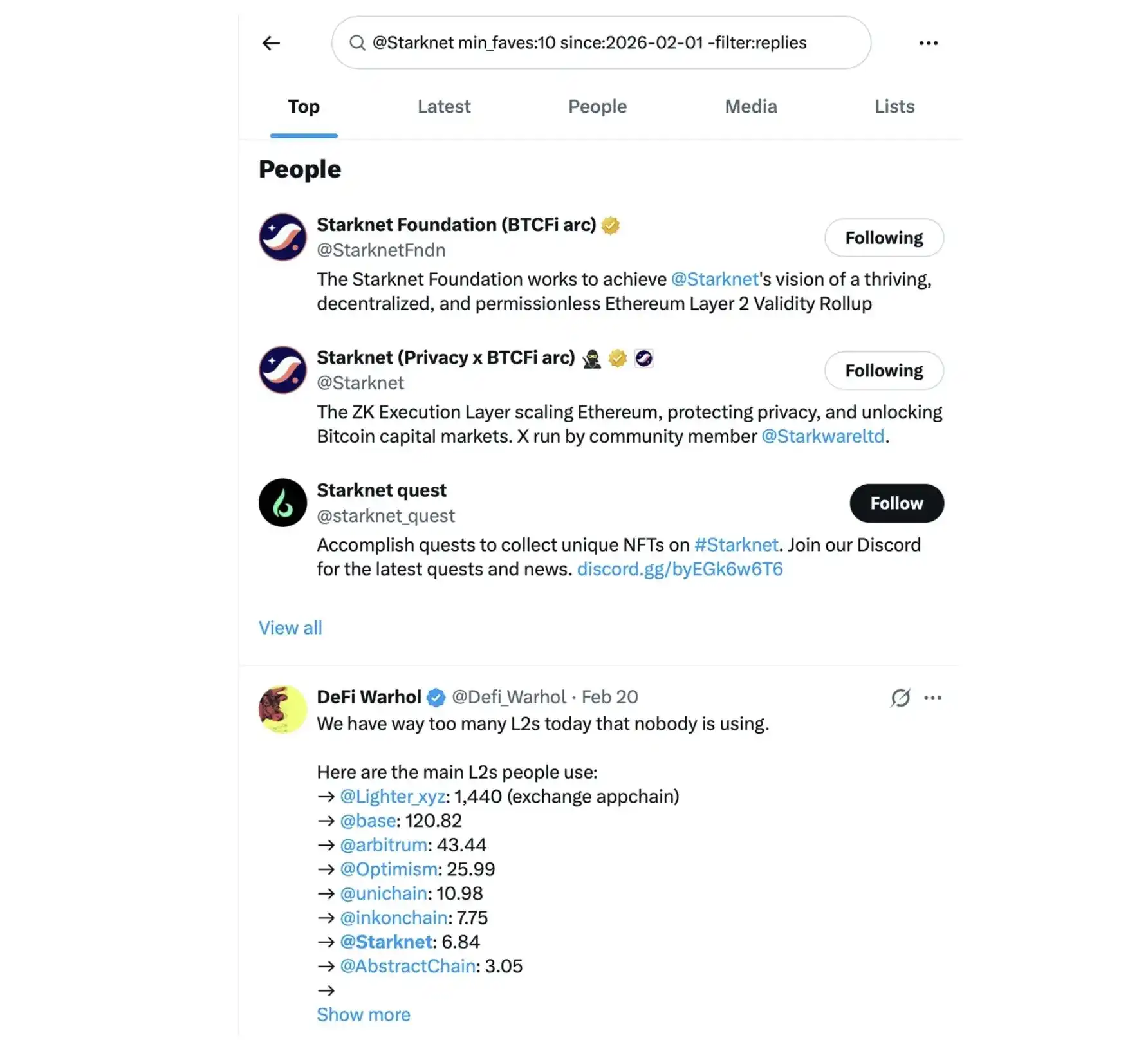
The most mentioned post was actually from Warhol. Overall, in February, only a little over 100 independent posts mentioning Starknet received more than 10 likes. For a well-known L2 ecosystem, this number is not high.

Some popular organic mentions of Starknet included:

  • Mookie's post about token unlocks (approx. 10k views)
  • Warhol's post about the best internship brands in the crypto industry (approx. 16k views)
  • Warhol's L2 rating list (approx. 30k views)
  • santiment's post ranking L2s by developer activity (approx. 50k views)
  • mztacat's post about the "Big Four companies" (approx. 82k views)

The above roughly constitutes Starknet's mention volume on Platform X in February. This leads to a more important question, not just concerning Starknet, but concerning the fact that the classic Web3 marketing strategy is gradually failing on Platform X.

Why is the classic Web3 advertising strategy failing?

For years, the default mode of Web3 marketing has been this: Announcement -> KOL promotion -> Community discussion.

This classic model worked when X's timeline was less crowded, narratives were strong, and most promotions were not easily identifiable as paid promotions. But it started failing after the following changes occurred.

Paid disclosure kills implicit virality

Once creators started adding paid disclosure information, this promotion model became obvious to followers.

First, users see an announcement, then within the next 24 hours, 5-10 similar promotional posts appear, all with largely identical content. Users can immediately recognize this structure. It doesn't trigger community discussion; instead, it sends a signal that "this is an ad campaign."

In the environment of Crypto Twitter, ads rarely spark community discussion; they are usually just scrolled past.

KOL behavior is now very easy to identify

Crypto Twitter has matured; people understand how KOL marketing works.

When the same group of creators quotes the same announcement with slightly different wording, it's easily interpreted as a coordinated promotion. And once KOL content is clearly identified as a promotion, user engagement drops because the audience switches from curiosity mode to ad-filtering mode.

X rewards buzz, not announcements

X is not a distribution channel; it's a narrative space. Unless a Web3 project's announcement can trigger the following, they rarely become trending topics:

  • Arguments and debates
  • Meme coins
  • Hot takes
  • Competition between KOLs

Without these dynamic factors, dissemination can only bring brief user reach but cannot truly win users' minds. Therefore, to truly gain buzz, Web3 projects should change the sequence of their marketing campaigns.

The old promotion flow was: Announcement -> KOL promotion -> Community discussion. The new promotion structure should be: First build the topic -> Spark creator debate -> Generate community content -> Finally announce, so the announcement becomes the final confirmation moment, not the starting point.

If the project skips the narrative stage, promotion has nothing to build on.

How to redesign a promotion campaign for Starknet

Let's get back to reality. Starknet carries heavy baggage. The previous airdrop phase triggered a lot of fear, uncertainty, and doubt. Explanations and promotional videos alone cannot solve this problem; the project needs to control the conversation to resolve it. Different goals also require different marketing strategies.

If the goal is to win mindshare

The strategy should be to actively engage in controversy. Don't try to suppress critics; design topics that can spark debate.

For example:

  • "Which L2 is better for developing BTCFi?"
  • "Ethereum L2 vs Bitcoin L2"
  • "Top 5 ecosystems for BTCFi developers"

Then sponsor posts related to ranking lists, posts comparing Starknet with other projects, and posts with debates. Maybe half the timeline will support Starknet, and the other half will attack Starknet, but both sides increase exposure. Creating drama is not bad marketing; marketing that goes unnoticed is bad.

If the goal is to dominate the narrative

Then stop publishing lengthy PR articles; few people read them. Instead, publish visual infographics, ecosystem maps, competitor comparisons, and short frameworks that KOLs can reuse. Giving creators space to remix content is far more powerful than content they can only quote.

The goal of dominating the narrative is not one good article, but dozens of derivative articles. This is how narratives spread.

If the goal is to attract developers

Then remember that developer acquisition is a B2B model. Posting announcements on X is not effective for developer onboarding. What projects should do is:

  • Build topic momentum
  • Build ecosystem prestige
  • Showcase developers who have already found success there

Once this trend forms, onboarding developers becomes much easier. Because developers also chase hotspots.

Conclusion

The traditional Web3 promotion model (Announcement -> KOL promotion) is dying on X. The new model is more like: Design the topic -> Spark creator interest -> Trigger discussion -> Let the community run with it.

The project's announcement is still important, but it should no longer be the beginning of the promotion campaign; it should be the end point.


Связанные с этим вопросы

QAccording to the article, why is the classic Web3 marketing strategy of 'announcement → KOL promotion' no longer effective on platform X?

AThe strategy is no longer effective due to several key changes: paid disclosure labels make the promotional nature obvious to users, the coordinated posting by KOLs is easily recognized as a campaign, and the X platform's algorithm rewards engaging topics and drama rather than simple announcements.

QWhat does the author suggest is the new, more effective structure for a marketing campaign on X?

AThe author suggests the new structure should be: design a debatable topic → spark creator debate → generate community content → and finally, publish the official announcement as the confirmation point, not the starting point.

QWhat was identified as a major problem with Starknet's recent promotional campaign on X?

AA major problem was the weak vetting of the creators involved in the promotion, which failed to generate significant independent discussion, community content, or ecosystem activation.

QWhat specific type of content does the author recommend creating to dominate public opinion, instead of long PR articles?

AThe author recommends creating visual infographics, ecosystem maps, competitor comparisons, and short, reusable frameworks that creators can easily remix and build upon, leading to dozens of derivative posts.

QFor the goal of attracting developers, what does the article say is more effective than making announcements on X?

AFor attracting developers, it is more effective to build topic momentum, create ecosystem prestige, and showcase developers who have already found success on the platform, as developer acquisition is a B2B process that follows trends.

Похожее

Отправляй сообщения и переводи монеты? Telegram этим летом «встроит» криптокошелек для 1 млрд пользователей

Создатель Telegram Павел Дуров объявил о запуске летом этого года собственного встроенного некастодиального криптокошелька Gram для более чем 1 млрд пользователей приложения. Кошелек позволит совершать мгновенные переводы без комиссий. В отличие от текущего сервиса @wallet, которым управляет сторонняя компания, новый кошелек будет родной функцией Telegram, где пользователи будут самостоятельно контролировать свои приватные ключи. После анонса цена токена GRAM (ранее Toncoin) выросла примерно на 8%, хотя все еще значительно ниже исторических максимумов. Это событие знаменует возвращение Дурова к проекту TON после урегулирования с SEC в 2020 году и является частью его дорожной карты «Make TON Great Again». Запуск происходит в период усиления конкуренции между суперприложениями в сфере платежей: X Money Илона Маска развивает фиатные переводы, а Meta изучает интеграцию стейблкоинов. Telegram делает ставку на криптонативное решение, используя свою огромную аудиторию и близость к криптосообществу. Однако остаются неясными ключевые детали, такие как техническая реализация «нулевых комиссий», поддержка активов помимо GRAM, а также конкретные сроки запуска, помимо обещания «летом».

marsbit19 мин. назад

Отправляй сообщения и переводи монеты? Telegram этим летом «встроит» криптокошелек для 1 млрд пользователей

marsbit19 мин. назад

Предложение Hyperliquid HIP-4 подпитывает стейкинг HYPE по мере роста долгосрочных перспектив

Протокол Hyperliquid (HYPE) представил предложение HIP-4, направленное на создание разрешенных рынков прогнозов и расширение функционала за пределы вечных фьючерсов до базового инфраструктурного уровня для ончейн-приложений. Для запуска новых рынков разработчикам необходимо застейкать 500 000 токенов HYPE. Меры по обеспечению качества рынков призваны трансформировать Hyperliquid из создателя продуктов в инфраструктуру для сторонних разработчиков. Уверенность в долгосрочных перспективах проекта растет, что подтверждается увеличением позитивного настроя вокруг HYPE и активным стейкингом. Крупный трейдер предпочел застейкать токены на сумму около $15,5 млн вместо фиксации прибыли. Общий объем застейканных токенов достиг почти 439 млн, что составляет около 43.9% от общего предложения, укрепляя безопасность сети и сокращая ликвидное предложение. Рыночная структура также демонстрирует силу: открытый интерес превысил $11 млрд при сбалансированных ставках финансирования и ограниченных ликвидациях, что указывает на взвешенный подход трейдеров. Укрепление фундаментальных показателей, таких как рост доходов и TVL, поддерживает оптимистичный прогноз. Успешная реализация обновлений и дальнейшее внедрение пользователями будут ключевыми факторами для поддержания текущего импульса роста.

ambcrypto22 мин. назад

Предложение Hyperliquid HIP-4 подпитывает стейкинг HYPE по мере роста долгосрочных перспектив

ambcrypto22 мин. назад

Через 7 месяцев после краха Huiwang: крупная перетасовка среди платформ-гарантов в Юго-Восточной Азии

За семь месяцев после краха платформы гарантийных платежей Huiwang в Юго-Восточной Азии началась крупная перетасовка на рынке. Такие платформы, как XinBi (Newpay), Linghang (Tiger), Jinbei (Jinbo), Dali (Tiancheng) и Fuli Lai, активно заполняют образовавшийся вакуум, обслуживая теневой бизнес, включая отмывание денег, онлайн-азартные игры, мошенничество в «промышленных парках» и даже торговлю людьми. По данным аналитиков, общий объем средств, проходящих через эти платформы, исчисляется миллиардами долларов США. Крах Huiwang, связанного с камбоджийской группой Prince и конфискацией США 150 000 BTC, не остановил индустрию, а привел к ее реструктуризации и росту новых игроков, которые действуют еще более скрытно. Эксперты подчеркивают, что эти платформы, иногда называемые «азиатским Alipay», являются не законными финансовыми сервисами, а ключевым элементом инфраструктуры для преступной деятельности в регионе.

Odaily星球日报31 мин. назад

Через 7 месяцев после краха Huiwang: крупная перетасовка среди платформ-гарантов в Юго-Восточной Азии

Odaily星球日报31 мин. назад

Свет слабеет: что происходит с криптовалютными венчурными фондами?

**Крипто-венчурные фонды на перепутье: от нишевых игроков к интеграции** Когда-то узкоспециализированные крипто-фонды, такие как Paradigm, были первопроходцами, обладавшими уникальными знаниями и готовыми брать на себя высокие риски нового рынка. Однако сегодня, как показывает пример Paradigm, собравшего 1,2 млрд долларов для инвестиций в ИИ и робототехнику, эти границы размываются. История повторяется по модели Карлоты Перес: по мере взросления технологии (крипто переходит от «фазы установления» к «фазе внедрения») исчезает информационное преимущество специалистов. Традиционные финансовые гиганты, такие как BlackRock или Visa, теперь понимают блокчейн и приходят в отрасль, но им нужны не технические детали, а регуляторные и банковские связи. Это привело к «эффекту гантели» на рынке венчурного капитала. Гигантские универсальные фонды (a16z, Sequoia) и небольшие нишевые игроки выживают, в то время как фонды среднего размера, составляющие большинство крипто-специалистов, оказываются в «зоне смерти». Их размера недостаточно для конкуренции за крупные раунды с гигантами, а доходности только от крипто-стартапов может не хватить для выполнения обязательств перед инвесторами (LP). Поэтому они вынуждены диверсифицироваться, как Framework Ventures, или полностью менять фокус. Даже оставшиеся «чистыми» крипто-фонды, такие как Dragonfly или a16z, сужают свою стратегию до блокчейн-инфраструктуры для финансов (стейблкоины, рынки предсказаний), области, которая также интересует крупные универсальные фонды. Это создает проблемы для крипто-стартапов: им приходится конкурировать за внимание инвесторов с модными ИИ-проектами, а также они теряют поддержку в финансировании важной, но неприбыльной на ранних этапах инфраструктуры, которую раньше строили специализированные фонды. В будущем термин «крипто-инвестор» может устареть, как когда-то «интернет-инвестор». Крипто станет базовой инфраструктурой, а не отдельным классом активов. Рынок будет разделен: крупные универсальные фонды будут финансировать зрелые проекты, а небольшие специализированные фонды — поддерживать нишевые инновации. При этом появляется новая тенденция: такие проекты, как Hyperliquid, успешно запускаются вообще без венчурного капитала, через сообщество. Эра, когда крипто зависело от специализированных VC, подходит к концу, открывая путь новой, более интегрированной и самостоятельной модели роста.

Foresight News52 мин. назад

Свет слабеет: что происходит с криптовалютными венчурными фондами?

Foresight News52 мин. назад

Когда консенсус формируется всё быстрее, во что ставят молодые инвесторы?

Статья «Когда консенсус ускоряется, на что делают ставки молодые инвесторы?» (издание Huxiu) анализирует новые тенденции в технологических инвестициях на фоне быстрого развития ИИ, робототехники, коммерческой космонавтики и квантовых вычислений. Молодые инвесторы смещают фокус от простого преследования технологических трендов к пониманию реальных путей интеграции технологий в промышленность. Выделяются четыре ключевых направления: 1. **ИИ переходит в физический мир:** Инвестиции смещаются от облачных моделей к периферийным устройствам, роботам (включая воплощённый интеллект) и интеллектуальному оборудованию. Акцент делается не на демонстрационных возможностях, а на надёжности, стоимости развёртывания и реальной окупаемости. 2. **Конкурентное преимущество смещается к «интеллектуальной маховичной модели»:** Вместо вопроса «чей ИИ-модель мощнее» важен вопрос, какая компания может встроить возможности модели в рабочие процессы, создав цикл обратной связи «данные — обучение — улучшение продукта». Это создаёт долгосрочный барьер, как показывают примеры компаний Zhipu AI и Kling AI. 3. **Новые базовые технологии для преодоления дефицита данных:** По мере исчерпания общедоступных данных качественного обучения растёт интерес к таким подходам, как обучение с подкреплением и самоиграющие модели. Научные базовые модели (например, для биологии, химии) рассматриваются как перспективное, но сложное направление для генерации новых высококачественных данных. 4. **Терпеливый капитал для глубоких технологий:** В таких сферах, как коммерческая космонавтика и квантовые вычисления, где циклы разработки и валидации длительны, инвесторы должны рано оценивать фундаментальный потенциал, инженерные компетенции команд и готовность сопровождать проекты в долгосрочной перспективе, даже при неопределённости технических путей. Общий вывод: современный технологический инвестор должен глубже понимать язык технологий, оценивать не только финансовые модели, но и инженерные, и коммерческие траектории, и делать выбор в условиях, когда консенсус ещё не сформирован.

marsbit1 ч. назад

Когда консенсус формируется всё быстрее, во что ставят молодые инвесторы?

marsbit1 ч. назад

Торговля

Спот
活动图片




