Wall Street Turns Ultra-Bullish on Ethereum as Institutional Demand Rises and Fee Reform Advances

bitcoinistОпубликовано 2025-12-09Обновлено 2025-12-09

Введение

Ethereum is entering a phase resembling its strongest market cycles, driven by institutional accumulation, shrinking exchange supply, and proposals to stabilize network economics. ETH held on exchanges has fallen to a record low of 8.7% of total supply, with significant accumulation from entities like BitMine Immersion Technologies and ETF inflows. Nearly 40% of ETH is locked in staking or institutional products, creating a tight supply environment. Additionally, Vitalik Buterin has proposed a gas futures market to help users hedge against fee volatility. Analysts compare current dynamics to Bitcoin years ago, citing reduced speculation and sustained institutional demand as factors that could support a major repricing.

Ethereum (ETH) is entering a phase that analysts say resembles the early stages of its strongest market cycles, driven by institutional accumulation, shrinking exchange supply, and new proposals aimed at stabilizing the network’s economics.

Related Reading: ‘Something Big’ Is Coming For XRP, Says Toroso Investments Portfolio Manager

As large investors deepen their presence and developers explore changes that could make transaction fees more predictable, sentiment on Wall Street has shifted sharply recently. For many, the combination of tightening supply and improving fundamentals has created conditions that could support a meaningful repricing.

ETH's price records some gains on the daily chart. Source: ETHUSD on Tradingview

Exchange Supply Tightens as Institutions Accelerate Accumulation

Ethereum held on centralized exchanges has fallen to its lowest level since the network launched in 2015. Glassnode data shows that balances dropped to 8.7% of the total supply last week, marking a 43% decline since July.

The reduction is tied to staking, layer-2 migration, institutional custody, and long-term treasury allocations, destinations that rarely send tokens back to exchanges.

BitMine Immersion Technologies, now the largest corporate holder of Ether, expanded its position by another $199 million over the weekend. The firm controls $11.3 billion in ETH, representing about 3.08% of supply, and continues buying toward its 5% target.

ETFs have also contributed to the drawdown, with cumulative inflows now above $12 billion. Analysts note that nearly 40% of all ETH is locked in staking or institutional products, creating one of the tightest supply environments the asset has experienced.

Technical analysts point to hidden signs of accumulation. Recent On-Balance Volume readings have broken above resistance, even as the price lingers near $3,050, a divergence that some interpret as indicating buying pressure.

Fee Reform Pushes Forward as Vitalik Buterin Proposes Gas Futures Market

Alongside market activity, a new economic proposal from Vitalik Buterin is drawing attention. The Ethereum co-founder outlined a system for onchain gas futures that would allow users to lock in transaction fees for future time periods.

The mechanism resembles traditional futures markets and is designed to help traders and developers hedge against sudden increases in network demand.

Buterin argues that clearer forward pricing could support businesses that rely on predictable costs, particularly as activity expands across staking, tokenization, and decentralized applications. Although still in its early stages, the idea is viewed as part of a broader effort to make Ethereum more stable as it scales.

Analysts See Conditions Forming for a Larger Cycle

Market commentators increasingly cite a combination of shrinking supply, rising institutional involvement, and improving network efficiency as reasons Ethereum may outperform in the next major cycle.

Some compare current dynamics to Bitcoin eight years ago, noting that Ethereum’s evolving economic model and expanding role in tokenized finance give it a broader set of drivers than in previous cycles.

Related Reading: Trump’s New Security Strategy Leaves Crypto And Blockchain Out

Whether these developments immediately translate into price gains remains uncertain. But with exchange balances at record lows and institutions steadily accumulating, analysts agree that Ethereum is entering a structurally different phase, one defined less by speculation and more by sustained demand.

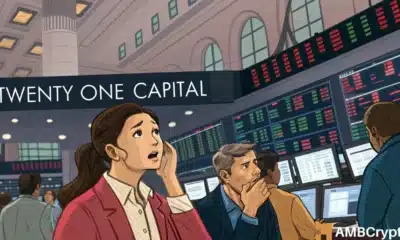
Cover image from ChatGPT, ETHUSD chart from Tradingview

Похожее

Institutions Are Taking Over the Crypto Market: Is This the End of Decentralization, or the Prelude to a New Cycle?

The cryptocurrency market is undergoing a structural shift in 2025, with institutional investors now accounting for approximately 95% of capital inflows, while retail participation has declined to 5–6%. According to Aishwary Gupta of Polygon Labs, this transition is driven by maturing infrastructure rather than market sentiment. Major asset managers like BlackRock, Apollo, and Hamilton Lane are allocating portions of their portfolios to digital assets via ETFs and on-chain tokenized products, leveraging public blockchains that meet traditional finance compliance standards. Key drivers include yield generation through tokenized treasuries and institutional staking, followed by efficiency gains from faster settlements, shared liquidity, and programmable assets. While retail investors retreated due to losses from meme coin cycles, Gupta believes they will return as more regulated and transparent products emerge. He argues that institutional involvement does not undermine decentralization; instead, it enhances legitimacy and fosters a hybrid financial ecosystem where DeFi, NFTs, and traditional assets coexist on public chains. Although increased compliance may limit some experimentation, it promotes more sustainable innovation. Looking ahead, institutional liquidity is expected to reduce market volatility and accelerate the growth of real-world asset tokenization and cross-chain interoperability infrastructure. This evolution signals crypto’s transition from a speculative asset to a core component of the global financial system.

比推12 мин. назад

Institutions Are Taking Over the Crypto Market: Is This the End of Decentralization, or the Prelude to a New Cycle?

比推12 мин. назад

World's Richest Man, 'Silicon Valley Iron Man' Musk, to Take SpaceX Public in 2026!

Elon Musk, the world's richest person and CEO of SpaceX, plans to take the company public in 2026 with a target valuation of approximately $1.5 trillion. The IPO is expected to raise "significantly more than $30 billion," potentially making it the largest in history, surpassing Saudi Aramco's 2019 offering. A key driver of this ambitious valuation is a new narrative: **space-based AI computing**. Musk introduced the concept of "space AI compute" at a recent investor conference, arguing that within five years, running AI training and inference in space could become the lowest-cost solution. The core advantages include near-uninterrupted solar power and the vacuum of space acting as an ultimate heat sink. Additionally, with its reusable Starship rockets, SpaceX aims to drastically reduce launch costs to as low as $200–300 per kilogram. This vision, however, faces significant technical hurdles. Challenges include managing extreme heat radiation in direct sunlight, protecting hardware from cosmic radiation, and the economic risks associated with potential launch failures. Competitors are also entering the arena, including Jeff Bezos’ Blue Origin, which is developing its own orbital data centers, and Sam Altman’s OpenAI, which is reportedly considering acquiring a rocket company. Despite the challenges, Wall Street has responded positively. Firms like Ark Invest are now valuing SpaceX as a high-growth AI infrastructure company rather than a traditional aerospace firm, projecting that its space-based compute business could generate $80–120 billion in high-margin revenue by 2030. The success of this new "space dream" hinges on the continued development of Starship, overcoming technical barriers, and navigating future regulatory landscapes.

marsbit26 мин. назад

World's Richest Man, 'Silicon Valley Iron Man' Musk, to Take SpaceX Public in 2026!

marsbit26 мин. назад

Торговля

Спот
Фьючерсы
活动图片