Vibe Coding, Possibly a New Narrative for Web3

深潮Опубликовано 2025-12-19Обновлено 2025-12-19

Введение

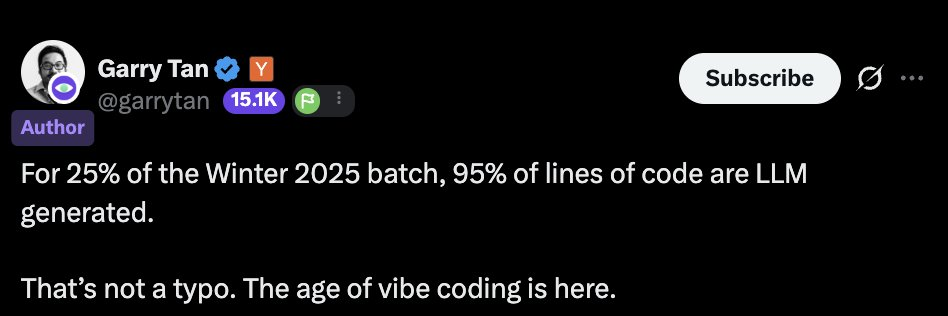
"Vibe Coding, the Next Web3 Narrative" explores how AI-assisted development, or "Vibe Coding," is poised to transform Web3 application landscape, similar to how Pump.fun revolutionized token creation. Key signals from Web2 indicate rapid growth: programming-related LLM queries grew from 11% to 50% of all usage in under a year, and leading AI development platforms saw valuations surge 72x. Studies show 84% of developers use or plan to use AI tools, with 41% of code now AI-generated. While Web3 Vibe Coding platforms are still emerging, early examples include: - @dreamspaceHQ for no-code website and dashboard creation with multi-chain data aggregation. - @Minidevx for building mini-apps on Farcaster. - @Poofnew, a chain-based Replit alternative for creating apps via prompts. - @RemixGG_ for creating and playing games on Base. The movement empowers non-developers (especially degens) to rapidly experiment with consumer apps, trading terminals, SocialFi, and more—accelerating innovation and narrative cycles. The article concludes that Vibe Coding could do for Web3 apps what Pump.fun did for tokens, marking 2026 as a pivotal year for adoption and signaling.

Author:miguelrare

Compiled by: Deep Tide TechFlow

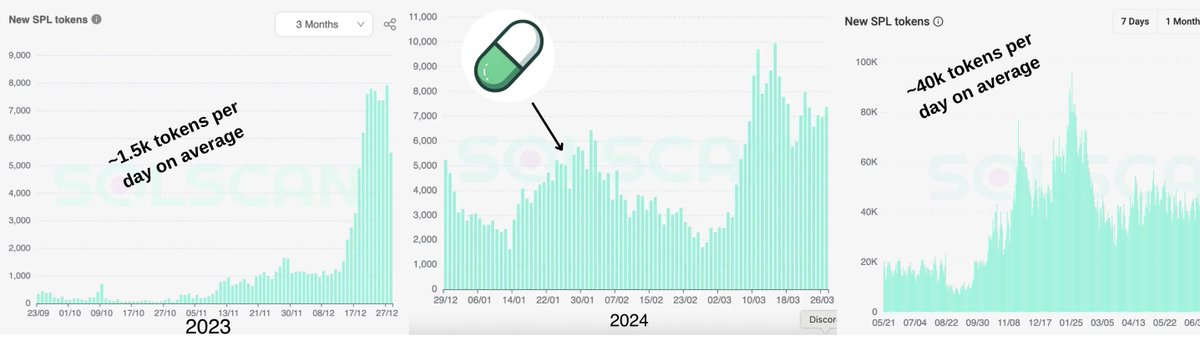
Pumpfun has brought hundreds of thousands of new tokens to the market,

and Vibecoding will bring the same transformation to Web3 applications.

$GOAT is a pioneer in the field of AI agents.

It successfully combined two major hot narratives at the time: AI agents + Meme coins, instantly making "token value" clear to speculators (degens).

However, $GOAT did not appear out of thin air; its success relied on a series of important catalysts from Web2—the infrastructure provided by X and the growing momentum of OpenAI.

If you were active in the market at the time, you probably remember what happened next.

Shortly after $GOAT was launched, everyone started talking about Virtual Protocol. This was a project that existed before the narrative exploded, and its FDV (fully diluted valuation) had hovered between $20 million and $50 million for nearly a year.

Now, a very similar pattern is forming around Vibecoding. This term has only recently emerged. Some speculators are already doing Vibecoding for simple on-chain projects, but due to a lack of infrastructure, especially in the Web3 space, these applications have failed to gain enough attention.

Here is a detailed analysis:

  • The rise of Vibecoding in Web2

  • Its inevitable impact on Web3

  • The formation of early on-chain infrastructure

  • Bullish signals from Web2

Bullish Signals from Web2

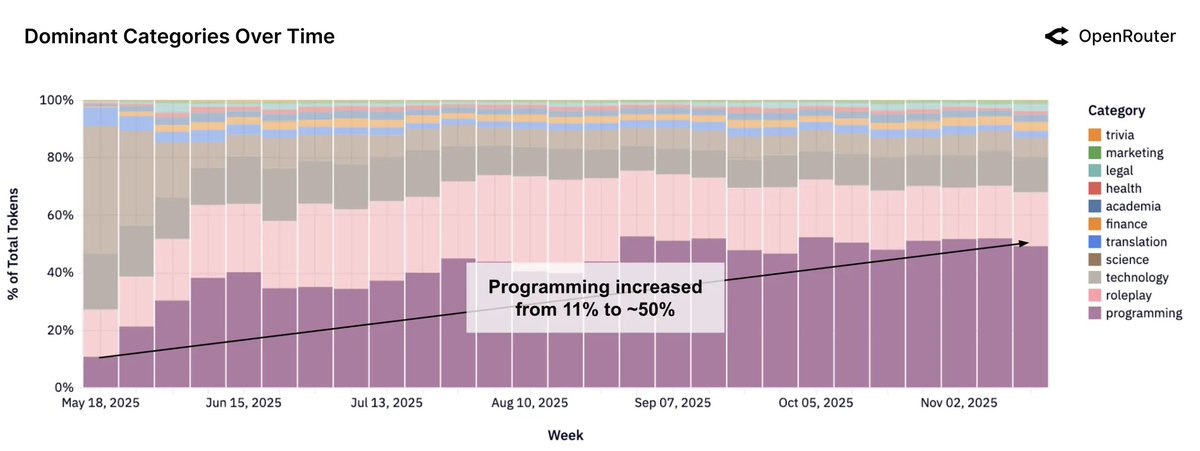
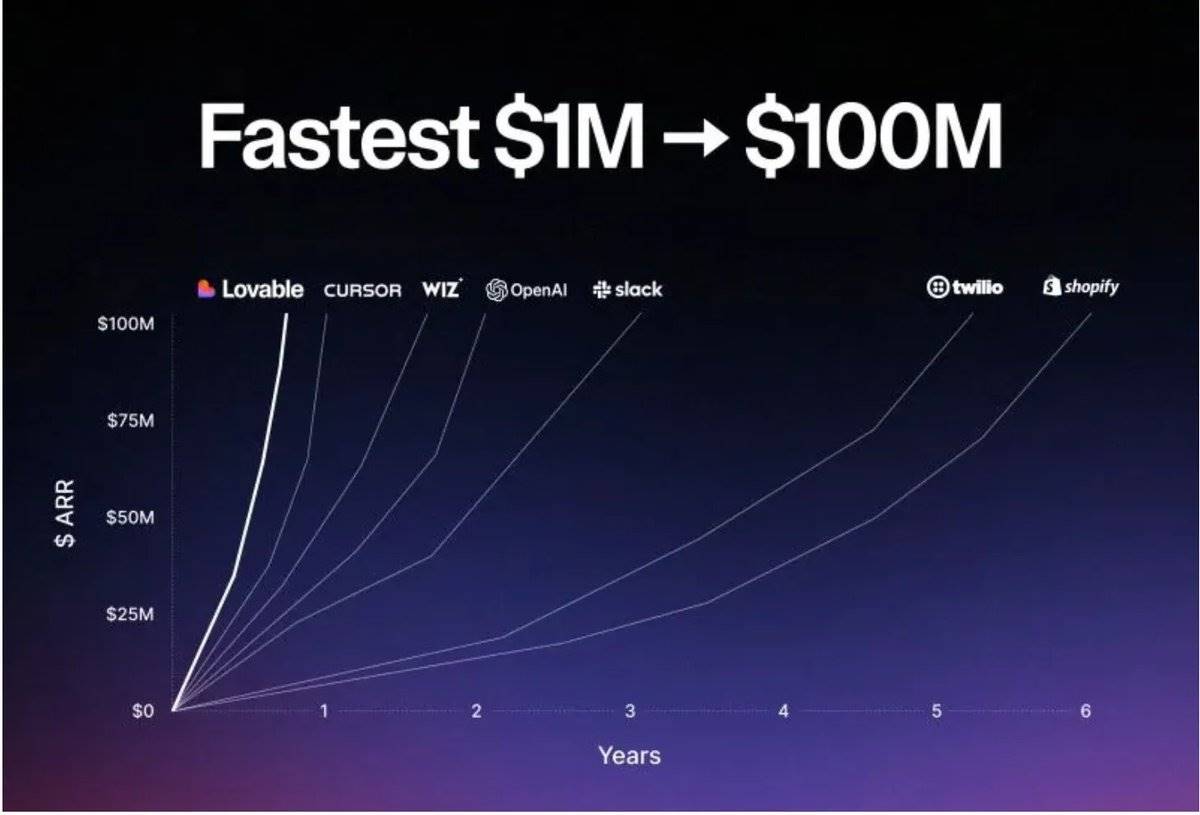
From May 2025 to December 2025, the proportion of all LLM queries related to programming grew from 11% to 50%.

In less than a year, programming queries accounted for half of all LLM usage categories.

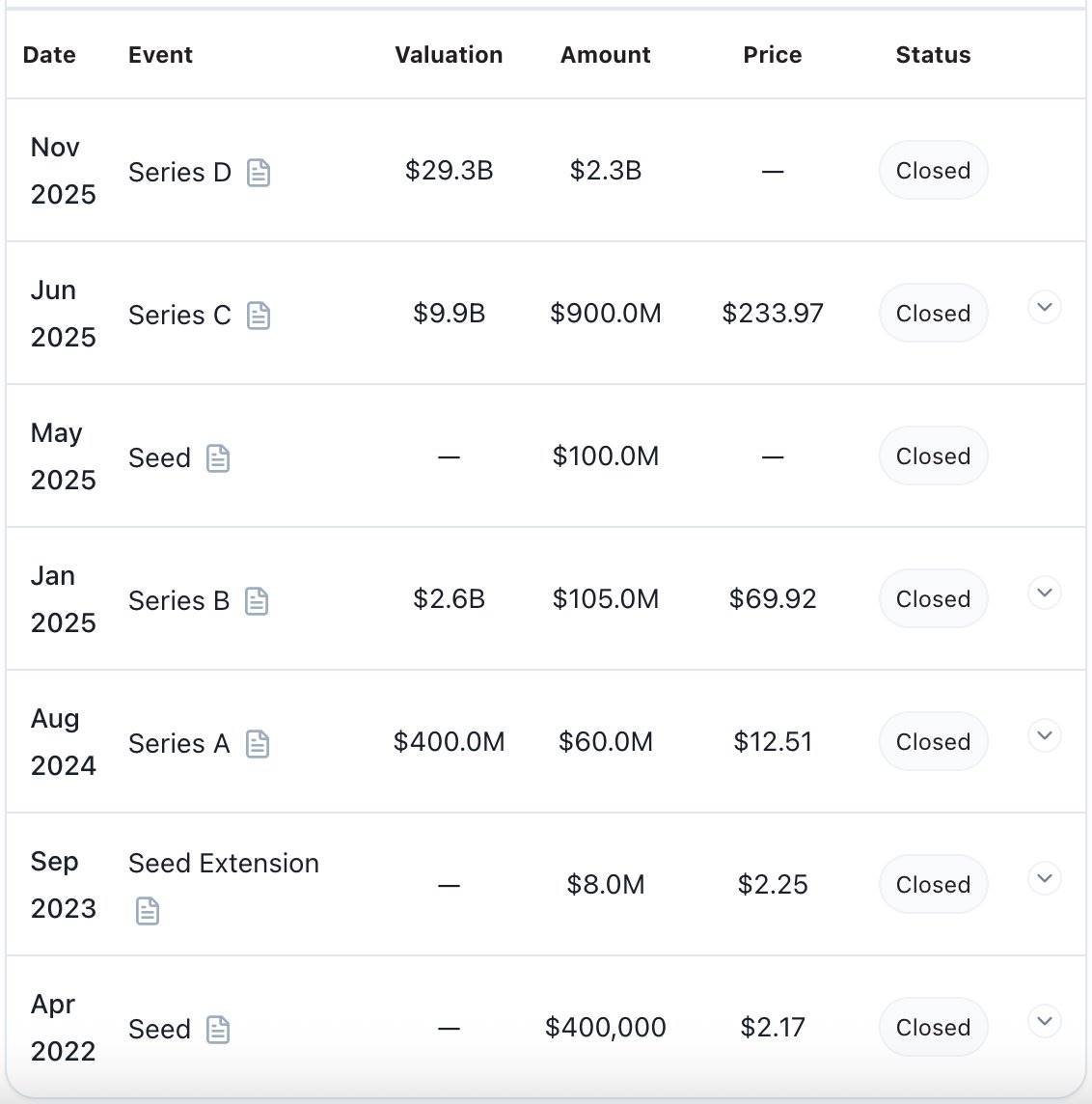
At the same time, the valuation of the most popular AI-driven development platform surged 72 times in one year, from $400 million to $29.3 billion.

If we zoom out and look at survey data and research reports, there are three important signals worth noting:

  • 84% of respondents are using or plan to use AI tools in their development process.

  • 41% of code is now generated by AI.

  • Developers report that AI tools improve productivity by an average of 10%-30%.

At the same time, it is important to clarify that Vibecoding is not the same as AI-assisted development.

For complex production-level systems, relying solely on Vibecoding may be risky. However, given the astonishing expansion speed of this field, more and more developers will begin to incorporate Vibecoding into their workflows.

(According to the 2025 Stack Overflow Developer Survey, only 17% of developers are currently using Vibecoding, which means there is still huge room for growth.)

The PumpFun Effect

A few years ago, issuing your own token was not easy. Teams tried various issuance mechanisms until PumpFun introduced an extremely simple model. PumpFun provided creators with a simplified way to issue tokens and also brought a new trading experience to speculators (degens). So, why can't we see a similar pattern replicated in Web3 applications?

Speculators (Degens) are always the first users and early adopters of emerging narratives.

Many of them know exactly what products the market currently needs, how to launch these products, and what Crypto Twitter (CT) truly cares about—because they have been observing new project launches for years.

Empowering degens to turn ideas into products without coding skills or high costs essentially provides the front line with fresh ideas to experiment with.

Therefore, we may see hundreds of creative experiments emerging across multiple tracks:

Consumer applications, trading terminals, SocialFi, prediction markets, GameFi Ponzi projects, and more.

This phenomenon, in turn, may accelerate the growth of specific market narratives.

Beyond the Front Line: AI Integration into Core Protocols

Beyond the abstract concept of "frontline narratives," there is another direction that excites me—AI directly integrated into large protocols.

The simplest example is trading terminals.

Delta-neutral strategies, points farming, arbitrage operations—all of these can be transformed into personalized bots or features by users entering simple prompts on the platform.

For example:

Monitor the funding rates of tokenized stocks and automatically open positions when significant spreads appear between two perpetual decentralized exchanges (perps DEXes).

In practice, this approach allows platforms to meet thousands of small user needs that are often relatively simple but overlooked by teams.

"We already have Cursor, Replit, Lovable—why do we need a Web3 fork?"

For a while, I asked myself the same question.

But after extensive research, the answer became very clear.

Even in the Web2 Vibecoding space, there is no absolute winner. Each platform has its unique features, including its own priorities, functions, and target user groups.

Some products excel at solving one or two specific problems,

while others try to do everything and end up achieving nothing.

Web3 Vibecoding platforms will not be hindered by competition with Lovable or Replit.

Their infrastructure is specifically built for on-chain creativity, not for Web2 applications.

Web3 Vibe Ecosystem

As of December 2025, there are still very few Web3 projects focused on Vibecoding or development tools, and cases of non-developers successfully launching meaningful Web3 products are even rarer.

Nevertheless, I believe it is still very important to sort out the current industry landscape.

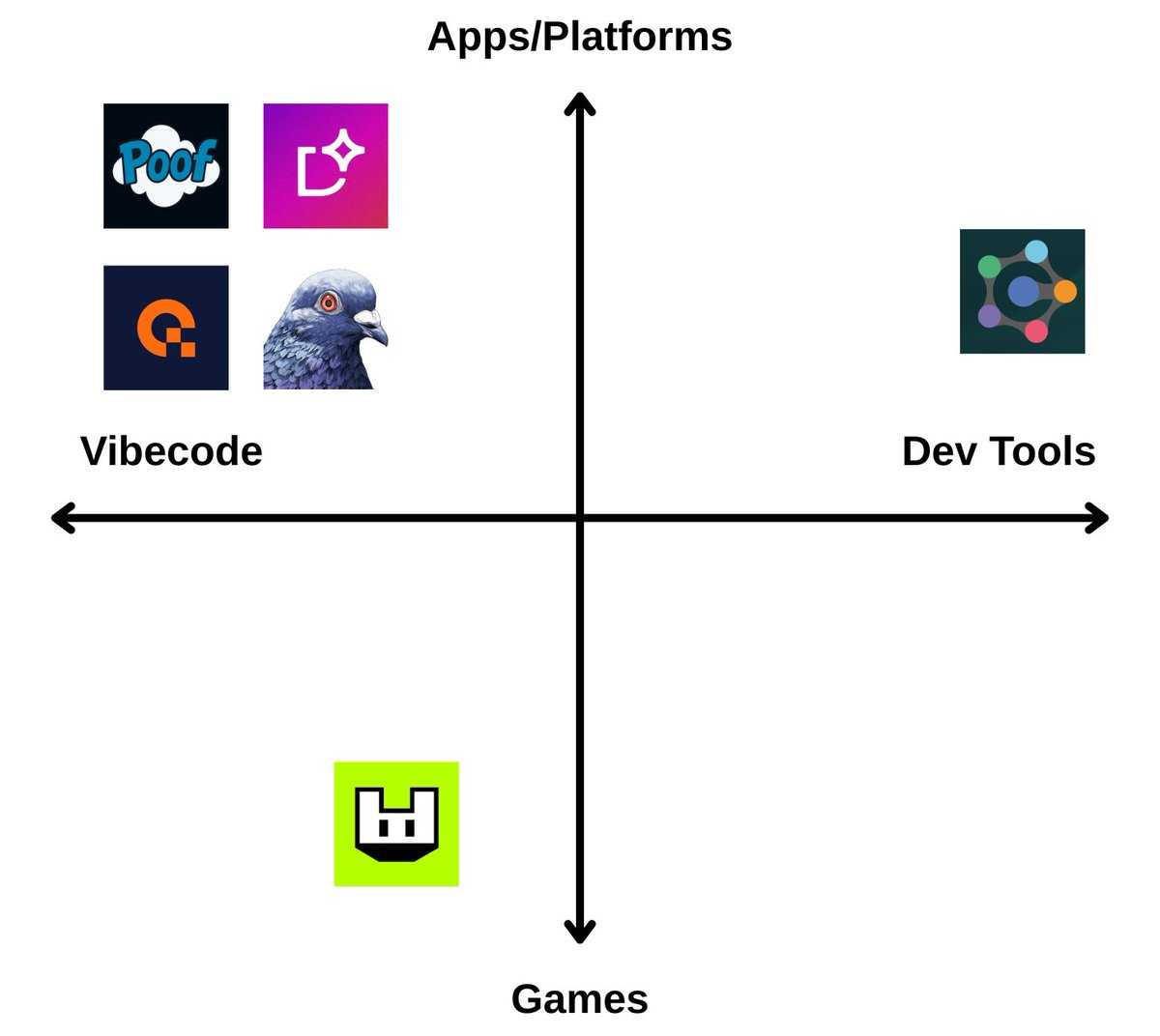
Application/Platform Overview

@dreamspaceHQ—Without any coding knowledge, you can create websites, platforms, and dashboards.

The core advantage of Dreamspace is that, in addition to creating or connecting smart contracts through prompts, you can also aggregate data across multiple chains: BTC, ETH, zkSync, Sei, Base, and even Stellar, WTF?

@Minidevx—A Vibecoding platform based on Base, focused on building mini-apps on Farcaster.

Currently, the product is still in its early stages, with relatively few launched applications.

Minidev launched its token $MINI about a month ago—which may seem a bit rushed. Nevertheless, @0xjenil is still actively launching and improving the product, so I wouldn't be surprised to see high-quality applications emerging on Minidev soon.

@Poofnew —An on-chain version of Replit

Poof allows you to create on-chain websites and applications through prompts, which are passed to an agent and then assigned to three specialized agents: UI Agent, Smart Contract Agent, and Actions Agent.

In July of this year, the team showcased an application built entirely using Poof, where two users could duel for a "Waifu" and bet SOL in the process.

This kind of project demonstrates the flexibility of Poof as an experimental field.

Games

@RemixGG_ —A Vibecoding platform where you can create games on Base through prompts or play hundreds of games created by other users.

Some of these games are really quite good.

This application is extremely simple: download it to your phone, no wallet required, swipe through the content, try out games, or create your own.

In my opinion, this is exactly the kind of product that can attract Web2 users—they won't even realize they are using Web3 infrastructure.

Development Tools

@CodigoPlatform—Codigo is an AI-driven development platform built specifically for Solana.

It combines a cloud IDE, specially trained AI models, and complete build and deployment tools.

However, unlike Poof, Codigo is difficult to classify as a Vibecoding platform—you still need some programming skills.

Trading Bots

@pigeon_trade —A trading bot with built-in AI.

In addition to spot, perpetual, and prediction market trading, you can chat with Pigeon and Vibecode custom functions, such as:

  • Monitor funding rates on specific DEXes, set alerts, or automatically open positions

  • Track selected wallets and copy trades

  • Look for arbitrage opportunities on Polymarket and more.

Final Thoughts

Currently, there are still very few high-quality Web3 Vibecoding platforms.

Most existing projects are either still in development or have not found product-market fit (PMF), which is completely normal.

As mentioned earlier, Virtual Protocol also took a long time to form a complete narrative.

Often, the product is not bad; it is just launched too early.

I firmly believe that 2026 will be the year we start to see real signals:

Non-developers will independently build profitable Web2 companies based on creativity, large platforms will integrate Vibecoding tools, and the number of users and annual recurring revenue (ARR) of Cursor, Replit, and Lovable will continue to grow exponentially.

As always, degens will be the first users.

In a few months or a year, we will look back and compare the starting point of the Vibecoding narrative to the rise of PumpFun.

The only difference?

Pumpfun brought us hundreds of thousands of new tokens -> Vibecoding will bring the same transformation to Web3 applications.

Связанные с этим вопросы

QWhat is the core argument made about Vibecoding in relation to Web3?

AThe article argues that Vibecoding will bring a transformative change to Web3 applications, similar to how Pump.fun revolutionized token creation by enabling the launch of hundreds of thousands of new tokens. It suggests that Vibecoding will empower non-developers to easily build and experiment with on-chain applications, accelerating innovation and adoption in the Web3 space.

QAccording to the article, what are some key bullish signals from Web2 that support the rise of Vibecoding?

AKey bullish signals from Web2 include: programming-related LLM queries growing from 11% to 50% of all queries between May and December 2025; the valuation of a popular AI-driven development platform surging 72x from $400M to $29.3B in a year; 84% of surveyed developers using or planning to use AI tools; 41% of code now being AI-generated; and AI tools boosting developer productivity by 10-30% on average.

QHow does the article compare the potential impact of Vibecoding to the 'Pump.fun effect'?

AThe article compares Vibecoding to the 'Pump.fun effect' by stating that just as Pump.fun simplified token creation and launched a massive wave of new tokens, Vibecoding platforms will democratize the creation of Web3 applications. It will allow degens and non-coders to easily turn ideas into on-chain products, leading to hundreds of creative experiments across various sectors like consumer apps, trading terminals, SocialFi, and GameFi.

QName three Web3 projects mentioned in the article that are building Vibecoding infrastructure and briefly describe their focus.

A1. @dreamspaceHQ: A platform for creating websites, platforms, and dashboards with no coding, with a core strength in aggregating data across multiple blockchains. 2. @Poofnew: An on-chain version of Replit that uses AI agents to build on-chain websites and applications from prompts. 3. @RemixGG_: A Vibecoding platform focused on creating and playing games on Base, designed to be simple and accessible to attract Web2 users.

QWhat is the author's outlook for the Vibecoding narrative in 2026?

AThe author believes that 2026 will be the year we start to see real signals of Vibecoding's impact: non-developers independently building profitable Web2 companies, large platforms integrating Vibecoding tools, and continued exponential growth in user numbers and Annual Recurring Revenue (ARR) for platforms like Cursor, Replit, and Lovable. Degens will be the first users, and the narrative's rise will be compared to that of Pump.fun.

Похожее

Will the Next Crypto Bull Run Start with On-Chain Trading of SpaceX?

This article presents a scenario-based forecast for the crypto industry from 2026 to 2029, arguing that the next major cycle will be driven not by technological narratives but by legal access to real-world assets. The author predicts that by mid-2026, pre-IPO perpetual contracts for top private companies like SpaceX, OpenAI, and Anthropic on platforms like Hyperliquid will become the primary gateway for accessing quality assets, as most crypto-native tokens fail to capture real value. The much-hyped AI x Crypto intersection largely fails except for prediction markets, which thrive on betting on AI model supremacy. By 2027, public blockchain foundations are forced to choose between catering to retail speculation or building compliant infrastructure for institutions, with many opting for the latter. Growth in stablecoins and tokenized private credit/equity hits a "triple ceiling" due to regulatory and political uncertainty rather than market demand. The pivotal shift is forecast for 2028. A major liquidation event in pre-IPO perpetuals exposes the structural flaw of synthetic markets lacking a real underlying asset anchor. In response, regulatory changes finally allow the public solicitation of private securities resales to verified accredited investors. This creates a legitimate secondary market for real company equity, which then becomes the core asset class of the new bull market, relegating synthetic perps to a niche role. By 2029, the industry becomes "boring" but foundational. Tokens without claims on real cash flows or assets cease trading. Stablecoin growth is steady but politically capped. Crypto infrastructure fades from view as it gets absorbed into traditional finance backends. The article's central thesis is that the key bottleneck for crypto's next phase is legal and regulatory channels for real asset ownership, not technology.

marsbit37 мин. назад

Will the Next Crypto Bull Run Start with On-Chain Trading of SpaceX?

marsbit37 мин. назад

The Value Distribution of Stablecoins

**Summary: The Value Distribution of Stablecoins** The article argues that stablecoins are evolving from mere trading tools into broader channels for dollar access. It divides the stablecoin ecosystem into four layers to analyze how value is distributed: 1. **Issuance Layer:** Mints stablecoins, holds reserve assets, and captures the spread between reserve yield and user costs (e.g., Tether, Circle). This layer currently earns the largest profit margin. 2. **Infrastructure Layer:** Connects stablecoins to the traditional financial system, handling fiat on/off-ramps, banking integration, compliance (KYC/AML), and asset management (e.g., Bridge, BVNK). This is the "unglamorous" but critical work, building the essential bridges between crypto and real-world finance. 3. **Acquiring/Distribution Layer:** Integrates stablecoins into merchant systems, manages payment flows, and provides enterprise financial software (e.g., Stripe, Coinbase). They act as the access point for businesses. 4. **Application Layer:** The end-users and businesses that ultimately use stablecoins for payments, settlements, or as a store of value. They benefit from convenience but have little pricing power. The core thesis is that while the issuance layer currently dominates profits, the often-overlooked **infrastructure layer holds significant long-term potential**. The real challenge and barrier to mass adoption is not the on-chain transfer of stablecoins (which is simple), but the complex "last mile" integration into existing business workflows, banking systems, and regulatory frameworks across different countries. Companies in this layer are currently in a "land grab" phase, investing heavily to build networks, secure bank partnerships, and establish compliance pathways. While their position is currently pressured by the profitable issuers above and distribution platforms below, the article suggests that if stablecoins become a default financial rail for businesses, the infrastructure providers who have done the hard work of integration will ultimately gain strong pricing power and become entrenched, essential players.

marsbit7 ч. назад

The Value Distribution of Stablecoins

marsbit7 ч. назад

The Value Distribution of Stablecoins

The Value Distribution of Stablecoins The article argues that stablecoins are evolving from a mere trading tool into a broad "dollar channel." It analyzes the industry's value chain through four layers: 1. **Issuance Layer (e.g., Tether, Circle):** The top layer that mints stablecoins, holds reserve assets, and captures the thickest interest rate spread. 2. **Infrastructure Layer (e.g., Bridge, BVNK):** Connects stablecoins to the traditional financial system, handling critical but complex "dirty work" like fiat on/off-ramps, banking integration, compliance (KYC/AML), and cross-border settlement. 3. **Acquiring/Distribution Layer (e.g., Stripe, Coinbase):** Embeds stablecoins into merchant systems, manages payment flows, and integrates with enterprise software. 4. **Application Layer:** End-users and businesses that ultimately use stablecoins for payments, settlement, or storing value. The author posits that while the issuance layer currently captures the most profit, the most overlooked and potentially critical layer is infrastructure. The core challenge for stablecoin adoption isn't the on-chain transfer (which is simple), but bridging the gap between blockchain and the real-world financial system. This involves solving practical problems for businesses: fiat conversion, reconciliation, tax handling, and user onboarding. Infrastructure companies are currently in a difficult "land-grab" phase—building networks, securing banking relationships, and achieving compliance country-by-country. They face pressure from both the profitable issuance layer above and distribution platforms below. However, the author suggests this layer is building a crucial moat. Once stablecoins become a default business rail, the infrastructure players who have done the hard work of integration may gain significant, durable value and pricing power.

链捕手7 ч. назад

The Value Distribution of Stablecoins

链捕手7 ч. назад

Торговля

Спот
Фьючерсы

Популярные статьи

Как купить SFP

Добро пожаловать на HTX.com! Мы сделали приобретение SafePal (SFP) простым и удобным. Следуйте нашему пошаговому руководству и отправляйтесь в свое крипто-путешествие.Шаг 1: Создайте аккаунт на HTXИспользуйте свой адрес электронной почты или номер телефона, чтобы зарегистрироваться и бесплатно создать аккаунт на HTX. Пройдите удобную регистрацию и откройте для себя весь функционал.Создать аккаунтШаг 2: Перейдите в Купить криптовалюту и выберите свой способ оплатыКредитная/Дебетовая Карта: Используйте свою карту Visa или Mastercard для мгновенной покупки SafePal (SFP).Баланс: Используйте средства с баланса вашего аккаунта HTX для простой торговли.Третьи Лица: Мы добавили популярные способы оплаты, такие как Google Pay и Apple Pay, для повышения удобства.P2P: Торгуйте напрямую с другими пользователями на HTX.Внебиржевая Торговля (OTC): Мы предлагаем индивидуальные услуги и конкурентоспособные обменные курсы для трейдеров.Шаг 3: Хранение SafePal (SFP)После приобретения вами SafePal (SFP) храните их в своем аккаунте на HTX. В качестве альтернативы вы можете отправить их куда-либо с помощью перевода в блокчейне или использовать для торговли с другими криптовалютами.Шаг 4: Торговля SafePal (SFP)С легкостью торгуйте SafePal (SFP) на спотовом рынке HTX. Просто зайдите в свой аккаунт, выберите торговую пару, совершайте сделки и следите за ними в режиме реального времени. Мы предлагаем удобный интерфейс как для начинающих, так и для опытных трейдеров.

271 просмотров всегоОпубликовано 2026.05.22Обновлено 2026.06.02

Как купить SFP

Как купить CTR

Добро пожаловать на HTX.com! Мы сделали приобретение Citrea (CTR) простым и удобным. Следуйте нашему пошаговому руководству и отправляйтесь в свое крипто-путешествие.Шаг 1: Создайте аккаунт на HTXИспользуйте свой адрес электронной почты или номер телефона, чтобы зарегистрироваться и бесплатно создать аккаунт на HTX. Пройдите удобную регистрацию и откройте для себя весь функционал.Создать аккаунтШаг 2: Перейдите в Купить криптовалюту и выберите свой способ оплатыКредитная/Дебетовая Карта: Используйте свою карту Visa или Mastercard для мгновенной покупки Citrea (CTR).Баланс: Используйте средства с баланса вашего аккаунта HTX для простой торговли.Третьи Лица: Мы добавили популярные способы оплаты, такие как Google Pay и Apple Pay, для повышения удобства.P2P: Торгуйте напрямую с другими пользователями на HTX.Внебиржевая Торговля (OTC): Мы предлагаем индивидуальные услуги и конкурентоспособные обменные курсы для трейдеров.Шаг 3: Хранение Citrea (CTR)После приобретения вами Citrea (CTR) храните их в своем аккаунте на HTX. В качестве альтернативы вы можете отправить их куда-либо с помощью перевода в блокчейне или использовать для торговли с другими криптовалютами.Шаг 4: Торговля Citrea (CTR)С легкостью торгуйте Citrea (CTR) на спотовом рынке HTX. Просто зайдите в свой аккаунт, выберите торговую пару, совершайте сделки и следите за ними в режиме реального времени. Мы предлагаем удобный интерфейс как для начинающих, так и для опытных трейдеров.

263 просмотров всегоОпубликовано 2026.05.25Обновлено 2026.06.02

Как купить CTR

Что такое USOIL

USOILUSDT Перпетуальный контракт — это торговый символ для нефти сорта Западный Техас (WTI), цена которой указана в долларах США, представляющий 1 баррель сырой нефти.

134 просмотров всегоОпубликовано 2026.05.25Обновлено 2026.05.25

Что такое USOIL

Обсуждения

Добро пожаловать в Сообщество HTX. Здесь вы сможете быть в курсе последних новостей о развитии платформы и получить доступ к профессиональной аналитической информации о рынке. Мнения пользователей о цене на A (A) представлены ниже.

活动图片